How to Build an App Like Lyft in 2026: Features, Stack, and Cost


Create engaging, high-performance mobile applications tailored to your business needs. We craft future-ready apps that offer smooth user experiences on all devices.
Build robust and scalable websites and CMS platforms that help you manage content effortlessly. Our development ensures a seamless digital presence.
Launch secure, feature-rich online stores with intuitive shopping experiences. We build tailored eCommerce platforms designed for growth.
Design captivating games with immersive gameplay and stunning graphics. From concept to launch, we build engaging experiences that players love.
Enhance your customer relationships with customized Salesforce implementations. Drive growth and efficiency with smarter CRM solutions.
Harness artificial intelligence and machine learning to automate workflows and gain actionable insights. Our AI transforms data into smart decisions.
Accelerate your software delivery lifecycle with continuous integration, delivery, and infrastructure automation to boost efficiency.
Hire app developers ready to turn your ideas into sleek, high-performing mobile apps for any platform.
Bring in frontend pros who craft smooth, beautiful, and user-friendly interfaces that your visitors will love.
Get backend developers who build fast, secure, and reliable systems to keep everything running behind the scenes.
Hire eCommerce developers who build secure, scalable online stores designed to offer seamless shopping and grow your sales.
Get dedicated developers committed to your projects, delivering consistent quality and speed as an extension of your team.
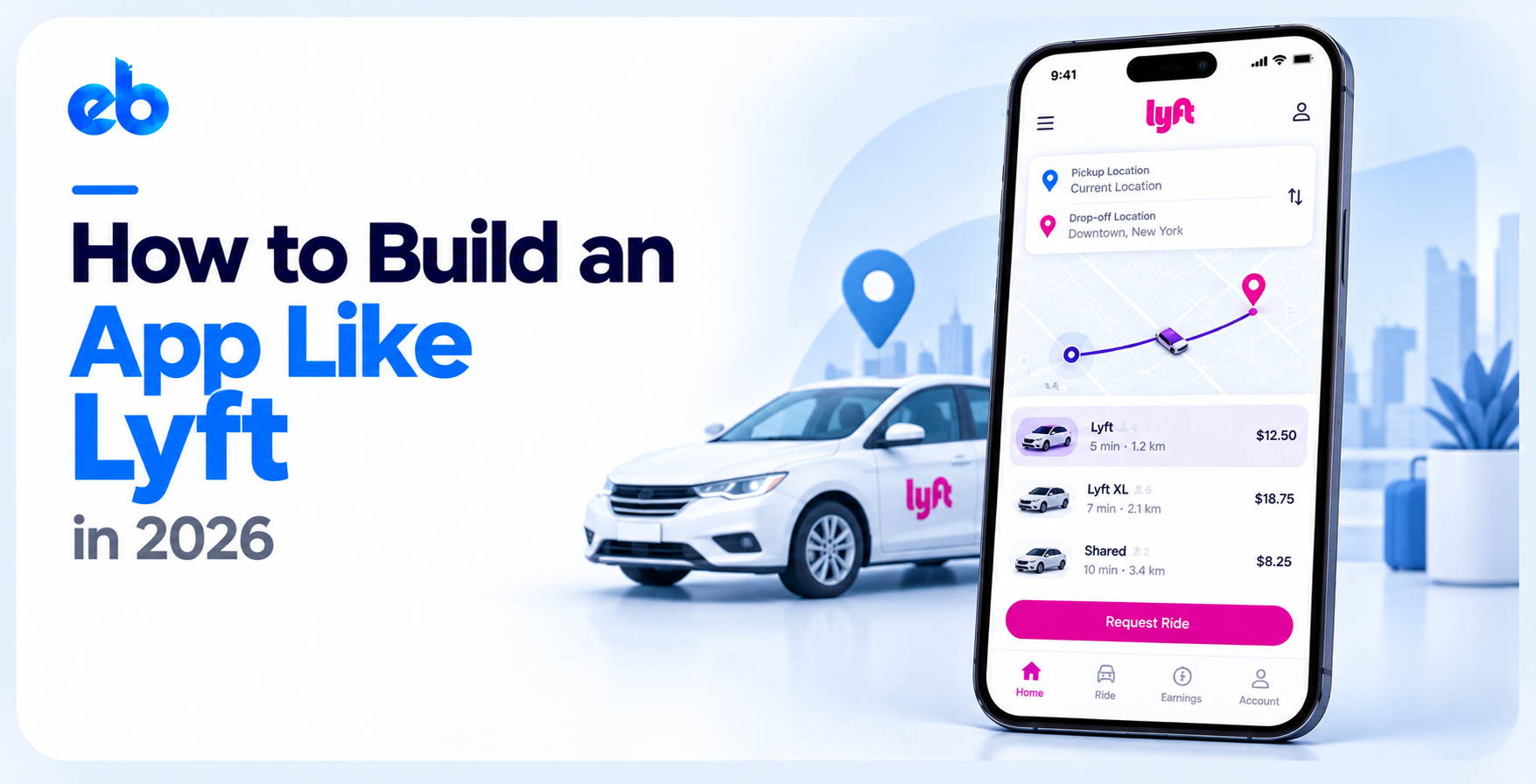
A rider taps once. Within two seconds, your backend has scored every nearby driver, checked who is actually online, estimated arrival time, priced the trip, and committed to a promise it cannot take back. Lyft makes that feel like nothing.
It is nothing. And the teams who decide to build an app like Lyft usually discover that around month four, when the demo works beautifully, and the dispatch falls apart at 200 concurrent riders.
The demand is real enough to justify the effort. The US ride-sharing market alone is projected to reach $60.47 billion in 2026, according to Fortune Business Insights. This guide walks through what you actually have to build, what it costs, and where most attempts break.
To build an app like Lyft, you need four pieces working together: a rider app, a driver app, an admin dashboard, and a real-time dispatch engine. On top of that sit payments, mapping, background checks, and insurance coverage logic.
A focused team of six to eight people can put a single-city version live in five to seven months. Anything faster usually means someone skipped compliance, and that bill arrives later.
Founders budget for one app and get surprised by three. Each has a different user, a different failure mode, and a different release cadence.
Sign-up, pickup selection, fare preview, ride tracking, payment, rating, receipts, support. It must work on weak signal in parking garages. It must also handle the ugly cases cleanly: driver cancels, rider is in the wrong place, card declines mid-trip.
This one runs for ten hours straight on someone’s personal phone. Battery drain is a product problem, not an engineering detail. It needs ride offers with countdown timers, turn-by-turn navigation, earnings views, heat maps, document uploads, and a payout screen drivers trust.
Your operations team lives here. Live fleet map, ride intervention, fare adjustments, driver onboarding queue, fraud flags, city-level pricing controls, and refunds. Skip this, and your support team ends up editing the database by hand.
The same three-app structure applies if you plan to build an app like Uber, so the architecture work transfers across the category.
Feature lists are easy to pad. These are the ones that correlate with retention.
Rider side:
Driver side:
Location accuracy sits underneath all of it. Precise pickup zones at stadiums and airports depend on geofencing rules rather than raw GPS coordinates.
Everything visible is a wrapper around matching. When you build an app like Lyft, this is the component that decides whether the business works.
Dispatch has to answer one question repeatedly: which driver should get this ride, right now? Naive distance matching fails fast. A driver 0.4 miles away across a divided highway is further than one a mile away on the same street.
Production systems score candidates on road-network ETA, current trip status, acceptance history, vehicle type, and direction of travel. They also batch requests over short windows instead of assigning instantly, which measurably improves overall match quality.
Build it as a separate service from day one. Use geospatial indexing, keep driver state in memory, and stream location updates over persistent connections rather than polling. Dispatch should scale independently of everything else, because it will be the first thing to buckle.
Three money flows run in parallel: rider charges, platform commission, and driver payouts.
Pricing needs a base fare, per-mile and per-minute rates, city-specific minimums, airport surcharges, tolls, and dynamic multipliers tied to live supply and demand. Publish the multiplier before the ride, not after.
On the payments side, you need card-on-file with pre-authorisation, support for digital wallets, tipping after the trip, automatic retries on failed charges, and clean refund paths. Choosing the right processor matters more than founders expect, and comparing payment gateways for startups early saves painful migrations later.
Payouts carry their own weight. Drivers expect instant transfers, which means pre-funded balances, fraud checks on cash-out, and 1099 reporting at year-end.
This is where ride-hailing stops being a normal app project.
Build these as configurable policy, not as code branches per city. You will thank yourself at market number four.
There is no single correct answer, but there are defensible defaults.
| Layer | Practical choice | Why |
| Rider app | React Native or Flutter | Faster parity across iOS and Android |
| Driver app | Native Kotlin and Swift | Background location and battery control |
| Dispatch | Go or Elixir | Concurrency and low-latency matching |
| Core API | Node.js or Java | Mature ecosystem, easy hiring |
| Data | PostgreSQL with PostGIS, Redis, Kafka | Geo queries, live state, event streaming |
| Maps | Google Maps or Mapbox | Routing, ETA, traffic data |
The split above is deliberate. The native versus cross-platform decision is not one call; it is two, and the driver app has stricter requirements. Plan capacity early too, since cloud architecture determines app scalability far more than framework choice does.
Quotes vary wildly because scope does.
| Scope | What is included | Cost | Timeline |
| Single-city MVP | Rider and driver apps, basic dispatch, card payments | $70,000 to $110,000 | 4 to 5 months |
| Launch-ready | Adds surge, admin console, background checks, insurance states, ratings | $120,000 to $190,000 | 6 to 8 months |
| Multi-city platform | Adds fraud tooling, analytics, scheduled rides, accessible vehicle flows, native driver app | $200,000 to $350,000 | 9 to 12 months |
Ongoing costs are separate. Maps, SMS, background checks, payment fees, and cloud usually run $3,000 to $15,000 a month at early volume.
For a broader market view, the breakdown of mobile app development costs in the USA gives useful context on rate ranges.
Ride-hailing is a density game, not a geography game. Twenty drivers spread across a state is a dead marketplace. Twenty drivers in one neighbourhood is a working one.
Pick a single metro with a specific wedge: airport runs, late-night service, campus coverage, or medical transport. Seed driver supply before you spend a dollar on rider acquisition, because an empty map kills retention permanently.
Treat the first city as a product experiment and a compliance template at once.
Shipping narrow is also the cheaper path, which is why MVP development for startups in the USA tends to outperform full-scope launches in this category.
If you plan to build an app like Lyft and want the dispatch layer built the first time properly, that is the kind of work EngineerBabu does. The team delivers custom mobile app development across iOS, Android, backend, and cloud, under a CMMI Level 5 process with senior engineers staying on the project rather than rotating off after kickoff.
You can also extend your own team instead of outsourcing the whole build, which many founders prefer once they understand how to hire mobile app developers in the USA without losing velocity.
The decision to build an app like Lyft is less about cloning screens and more about committing to real-time systems and regulated operations. Get dispatch, payouts, and compliance right in one city, and the rest becomes repetition. Get them wrong, and no amount of marketing budget rescues the experience.
Ready to scope your build? Talk to the EngineerBabu team about your dispatch architecture before you write the first line of app code.
A single-city MVP takes four to five months with a dedicated team. A launch-ready product with surge pricing, background checks, and an admin console takes six to eight months.
Most projects land between $70,000 and $250,000 depending on scope. Monthly running costs for maps, SMS, screening, and cloud typically add $3,000 to $15,000 early on.
Yes, in nearly every US state. Requirements differ by state and sometimes by city, covering permits, insurance tiers, driver screening, and vehicle inspection rules.
Native is usually the right call. Background location tracking, battery behavior, and navigation reliability are easier to control with Kotlin and Swift.
The dispatch engine. Matching riders to drivers in under two seconds, at scale, with fair driver distribution, is where most clone projects fail.