How to Build an App Like AbhiBus in India: Features, Cost, Tech (2026)


Create engaging, high-performance mobile applications tailored to your business needs. We craft future-ready apps that offer smooth user experiences on all devices.
Build robust and scalable websites and CMS platforms that help you manage content effortlessly. Our development ensures a seamless digital presence.
Launch secure, feature-rich online stores with intuitive shopping experiences. We build tailored eCommerce platforms designed for growth.
Design captivating games with immersive gameplay and stunning graphics. From concept to launch, we build engaging experiences that players love.
Enhance your customer relationships with customized Salesforce implementations. Drive growth and efficiency with smarter CRM solutions.
Harness artificial intelligence and machine learning to automate workflows and gain actionable insights. Our AI transforms data into smart decisions.
Accelerate your software delivery lifecycle with continuous integration, delivery, and infrastructure automation to boost efficiency.
Hire app developers ready to turn your ideas into sleek, high-performing mobile apps for any platform.
Bring in frontend pros who craft smooth, beautiful, and user-friendly interfaces that your visitors will love.
Get backend developers who build fast, secure, and reliable systems to keep everything running behind the scenes.
Hire eCommerce developers who build secure, scalable online stores designed to offer seamless shopping and grow your sales.
Get dedicated developers committed to your projects, delivering consistent quality and speed as an extension of your team.
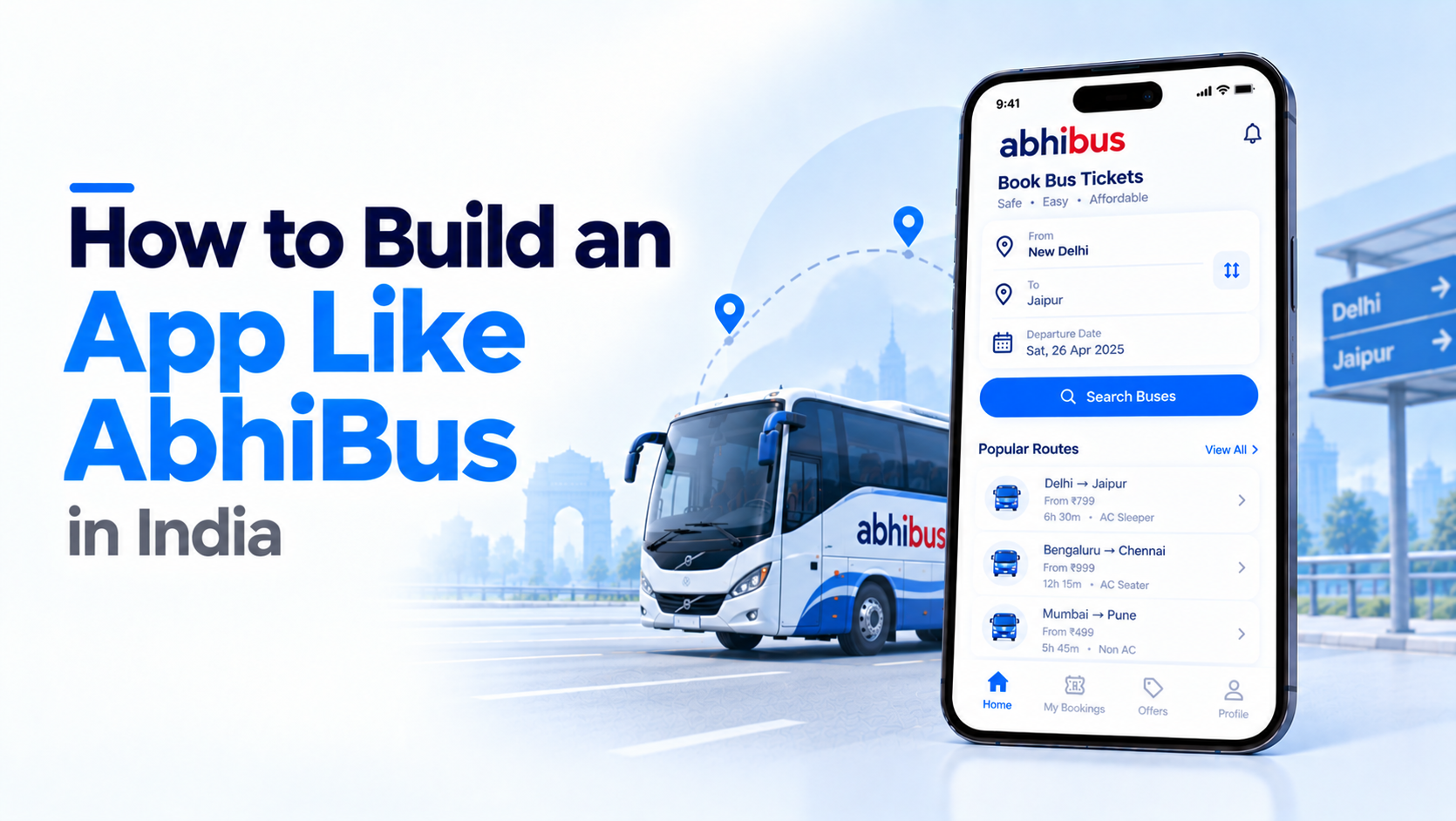
Ask a traveler in Vijayawada how they book a bus and you’ll hear something a product manager in Bengaluru rarely accounts for: they check the APSRTC option first, then compare private sleepers, then ask the agent near the bus stand if the app price is real.
That is the market. Any attempt to build an app like AbhiBus has to work inside it, not around it.
TL;DR
The short answer on how to build an app like AbhiBus: win inventory first, then win the interface.
India’s online travel market is worth USD 25.38 billion in 2026 and is forecast to reach USD 38.58 billion by 2031, with mobile bookings growing at a 14.39% CAGR (Mordor Intelligence). Bus is the volume engine inside that number, and it is still the least consolidated category.
Three things, mainly.
Before any screen gets designed, answer this: where do your buses come from?
| Source | How you integrate | Difficulty |
| State RTCs | Formal API tie-up or authorized reseller agreement | High, slow, high reward |
| Large private operators | Direct API with their reservation system | Medium |
| Small operators | Operator panel, CSV upload, or WhatsApp-driven manifest | Low effort, high maintenance |
| Consolidators | Single API covering many small operators | Fast, but thinner margin |
Most teams start with a consolidator for breadth, sign two or three large private operators directly, and begin RTC conversations immediately because they take months.
Building a clean inventory abstraction early means swapping sources later does not touch your app, which is standard practice in good transportation management system development.
Indian sleeper layouts are not a grid. Upper and lower berths, single and double berths, and side seating all need accurate visual representation. Getting this wrong generates cancellations on day one.
UPI first, then cards, net banking, digital wallets, and pay-at-boarding for selected operators. Partial refunds and instant cancellation credits should be built in from launch, not bolted on.
Start with the commercial shape, not the product. Will you earn operator commission, charge a convenience fee, or both? RTC bookings typically carry thinner margins but enormous volume and trust. Private sleeper operators pay better but need more relationship management.
Write down your target blend before design begins, because it determines whether you need an operator onboarding panel in version one. Teams that skip this usually discover at launch that their unit economics only work on routes they barely cover.
This is the core service. Model every bus as a layout object with addressable berth positions, types, and per-seat pricing. Support upper and lower berths, side seats, and gender-locked seats as first-class concepts.
Add seat hold with a strict timeout, because abandoned checkouts block real sales on peak routes. Reconcile against operator systems on a schedule so your availability never drifts. This service will carry more traffic than anything else you build, so plan app performance optimization around it from the start.
Indian bus bookings are overwhelmingly UPI. Integrate a payment gateway with strong UPI intent and collect-request support, then add cards and net banking. Build refund logic as a state machine covering operator cancellation, user cancellation, partial cancellation, and failed-trip scenarios.
Instant refund to a platform wallet keeps users in your ecosystem and cuts support load noticeably. Verification flows for operator payouts benefit from the approaches covered in KYC and identity verification software, especially once you handle settlements at volume.
Localization is not a translation file. It is Hindi, Telugu, Tamil, Kannada, Marathi, and Bengali in the booking flow, with numerals and dates formatted correctly. It is also an app that loads on a 3G connection with a 40 MB install size.
Build offline ticket access so a saved m-ticket opens without network at the boarding point. Cross-platform work using Flutter keeps this manageable across a wide device range without doubling your build.
Pick one state, ideally one where you have RTC access or strong operator relationships. Support offline agents rather than fighting them, since they still drive meaningful volume in smaller towns.
Give them a lightweight panel with their own commission view. Track cancellation rate, boarding-point complaints, and refund turnaround as your three launch health metrics. Expand to an adjacent state only after on-time ticket delivery and refund speed are boringly consistent for a full month.
| Component | Recommendation |
| Mobile | Flutter for Android-first reach, native where tracking demands it |
| Backend | Node.js or Java microservices, inventory isolated |
| Database | PostgreSQL, Redis for seat holds and search cache |
| Payments | Razorpay, Cashfree, or PayU with UPI intent |
| Notifications | FCM plus SMS and WhatsApp fallback |
| Infra | AWS Mumbai region, autoscaling for festival peaks |
A typical team runs two mobile engineers, two to three backend engineers, a QA lead, a designer, and a product manager. Many founders staff this through a dedicated development team in India rather than hiring in-house, since the peak effort is concentrated in the first two quarters.
Solid DevOps matters more than usual here, because Diwali and summer vacation traffic will test you.
| Scope | Timeline | Cost (INR) |
| MVP: search, seat map, UPI payment, m-ticket | 3 to 4 months | ₹18L to ₹28L |
| Standard: operator panel, refunds, tracking, multilingual | 5 to 7 months | ₹30L to ₹50L |
| Full platform: RTC integrations, agent network, analytics | 8 to 10 months | ₹55L to ₹90L |
For a wider comparison of what drives these numbers up or down, this mobile app development cost guide is a useful reference before you finalize scope.
The teams that build an app like AbhiBus successfully treat inventory, payments, and refunds as the product. Everything else is presentation.
EngineerBabu has delivered booking engines, UPI payment flows, and high-concurrency inventory systems for Indian travel and on-demand platforms. Our engineers work on a CMMI Level 5 process with senior people staying on through launch, and our mobile app development services cover the full stack from seat maps to settlement.
Planning to build an app like AbhiBus for your state or region? Talk to EngineerBabu about scoping your first integration set.
About EngineerBabu
EngineerBabu is a technology development company building products across fintech, healthtech, travel, and AI, from MVPs to scaled, production-ready platforms. It holds a CMMI Level 5 rating, has worked with 4 unicorn clients, and has supported 200+ VC-funded products. The company is backed by Vijay Shekhar Sharma.
Founded by Mayank Pratap (Co-founder) · mayank@engineerbabu.com
An MVP with search, seat maps, UPI payments, and m-tickets costs roughly ₹18 lakh to ₹28 lakh. A full platform with RTC integrations, operator panels, and an agent network runs ₹55 lakh to ₹90 lakh.
Yes, through authorized reseller tie-ups, but expect a long approval cycle. Most platforms launch on private operator and consolidator inventory while RTC discussions progress in parallel.
For most Indian bus booking apps, yes. Android carries the overwhelming majority of bookings. Build cross-platform so iOS is a release decision rather than a rebuild.
Operator commission, convenience fees, cancellation charges, insurance and seat upgrade add-ons, and later, advertising or sponsored operator placement on high-traffic routes.
Inventory and seat selection for a single state, with UPI payment and an offline-capable m-ticket. Everything else, including tracking and multilingual support, can follow once bookings are flowing.