How to Build an App Like Rapido: Phase-by-Phase Guide for India (2026)


Create engaging, high-performance mobile applications tailored to your business needs. We craft future-ready apps that offer smooth user experiences on all devices.
Build robust and scalable websites and CMS platforms that help you manage content effortlessly. Our development ensures a seamless digital presence.
Launch secure, feature-rich online stores with intuitive shopping experiences. We build tailored eCommerce platforms designed for growth.
Design captivating games with immersive gameplay and stunning graphics. From concept to launch, we build engaging experiences that players love.
Enhance your customer relationships with customized Salesforce implementations. Drive growth and efficiency with smarter CRM solutions.
Harness artificial intelligence and machine learning to automate workflows and gain actionable insights. Our AI transforms data into smart decisions.
Accelerate your software delivery lifecycle with continuous integration, delivery, and infrastructure automation to boost efficiency.
Hire app developers ready to turn your ideas into sleek, high-performing mobile apps for any platform.
Bring in frontend pros who craft smooth, beautiful, and user-friendly interfaces that your visitors will love.
Get backend developers who build fast, secure, and reliable systems to keep everything running behind the scenes.
Hire eCommerce developers who build secure, scalable online stores designed to offer seamless shopping and grow your sales.
Get dedicated developers committed to your projects, delivering consistent quality and speed as an extension of your team.
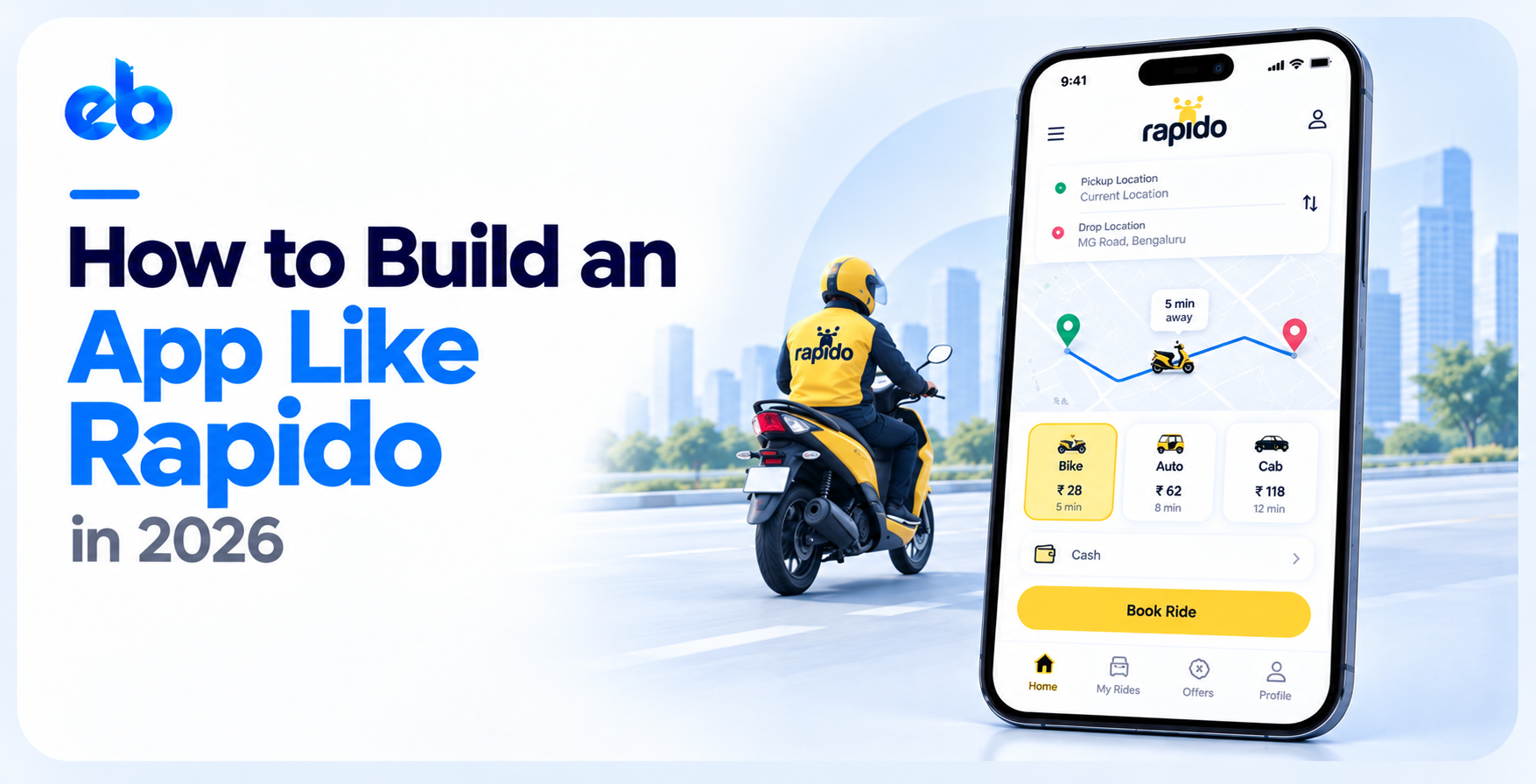
A Rapido captain in Hyderabad pays about Rs 25 for the day and keeps every rupee of every fare after that. A cab driver on a commission platform hands over a quarter of each trip. Same roads, completely different math.
That single pricing decision is why Rapido now sits ahead of its rivals on usage. Sensor Tower figures reported in early 2026 put Rapido at roughly 74 million monthly active users, around 52% of tracked ride-hailing users in India, more than Uber and Ola combined.
So if you want to build an app like Rapido, the product brief does not start with screens. It starts with a spreadsheet. Here is the full build, in the order it should actually happen.
Rapido is three businesses stacked on one app: bike taxis, autos, and cabs. Trying to launch all three at once splits your supply and confuses your pricing.
Pick one vehicle class for launch. Two-wheelers give you the cheapest supply, fastest pickups, and the strongest wedge in congested cities. Autos give you fewer regulatory headaches in states where bike taxis face restrictions. Cabs need deeper capital.
Write down your target city, your opening vehicle class, and your expected daily rides at month six. Every architectural decision after this traces back to those three numbers.
This is the phase teams skip, then regret.
Build a simple model with average fare, average trip distance, captain subscription price, expected daily rides per captain, and support cost per ride. Then stress it.
The subscription model only works at volume, because your revenue per captain is fixed while your cost per ride is not. That means density targets per locality, not per city. Decide your break-even rides per captain per day now, and let it drive the entire allocation design later.
Your captain app will run on a sub Rs 10,000 Android device with 3GB RAM and patchy data. Design for that, not for the test device on your desk.
Keep the APK small, cache aggressively, and make the app work in degraded mode when the network drops. Ride offers need large tap targets and a loud, distinct sound, because the phone sits in a handlebar mount at road speed.
Core screens stay minimal: online toggle, incoming offer, navigation handoff, trip completion, daily earnings, and subscription status. Multilingual support is not a later feature, it is launch scope.
Rider expectations in this category are brutally simple. Show the fare, show the wait time, book in under three taps.
Bike taxi riders are usually commuters making the same trip twice a day. Saved locations, repeat booking, and one-tap rebooking matter more than elaborate onboarding. Fare transparency matters even more, because a Rs 15 difference changes the decision.
Keep the flow tolerant of bad input. Pin accuracy is low in dense neighborhoods, so let riders type a landmark and confirm by voice call if needed. The same low-friction patterns show up in any serious bike ride sharing app that scales past one city.
Two-wheeler allocation is not cab allocation shrunk down. Bikes move differently, park anywhere, and turn around in half the space.
Your engine should score captains on travel time through actual road paths, current subscription status, recent acceptance behavior, and locality familiarity. Broadcast to a small, ranked set rather than blasting every captain nearby, which burns goodwill fast.
Handle the dense-cluster problem explicitly. In a market area, fifty captains may sit within 300 meters, and raw distance tells you nothing useful. Add dwell time and direction of travel as tiebreakers. Behavioral ranking is also where AI in mobile app development earns its keep rather than acting as decoration.
Cash is still a large share of rides in most Indian cities, which creates a settlement problem no US playbook covers.
You need UPI intent flows, wallet top-ups, card support, and a cash mode that records collection without touching your ledger. Captain subscriptions should auto-debit through UPI mandates, with grace periods and clear reminders before suspension.
Build a reconciliation job that runs nightly and flags mismatches between recorded rides, cash collected, and platform dues. Without it, your receivables drift within weeks. Teams building any on-demand app in India hit this same wall around month three.
Bike taxi regulation in India is not national. Some states permit commercial two-wheeler aggregation, some restrict it, and rules shift with court rulings and policy updates.
Your platform must support per-state configuration for vehicle eligibility, permit type, fare caps, and aggregator licensing requirements. Store captain documents with expiry tracking and automated re-verification prompts.
Also plan for the Motor Vehicle Aggregator Guidelines: driver training records, grievance handling, cancellation rules, and data localization. Treating compliance as configurable data rather than hardcoded logic is what makes expansion to the next state a two-week job instead of a rebuild.
Do not open a city. Open three neighborhoods.
Pick corridors with repeat demand: a tech park, a railway station, a university cluster. Recruit captains who already ride those routes. Your goal in month one is a pickup time under four minutes in that corridor, nothing else.
Spend on captain acquisition before rider acquisition. An empty map loses a rider permanently, while a crowded map sells itself through word of mouth. Once one corridor holds its service levels, clone the playbook street by street.
| Scope | Includes | Cost (INR) | Timeline |
| Single-city MVP | Rider app and captain apps, basic allocation, UPI and cash, simple admin | Rs 20 lakh to Rs 32 lakh | 4 to 5 months |
| Launch-ready platform | Adds subscriptions, zone pricing, document verification, incentives, analytics | Rs 35 lakh to Rs 60 lakh | 6 to 8 months |
| Multi-city, multi-vehicle | Adds autos and cabs, fraud systems, state-wise compliance, ops tooling | Rs 75 lakh and above | 9 to 12 months |
Running costs for maps, SMS, cloud, and payment fees typically add Rs 1.5 lakh to Rs 6 lakh a month early on. A deeper look at the cost of developing an on-demand app helps when you need to defend a budget internally.
Flutter or React Native covers both apps efficiently when your team is small, and the comparison of cross-platform app frameworks is worth reading before committing.
Use Go or Node.js for allocation, PostgreSQL with PostGIS for geo queries, Redis for live captain state, and Kafka for event streaming.
Design services to be split later. Allocation, pricing, and payments should scale independently once volume climbs, which is the core principle behind building scalable custom apps.
Teams that set out to build an app like Rapido usually need help with two things: allocation at scale and payment reconciliation across UPI and cash. Both are squarely in EngineerBabu’s track record.
The company builds on-demand platforms end to end, from captain apps to admin tooling, and its work on mobile app development services in India covers exactly the device and network realities this category demands.
To build an app like Rapido, the engineering is demanding but learnable. The real difficulty is holding your nerve on economics while competitors discount around you. Rapido grew because captains stayed, and captains stayed because the money made sense to them.
Get your corridor density and your captain payout story right, and the product has somewhere to stand.
Want a scoped plan and a realistic INR budget for your city? Talk to EngineerBabu about your mobility build.
A single-city MVP runs Rs 20 lakh to Rs 32 lakh. A full launch-ready platform with subscriptions and compliance tooling usually lands between Rs 35 lakh and Rs 60 lakh.
It attracts drivers faster and reduces churn, but it needs ride density to work. Model your break-even rides per captain before choosing.
Rules vary by state. Some states permit commercial two-wheeler aggregation, others restrict it, so build state-level configuration into the platform from day one.
Four to five months for a focused MVP in one city, and six to eight months for a platform ready to scale across neighborhoods.
Start with one. Two-wheelers give the cheapest supply and fastest pickups, which makes early density far easier to achieve.