Build an App Like Wanderu: The Real Guide to Travel Aggregation (2026)


Create engaging, high-performance mobile applications tailored to your business needs. We craft future-ready apps that offer smooth user experiences on all devices.
Build robust and scalable websites and CMS platforms that help you manage content effortlessly. Our development ensures a seamless digital presence.
Launch secure, feature-rich online stores with intuitive shopping experiences. We build tailored eCommerce platforms designed for growth.
Design captivating games with immersive gameplay and stunning graphics. From concept to launch, we build engaging experiences that players love.
Enhance your customer relationships with customized Salesforce implementations. Drive growth and efficiency with smarter CRM solutions.
Harness artificial intelligence and machine learning to automate workflows and gain actionable insights. Our AI transforms data into smart decisions.
Accelerate your software delivery lifecycle with continuous integration, delivery, and infrastructure automation to boost efficiency.
Hire app developers ready to turn your ideas into sleek, high-performing mobile apps for any platform.
Bring in frontend pros who craft smooth, beautiful, and user-friendly interfaces that your visitors will love.
Get backend developers who build fast, secure, and reliable systems to keep everything running behind the scenes.
Hire eCommerce developers who build secure, scalable online stores designed to offer seamless shopping and grow your sales.
Get dedicated developers committed to your projects, delivering consistent quality and speed as an extension of your team.
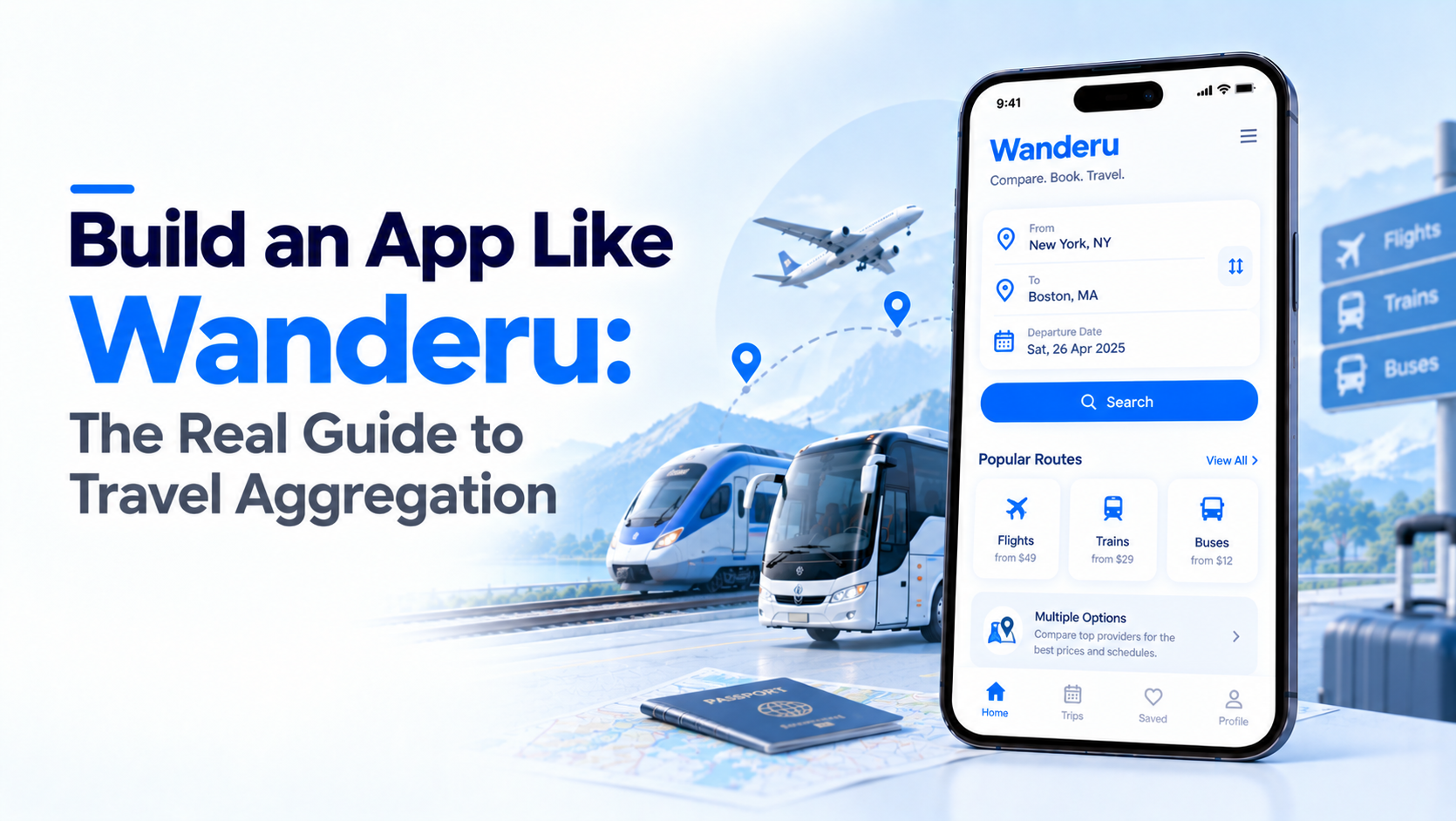
Here is the uncomfortable truth about aggregators: the product users love is the easy half.
The search bar, the clean comparison, the one-tap booking. All of that is a few weeks of good design work. The other half is wrestling hundreds of carriers whose data arrives in different formats, at different intervals, with different definitions of what “available” means.
TL;DR
If you want to build an app like Wanderu, the question to answer first is not “what should the app look like.” It is “where does my inventory come from, and how fresh is it.”
The online bus ticket service market is projected to grow from USD 11.48 billion in 2026 to USD 30.95 billion by 2034, a 13.2% CAGR (Straits Research).
Aggregators win that market by being the fastest, most complete answer to a single question: how do I get from here to there.
A bus company sells its own seats. An aggregator sells certainty across everyone’s seats. That shifts the entire engineering problem.
You are not optimizing a checkout. You are optimizing coverage, freshness, and trust. If a user books through you and arrives to find no reservation, you lose them forever and the carrier blames you.
This is closer to building a marketplace than building a travel app.
Some carriers have modern APIs. Many have a CSV on an FTP server. A few have nothing but a website. Each tier needs a different ingestion strategy and a different refresh cadence.
One carrier calls a city “NYC,” another “New York, NY,” a third “Port Authority Bus Terminal.” Stops, times, fare classes, and baggage rules all need mapping into one internal schema. This is where aggregators quietly win or lose.
Live availability calls are accurate but slow. Cached results are fast but go stale. Most mature aggregators run a hybrid: cached search results, live confirmation at the moment of selection.
With fifteen options on a route, what you show first decides your revenue and your reputation. Cheapest is rarely best. Duration, transfers, departure time, and carrier reliability all belong in the score.
If you sell the ticket, you own cancellations, refunds, and support. If you redirect, you own none of it but earn far less per transaction.
| Model | How it works | Revenue per booking | Build complexity |
| Redirect / metasearch | User searches with you, books on carrier site | Low, CPC or affiliate | Lowest |
| Agency booking | You take payment and issue the ticket | Highest, commission plus fees | Highest |
| Hybrid | Direct booking for integrated carriers, redirect for the rest | Mixed | Moderate |
Wanderu built toward direct booking, which is why it can own the post-purchase experience. Most new entrants start hybrid, because it lets you launch with broad coverage before you’ve signed deep contracts.
That staged approach is also kinder to budget, however the costs to build an app also depend on several other factors.
Think in four layers instead of screens.
Each layer assures scalable custom apps. Robust API development across these boundaries is what keeps a bad carrier feed from becoming a bad user experience.
Aggregators are not won on feature count. They won in four moments.
Add price alerts and flexible-date views next. Those features depend on history, and predictive analytics in mobile apps turns that history into something users will pay attention to.
Pick one dense travel region, such as the Northeast corridor, and integrate the six to ten carriers that handle most of its volume. Coverage beats polish at this stage. Build the ingestion and canonical layers first, even if the front end is a plain list.
Measure one number obsessively: what percentage of real searches return at least three accurate options. Below eighty percent, users stop trusting the app, and no amount of UI/UX design will rescue that.
Convert from redirect to direct booking for your two or three largest carriers. This is where revenue per user jumps. You’ll need payment processing, ticket issuance, a refund state machine, and customer support tooling. Expect contract negotiation to take longer than the code.
Keep redirect in place for everyone else, so coverage never regresses while commercial conversations run. Users rarely notice the difference, as long as the handoff is fast and the price shown is the price paid.
Once you have booking data, ranking stops being a guess. Feed completed trips, abandonment points, and carrier punctuality into a scoring model that adapts per route and per user segment.
A business traveler on a Tuesday morning values departure time. A student on a Friday values price. Applied AI development here lifts conversion more than any redesign will. Keep the model explainable, because carriers will absolutely ask why they rank where they do.
Extend past the purchase. Gate and platform details, delay alerts, connection risk warnings, and rebooking options turn a transaction into a relationship. A support chatbot handles the volume of “where is my bus” questions that would otherwise need a team.
This is also where corporate accounts become viable, which overlaps heavily with corporate travel management software requirements.
| Stage | What you get | Timeline | Cost |
| Regional search MVP | Ingestion, normalization, search, redirect booking | 3 to 5 months | $50,000 to $85,000 |
| Direct booking platform | Payments, issuance, refunds, wallet, support tools | 6 to 9 months | $110,000 to $190,000 |
| Intelligent aggregator | Ranking models, price alerts, disruption handling | 10 to 14 months | $200,000 to $320,000 |
Connector count is the real cost multiplier. Ten clean APIs cost less than four messy ones. For a general sense of how scope maps to schedule, this guide on the timeline to build a mobile app is a useful sanity check against any quote.
Anyone can ship a search screen. The reason it’s hard to build an app like Wanderu is that the value lives in integrations nobody sees.
EngineerBabu builds that invisible layer: supplier connectors, canonical data models, booking state machines, and the SaaS development tooling your operations team runs on. The same patterns carry across travel verticals, which is why our work on flight booking apps and online booking platforms transfers directly to ground travel.
If you’re ready to build an app like Wanderu, start with the data, not the design. Talk to EngineerBabu about scoping your first region.
About EngineerBabu
EngineerBabu is a technology development company building products across fintech, healthtech, travel, and AI, from MVPs to scaled, production-ready platforms. It holds a CMMI Level 5 rating, has worked with 4 unicorn clients, and has supported 200+ VC-funded products. The company is backed by Vijay Shekhar Sharma.
Founded by Mayank Pratap (Co-founder) · mayank@engineerbabu.com
A regional search MVP with redirect booking runs $50,000 to $85,000. A full direct-booking aggregator with payments, refunds, and support tooling typically lands between $110,000 and $190,000.
For redirect and affiliate models, often no. For direct booking, yes. Most teams build the ingestion layer while commercial conversations run in parallel, then switch carriers over as contracts close.
Commission on tickets sold, service fees added at checkout, affiliate payouts on redirects, sponsored placement, and ancillary sales such as travel insurance or seat upgrades.
Yes, if your target corridors have both. Users think in terms of getting somewhere, not in modes. Mixed-mode results are a genuine differentiator against single-mode booking sites.
Stale inventory. If your cached results disagree with the carrier at checkout, conversion collapses and refunds climb. Design the cache invalidation strategy before you write the search service.