MVP Development for Startups in the USA: A Founder's Guide


Create engaging, high-performance mobile applications tailored to your business needs. We craft future-ready apps that offer smooth user experiences on all devices.
Build robust and scalable websites and CMS platforms that help you manage content effortlessly. Our development ensures a seamless digital presence.
Launch secure, feature-rich online stores with intuitive shopping experiences. We build tailored eCommerce platforms designed for growth.
Design captivating games with immersive gameplay and stunning graphics. From concept to launch, we build engaging experiences that players love.
Enhance your customer relationships with customized Salesforce implementations. Drive growth and efficiency with smarter CRM solutions.
Harness artificial intelligence and machine learning to automate workflows and gain actionable insights. Our AI transforms data into smart decisions.
Accelerate your software delivery lifecycle with continuous integration, delivery, and infrastructure automation to boost efficiency.
Hire app developers ready to turn your ideas into sleek, high-performing mobile apps for any platform.
Bring in frontend pros who craft smooth, beautiful, and user-friendly interfaces that your visitors will love.
Get backend developers who build fast, secure, and reliable systems to keep everything running behind the scenes.
Hire eCommerce developers who build secure, scalable online stores designed to offer seamless shopping and grow your sales.
Get dedicated developers committed to your projects, delivering consistent quality and speed as an extension of your team.
A founder in Austin spent 14 months and $220,000 building the “complete” version of his logistics app. It launched to 63 signups. His competitor shipped a stripped-down version in 11 weeks, learned what shippers actually wanted, and raised a seed round on that traction.
Same market. Same year. The difference was not talent or funding. It was the decision to test before building everything.
That decision has a name, and getting it right is the entire point of MVP development for startups in the USA. This guide walks you through how it works, what it costs, and where founders most often get it wrong.
An MVP, or minimum viable product, is the smallest version of your product that solves one real problem for one specific user. Not a prototype. Not a demo. A working product that real customers can use and, ideally, pay for.
MVP development for startups in the USA carries a specific pressure that founders elsewhere feel less acutely.
The US market is crowded, investor expectations are traction-based, and customer acquisition costs are among the highest in the world. You cannot afford to guess for a year. You need evidence within a quarter.
The MVP is how you buy that evidence at the lowest possible price.
The data on this is blunt. According to CB Insights, 35% of failed startups collapsed because there was no market need for what they built. It is the single most cited reason for startup failure, ahead of running out of cash.
Read that again. More than a third of dead startups built something nobody wanted. Every one of them could have discovered that with an MVP in three months instead of a full build in eighteen.
For US founders, the stakes compound. Seed investors now expect early usage data, not just a pitch deck. An MVP with 500 active users beats a polished product with zero every single time.
That is why MVP development for startups in the USA has shifted from optional best practice to fundraising prerequisite.
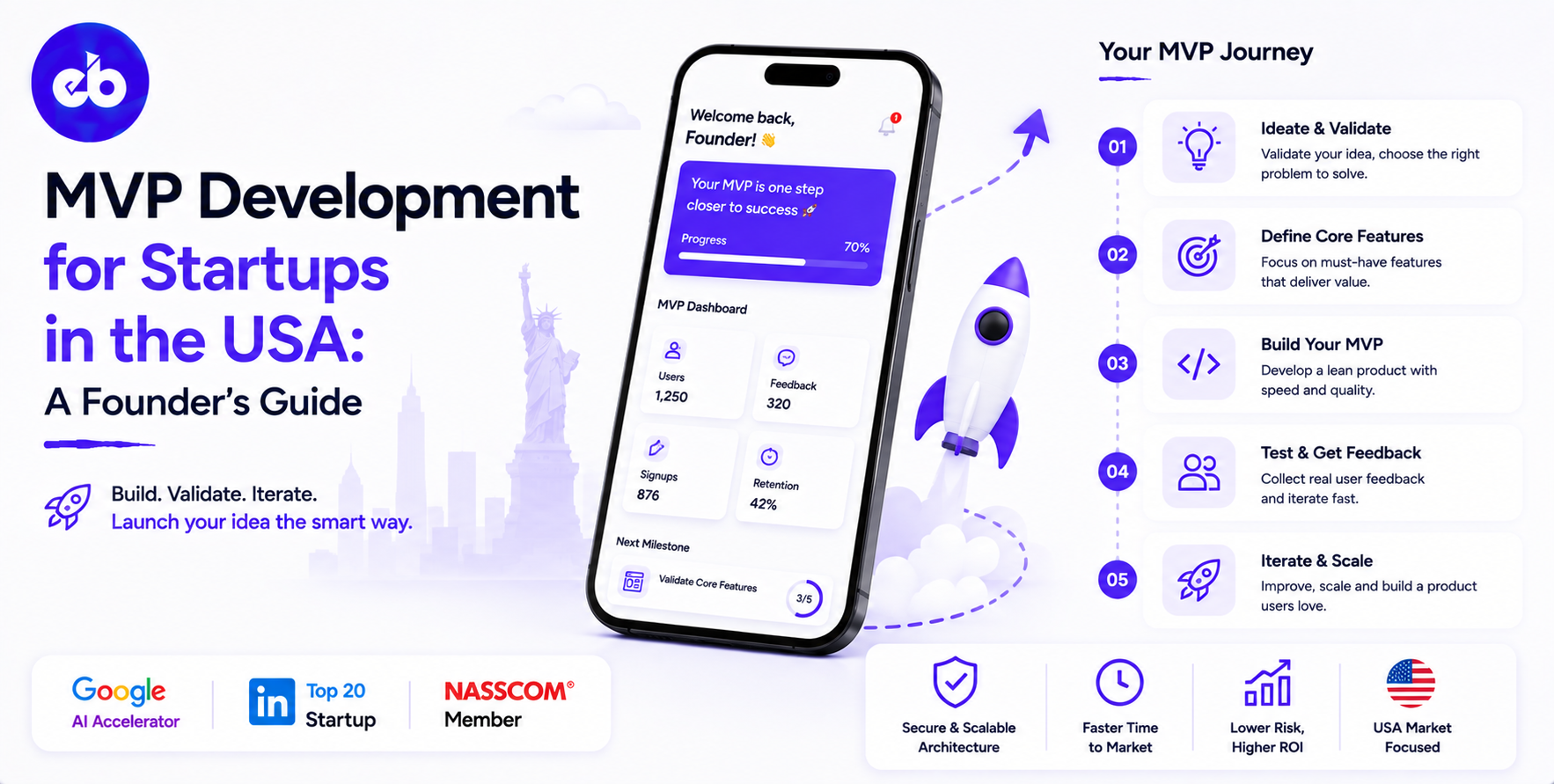
Here is the process behind successful MVP development for startups in the USA, the kind that generates learning instead of just invoices.
Talk to 20 to 30 people who live with the problem you want to solve. Not friends. Not other founders. Actual potential customers in your target segment.
Ask what they currently do, what it costs them, and what they have already tried. If nobody describes the problem as painful without your prompting, stop. You have a solution looking for a problem.
Document the exact words customers use. Those phrases become your landing page copy, your onboarding flow, and your positioning later. This step costs almost nothing and saves more money than any other decision in MVP development for startups in the USA.
List every feature you imagine. Then delete everything that does not directly serve the single moment where your user gets value. Uber’s MVP had no fare splitting, no scheduled rides, no driver ratings. It let you press a button and get a car.
A useful test: if removing a feature still lets a user complete the core job, it goes in the backlog. Login via Google instead of custom auth. Stripe checkout instead of a billing system. Manual admin work instead of automation.
Your MVP should feel almost embarrassingly narrow. That narrowness is what makes the feedback signal clean.
Now decide how the thing gets built. For MVP development for startups in the USA, founders typically choose between an in-house hire, freelancers, or a dedicated MVP Development partner. In-house is slow to assemble. Freelancers are cheap but risky on continuity. A specialized team is usually the fastest route to a working product.
On stack, boring wins. React Native or Flutter for Mobile App Development in the USA, a proven backend framework, and managed cloud infrastructure. Exotic technology choices at MVP stage add risk without adding learning.
Plan for 10 to 14 weeks from kickoff to launch. Longer than that usually means your scope crept.
Ship to a small, real audience. Fifty engaged users from your validation interviews beat 5,000 cold signups from a Product Hunt spike.
Define your success metrics before launch, not after. Pick two or three: activation rate, week-two retention, or willingness to pay. Vanity metrics like downloads and page views tell you nothing about market need.
Instrument the product properly from day one. Third-party integrations through clean API Development matter here too, because payment, analytics, and notification services are where early data quality breaks. Watch session recordings weekly. Users will surprise you within days.
Give the MVP six to eight weeks of live usage, then face the data honestly. Strong retention and organic referrals mean you double down and extend the product. Flat engagement despite fixes means the problem or the audience is wrong, and a pivot is cheaper now than later.
This is the payoff moment of MVP development for startups in the USA. You are making a six-figure decision with real evidence instead of hope. Founders who skip this review and just keep building features are running a slower, more expensive version of the original mistake.
Budget depends mostly on who builds it and how disciplined your scope stays.
A US-based agency typically charges $80,000 to $150,000 for a solid MVP. US freelancers land between $30,000 and $70,000 with variable reliability.
An experienced offshore or hybrid team usually delivers the same scope for $15,000 to $50,000, which is why so many American founders now build their first version this way.
Two cost traps to watch. First, AI features. Adding a recommendation engine or an intelligent assistant through AI Development can raise the budget 20 to 40%, so include AI only if it is the core value proposition. Second, ongoing costs. Post-launch iteration typically runs 15 to 20% of the build cost per quarter, and that is where the real learning happens.
The same failure patterns show up across MVP development for startups in the USA, from SaaS to marketplaces.
The partner question decides your speed, and speed is the whole point of MVP development for startups in the USA. Look for a team that has shipped MVPs in your vertical, shows you who will actually write the code, and pushes back on your feature list instead of quoting everything you ask for.
A vendor that never says no is billing you, not advising you.
If you want a starting point for shortlisting, this comparison of mobile app development companies in the USA breaks down which firms fit which stage.
Ask every candidate two questions. How fast can we get real users on this? And what would you cut from my scope? The answers reveal more than any portfolio.
MVP development for startups in the USA is not about building less because you have less money. It is about learning faster than the market can punish you.
The founders who win are rarely the ones with the biggest first version. They are the ones who found the truth about their market first, then built with confidence instead of hope.
Validate the problem, cut the scope, ship in weeks, and let real user behavior make your next decision. That sequence has outperformed the “build it all first” approach for two decades, and nothing about 2026 has changed it.
If you want a realistic scope and budget for your idea, EngineerBabu has shipped MVPs for 200+ VC-funded products across fintech, healthtech, and AI. A one-hour scoping call will tell you exactly what to build first.
Most well-scoped MVPs take 10 to 16 weeks from kickoff to launch. Two to three weeks go to discovery and design, eight to ten to development, and the rest to testing. Timelines beyond four months usually signal scope creep rather than genuine complexity.
Between $15,000 and $50,000 with an experienced offshore or hybrid team, and $80,000 to $150,000 with a US agency. Regulated industries like healthcare and lending sit at the higher end because of compliance requirements.
Only if AI is the product’s core value. If your differentiator is an intelligent workflow or prediction, build a thin version of it. If AI is a nice-to-have, launch without it and add it once retention proves the base product works.
A prototype demonstrates an idea and is usually thrown away. An MVP is a real, working product that customers use in their daily lives. Prototypes generate opinions. MVPs generate behavioral data, which is what investors and product decisions actually need.
Look at retention and willingness to pay, not downloads. If a meaningful share of users return in week two without prompting, or pay even a small amount, you have signal. Flat engagement after multiple fix cycles means the problem, audience, or solution needs to change.