Mobile App Development Cost in USA: 2026 Updated


Create engaging, high-performance mobile applications tailored to your business needs. We craft future-ready apps that offer smooth user experiences on all devices.
Build robust and scalable websites and CMS platforms that help you manage content effortlessly. Our development ensures a seamless digital presence.
Launch secure, feature-rich online stores with intuitive shopping experiences. We build tailored eCommerce platforms designed for growth.
Design captivating games with immersive gameplay and stunning graphics. From concept to launch, we build engaging experiences that players love.
Enhance your customer relationships with customized Salesforce implementations. Drive growth and efficiency with smarter CRM solutions.
Harness artificial intelligence and machine learning to automate workflows and gain actionable insights. Our AI transforms data into smart decisions.
Accelerate your software delivery lifecycle with continuous integration, delivery, and infrastructure automation to boost efficiency.
Hire app developers ready to turn your ideas into sleek, high-performing mobile apps for any platform.
Bring in frontend pros who craft smooth, beautiful, and user-friendly interfaces that your visitors will love.
Get backend developers who build fast, secure, and reliable systems to keep everything running behind the scenes.
Hire eCommerce developers who build secure, scalable online stores designed to offer seamless shopping and grow your sales.
Get dedicated developers committed to your projects, delivering consistent quality and speed as an extension of your team.
A SaaS founder in Austin collected three bids for the same app brief last month: $22,000, $95,000, and $240,000. All three teams had read the exact same one-page brief. None of them were bluffing.
That’s the reality of mobile app development cost in USA right now. Pricing depends less on the idea itself and more on who builds it, how it’s built, and what it needs to do once it ships.
US consumers spend close to three hours and forty-five minutes a day inside mobile apps, nearly all of the total time they spend on their phones (eMarketer).
That kind of attention is exactly why founders and enterprises keep pouring budget into apps, and why understanding the real app development cost right before you sign a contract matters so much.
This guide breaks down what actually drives the cost to develop a mobile app in the USA in 2026, stage by stage, so you can budget with real numbers instead of a guess.
Before any agency hands you a number, a handful of variables decide what your project actually costs. Complexity sits at the top of that list. A static content app costs a fraction of one syncing live data across payment rails, calendars, and third-party APIs.
Platform choice matters just as much. Building separate native iOS and Android apps means paying for two codebases, while a single cross-platform build through React Native or Flutter usually trims that bill by a third or more.
Where your Mobile App Development partner sits on the map changes the math too. A team in San Francisco or New York bills at a very different rate than a comparable team in India or Poland, even when the finished product looks identical.
Here’s a realistic breakdown based on current 2026 market rates for US-focused app projects.
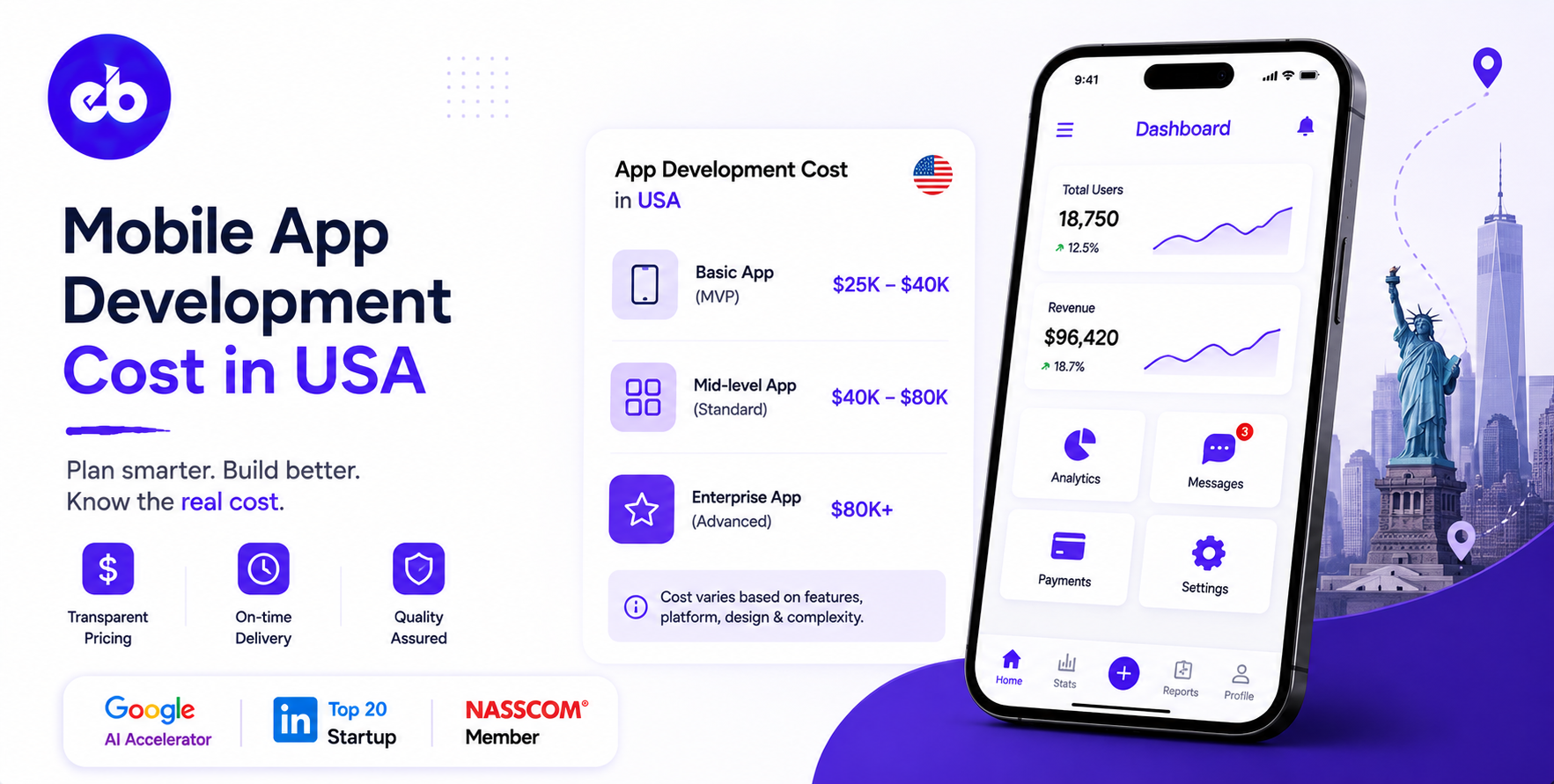
A basic app with a handful of screens, no custom backend, and standard UI components usually falls between $10,000 and $40,000. Think appointment reminders, simple directories, or single-purpose utility tools built on off-the-shelf components.
This tier rarely needs a dedicated backend team. Most of the mobile app development cost in USA at this level goes toward design polish and app store submission, not engineering hours.
Founders testing an early idea before raising money typically start here, since it’s the fastest way to get something real in front of users.
Apps that need user accounts, push notifications, payment processing, and an admin dashboard generally land between $50,000 and $150,000. Most retail, on-demand, and service-booking apps built for the US market sit squarely in this bracket.
This is also where third-party integrations start eating real budget, since every payment gateway, mapping service, or CRM connection adds testing and maintenance hours. A mid-complexity build typically takes three to five months from kickoff to launch, depending on how many outside services it touches.
Apps involving AI features, multi-region compliance, or fintech-grade security routinely run from $150,000 to $400,000 or more. Banking apps, insurance platforms, and large-scale healthcare or Fintech app development projects land in this range.
At this tier, the mobile app development cost in USA reflects far more than screen count. You’re paying for security audits, HIPAA or SOC 2 documentation, load testing at scale, and engineers senior enough to architect for millions of users from day one.
Knowing where your budget actually goes helps you push back on vague line items from any agency you hire.
This stage covers market research, technical scoping, and defining the feature set before any code gets written. Most US agencies spend one to three weeks here mapping user flows and system requirements.
Skipping discovery is the single biggest reason projects blow past their original mobile app development cost in USA estimate later on. Expect this phase to run 5 to 10% of total project cost, depending on how well defined your idea already is when you walk in.
Design work carries a real premium in the US market, since user expectations around polish run high across nearly every category. This stage covers wireframes, high-fidelity mockups, and clickable prototypes that guide the engineering team.
Budget roughly 15 to 20% of total cost here. A rushed design phase almost always resurfaces later as expensive rework, once real users start clicking through an interface that was never properly tested against actual behavior.
This is where most of your budget goes, typically 45 to 55% of total project cost. Frontend and backend engineers build your actual features, wire up your database, and handle every API Development integration for payments, maps, or messaging.
Timeline here depends heavily on whether you’re building separate native apps or one cross-platform codebase. Most mid-complexity US builds take 12 to 18 weeks to move through core development, longer if the app touches regulated data like health records or financial accounts.
Testing across device types, OS versions, and network conditions is non-negotiable in a market as fragmented as the US, where users run everything from three-year-old Androids to the newest iPhones. This phase covers functional, security, and performance testing, plus app store submission.
Budget 10 to 15% of total cost here. Rushing QA to hit a launch date is one of the most common founder mistakes, and it almost always costs more to fix after launch than it would to test properly upfront.
A few specific factors consistently push the cost to develop a mobile app in the USA past baseline estimates.
Where you build your app changes the cost equation more than almost any other decision, and it’s worth weighing the tradeoffs honestly before signing anything.
An in-house team gives you the most control and the tightest feedback loop, but salaries, benefits, and hiring time make it the most expensive path for most founders.
A US-based agency offers faster communication and deep familiarity with domestic compliance rules, though hourly rates commonly run $100 to $250 per hour according to Clutch’s 2026 pricing data.
Offshore teams, particularly from India, often deliver the strongest balance of cost and quality for US founders working with a fixed runway. Many startups now build their MVP Development through an offshore partner first, validate demand, then scale engineering locally once the product proves traction.
AI-powered features have become a real cost driver in the US app market, not just a nice-to-have add-on. Adding recommendation engines, chatbots, or predictive features through AI Development typically adds 20 to 35% to your base mobile app development cost in USA.
Generative features like AI-written content or conversational assistants require ongoing API costs on top of development hours, since most teams call third-party model providers per request rather than hosting anything themselves.
If your app needs a custom scoring model or a prediction engine trained on your own data rather than an off-the-shelf tool, ML Development work extends both timeline and budget noticeably. Plan for this early rather than bolting it on after your MVP ships.
Cost estimates only mean something if the team quoting them actually understands your market and your compliance obligations.
A partner unfamiliar with US app store review guidelines or state-level data privacy laws will quote low, then bill you for corrections once real work starts.
Ask any potential partner for a stage-by-stage cost breakdown, not a single lump number that hides where the money actually goes.
Request examples of apps they’ve shipped in your specific industry, and compare a few of the top mobile app development companies in the USA before committing to one. Ask directly how they handle support once your app is live and generating real user traffic.
The mobile app development cost in USA isn’t a number you look up once and trust forever. It moves based on complexity, compliance needs, and how much of the actual engineering happens onshore versus offshore.
What stays consistent is that founders who plan their budget stage by stage end up with far fewer surprises than founders who accept a single quote at face value.
If you’re scoping a build for the US market and want a realistic number tied to your actual feature list, working with a partner like EngineerBabu, experienced across fintech, healthcare, and retail apps makes that process far more predictable.
EngineerBabu is a technology development company building products across fintech, healthtech, and AI, from MVPs to scaled, production-ready platforms.
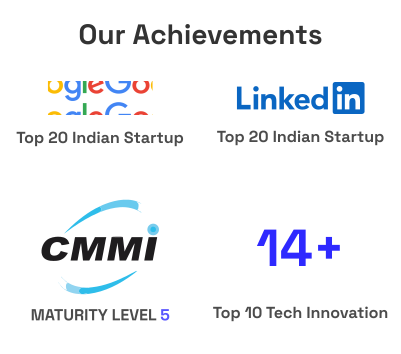
It holds a CMMI Level 5 rating, has worked with 4 unicorn clients, and has supported 200+ VC-funded products. The company is backed by Vijay Shekhar Sharma.
Founded by Mayank Pratap (Co-founder) · mayank@engineerbabu.com
Most apps range from $10,000 for a basic build to $400,000 or more for an enterprise platform with AI or fintech-grade compliance requirements.
Higher operating costs, local compliance expertise, and same-timezone availability all factor into US agency rates compared to offshore alternatives.
Yes, AI features like chatbots or recommendation engines typically add 20 to 35% to base development costs depending on complexity.
Most mid-complexity apps take 12 to 18 weeks for core development, plus additional time for discovery, design, and QA.
Yes, an MVP typically costs 40 to 60% less than a full-featured launch and lets you validate demand before you scale.