How to Build an App Like FlixBus: Features, Cost & Tech Stack (2026)


Create engaging, high-performance mobile applications tailored to your business needs. We craft future-ready apps that offer smooth user experiences on all devices.
Build robust and scalable websites and CMS platforms that help you manage content effortlessly. Our development ensures a seamless digital presence.
Launch secure, feature-rich online stores with intuitive shopping experiences. We build tailored eCommerce platforms designed for growth.
Design captivating games with immersive gameplay and stunning graphics. From concept to launch, we build engaging experiences that players love.
Enhance your customer relationships with customized Salesforce implementations. Drive growth and efficiency with smarter CRM solutions.
Harness artificial intelligence and machine learning to automate workflows and gain actionable insights. Our AI transforms data into smart decisions.
Accelerate your software delivery lifecycle with continuous integration, delivery, and infrastructure automation to boost efficiency.
Hire app developers ready to turn your ideas into sleek, high-performing mobile apps for any platform.
Bring in frontend pros who craft smooth, beautiful, and user-friendly interfaces that your visitors will love.
Get backend developers who build fast, secure, and reliable systems to keep everything running behind the scenes.
Hire eCommerce developers who build secure, scalable online stores designed to offer seamless shopping and grow your sales.
Get dedicated developers committed to your projects, delivering consistent quality and speed as an extension of your team.
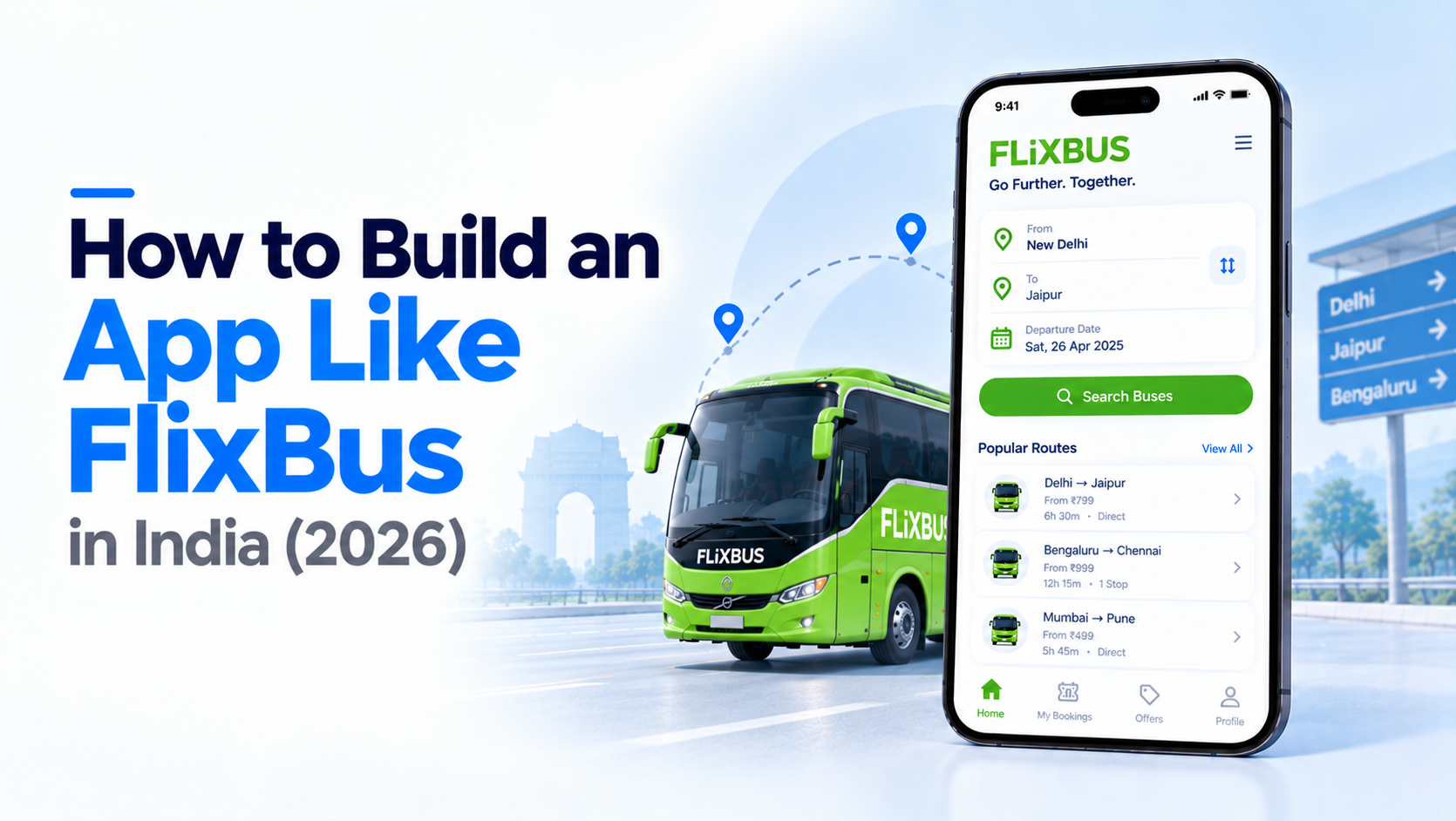
FlixBus does not own most of the green buses carrying its name. Independent coach operators do.
What FlixBus owns is the demand, the pricing engine, the brand, and the software that ties several hundred partners into one timetable. That distinction changes everything about the product you need to build.
TL;DR
So what does it actually take to build an app like FlixBus in the US market? You need a marketplace that sells seats it doesn’t own, prices them in real time, and keeps riders informed about a vehicle you don’t control.
The intercity bus travel market is worth USD 21.81 billion in 2026 and is projected to reach USD 30.19 billion by 2031 (Mordor Intelligence). That growth is being captured by platforms, not fleet owners.
Most founders describe this as a bus ticket app. It isn’t. It’s a three-sided system where each side has different failure modes.
Riders care about one thing: did the bus leave on time and can they find it. Your app has to answer that without a support call.
Coach partners need their inventory, schedules, and payouts visible. They also need you to stop double-selling a seat when their offline agent sold it first.
This is where pricing, routing, cancellations, and refunds live. The decisions made here determine your margin on every single seat.
Treating all three as one build is the most common planning error in travel mobile app development. They share a database, not a release cycle.
Skip the feature wishlist. These are the modules that carry the product.
The tracking layer deserves its own note. Accurate arrival alerts depend on geofencing around each stop, not raw GPS pings. If you already run coaches, this logic overlaps heavily with fleet management software.
| Layer | Practical choice | Why it fits |
| Mobile apps | React Native or native Swift and Kotlin | One codebase for riders, native for the driver app |
| Backend | Node.js or Go microservices | Booking, pricing, and tracking scale independently |
| Database | PostgreSQL plus Redis | Relational bookings, cached seat locks |
| Real-time | WebSockets and MQTT | Live positions without battery drain |
| Payments | Stripe or Braintree | Cards, wallets, refunds, partner payouts |
| Maps | Mapbox or Google Maps Platform | Routing, stop geometry, ETA |
| Infra | AWS or GCP with Kubernetes | Holiday traffic spikes are brutal |
Seat inventory is the part that breaks first. Keep it in a single service with pessimistic locking and a short hold window, then let cloud scalability absorb the peaks.
Decide before design whether you resell operator inventory, operate your own coaches, or run both. FlixBus chose a franchise-style partnership where operators carry the vehicle cost and the platform carries brand and demand. Your model dictates contracts, payout logic, liability, and insurance handling.
It also decides whether you need a full operator console in version one or a simple spreadsheet import. Founders who skip this step end up rebuilding the settlement module six months in, which is expensive and entirely avoidable.
A route is not a line between two cities. It is an ordered list of stops, each with boarding rules, pickup geometry, and a time offset. Model this properly and everything downstream gets easier, including search, pricing, and partial-leg selling.
Partial legs matter because a rider boarding mid-route is pure incremental revenue. Build a stop registry with verified coordinates and photos, since American curbside pickup points confuse first-time riders more than any other part of the journey.
This is the heart of the product. Build a service that holds seats for a fixed window, releases them on timeout, and never exposes the same seat to two checkouts. Handle group bookings, infant seats, and wheelchair positions as inventory types rather than add-on flags.
Write the cancellation and refund rules into this service directly, not into the payment layer. Clean API development here lets operator systems, your website, and third-party resellers all read the same truth.
Wire payments next, because every pricing decision depends on how refunds and credits behave. Support cards, Apple Pay, Google Pay, and a stored credit wallet for canceled trips. Reviewing how payment gateways for startups handle chargebacks early will save you real money.
Once transactions flow, layer dynamic pricing on top: seats sold, days to departure, route demand, and competing modes. Start rules-based, collect six months of data, then move to a model.
Riders forgive a late bus. They do not forgive silence. Build position streaming from the driver device, geofence every stop, and trigger automatic alerts for boarding, delay, and arrival. Push notifications should carry the gate or curb detail, not just a time.
Add SMS fallback, because intercity routes cross weak coverage zones constantly. Give drivers one-tap delay reasons so the message that reaches riders is specific. This single feature cuts support ticket volume more than any other investment.
Launch on a single high-demand corridor with three to five daily departures. One corridor exposes every operational gap fast: no-shows, curbside confusion, refund disputes, driver app adoption. Treat this as MVP development with real revenue attached rather than a pilot.
Fix the gaps, publish honest on-time numbers, then add adjacent corridors that share stops. Network effects in intercity bus travel come from connection density, not from the raw number of cities on your map.
| Scope | Timeline | Cost range |
| MVP: search, booking, payments, e-ticket | 3 to 4 months | $45,000 to $70,000 |
| Standard: adds driver app, live tracking, operator console | 5 to 7 months | $80,000 to $150,000 |
| Full platform: dynamic pricing, multi-operator settlement, analytics | 8 to 10 months | $160,000 to $250,000+ |
Those ranges shift with team location and integration count. Similarly the mobile app development cost in the USA is also affected by the type and state location.
Also reserve 15 to 20 percent annually for app maintenance and support, since schedule data and map SDKs change constantly.
Ticket margin is the obvious line, but it’s rarely the healthiest one.
If you’re serious enough to build an app like FlixBus, the hard parts are inventory integrity, pricing, and real-time reliability, not screens.
EngineerBabu builds exactly that layer. Our travel app development work covers booking engines, seat inventory services, GPS tracking, and multi-party payouts, with senior engineers staying on the project through launch.
When you’re ready to move pricing from rules to predictions, our machine learning development team handles the demand modeling.
Ready to scope your corridor and build an app like FlixBus properly? Talk to the EngineerBabu team.
About EngineerBabu
EngineerBabu is a technology development company building products across fintech, healthtech, travel, and AI, from MVPs to scaled, production-ready platforms. It holds a CMMI Level 5 rating, has worked with 4 unicorn clients, and has supported 200+ VC-funded products. The company is backed by Vijay Shekhar Sharma.
Founded by Mayank Pratap (Co-founder) · mayank@engineerbabu.com
A working MVP with search, booking, payments, and e-tickets takes three to four months. A full platform with a driver app, live tracking, operator console, and dynamic pricing usually takes eight to ten months with a team of six to eight.
No. FlixBus itself relies on partner operators for most coaches. You can launch with signed operator agreements and an inventory feed, which keeps capital expenditure near zero while you prove corridor demand.
Seat inventory consistency. Two checkouts touching the same seat at once is the failure every bus booking platform hits. It needs a dedicated service with locking, timeouts, and a reconciliation job against operator systems.
It shouldn’t. Riders and drivers need separate mobile apps with different permissions and offline behavior. Operators are best served by a web console, since their work happens at a desk.
Scheduled bus travel sells fixed inventory in advance, while ride-hailing matches supply in real time. The concepts overlap though, and this breakdown of how to build an app like Uber covers the dispatch side well.