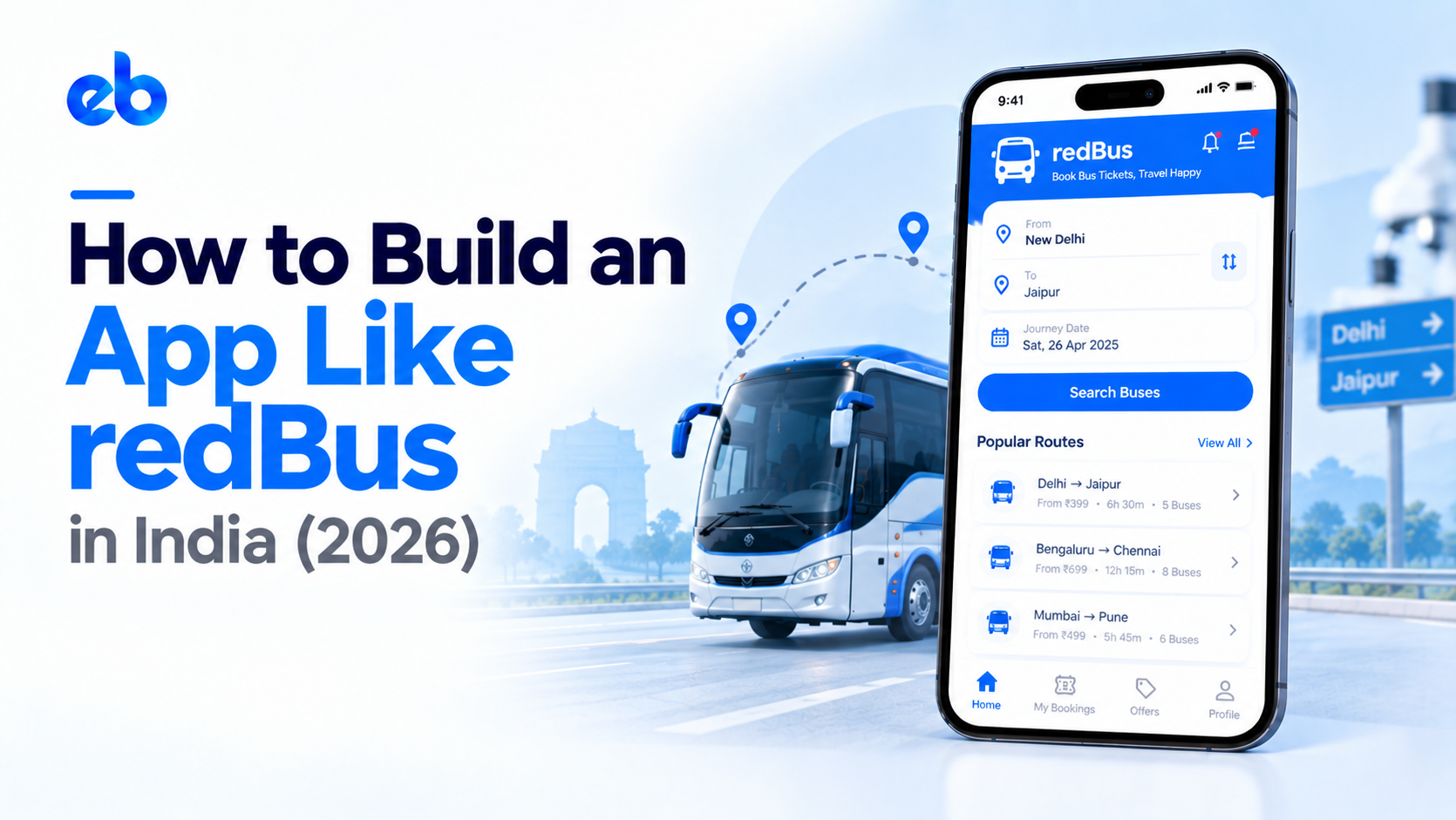
How to Build an App Like redBus in India: Full 2026 Guide


Create engaging, high-performance mobile applications tailored to your business needs. We craft future-ready apps that offer smooth user experiences on all devices.
Build robust and scalable websites and CMS platforms that help you manage content effortlessly. Our development ensures a seamless digital presence.
Launch secure, feature-rich online stores with intuitive shopping experiences. We build tailored eCommerce platforms designed for growth.
Design captivating games with immersive gameplay and stunning graphics. From concept to launch, we build engaging experiences that players love.
Enhance your customer relationships with customized Salesforce implementations. Drive growth and efficiency with smarter CRM solutions.
Harness artificial intelligence and machine learning to automate workflows and gain actionable insights. Our AI transforms data into smart decisions.
Accelerate your software delivery lifecycle with continuous integration, delivery, and infrastructure automation to boost efficiency.
Hire app developers ready to turn your ideas into sleek, high-performing mobile apps for any platform.
Bring in frontend pros who craft smooth, beautiful, and user-friendly interfaces that your visitors will love.
Get backend developers who build fast, secure, and reliable systems to keep everything running behind the scenes.
Hire eCommerce developers who build secure, scalable online stores designed to offer seamless shopping and grow your sales.
Get dedicated developers committed to your projects, delivering consistent quality and speed as an extension of your team.
Two people tap the same window seat on a Pune to Hyderabad sleeper at exactly 9:47 PM. One gets it. The other needs to find out within 300 milliseconds, and without ever seeing a double booking.
Solve that, and you have understood the actual problem.
TL;DR
Anyone planning to build an app like redBus starts by designing the seat selection screen. That is the wrong starting point.
India has thousands of private bus operators plus dozens of state transport corporations. Some run modern reservation software with APIs. Many run desktop software from 2011. Plenty still manage seats on paper at a counter in a bus stand.
Your platform has to show all of them as one searchable, bookable inventory. That is the product. Everything else is presentation.
Uber estimates India’s broader mobility opportunity could reach $13 billion by 2030, with bus travel alone accounting for $6 to $8 billion of it, as reported by Inc42. The category is large, and it is still mostly offline.
Most platforms run all three simultaneously. Building the normalization layer that makes them look identical to your app is the core engineering effort, and the principles mirror any online service marketplace with fragmented supply.
When a user opens a seat map, you hold their selection for a short window while they pay. Hold too long and inventory sits idle during peak demand. Hold too short and payments fail after money leaves the account.
Use a distributed lock with a hard expiry, typically 7 to 10 minutes. Release locks aggressively on abandonment. Reconcile with the operator system on every confirmation, never trust your cache alone.
Diwali, Holi, and long weekends generate traffic spikes of ten to twenty times baseline, concentrated into a few hours.
This is where cloud infrastructure and app scalability decisions made months earlier show their value. Autoscaling alone is not enough. Cache search results aggressively, queue non-critical writes, and keep the booking path as lean as possible.
Every operator has different cancellation windows and penalty slabs. State corporations have their own rules again. Encoding this as scattered conditional logic creates a maintenance nightmare within a year.
Build a rules engine where cancellation policies are configurable data, not code. Your operations team should be able to add an operator’s policy without a deployment.
Launch on one high-density route cluster, such as Bengaluru to Chennai or Delhi to Jaipur. Sign 15 to 30 operators on that corridor before writing integration code.
A corridor launch gives you enough supply density that search results look credible. It also keeps operator onboarding manageable while you learn what their systems actually return. Founders who try national coverage from day one end up with empty search results across most routes, which kills trust immediately and permanently.
Design a single internal schema for routes, schedules, seat maps, fares, and boarding points. Then write adapters that translate each operator source into that schema.
Keep adapters isolated so one broken operator feed cannot corrupt your search index. Add health checks per source and fall back gracefully when a feed goes stale. Solid API development practice matters here, because you will be adding, replacing, and debugging these connections for the life of the product.
Search needs to be fast and forgiving. Handle misspelled city names, nearby boarding points, and flexible dates without making users retype anything.
Seat maps must render the actual bus layout, including sleeper berths, upper and lower decks, and ladies-only seat rules. Checkout should support UPI, cards, wallets, and pay-at-boarding where operators allow it.
The tradeoffs across payment gateways for startups are worth comparing before you commit to a provider.
Tracking is the feature passengers ask for most and operators deliver least consistently. Some buses have GPS units. Some rely on the driver’s phone. Some have nothing.
Build a tracking service that accepts multiple input sources and degrades honestly, showing last known position with a timestamp rather than a fabricated dot.
Using geofencing around boarding points lets you send accurate arrival alerts, which cuts missed-boarding complaints sharply.
Your operators need a dashboard showing bookings, occupancy, revenue, cancellations, and settlement status. Without it, every query becomes a phone call to your support team.
Give them schedule management, fare controls, and seat blocking for their own offline counter sales. Operators who can self-serve stay on the platform.
Those who cannot drift back to their own channels. For example: the logic resembles supply-side tooling in transportation management systems, adapted for passenger inventory.
| Layer | Choice | Reason |
| Mobile | Flutter or React Native | One codebase, fast iteration |
| Backend | Node.js or Go microservices | Handles concurrent booking load |
| Search | Elasticsearch | Fuzzy city and route matching |
| Locking and cache | Redis | Short-lived seat holds |
| Database | PostgreSQL | Transactional booking integrity |
| Queue | Kafka or RabbitMQ | Decouples confirmations and notifications |
Keep booking, inventory, payments, and notifications as separate services. A notification backlog should never delay a ticket confirmation. Teams building comparable systems in flight booking apps arrive at nearly identical architecture for the same reasons.
Bus marketplaces earn through commission per ticket, typically 8 to 12%, plus a convenience fee charged to the passenger.
Secondary streams add up faster than founders expect. Travel insurance attach rates run high on long routes. Operator subscriptions for analytics, seat-boost placement in search, and cancellation protection plans all contribute.
Corporate accounts are another lane, and the mechanics overlap with corporate travel management software.
| Scope | Timeline | Indicative cost |
| Single-corridor MVP, limited operators | 3 to 5 months | $28,000 to $50,000 |
| Full marketplace with tracking and operator panel | 5 to 8 months | $50,000 to $110,000 |
| Multi-state, dynamic pricing, deep integrations | 9 to 13 months | $110,000 to $175,000 |
Operator integration count drives cost more than feature count. Twenty API integrations cost more than most of the user-facing product combined.
For broader context on estimates, this guide on mobile app development cost covers the underlying variables, and the typical timeline to build a mobile app helps set realistic expectations.
Launching nationally with thin inventory makes your app look broken on most searches.
Trusting cached availability without operator reconciliation produces double bookings, which generate refunds and one-star reviews together.
Neglecting app performance optimization before your first festival week means your worst outage happens on your highest revenue day.
Ignoring the operator experience means your supply quietly erodes while you focus on consumer growth.
Founders who decide to build an app like redBus usually need help with two specific things: inventory normalization across messy operator systems, and booking integrity under concurrent load.
EngineerBabu builds both. The team ships travel and marketplace platforms covering aggregation layers, distributed seat locking, payment orchestration, live tracking, and operator dashboards, through mobile app development services in India delivered on a CMMI Level 5 process with senior engineers staying on the build.
Users judge a bus booking app on whether the seat they paid for exists when they board. Everything in your architecture should serve that one promise.
A single-corridor MVP costs around $28,000 to $50,000. A full marketplace with live tracking and an operator panel typically runs $50,000 to $110,000, depending on integration count.
Roughly 5 to 8 months for a complete platform. Operator integrations and partnership agreements often take longer than the engineering itself, so start those conversations early.
Through three channels: direct API integration with operator reservation systems, allocated seat blocks held by the platform, and a self-service operator dashboard for smaller fleets.
Mainly a commission of 8 to 12% per ticket plus a passenger convenience fee. Insurance, search placement, operator subscriptions, and corporate accounts add further revenue.
Short-lived distributed seat locks with hard expiry, combined with real-time reconciliation against the operator system before every confirmation. Cached availability alone is never trusted.
The code is straightforward. The difficulty is data quality, since GPS coverage varies widely across operators. A good tracking service accepts multiple sources and shows honest last-known positions.