Cost to Build an App in Delhi NCR: 2026 Price Breakdown


Create engaging, high-performance mobile applications tailored to your business needs. We craft future-ready apps that offer smooth user experiences on all devices.
Build robust and scalable websites and CMS platforms that help you manage content effortlessly. Our development ensures a seamless digital presence.
Launch secure, feature-rich online stores with intuitive shopping experiences. We build tailored eCommerce platforms designed for growth.
Design captivating games with immersive gameplay and stunning graphics. From concept to launch, we build engaging experiences that players love.
Enhance your customer relationships with customized Salesforce implementations. Drive growth and efficiency with smarter CRM solutions.
Harness artificial intelligence and machine learning to automate workflows and gain actionable insights. Our AI transforms data into smart decisions.
Accelerate your software delivery lifecycle with continuous integration, delivery, and infrastructure automation to boost efficiency.

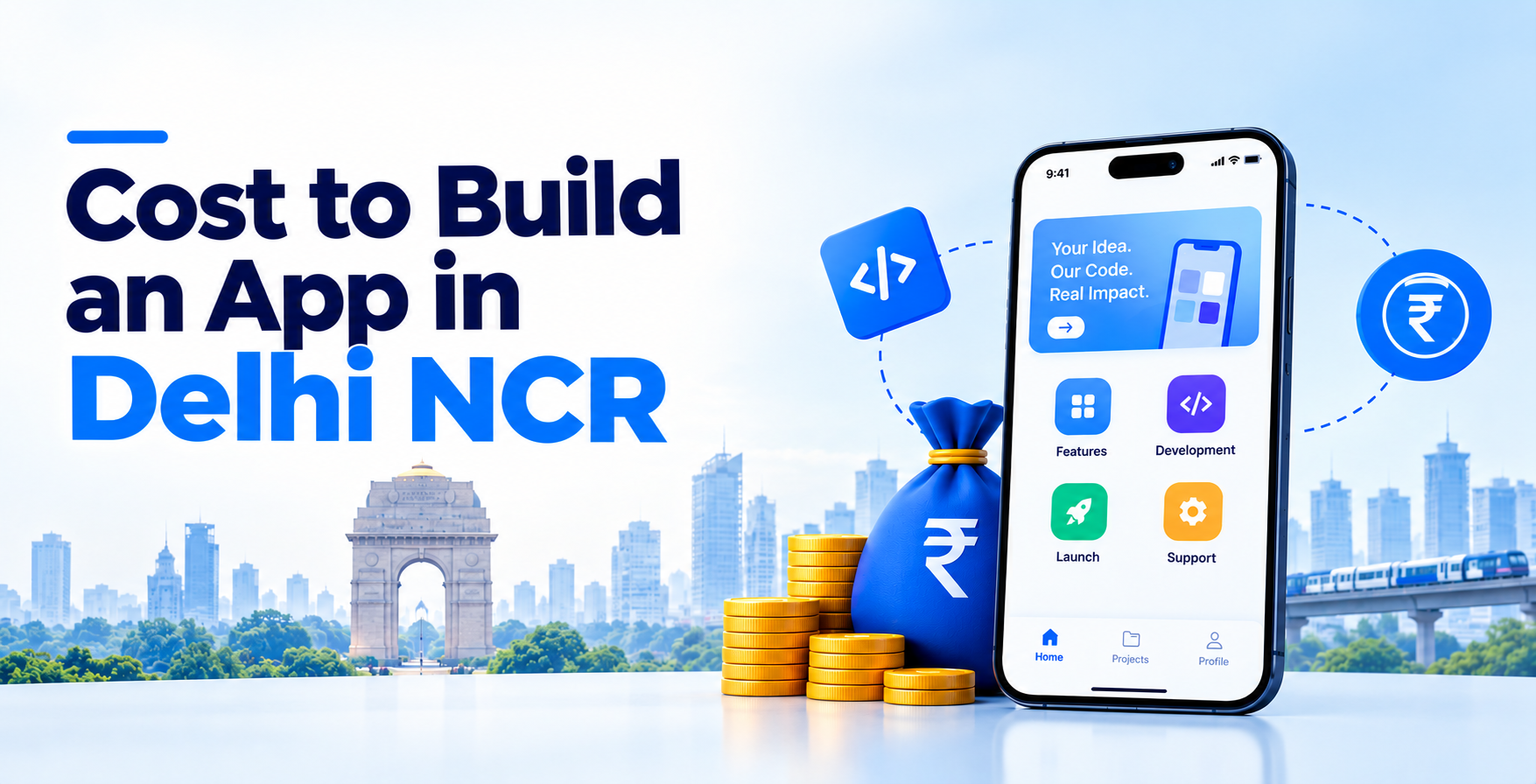
Two founders, same product idea, offices four kilometers apart in Sector 62. One paid ₹7 lakh. The other paid ₹41 lakh. Neither of them was cheated.
That gap is the single most confusing thing about app budgeting in this region. The cost to build an app in Delhi NCR is not one number sitting on a rate card. It is the sum of decisions you make about platforms, backend architecture, compliance, and how much of the work happens in a Cyber City office versus a distributed team.
This guide breaks those decisions down so you can read any quote and know exactly what you are being charged for. If you want the wider national picture first, the full mobile app development cost view sets useful context before you narrow down to NCR pricing.
TL;DR
Most NCR projects land in three bands. A simple app with a handful of screens and no heavy backend costs ₹5 lakh to ₹12 lakh. A mid-complexity app with authentication, payments, notifications, and an admin panel costs ₹14 lakh to ₹38 lakh.
An enterprise or fintech-grade build with AI features, strict compliance, and multiple integrations starts near ₹45 lakh and climbs past ₹1 crore.
Agency hourly rates across NCR sit between ₹1,200 and ₹3,800. Independent developers quote lower, usually ₹600 to ₹1,600, with the tradeoffs that come with that. For a wider benchmark across markets, the general cost to build an app guide is worth a quick look.
Delhi alone crossed 21,120 DPIIT-recognised startups as of March 31, 2026, according to Inc42’s report on FY26 startup recognitions. Add Gurugram and Noida and you get one of the densest product-building corridors in the country.
That density cuts both ways. Senior engineers here have plenty of options, so salaries climb, and agencies price accordingly. At the same time, competition keeps quotes honest, and you can find strong teams at every budget level.
NCR also carries a real concentration of fintech, logistics, and D2C product experience, which matters when your app needs domain knowledge rather than just clean code. The broader market for mobile app development services in India gives you a sense of how regional rates compare.
Complexity is measured in logic, not layouts. A screen that lists products is cheap. A screen that calculates dynamic pricing against live inventory is not. Count your business rules, not your wireframes.
Founders who scope a first release around a narrow problem spend far less, which is why MVP development remains the most common starting point in NCR.
Building separately for iOS and Android means two codebases, two QA cycles, and two release pipelines. That decision alone can add 40 to 70 percent to your build.
A single cross-platform codebase covers both for most consumer apps, though hardware-heavy products still justify going native. The tradeoffs in native vs cross-platform development are worth settling before you request quotes.
Template-driven design is quick and cheap. Custom interaction work, motion, illustration, and a proper design system are not. NCR agencies typically bill 12 to 20 percent of the project for this stage.
Skimping here rarely saves money, because interface rework after launch costs more than getting UI/UX design right the first time.
Every external service you connect adds build time, error handling, and testing overhead. Payment gateways, KYC providers, logistics partners, maps, and analytics each carry their own quirks.
Three integrations is routine. Twelve is a different project entirely. Solid API development work is usually the quiet reason one quote is double another.
Recommendation engines, chatbots, document parsing, and fraud scoring all push budgets up by 20 to 40 percent, plus recurring model and inference costs. Regulated categories add audit trails, data residency, and security review time.
Teams that have shipped AI development work before scope this accurately. Teams that have not tend to discover the cost halfway through.
| App category | Realistic NCR range | What drives the number |
| Informational or catalog app | ₹5 lakh to ₹10 lakh | Content management, basic search |
| Booking or appointment app | ₹12 lakh to ₹25 lakh | Scheduling logic, payments, notifications |
| On-demand delivery app | ₹22 lakh to ₹50 lakh | Live tracking, three user apps, dispatch logic |
| Ecommerce or marketplace app | ₹20 lakh to ₹55 lakh | Catalog, cart, returns, seller tooling |
| Fintech & Lending app development | ₹35 lakh to ₹1 crore+ | KYC, underwriting, audit logs, security review |
| Social or community app | ₹18 lakh to ₹45 lakh | Feeds, media handling, moderation |
Delivery and logistics products dominate the upper-middle band here, partly because NCR has so much operational depth in that space.
If you are building in that category, on-demand app development teams in the region tend to quote faster and more accurately than generalists. The same applies to fintech app development, where compliance experience saves months.
This is where budgets quietly break. Ask about each of these before you sign anything.
Gurugram carries the highest rates in the region. Cyber City and Golf Course Road addresses come with rent and salary structures that show up in your invoice, often 25 to 40 percent above the regional average. You get access to the deepest senior talent pool in NCR, which justifies it for complex products.
Noida and Greater Noida sit in the middle. Strong engineering supply, lower overheads, and a growing cluster of product companies make it the most balanced option for mid-complexity builds. Delhi proper and Faridabad run cheapest, with more variance in quality.
The practical move is to shortlist on capability, then compare. Many founders hire mobile app developers as an extension of their own team rather than handing over the full project, which is a different cost structure worth weighing in the in-house vs agency app development comparison.
Write down every feature you want, then mark the ones your app genuinely cannot launch without. Most lists shrink by 50 percent under that test. Everything else moves to version two, funded by revenue or a raise rather than your founding capital. This single exercise saves more money than any negotiation.
It also shortens your timeline, which lowers cost directly, since you are paying for engineering weeks. The broader tactics in reduce mobile app development costs build on exactly this principle.
Mid-build changes are the most expensive thing you can do. A feature added in week two costs a fraction of the same feature added in week ten, because the second version touches code that already exists. Lock your feature list after design sign-off and hold it.
Keep a parked list for new ideas instead of pushing them into the current sprint. Understanding the realistic timeline to build a mobile app helps you resist the urge to squeeze more in.
Unless your app depends on deep hardware access or heavy on-device processing, one shared codebase serves both platforms well. You ship to iOS and Android together, maintain one set of fixes, and cut QA effort nearly in half.
Most consumer and B2B apps in NCR launch this way now. Teams using Flutter development typically deliver dual-platform builds for close to what a single native app would cost elsewhere.
Ask every shortlisted agency to break the number into discovery, design, development, QA, and deployment, with hours against each. A vendor who cannot do that is guessing.
A stage-wise quote also lets you stop after design if the fit is wrong, instead of losing the whole retainer. Use the breakdown to compare like for like. The questions in choose a mobile app development company are useful to bring to that first call.
The cost to build an app in Delhi NCR is predictable once you stop treating it as a market rate and start treating it as a set of choices you control. Scope, platform, integrations, and partner location account for almost all of the variance between a ₹7 lakh quote and a ₹41 lakh one.
Get those four decisions right before you ask for pricing, and the quotes you receive will finally start to agree with each other. If you want a budget built around your actual feature list, a mobile app development partner that scopes stage by stage will get you there faster than another round of comparison calls.
EngineerBabu is a technology development company building products across fintech, healthtech, and AI, from MVPs to scaled, production-ready platforms.
It holds a CMMI Level 5 rating, has worked with 4 unicorn clients, and has supported 200+ VC-funded products. The company is backed by Vijay Shekhar Sharma.
Founded by Mayank Pratap (Co-founder) · mayank@engineerbabu.com
Most projects fall between ₹5 lakh and ₹38 lakh. Simple apps sit at the lower end, while fintech, marketplace, and AI-driven products commonly cross ₹45 lakh depending on compliance and integration load.
Generally yes. Noida agencies run 25 to 40 percent below Gurugram rates for comparable work, mainly because of lower operating costs rather than any difference in engineering capability.
A lean first release takes 8 to 12 weeks. Mid-complexity apps take 16 to 24 weeks including discovery, design, and testing. Regulated products take longer because of audit and security review cycles.
Budget 15 to 20 percent of your build cost annually for maintenance, plus monthly spend on hosting, maps, SMS, and push services. These recur whether or not you ship new features.
It lowers the hourly rate but shifts project management, QA, and hiring risk onto you. Direct hiring works well once you have a technical founder or CTO in place to run the team.
Ask both to itemize hours by stage and list every third-party integration. Differences almost always trace back to backend depth, QA coverage, or senior engineer involvement rather than greed.