In-House vs Agency App Development: Which One Ships Faster?


Create engaging, high-performance mobile applications tailored to your business needs. We craft future-ready apps that offer smooth user experiences on all devices.
Build robust and scalable websites and CMS platforms that help you manage content effortlessly. Our development ensures a seamless digital presence.
Launch secure, feature-rich online stores with intuitive shopping experiences. We build tailored eCommerce platforms designed for growth.
Design captivating games with immersive gameplay and stunning graphics. From concept to launch, we build engaging experiences that players love.
Enhance your customer relationships with customized Salesforce implementations. Drive growth and efficiency with smarter CRM solutions.
Harness artificial intelligence and machine learning to automate workflows and gain actionable insights. Our AI transforms data into smart decisions.
Accelerate your software delivery lifecycle with continuous integration, delivery, and infrastructure automation to boost efficiency.
The math looked clean on the whiteboard. Two senior engineers, one designer, twelve months, and the product would be theirs forever.
Fourteen months later, that founder had made three hires, lost one to a counteroffer, and shipped nothing users could open.
This is the part of the in-house vs agency app development debate that rarely makes it into the pitch deck. The choice is not really about headcount or hourly rates. It is about which risk you would rather carry: the risk of building a team, or the risk of depending on one.
Both models ship great apps. Both models produce expensive wreckage. What separates the two outcomes is matching the model to your stage, your domain, and how central the app is to your business.
Build in-house when the app is the business, when you expect to ship changes weekly for years, and when you can afford eighteen months of payroll before revenue.
Hire a mobile app development agency when you need a defined product shipped inside a fixed window. The same applies when the skills are specialized, or when demand is still unproven.
Most companies get this wrong by treating in-house vs agency app development as a permanent decision. It is a stage decision, and the right answer usually changes twice.
Most in-house vs agency app development comparisons go soft here. They quote agency invoices against base salaries and stop.
That comparison is not close to accurate.
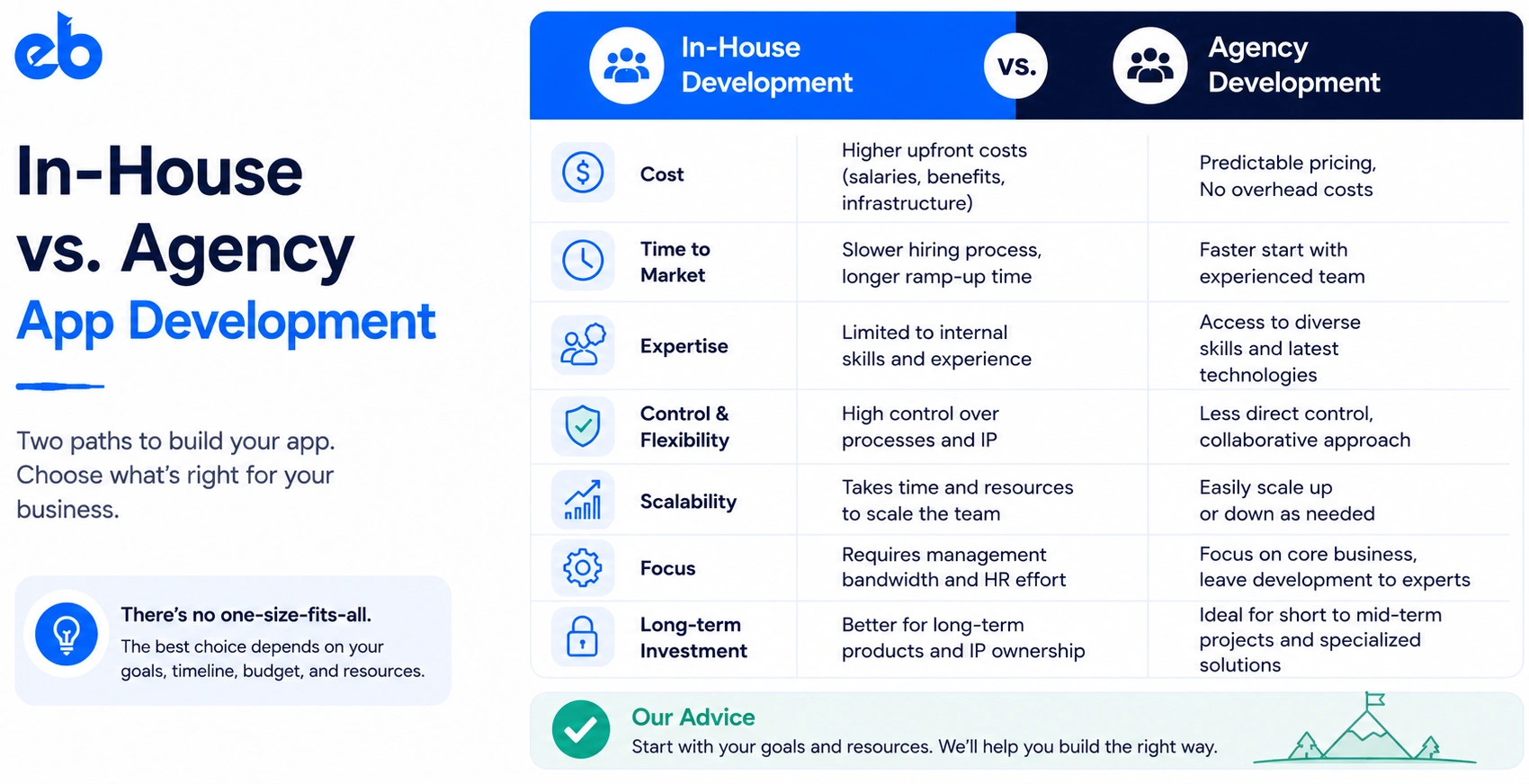
The median annual wage for software developers in the United States was $133,080 as of May 2024, according to the U.S. Bureau of Labor Statistics. That is base wage only.
Employer benefit costs add roughly another 30% on top of wages for private industry workers, per the same agency’s compensation data. Then add recruiter fees, equipment, software licenses, and the manager’s time spent interviewing.
A minimum viable app team is usually four people: iOS, Android app or cross-platform, backend, and design. Loaded, that team clears $700,000 a year before anyone writes a line of shipped code.
Agencies quote per project or per sprint. That number already absorbs recruiting, benefits, replacement risk, and idle time you never see itemized.
A defined build from an established mobile app development partner like EngineerBabu typically lands between $40,000 and $150,000. Complexity and platform count drive that spread, and offshore or hybrid teams sit lower in it.
The honest tradeoff: agency spend stops when the project stops. In-house spend continues whether the roadmap is full or empty.
Hiring is the hidden clock in this decision. Filling one senior mobile role commonly takes eight to twelve weeks from job post to signed offer. Filling four takes a quarter or more, and that is before onboarding.
An agency starts with a staffed team. Kickoff to first build is usually days, not months.
That gap matters most when you are validating an idea rather than scaling a known winner. If you want a working MVP development build in front of real users this quarter, in-house hiring loses on timeline alone.
Speed cuts the other way after launch. An in-house team pushes a hotfix in an hour. An agency without a retainer may need a scoping call first.
Control is the strongest in-house argument in the in-house vs agency app development debate, and it is a fair one. Your engineers sit in your standups, absorb your customer calls, and make small judgment calls correctly because they understand the business.
Agencies work from written scope. Anything not written down gets interpreted, and interpretation is where rework comes from.
Ownership is a solvable problem, not a real risk, as long as you handle it in the contract. Insist on full IP assignment, your own repositories, your own cloud accounts, and documented architecture from week one.
The genuine risk is knowledge concentration. If one external team holds every decision in their heads, your switching cost quietly grows each sprint. Weekly documentation handoffs fix this cheaply.
In-house vs agency app development tilts toward hiring when these conditions stack up.
If two or more of these describe you, start hiring, and use contractors only to cover gaps.
It tilts the other way when the work is bounded, specialized, or still speculative.
The hybrid model settles in-house vs agency app development in sequence rather than in principle. The pattern that works repeatedly looks like this. An agency builds version one, including the backend and the API development layer connecting payments, maps, and third-party services.
Once the product finds traction, the company hires a lead engineer who owns architecture and reviews every merge. Agency developers then shift to feature work under that lead.
Over the next two or three quarters, in-house hires replace external seats one at a time, with paid overlap for handover.
This sequence avoids both classic failures. You do not burn a seed round on payroll before validation. You also do not stay dependent on outsiders once the app becomes the business.
Write down what the app does for revenue. If it is the product customers pay for, it is core, and core systems eventually belong in-house. If it supports a business that earns money elsewhere, such as a booking tool for a clinic chain, it is supporting infrastructure. Supporting systems rarely justify permanent engineering payroll.
Be honest here, because founders routinely overstate how central an app is. The answer determines everything downstream, including how much switching cost you should tolerate later.
Build two columns in a spreadsheet. In-house: salaries, benefits at roughly 30%, recruiter fees, equipment, tooling, and three months of hiring lag with zero output. Agency: total project fee, plus a maintenance retainer, plus a contingency for scope changes.
Extend both to eighteen months rather than to launch day. Short-horizon math flatters agencies, and lifetime math flatters in-house teams. Eighteen months is where the honest crossover shows up for most products, and the gap is often smaller than either side claims.
Before you commit to in-house, post one real job and run the process for three weeks. Track applicant quality, response rates, and the salary numbers candidates actually name. Founders in secondary markets often discover that senior mobile engineers are unavailable at their budget.
That data point is worth more than any cost model. If you cannot fill one seat in three weeks, you cannot fill four in a quarter. Treat the experiment as cheap research, not as a failed hiring round.
Compare two or three firms, not eight. Published roundups of mobile app development companies are a starting point, never a decision. Then ask the questions that reveal delivery reality. Who writes my code, and can I meet them this week? What is your developer turnover on long projects?
Show me an app you shipped in my industry that is still live. Who maintains this after launch, and at what rate? Vague answers to any of these predict exactly how the project will go.
In-house vs agency app development is not a values question about commitment or control. It is a sequencing question about capital, timelines, and how quickly you need proof.
Agencies buy speed and specialized skill while your idea is still unproven. In-house teams buy compounding knowledge once the product clearly works.
Founders who get this right pick the model that fits the next twelve months, then plan the transition deliberately instead of drifting into it.
For a first build, usually yes. A loaded four-person team costs more per year than most agency projects. Over three or more years of continuous development, in-house typically becomes cheaper.
You do, if the contract says so. Require full IP assignment, repositories under your accounts, and cloud infrastructure in your name. Confirm this in writing before the first sprint starts.
Plan on eight to twelve weeks per senior role, plus onboarding. A four-person team realistically takes a full quarter or longer in most markets.
Yes, and that is the most common successful path. Hire a technical lead first, require documentation throughout the build, and replace external seats gradually with paid overlap.
An agency, in most cases. MVPs need speed and reversibility, and hiring permanent staff for an unvalidated idea creates commitments that are painful to undo.