LLM Application Development: A Practical Build Guide 2026


Create engaging, high-performance mobile applications tailored to your business needs. We craft future-ready apps that offer smooth user experiences on all devices.
Build robust and scalable websites and CMS platforms that help you manage content effortlessly. Our development ensures a seamless digital presence.
Launch secure, feature-rich online stores with intuitive shopping experiences. We build tailored eCommerce platforms designed for growth.
Design captivating games with immersive gameplay and stunning graphics. From concept to launch, we build engaging experiences that players love.
Enhance your customer relationships with customized Salesforce implementations. Drive growth and efficiency with smarter CRM solutions.
Harness artificial intelligence and machine learning to automate workflows and gain actionable insights. Our AI transforms data into smart decisions.
Accelerate your software delivery lifecycle with continuous integration, delivery, and infrastructure automation to boost efficiency.

TL;DR
Most language model demos work on the first try. Most language model products break somewhere around the thousandth request, when a user phrases something sideways and the whole flow falls apart.
That gap between a working demo and a working product is what LLM application development actually is.
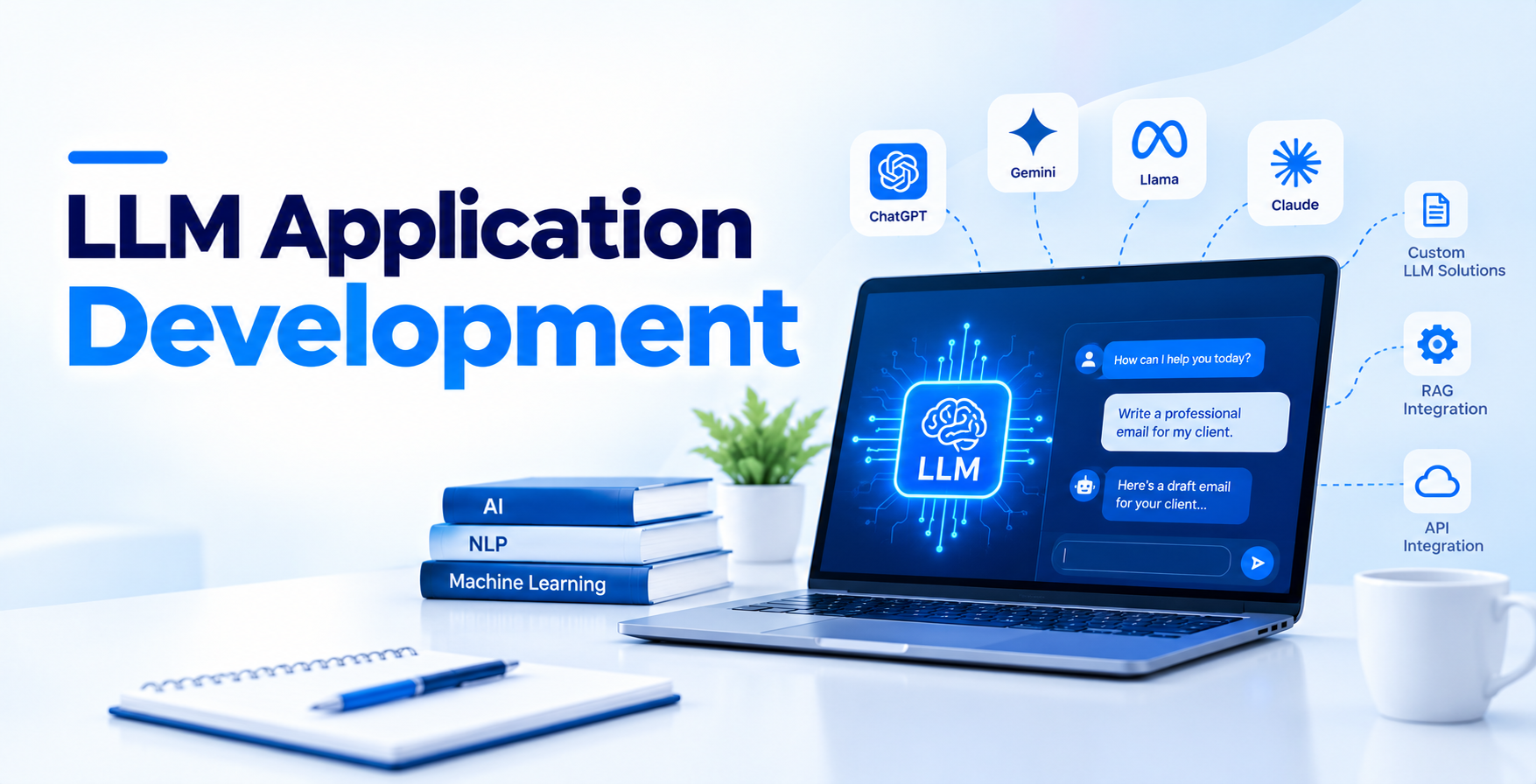
LLM application development is the practice of building software where a large language model handles part of the core logic. It is not a chat box bolted onto an existing screen. The model reads context, reasons over it, and returns output the rest of your system has to trust enough to act on.
That trust requirement is the whole challenge. Traditional code returns the same answer for the same input every time. A language model returns something close to the right answer, most of the time, with a distribution of failure modes you have to design around.
So the real work sits in the layers surrounding the model. You decide what context reaches it, how its output gets validated, what happens when it refuses or hallucinates, and how you measure any of it. Picking a model takes an afternoon. Everything else takes the quarter.
Teams coming from conventional backend work usually hit the same three surprises.
There is no assertion you can write that passes deterministically. Two identical requests can return different phrasings, and both can be correct. Testing moves from pass or fail to scored against a rubric, which changes how your QA process has to work.
A chatty feature can quietly multiply your inference bill. One badly designed retrieval step that stuffs 30,000 tokens into every call will cost more than your entire hosting budget. Cost modeling belongs in the design phase of any LLM application development project, not in a panic review after month one.
Providers release better and cheaper models constantly. If your prompts, tool definitions, and parsing logic are welded to one vendor’s SDK, every upgrade becomes a rewrite. Abstract the model call early, the same way you would abstract a database driver.
Gartner expects LLM observability investments to reach 50% of GenAI deployments by 2028, up from 15% today, which tells you where the industry’s pain actually is. Not in model access. In knowing what the model did and whether you can rely on it.
LLM application development usually produces five layers, and the model sits in the middle of them.
Start by writing down exactly what the model must produce and what counts as correct. “Summarize support tickets into three bullet points with the account tier named” is buildable. “Make support smarter” is not. Narrow tasks let you measure accuracy, cap token spend, and choose a smaller model that runs cheaper.
Most failed LLM application development projects were scoped as a vague capability instead of a specific job. Write the output format, the acceptable input range, and the failure behavior before anyone opens a code editor.
Collect 50 to 150 real examples with the output you would accept for each. Pull them from support logs, sales transcripts, or whatever source your feature will serve. This set becomes your regression suite for every prompt change, model swap, and retrieval tweak afterward.
Without it, “the new prompt feels better” is the only review you can give. Teams that skip this step spend months shipping changes they cannot defend. Grade with a mix of exact checks, a scoring model, and periodic human review on a sample.
If your app answers questions over company data, retrieval quality sets your ceiling. A perfect prompt over wrong documents still returns wrong answers. Tune chunk size to your content, test hybrid search against pure vector search, and add metadata filters so a 2024 policy never answers a 2026 question.
Most teams building RAG application development services find that reranking retrieved passages delivers a bigger accuracy jump than any prompt rewrite. Measure retrieval separately from generation so you know which half is failing.
Decide what happens when the model returns malformed JSON, refuses the request, or produces something your validator rejects. Real options include retrying with a stricter instruction, falling back to a larger model, or routing to a human queue.
Never let a parsing error surface as a blank screen. Timeouts need the same treatment, since inference latency varies widely under load. Good LLM application development treats these paths as features with their own tests, not as exception handling someone adds the week before launch.
Log every request with its prompt version, retrieved context, model name, token counts, latency, and final output. Add a thumbs up or down control in the interface and store the feedback against the request ID.
This is what makes a user complaint debuggable instead of theoretical. Set alerts on refusal rate, average latency, and daily token spend. Quality drift in LLM application development is rarely dramatic. It shows up as a slow rise in unhelpful answers that nobody notices without instrumentation.
Once your evaluation scores are stable, start cutting spend. Route easy requests to a smaller model and reserve the expensive one for hard cases. Cache responses for repeated queries. Trim retrieved context to what actually improves scores, since more context often hurts both accuracy and the bill.
Prompt caching on repeated system instructions cuts cost noticeably on high volume flows. Run every optimization against your evaluation set, because most cost savings quietly trade away a few points of quality.
These three get treated as competing options. They solve different problems.
The honest default for most LLM application development work is prompting plus retrieval, with fine-tuning reserved for a specific bottleneck you have already measured. Still deciding where a language model fits?
The difference between LLM vs generative AI is worth understanding before you scope the build.
Most LLM application development starts inside software that already has users. Adding intelligence to a live product is a different engineering problem from building a standalone AI tool.
The practical approach is to pick one workflow where the current experience is slow or manual. Document search, ticket triage, data entry from unstructured files, and first-line support all qualify. Retrofitting through planned AI integration keeps the existing product stable while the new feature proves itself behind a flag.
Customer-facing conversational features deserve particular care, since they fail in public. Teams who build an AI chatbot on top of real account data need scoped permissions, so the model can never retrieve records belonging to another user. That boundary belongs in your retrieval layer, enforced in code, never in a prompt instruction asking the model to behave.
The teams shipping useful language model features are not the ones with the cleverest prompts. They are the ones with honest evaluation sets, clean retrieval, visible logs, and a clear plan for what happens when the model gets it wrong.
Treat LLM application development as a reliability problem rather than a model selection problem, and most of the hard decisions get simpler.
Scoping a build and want a team that has shipped this architecture before? EngineerBabu works across AI development and generative AI development services, from MVP stage through enterprise scale.
It is the process of building production software where a large language model performs part of the core logic, supported by retrieval, orchestration, output validation, and monitoring. The model is one component inside a larger system, not the product itself.
A focused internal tool typically takes 6 to 10 weeks. Customer-facing LLM application development with retrieval, permissions, and compliance requirements usually runs 4 to 6 months. Evaluation and tuning continue after launch.
Usually not at the start. Prompting and retrieval solve most problems. Fine-tuning is worth it when you need consistent output structure or want to move a proven workflow onto a smaller, cheaper model.
Inference cost depends on tokens, not user count. Expect spend to scale with context size and request volume, which is why context trimming, caching, and model routing are standard parts of LLM application development.
You need a backend engineer comfortable with API design, someone owning data and retrieval, and a product person defining correct output. Many companies hire AI developers on a dedicated basis instead of building the capability in house.