Timeline to Build a Mobile App: How Long Does It Take?


Create engaging, high-performance mobile applications tailored to your business needs. We craft future-ready apps that offer smooth user experiences on all devices.
Build robust and scalable websites and CMS platforms that help you manage content effortlessly. Our development ensures a seamless digital presence.
Launch secure, feature-rich online stores with intuitive shopping experiences. We build tailored eCommerce platforms designed for growth.
Design captivating games with immersive gameplay and stunning graphics. From concept to launch, we build engaging experiences that players love.
Enhance your customer relationships with customized Salesforce implementations. Drive growth and efficiency with smarter CRM solutions.
Harness artificial intelligence and machine learning to automate workflows and gain actionable insights. Our AI transforms data into smart decisions.
Accelerate your software delivery lifecycle with continuous integration, delivery, and infrastructure automation to boost efficiency.
Hire app developers ready to turn your ideas into sleek, high-performing mobile apps for any platform.
Bring in frontend pros who craft smooth, beautiful, and user-friendly interfaces that your visitors will love.
Get backend developers who build fast, secure, and reliable systems to keep everything running behind the scenes.
Hire eCommerce developers who build secure, scalable online stores designed to offer seamless shopping and grow your sales.
Get dedicated developers committed to your projects, delivering consistent quality and speed as an extension of your team.
A founder once told us he was promised a finished app in six weeks. Fourteen months later, he was still reviewing “final” builds. The team wasn’t lazy. The estimate was fiction from day one.
That story repeats itself constantly because most people ask “how long” before defining “how complex.” The honest timeline to build a mobile app is not a single number. It’s a range that depends on scope, team structure, and how many decisions you’ve already made before the first line of code.
According to Clutch research, a typical mobile app development project takes 20 to 40 weeks from research to launch. That’s a wide window, and this guide explains exactly what pushes your timeline to build a mobile app toward either end of it.
If you want the short version before the breakdown, here it is.
| App Complexity | Typical Timeline | Examples |
| Simple app | 2 to 4 months | Calculators, directories, single-purpose tools |
| Mid-complexity app | 4 to 7 months | Booking apps, delivery apps, social features |
| Complex app | 8 to 14+ months | Fintech platforms, telehealth, marketplaces |
These ranges for the timeline to build a mobile app assume a dedicated team working continuously. Part-time teams, freelancers juggling projects, or founders who take three weeks to approve a design will stretch every number above.
Screen count gets all the attention, but it’s rarely the real driver. Backend complexity matters far more. An app that stores data locally is a sprint. An app syncing real-time data across users, payment systems, and third-party services is a marathon.
Platform choice is the second big lever. Building native apps for iOS and Android means two codebases, two QA cycles, and nearly double the development hours. A cross-platform build in Flutter or React Native cuts that significantly, which is why most mobile app development teams recommend it for first versions.
The third factor is you. Client-side decision speed quietly adds weeks to most projects. Every delayed feedback round on designs or builds pushes the launch date, and no agency can compress that for you.
Let’s put real numbers against the timeline to build a mobile app at each level, because “it depends” helps nobody budget a launch date.
These apps have under 10 screens, minimal backend work, and standard UI components. Think internal tools, content apps, or utility apps with one core function. Design takes 2 to 3 weeks, development takes 6 to 10 weeks, and testing wraps in 2 weeks. The biggest delay risk here isn’t technical. It’s founders adding “just one more feature” mid-build.
This bracket covers most commercial apps: user accounts, push notifications, payments, admin panels, and a custom backend. Most food delivery, service booking, and e-commerce apps live here. Development alone runs 10 to 16 weeks, and integrations are usually what blow the schedule. Every payment gateway or maps connection adds testing overhead you can’t skip.
Apps with regulatory requirements, AI features, real-time engines, or heavy security land in this range. A lending or banking product built with a fintech app development company carries compliance work that adds months, not weeks. HIPAA-grade healthcare apps face the same reality. The code isn’t the slow part. The audits, security reviews, and edge-case testing are.
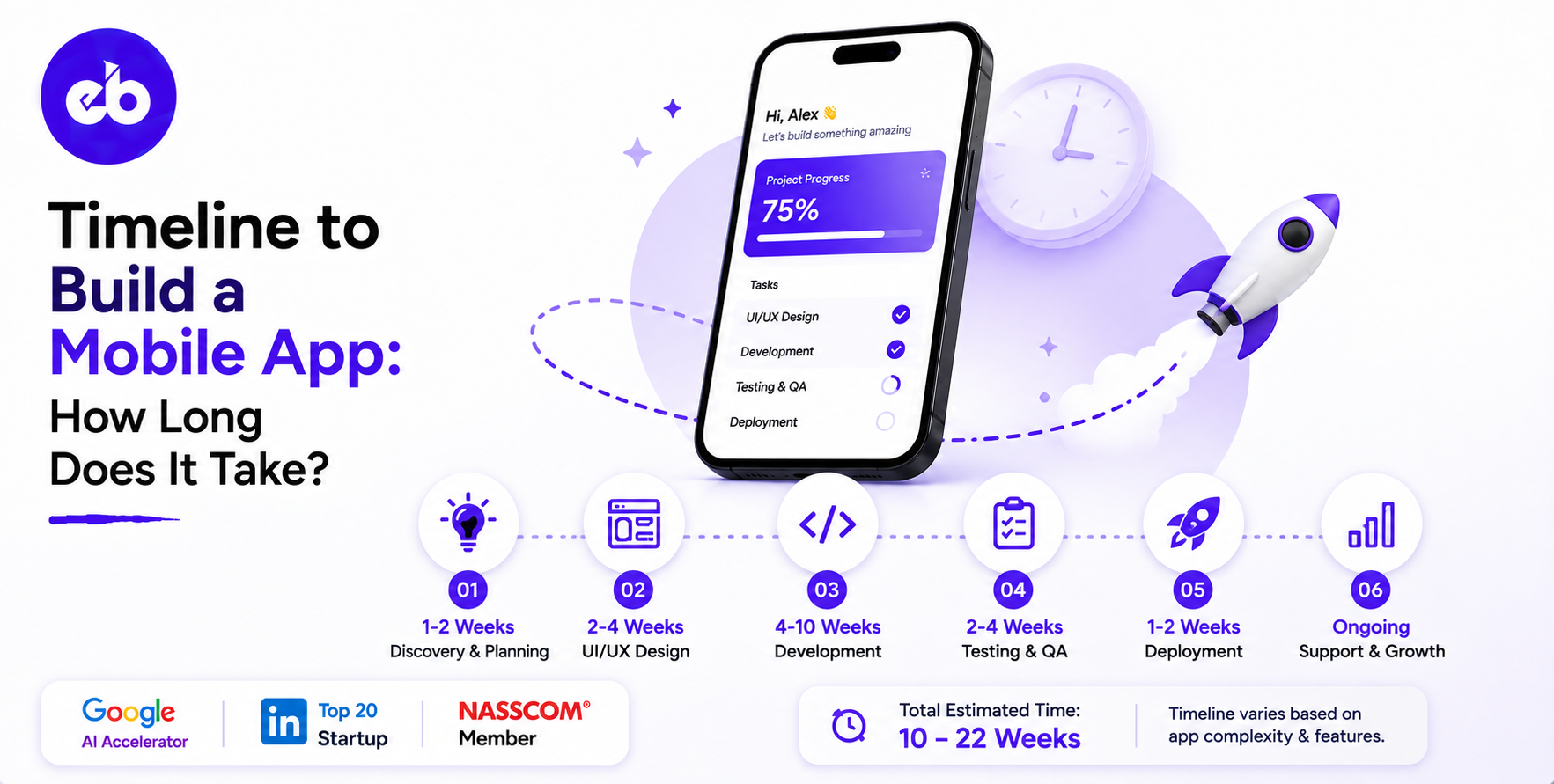
The full timeline to build a mobile app breaks into five stages, and each one has a predictable duration once scope is fixed.
This stage defines what you’re building and, more importantly, what you’re not. Teams map user flows, lock the feature list, choose the tech stack, and document technical requirements. It feels slow when you’re eager to see screens, but it’s the cheapest place to make mistakes. A feature cut on paper costs nothing. The same feature cut in month five costs weeks of wasted development. Founders who arrive with a written scope document can compress this stage to under two weeks.
Designers turn your approved flows into wireframes, then high-fidelity mockups, then clickable prototypes. Mid-complexity apps typically need 25 to 40 unique screens once you count empty states, error states, and onboarding. The prototype step matters more than most founders realize. Testing navigation on a prototype takes days. Fixing confusing navigation after development takes weeks. Design also runs partially in parallel with early backend work, so a good team doesn’t let this stage sit on the critical path alone.
This is the longest stage and consumes roughly half your total timeline. Frontend developers build the screens while backend engineers set up databases, authentication, and server logic. Third-party integrations for payments, maps, or messaging usually flow through dedicated API development work, and each integration adds its own testing cycle. Simple apps finish in 8 weeks here. Mid-complexity builds need 10 to 16 weeks. Complex platforms with real-time features or compliance layers can run 20 weeks or more in this stage alone.
QA overlaps with development, but a dedicated testing window before launch is non-negotiable. Testers check functionality across device types, screen sizes, OS versions, and poor network conditions. They also run security testing, which matters enormously for anything touching payments or personal data. Expect at least two full bug-fix cycles. Teams that shrink this stage to protect the overall timeline to build a mobile app always pay for it in one-star reviews. Post-launch fixes cost far more than pre-launch testing ever does.
Apple’s review typically takes 24 to 48 hours now, but rejections are common on first submissions. Privacy policy gaps, missing demo credentials, and unclear permission requests trigger most of them. Google Play reviews run faster but still require compliance checks. Smart teams submit a build early to catch rejection reasons before the real launch. Budget a full two weeks here, and treat anything faster as a pleasant surprise rather than the plan.
AI is no longer a fringe request. Chatbots, recommendation engines, and predictive features show up in most new app briefs we see.
Off-the-shelf AI integrations, like plugging in an existing model through an API, add 2 to 4 weeks to the timeline to build a mobile app. Custom work through a dedicated AI development team runs longer because models need training data, evaluation, and tuning cycles.
If your product needs custom scoring or prediction built from your own data, ML development can add 2 to 3 months to the schedule. Plan for it upfront rather than bolting it on after launch.
The fastest way to cut the timeline to build a mobile app is starting with an MVP. Launching a focused first version through MVP development typically gets you live in 3 to 4 months instead of 8. You validate demand with real users, then invest in features the market actually asked for.
Beyond that, three habits consistently save weeks. Freeze your scope before development starts. Respond to design and build reviews within 48 hours. And choose a cross-platform stack unless you have a hard technical reason for native.
Team selection matters too. Experienced mobile app development companies run design and development in parallel, reuse proven architecture patterns, and catch scope problems early. A cheap team that misses deadlines is always more expensive than a disciplined one that hits them.
The realistic timeline to build a mobile app runs from about 3 months for a lean MVP to well over a year for a complex, regulated platform. The number itself matters less than knowing what drives it: backend complexity, platform choice, integrations, and your own decision speed.
Founders who lock scope early, review fast, and launch lean consistently beat their estimates. Founders who treat the timeline as flexible watch it become exactly that.
If you want a stage-by-stage timeline built around your actual feature list rather than a generic range, EngineerBabu’s team can map one with you before you commit a dollar to development.
Most apps take 4 to 7 months from discovery to launch. Simple apps can ship in 2 to 4 months, while complex platforms with compliance or AI features often need 8 to 14 months or more.
Only a very basic app using templates or no-code tools. A custom app with accounts, a backend, and store approval realistically needs 3 months minimum, even with an experienced team moving fast.
Core development, which consumes 40 to 60% of the total schedule. It covers frontend screens, backend infrastructure, and third-party integrations, and each integration adds its own testing cycle.
With native development, nearly yes, since you maintain two codebases. Cross-platform frameworks like Flutter or React Native deliver both platforms from one codebase, adding only 15 to 25% over a single-platform build.
Directly. Most agencies bill by team-months, so every added month raises the budget. Delays from scope changes and slow feedback are the most common reason projects exceed both timeline and cost estimates.