Fintech App Development Compliance: Everything You Need to Know


Create engaging, high-performance mobile applications tailored to your business needs. We craft future-ready apps that offer smooth user experiences on all devices.
Build robust and scalable websites and CMS platforms that help you manage content effortlessly. Our development ensures a seamless digital presence.
Launch secure, feature-rich online stores with intuitive shopping experiences. We build tailored eCommerce platforms designed for growth.
Design captivating games with immersive gameplay and stunning graphics. From concept to launch, we build engaging experiences that players love.
Enhance your customer relationships with customized Salesforce implementations. Drive growth and efficiency with smarter CRM solutions.
Harness artificial intelligence and machine learning to automate workflows and gain actionable insights. Our AI transforms data into smart decisions.
Accelerate your software delivery lifecycle with continuous integration, delivery, and infrastructure automation to boost efficiency.
Your app clears QA. Your banking partner then asks one question: show the audit trail for every KYC decision made in the last 90 days. Nobody can.
That is how fintech app development compliance usually fails. Not as a fine, but as a blocked launch while engineers reverse-engineer evidence the system never captured.
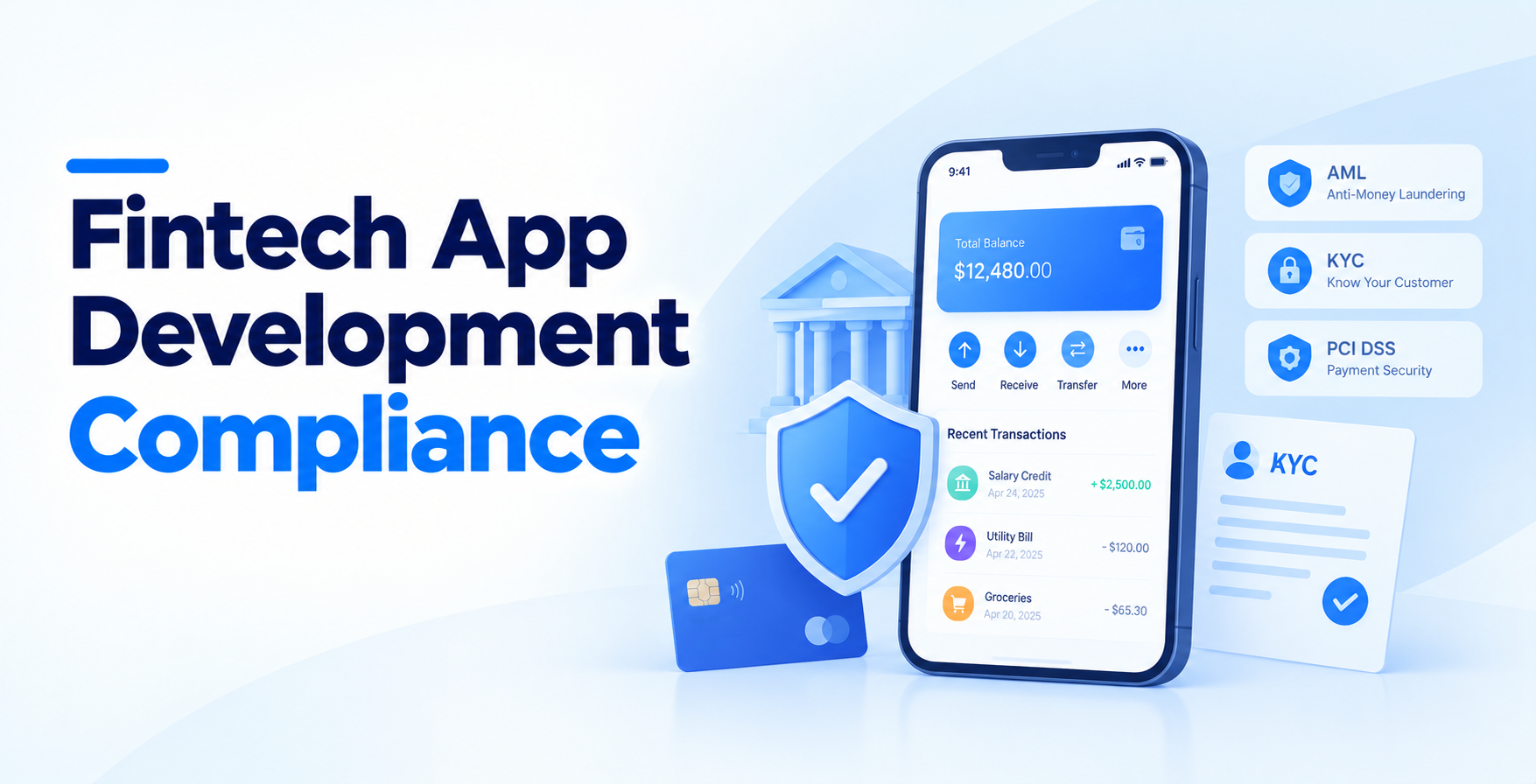
Fintech app development compliance is the practice of building regulatory requirements directly into product architecture, so identity checks, consent records, transaction logs, and model decisions are provable on demand. It covers AML and KYC, payment security standards, data protection law, and operational resilience rules.
This guide breaks down which rules apply to your product, what each one changes in the codebase, and the sequence that keeps compliance from becoming rework.
TL;DR
Regulators do not audit intentions. They audit records. Fintech app development compliance is judged on whether your system can reconstruct who was verified, when, on what evidence, and under which rule version.
That evidence requirement lands squarely on the engineering team. It shapes your data model, your retention policy, your event logging, and your release process.
The market has priced this in. The global regtech market was valued at USD 18.6 billion in 2025 and is projected to reach USD 77 billion by 2034, a 17.1% CAGR, according to IMARC Group.
Treating fintech app development compliance as a post-build legal pass creates a predictable pattern. Launch slips, partner banks hold onboarding, and teams rebuild core flows under deadline pressure.
Almost every fintech app development compliance requirement sits in one of four layers. Mapping your product against them early tells you what to build and what to buy.
This layer decides who gets an account, and it is where fintech app development compliance starts. You need customer identification, sanctions and PEP screening, risk scoring, and suspicious activity reporting.
The build implication is storage and traceability. Every verification attempt, document, match score, and override needs a timestamped record tied to a rule version.
In India, flows built on eKYC, eSign, and bank verification replace manual paperwork, but each step still has to log consent and outcome.
Most teams integrate a vendor rather than building screening in-house. Choosing the right KYC identity verification software matters, because false positive rates directly drive your manual review headcount.
The moment you touch card numbers, PCI DSS compliance requirements apply. Version 4.0.1 made previously future-dated controls mandatory in March 2025, including stricter authentication and scripting rules.
The cheapest fintech app development compliance decision you will ever make is scope reduction. Tokenize early, never let raw card numbers hit your servers, and push card handling to a certified processor.
ACH and local rails carry their own rules. NACHA requires authorization records, pre-debit notice in several states, and clean handling of return codes.
Mapping bank API integrations before you write integration code prevents the common failure, which is settlement logic that assumes initiation equals completion.
GDPR, India’s DPDP Act, and GLBA all converge on the same engineering demand. Collect a lawful minimum, record consent, honor deletion, and prove what you did.
Consent cannot live in a checkbox column. It needs purpose, timestamp, version, and withdrawal state, which is why consent-based data sharing architecture is now a standard pattern in account aggregation and open banking.
Encryption, key rotation, and access control sit here too. Strong cybersecurity in fintech is what makes most privacy obligations defensible rather than aspirational.
DORA has applied across the EU since January 2025, covering ICT risk, incident reporting, and third-party oversight. Vendor concentration is now a regulated concern, not a procurement note.
AI decisions add a newer branch to fintech app development compliance. Under the EU’s Digital Omnibus agreement, most standalone high-risk obligations, including credit scoring, shift to December 2027, while AI transparency duties landed in August 2026.
If a model declines a borrower, you must explain why in human terms. That makes explainable AI in fintech a product requirement, not a research topic.
Fintech app development compliance scope follows function, not branding. Here is how common products map to their primary obligations.
| Product type | Primary obligations | Usual blocker |
| Digital lending software | AML, fair lending, adverse action notices, credit reporting rules | Explaining automated declines |
| Wallet or P2P payments | Money transmission licensing, AML, PCI DSS | State or regional licensing timelines |
| Neobank on a partner bank | Partner bank program rules, AML, deposit disclosures | Partner audit readiness |
| Investment or trading app | Suitability, disclosures, record retention, market conduct | Communication archiving |
| Embedded finance or BaaS | Shared liability with the sponsor, vendor oversight | Unclear control ownership |
Lenders in India carry an extra layer, since digital lending directions and the broader loan compliance requirements in India govern disbursal, data storage, and recovery practices.
If you operate through a licensed entity, the compliance requirements for NBFCs apply to the product too.
Compliance work fails when it runs parallel to engineering. These four steps fold fintech app development compliance into the sprint rhythm your team already uses.
List every rule that applies, the trigger that brings it into scope, and the system behavior it demands. One row per obligation, phrased as a testable requirement rather than a citation.
This register becomes the source of truth for backlog grooming. It converts “we need AML” into specific tickets covering screening frequency, match thresholds, escalation paths, and retention windows.
Teams that skip this step usually discover missing requirements during partner due diligence, when changes are most expensive. Keeping it versioned also shows auditors exactly when a rule entered your scope.
Decide what each regulated action must prove before you design its schema. Verification events, consent changes, authorization grants, and model outputs all need immutable, queryable records.
Append-only event logs work better than mutable status fields here. A status column tells you where a user is now, while an event stream tells you how they got there.
Set retention per obligation, not per convenience, since AML records and privacy deletion rights often pull in opposite directions. Build export tooling early, because auditors always ask for extracts in their format.
Treat compliance rules as automated tests. Assert that a disbursement cannot fire without a completed KYC record, or that card data never appears in logs.
These checks catch regressions that code review misses, especially once teams grow and ownership rotates. They also create a running evidence trail that your build pipeline generates for free.
Pair this with environment discipline. Sandbox credentials, synthetic test identities, and masked production data keep engineering velocity high without creating new exposure.
Run an internal evidence drill a full quarter before your partner or regulator asks. Pick ten real users and reconstruct their entire lifecycle from the records alone.
Gaps surface fast. Missing consent versions, overwritten decision data, and logs without user context are the three findings that show up most often.
Fixing them during a drill takes days. Fixing them during live due diligence usually means a delayed launch, since you cannot recreate evidence that was never captured.
Assuming the vendor owns the obligation. Screening and processing can be outsourced, accountability cannot. Regulators still hold the licensed entity and its app responsible.
Logging outcomes without inputs. A stored decision with no record of the data behind it is unverifiable. Several mistakes fintech startups make in security trace back to this one habit.
Treating fraud and compliance as one system. They share signals but answer different questions. Teams that prevent fraud in fintech apps well still need separate AML monitoring and reporting logic.
Shipping onboarding that nobody can pass. Over-verification kills conversion. The fix is risk-tiered flows, which is where a tight fintech UX and onboarding checklist earns back its cost.
Fintech app development compliance rewards teams that decide early and document continuously. The rules themselves rarely break a launch. Missing evidence does.
Build the obligations register, design for provability, automate the checks, and rehearse the audit. That sequence turns compliance from a gate into a property of the system. For a scope-by-scope view, work through this fintech compliance checklist alongside your register.
If you are scoping a regulated product, working with a fintech app development company that has shipped under these constraints keeps the architecture and the rulebook aligned from day one.
EngineerBabu is a technology development company building products across fintech, healthtech, and AI, from MVPs to scaled, production-ready platforms.
It holds a CMMI Level 5 rating, has worked with 4 unicorn clients, and has supported 200+ VC-funded products. The company is backed by Vijay Shekhar Sharma.
Founded by Mayank Pratap (Co-founder) · mayank@engineerbabu.com
It is the practice of building regulatory requirements into a financial app’s architecture, covering identity verification, AML monitoring, payment security, data privacy, consent records, and auditable logs of every regulated decision.
It depends on what the product does. Most products face AML and KYC rules, PCI DSS for card data, and a privacy law such as GDPR or DPDP. Lending, investing, and money transmission each add licensing and conduct rules.
Before the first sprint. Scope decisions like tokenization, event logging, and consent modeling are architectural. Retrofitting them after launch typically costs more than building them correctly the first time.
No. A sponsor bank or BaaS provider shares the obligation but does not absorb it. Your app still needs its own controls, evidence, and reporting, and the partner will audit all three.
Plan for roughly 15 to 25% of initial build effort, covering verification integrations, logging infrastructure, security controls, and documentation. Ongoing monitoring and reporting then become a permanent line item.
Automate it. Encode rules as tests in your pipeline, keep a versioned obligations register, and run periodic evidence drills so audits confirm what you already know.