How to Choose a Mobile App Development Company in the USA


Create engaging, high-performance mobile applications tailored to your business needs. We craft future-ready apps that offer smooth user experiences on all devices.
Build robust and scalable websites and CMS platforms that help you manage content effortlessly. Our development ensures a seamless digital presence.
Launch secure, feature-rich online stores with intuitive shopping experiences. We build tailored eCommerce platforms designed for growth.
Design captivating games with immersive gameplay and stunning graphics. From concept to launch, we build engaging experiences that players love.
Enhance your customer relationships with customized Salesforce implementations. Drive growth and efficiency with smarter CRM solutions.
Harness artificial intelligence and machine learning to automate workflows and gain actionable insights. Our AI transforms data into smart decisions.
Accelerate your software delivery lifecycle with continuous integration, delivery, and infrastructure automation to boost efficiency.
Hire app developers ready to turn your ideas into sleek, high-performing mobile apps for any platform.
Bring in frontend pros who craft smooth, beautiful, and user-friendly interfaces that your visitors will love.
Get backend developers who build fast, secure, and reliable systems to keep everything running behind the scenes.
Hire eCommerce developers who build secure, scalable online stores designed to offer seamless shopping and grow your sales.
Get dedicated developers committed to your projects, delivering consistent quality and speed as an extension of your team.
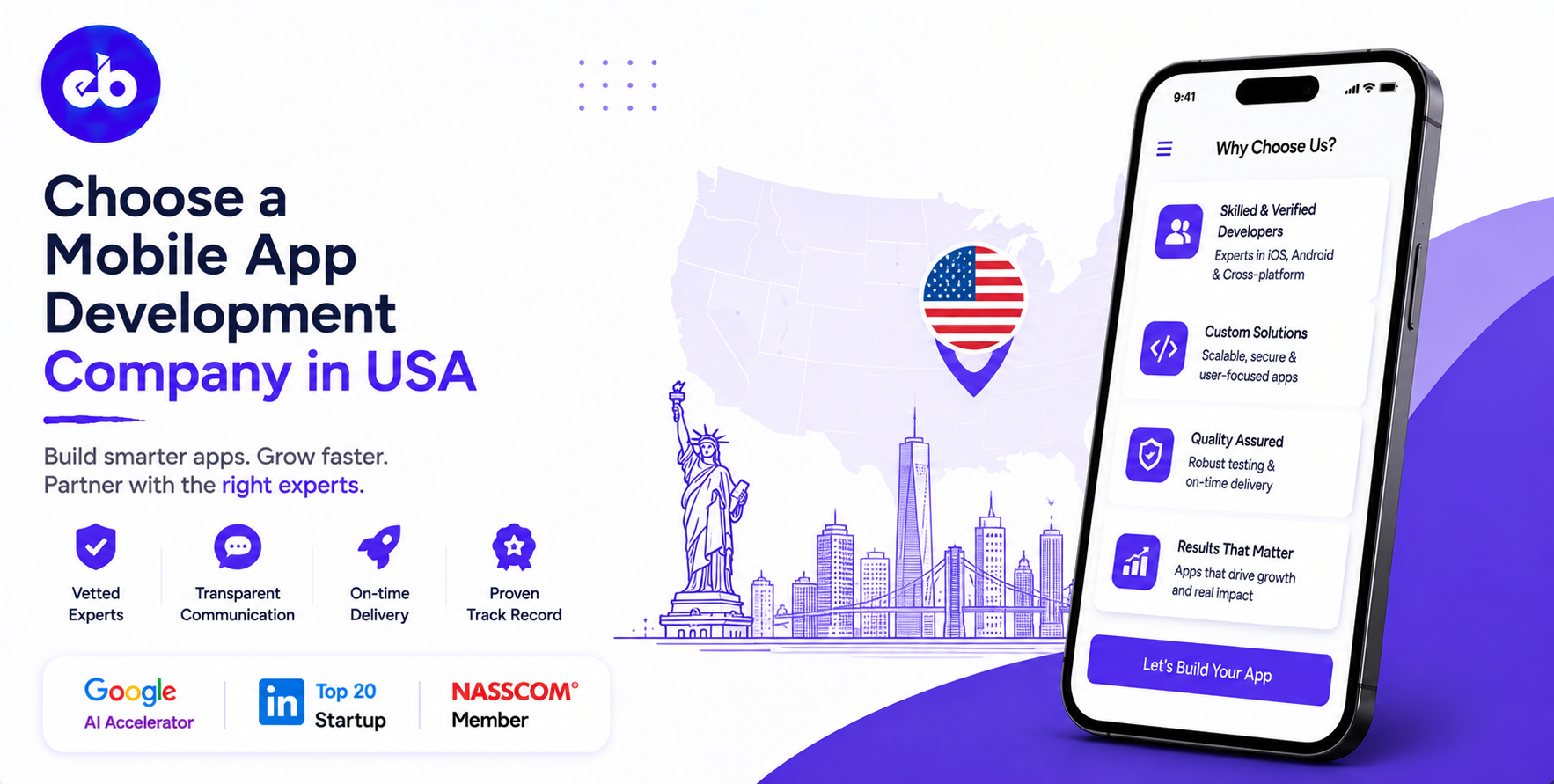
Two founders can hand the exact same spec to two different teams and end up with two completely different companies a year later. One ships an app that holds up under real traffic.
The other is still patching bugs from launch week while users quietly delete the app. The gap rarely comes down to budget. It comes down to who they picked.
That is the entire problem with trying to choose a mobile app development company in the USA right now. There are thousands of agencies, most of them claiming the same things: senior developers, agile process, on-time delivery.
Almost none of that tells you anything useful. This guide skips the generic checklist and gets into what actually separates a firm that ships from one that stalls.
Cost used to be the deciding factor in almost every vendor conversation. That has changed. According to Deloitte’s 2024 Global Outsourcing Survey, only 34% of businesses now name cost savings as their top reason for outsourcing work, down sharply from 70% in 2020. Companies are optimizing for outcomes, not the cheapest quote on the table (Deloitte).
That shift matters here. A cheap app that needs a rebuild in eighteen months costs more than a properly architected one did from the start.
Most sales calls sound impressive and reveal almost nothing. Ask questions that force specifics instead.
Agencies sell the work of their senior team, then staff the project with whoever is free that month. Ask directly who will be on your build, what their experience level is, and whether they stay through the full project or hand off midway.
A shipped app is not a finished app. Ask how the company handles bug fixes, OS updates, and scaling once real users show up. If the answer is vague, that is your answer.
A team that has built fintech apps understands compliance, encryption, and transaction flows in ways a general consumer app shop simply does not. Portfolio relevance beats portfolio size every time.
Beyond the obvious checks, a handful of factors quietly predict whether a build goes smoothly.
Plenty of firms can wire up screens and a database. Fewer can handle real complexity. If your app needs personalization, fraud detection, or predictive features, check whether the team has genuinely shipped AI Development work, not a chatbot bolted onto an existing app for the sales deck. Ask if they can build custom ML Development models trained on your own data rather than reselling an off-the-shelf API.
A single lump-sum number with no breakdown is a warning sign. A serious partner explains what each phase costs, from discovery through QA, and flags what could change the estimate. Vague pricing today usually means change orders later.
Ask how they run sprints, how often you get builds to test, and how they document decisions. Firms with a mature, repeatable process, the kind backed by frameworks like CMMI, tend to produce fewer surprises than teams that improvise project to project.
Some warning signs are consistent enough across bad engagements that they are worth naming directly:
Any one of these alone might be explainable. Two or more together usually means you are looking at the wrong firm.
Before contacting anyone, define what success looks like in business terms. Are you validating demand, replacing a manual process, or scaling something that already works? A vague brief invites vague proposals and inflated timelines.
Spend a few days on this before you take a single sales call, since agencies price and staff projects very differently depending on whether you are building a quick MVP or a compliance-heavy platform meant to run for years.
Search for firms that have built something close to your category, then check their case studies for specifics like user numbers, tech stack, or measurable outcomes.
A large agency with no fintech development experience is a worse fit for a lending app than a smaller shop that has shipped three of them. Narrow your list to four or five names before you start scheduling calls, so you can compare responses on equal footing.
Ask to meet the actual developers and project manager who would work on your app, not just the salesperson who closes the deal. Request a sample of documentation from a past sprint, and ask direct questions about how they handle scope changes, testing, and code reviews.
If integrations with banks, maps, or payment providers are involved, confirm the team has hands-on API Development experience with those specific systems, since generic API knowledge does not always translate cleanly.
Call at least two past clients directly and ask what went wrong, not just what went right. Every project hits friction somewhere, and how a firm handled it tells you more than a five-star Clutch review does.
Cross-check reviews across two or three platforms, since a single glowing source can be curated. If a firm cannot produce a reference willing to talk, treat that as a real gap, not an oversight.
Line up final quotes side by side against scope, timeline, and post-launch support, not just the total price.
If you are still validating your idea, ask whether the firm offers focused MVP Development to get a working version in front of users faster and cheaper than a full build. The lowest bid rarely stays the lowest once change requests start.
Generalist firms can build a decent app. Specialist firms build apps that survive contact with your industry’s actual constraints.
If you are building in financial services, the team needs to understand KYC, PCI compliance, and transaction security from day one, which is exactly why working with a fintech app development company with prior lending or payments experience saves months of rework.
Education products carry their own set of demands around content delivery, accessibility, and engagement design, and our breakdown of EdTech app development companies in the USA covers firms that specialize specifically in that space.
Healthcare, logistics, and marketplace apps each carry similar domain-specific traps. The right question is never “can this firm build an app.” It is “has this firm built this kind of app before, and what broke when they did.”
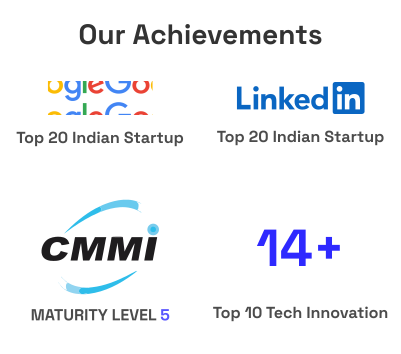
EngineerBabu operates on a CMMI Level 5 delivery process, has worked with four unicorn clients, and has supported over 200 VC-funded products across fintech, healthtech, and AI.
The team was selected into the Google AI Accelerator, so AI features come from engineers who understand the underlying models, not a plugin stitched on before a demo.
The Mobile App Development services cover native iOS and Android builds, UI/UX, backend architecture, and post-launch support, with senior engineers staying on the project instead of handing off after kickoff.
If your hardest problem is scaling past your first few thousand users without a rebuild, that process-first approach is worth a conversation.
There is no universal best answer to who should build your app. The right choice depends on your industry, your budget, and how much your app needs to scale in year two.
What stays constant is the process: define the outcome first, vet the actual team, check real references, and compare value instead of chasing the lowest number.
Founders who go through this process deliberately, checking real references and comparing value over price, spend far less time firefighting after launch than those who pick based on the flashiest portfolio site.
Start with your business outcome, not a feature list. Shortlist firms with real experience in your industry, vet the actual engineers on a call, check references directly, and compare proposals on scope and support, not just price.
Rates vary widely by complexity and location. Simple apps can run $15,000 to $40,000, while apps with custom backends, integrations, or AI features often run well past $100,000. Always request a phase-by-phase breakdown.
Both can work well. US agencies offer easier time-zone overlap and in-person meetings, while offshore and hybrid teams often deliver comparable quality at a lower cost. What matters more than location is process maturity and communication discipline.
Most mid-complexity apps take 12 to 20 weeks for core development, plus additional time for discovery, design, and QA. Simple MVPs can move faster, while apps with heavy compliance needs take longer.
Picking based on the lowest quote without checking whether that price includes QA, post-launch support, or realistic timelines. Cheap estimates that balloon mid-project end up costing more than a transparent quote would have upfront.