How to Build an App Like Redcliffe Labs: Full 2026 Guide (India)


Create engaging, high-performance mobile applications tailored to your business needs. We craft future-ready apps that offer smooth user experiences on all devices.
Build robust and scalable websites and CMS platforms that help you manage content effortlessly. Our development ensures a seamless digital presence.
Launch secure, feature-rich online stores with intuitive shopping experiences. We build tailored eCommerce platforms designed for growth.
Design captivating games with immersive gameplay and stunning graphics. From concept to launch, we build engaging experiences that players love.
Enhance your customer relationships with customized Salesforce implementations. Drive growth and efficiency with smarter CRM solutions.
Harness artificial intelligence and machine learning to automate workflows and gain actionable insights. Our AI transforms data into smart decisions.
Accelerate your software delivery lifecycle with continuous integration, delivery, and infrastructure automation to boost efficiency.
Hire app developers ready to turn your ideas into sleek, high-performing mobile apps for any platform.
Bring in frontend pros who craft smooth, beautiful, and user-friendly interfaces that your visitors will love.
Get backend developers who build fast, secure, and reliable systems to keep everything running behind the scenes.
Hire eCommerce developers who build secure, scalable online stores designed to offer seamless shopping and grow your sales.
Get dedicated developers committed to your projects, delivering consistent quality and speed as an extension of your team.
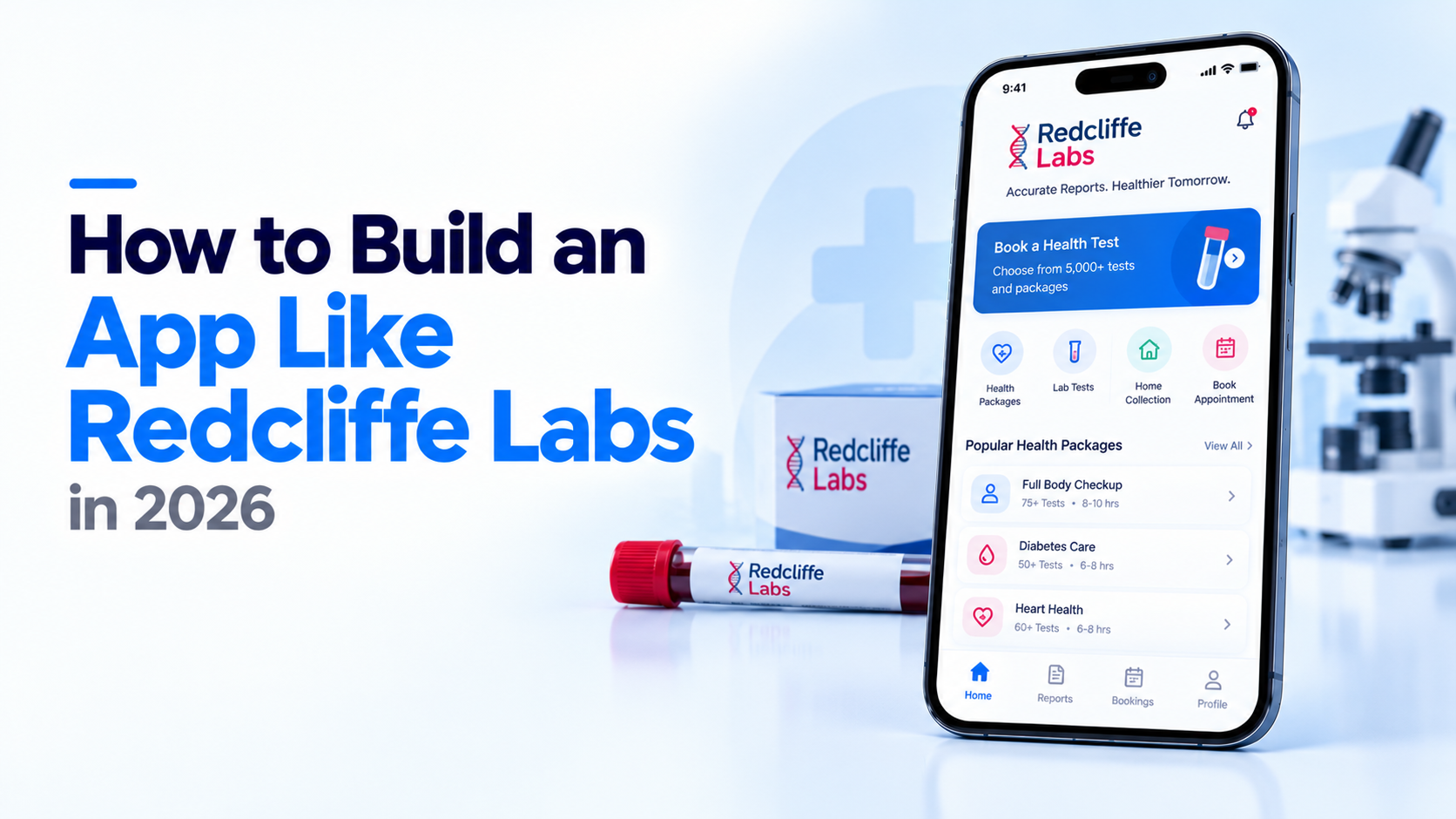
A patient books a thyroid panel at 9:40 PM from her sofa in Lucknow. A phlebotomist rings her doorbell at 6:15 the next morning. Her report lands on her phone before lunch.
That sequence looks like an app. It is actually a logistics company wearing an app as a face.
Most founders who want to build an app like Redcliffe Labs start by sketching the booking screen. Then they discover that the booking screen was never the hard part. The hard part is what happens in the eleven hours between the tap and the report.
To build an app like Redcliffe Labs, you need a patient booking app, a phlebotomist app with route and barcode handling, a LIMS or lab integration layer, and a payments and reporting stack. Redcliffe runs on pan-India home sample collection backed by NABL-accredited labs, so your platform has to treat sample logistics as the core product rather than an afterthought.
India’s diagnostic services market is worth about USD 11.8 billion in 2026 and is growing at an 11.10% CAGR toward USD 22.2 billion by 2031, with mobile and home collection as the fastest-growing delivery segment (Ken Research). That growth is exactly why the category is crowded and why a thin booking app will not survive contact with real demand.
Founders who treat this as a single build run out of runway in month five. Split it mentally from day one.
This is the only piece users ever see. It handles test discovery, package comparison, slot selection, address and family member management, fasting instructions, payments, and report access. Trust signals matter more than animation here. Price, accreditation, turnaround time, and phlebotomist identity all need to be visible before the user commits.
This is the operational spine. It carries the day’s route, patient details, barcode scanning, vial-type confirmation, sample rejection reasons, collection timestamps, and cash or UPI collection. It must work on cheap Android devices with patchy connectivity, which means offline-first sync is a requirement rather than a nice touch.
Here your team manages slot capacity per pincode, phlebotomist allocation, sample batching, TAT monitoring, re-collection requests, refunds, and report release. Most of the economics of the business live on this screen. A clean lab information system sits directly underneath it and decides how fast results move.
Skip the feature wishlist. These are the ones that separate a working diagnostics platform from a pretty catalog.
Decide whether you own labs, franchise collection centers, or route samples to partner labs. This single choice changes your entire data model. An owned-lab model needs deep LIMS control and instrument interfacing. A partner-lab model needs a normalization layer, because every partner returns results in a different format with different reference ranges.
Also fix your initial geography. Three dense pincodes beat a whole state when you are still learning your collection failure rate. Write down your target TAT per test category now, since every later engineering decision gets measured against it.
Build the field app before the consumer app. It sounds backwards and it is not. Your phlebotomist opens this screen thirty times a day under time pressure, often in a stairwell with one bar of signal. Map the full journey: route start, patient call, ID verification, vial selection, barcode scan, collection confirmation, payment, and handover at the hub.
Add offline queuing for every action. Then design the patient app around the promises this app can actually keep. Doing it in reverse produces a booking flow your operations team quietly cannot deliver.
Model tests as parameters, not as products. A lipid profile is nine parameters, and a package may contain it twice. Parameter-level modeling kills duplicate billing and lets you build packages without manual spreadsheets. Layer city-wise pricing on top, since diagnostics pricing varies sharply across markets.
The slot engine then joins pincode serviceability, phlebotomist shift data, and vial inventory to produce honest availability. Cache it aggressively. If slot calculation takes three seconds, users abandon before they ever reach checkout.
This is where projects slip. Results have to flow from analyzers to the LIMS, through pathologist verification, into a signed report, and onto the patient’s phone. Build an abstraction layer so partner labs with different formats all resolve into one internal result schema.
Keep critical value alerts on a separate priority path with immediate notification.
Our breakdown of how LIMS apps transform modern laboratory operations is worth reading before you scope this phase, because the integration surface is wider than it looks.
Indian diagnostics runs on UPI, cash on collection, corporate accounts, and insurance reimbursements at once. Support partial refunds for rejected samples, because hemolysis and insufficient volume happen daily.
Then handle ABDM: ABHA-linked health records, consent management, and standardized report formats. Treat consent as a first-class entity with its own audit log, not a checkbox. The same discipline applies to any healthcare API integration you add later for hospitals, clinics, or insurers.
Launch in your three pincodes with full telemetry. Track slot fill rate, phlebotomist on-time percentage, sample rejection rate, TAT breach rate, and repeat booking rate within ninety days. Those five numbers tell you whether the business works.
Fix operations before you expand geography, because scaling a broken collection process just multiplies the complaints. Only once your rejection rate is stable should you open the next city, add franchise partners, or start layering AI into lab diagnostics for report interpretation.
| Layer | Practical choice |
| Patient app | React Native or Flutter for one codebase across iOS and Android |
| Phlebotomist app | Native Android, offline-first with local sync queue |
| Backend | Node.js or Django with service separation for catalog, slots, and results |
| Database | PostgreSQL for transactions, Redis for slot caching |
| Routing | Google Maps Platform or MapmyIndia for Indian address accuracy |
| Payments | Razorpay or Cashfree with UPI autopay for subscriptions |
| Reports | Signed PDFs with S3 storage and time-bound access links |
NABL accreditation governs your lab, not your app, but your app must surface accreditation details and pathologist sign-off correctly on every report.
The DPDP Act makes health data sensitive personal data. You need explicit consent, purpose limitation, and deletion workflows that actually execute.
ABDM integration is optional today and quickly becoming a commercial expectation, especially for hospital and insurer tie-ups.
If you plan to add doctor consultations on top of test results, e-prescriptions bring their own telemedicine guidelines into scope.
An MVP covering one city, one lab partner, patient and phlebotomist apps, and a basic ops console typically lands between USD 45,000 and USD 80,000 over four to six months.
A multi-city platform with owned LIMS integration, franchise management, ABDM, and insurance workflows runs USD 110,000 to USD 220,000 and takes eight to twelve months.
Costs shift based on how many partner labs you normalize and how much of the ops console you automate.
If you want to build an app like Redcliffe Labs without rediscovering every operational trap yourself, the shortcut is a team that has already shipped lab, hospital, and patient-facing systems.
EngineerBabu works as a healthcare software development company in India across LIMS, EHR, telehealth, and diagnostics platforms. Teams typically start with a scoped MVP build in one city, prove the collection economics, then scale the architecture outward.
EngineerBabu is a technology development company building products across fintech, healthtech, and AI, from MVPs to scaled, production-ready platforms.
It holds a CMMI Level 5 rating, has worked with 4 unicorn clients, and has supported 200+ VC-funded products. The company is backed by Vijay Shekhar Sharma.
Founded by Mayank Pratap (Co-founder) · mayank@engineerbabu.com
A single-city MVP with patient app, phlebotomist app, and ops console takes four to six months. Full multi-city platforms with LIMS and ABDM integration take eight to twelve months.
No. Many platforms start by routing samples to partner labs. You will need a normalization layer, because each partner returns results in a different structure with different reference ranges.
Slot capacity tied to real phlebotomist availability per pincode. Getting this wrong creates confirmed bookings nobody can service, which damages trust immediately.
It is not legally mandatory for private platforms today. It is increasingly expected by hospital and insurer partners, so building ABHA and consent handling early saves rework.
Expect USD 45,000 to USD 80,000 for a focused MVP. A multi-city platform with owned LIMS, franchise tools, and insurance workflows ranges from USD 110,000 to USD 220,000.