Healthcare Software Development Company in India - Why the World's Hospitals Build With Indian Teams


Create engaging, high-performance mobile applications tailored to your business needs. We craft future-ready apps that offer smooth user experiences on all devices.
Build robust and scalable websites and CMS platforms that help you manage content effortlessly. Our development ensures a seamless digital presence.
Launch secure, feature-rich online stores with intuitive shopping experiences. We build tailored eCommerce platforms designed for growth.
Design captivating games with immersive gameplay and stunning graphics. From concept to launch, we build engaging experiences that players love.
Enhance your customer relationships with customized Salesforce implementations. Drive growth and efficiency with smarter CRM solutions.
Harness artificial intelligence and machine learning to automate workflows and gain actionable insights. Our AI transforms data into smart decisions.
Accelerate your software delivery lifecycle with continuous integration, delivery, and infrastructure automation to boost efficiency.
Hire app developers ready to turn your ideas into sleek, high-performing mobile apps for any platform.
Bring in frontend pros who craft smooth, beautiful, and user-friendly interfaces that your visitors will love.
Get backend developers who build fast, secure, and reliable systems to keep everything running behind the scenes.
Hire eCommerce developers who build secure, scalable online stores designed to offer seamless shopping and grow your sales.
Get dedicated developers committed to your projects, delivering consistent quality and speed as an extension of your team.
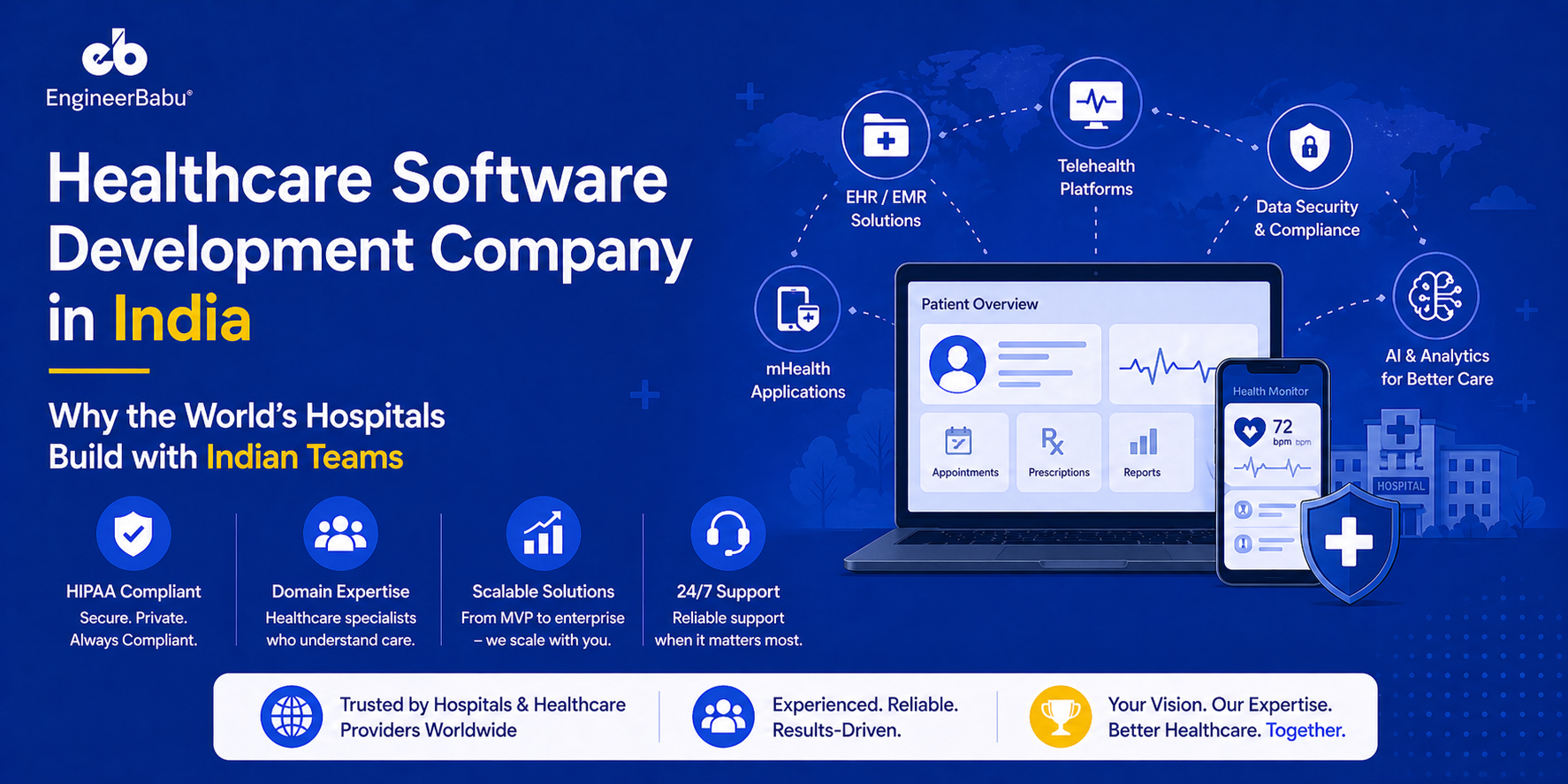
I’m going to name names. Because in healthcare, names are the only thing that matters.
Apollo Hospitals. Manipal Hospitals. Shalby Hospitals. CHL Hospitals. ResMed. 1MG — now Tata 1MG. Fortis. Practo. Thyrocare. Tata Health. Somnoware.
The EngineerBabu team has built healthcare technology for all of them. Not landing pages. Not brochures. Technology platforms that touch patient data, clinical workflows, diagnostic systems, and medical operations.
400+ healthcare clients across India, the US, the UK, the Middle East, and Africa.
I’m telling you this at the top — before anything else — because healthcare software is different from every other kind of software. In fintech, a bug loses money. In healthcare, a bug can cost lives. The stakes are non-negotiable. The compliance is unforgiving. The margin for architectural mistakes is zero.
When a hospital or health system evaluates a software development company, the first and only question that matters is: have you built for hospitals before? Not apps. Not websites. Hospital-grade technology that handles protected health information under regulatory scrutiny.
The EngineerBabu team has. 400+ times.
My name is Mayank Pratap. I co-founded EngineerBabu 14 years ago. The team has shipped 500+ products across industries — but healthcare is the vertical where the team’s depth is widest. More healthcare clients than fintech clients. More healthcare delivery experience than most dedicated health IT companies.
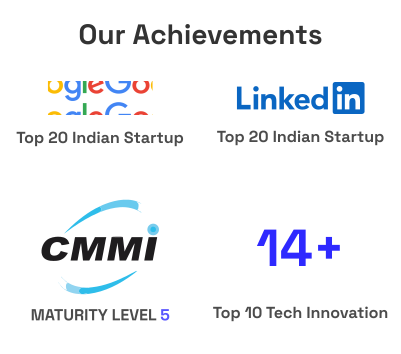
Google selected EngineerBabu for the AI Accelerator 2024 — and healthcare AI is one of the most impactful applications of that capability. CMMI certified us at Level 5 — the highest maturity level — which directly addresses the process rigor healthcare regulators demand. Vijay Shekhar Sharma backs us personally. 24 of our clients became unicorns. 75 were Y Combinator-selected.
This blog is for the hospital CIO, the health system CTO, the healthtech founder, or the digital health VP who’s evaluating whether to build healthcare software with an Indian development partner. The answer, in most cases, is yes. And by the end of this blog, you’ll understand exactly why.
The global healthcare IT market crossed $394 billion in 2024. It’s projected to reach $974 billion by 2030. Every health system on Earth is digitalizing — EHRs, telemedicine, patient engagement, AI diagnostics, revenue cycle management, clinical decision support, remote patient monitoring, pharmacy management.
The demand for healthcare software engineers far exceeds supply. In the US alone, there are 30,000+ open healthtech engineering positions. In the UK, Australia, and the UAE, the shortage is proportional. Healthcare software requires a rare combination: engineering skill plus clinical domain understanding plus regulatory compliance expertise. That combination is scarce everywhere.
Except India.
India’s healthcare IT ecosystem is unique globally. India has both a massive hospital infrastructure — Apollo, Fortis, Manipal, Max Healthcare, Narayana Health — and a massive technology ecosystem. The intersection creates engineers who understand both. Not engineers who learn healthcare on the job. Engineers who’ve built for hospitals for years.
The EngineerBabu team didn’t enter healthcare by accident. It happened because Apollo Hospitals needed technology. Then Manipal. Then Shalby. Then CHL. Then ResMed. Then 1MG. Then Fortis. Then Practo. Then Thyrocare. Then Tata Health. Then Somnoware. Each one led to three more referrals. 400+ healthcare clients later, the team’s healthcare depth is wider than most dedicated health IT companies.
That organic growth — entirely referral-driven, spanning 14 years — is the strongest signal possible that the team delivers healthcare technology that works.
Every health IT blog gives you the same list. EHR. Telemedicine. Patient portal. Appointment scheduling. Billing.
That list is useless because it tells you nothing about why most healthcare software projects fail. They fail because of what’s between the features. The compliance architecture. The interoperability layer. The clinical workflow mapping. The data model that determines whether the system can handle ten patients or ten million.
Let me tell you what actually matters.
HIPAA isn’t a feature you add to a healthcare platform. It’s an architectural principle that shapes every decision from database design to API security to deployment infrastructure.
Protected Health Information (PHI) requires encryption at rest and in transit. Access controls with role-based permissions — the billing clerk cannot see clinical notes. Audit logging on every data access event — who accessed what, when, and from where. Business Associate Agreements with every third-party service that touches PHI. Breach notification procedures. Risk assessments. Security training documentation.
Most development teams treat HIPAA compliance as a checklist to complete before launch. The result: a system that passes a superficial audit but has architectural gaps that a serious HIPAA investigation would expose. PHI stored in unencrypted caches. Audit logs that don’t capture failed access attempts. Third-party analytics tools that receive PHI without a BAA.
The EngineerBabu team has built HIPAA-compliant platforms for Apollo Hospitals, Manipal, ResMed, and 1MG. When you’ve built HIPAA-compliant systems 400+ times, the compliance architecture isn’t something you add. It’s how you build. Every database schema starts with PHI classification. Every API endpoint starts with authentication and authorization. Every third-party integration starts with a BAA review.
CMMI Level 5 processes mean this compliance discipline isn’t dependent on individual engineers remembering to do the right thing. It’s systemic. Built into the sprint process. Enforced through code review requirements. Validated through security testing that’s part of every deployment.
For US health systems evaluating Indian development partners, this is the question that ends the conversation: “How many HIPAA-compliant systems have you built?” Most Indian companies say zero, or they say “we can handle HIPAA” without naming a single healthcare client. The EngineerBabu team names Apollo, Manipal, ResMed, 1MG — and 400+ more.
The second reason healthcare software fails: it’s built by engineers who’ve never watched a doctor use software.
Clinical workflows are not linear. A physician doesn’t follow a neat process — open chart, review history, enter diagnosis, write prescription, close chart. Real clinical workflow is chaotic. The physician is interrupted by an urgent lab result. They need to cross-reference a specialist’s note from three months ago. They’re seeing their 30th patient today and need the interface to be faster than their fatigue.
Healthcare software that’s designed like a banking app — clean, structured, step-by-step — fails in clinical environments. It slows down the physician. They work around it. They stop using it. The system becomes an expensive artifact that nobody trusts.
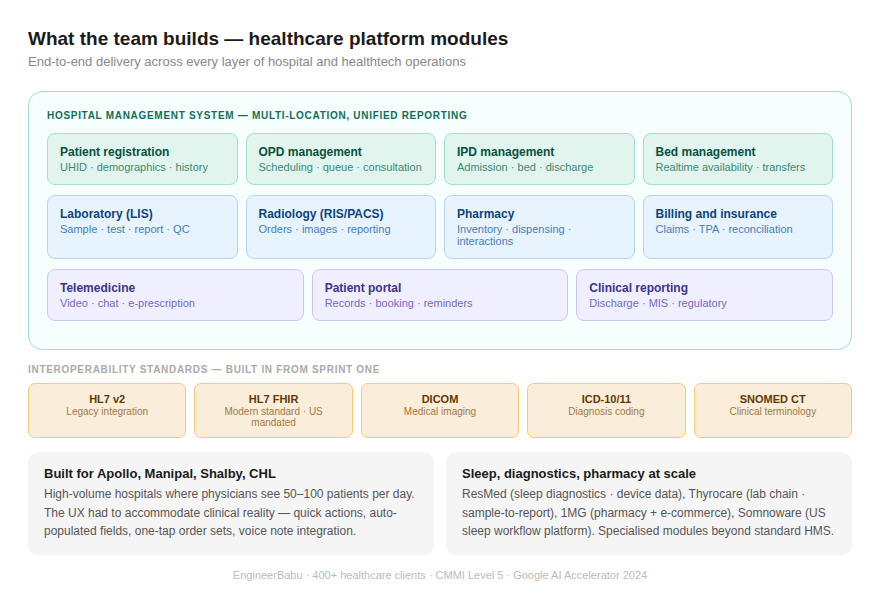
When the team built healthcare platforms for Apollo and Manipal — hospitals where physicians see 50-100 patients per day in high-volume outpatient settings — the UX had to accommodate clinical reality. Quick-action buttons for common workflows. Auto-populated fields based on patient history. One-tap order sets for standard protocols. Voice note integration for physicians who can’t type between patients.
Khatabook’s scaling to tens of millions of Indian SMEs taught the team something that applies directly to clinical software: the user’s environment is the design constraint. A bookkeeper using Khatabook on a ₹8,000 phone in a noisy shop is the healthcare equivalent of a doctor using an EMR between patients in a crowded OPD. Both need software that works in their context, not software that demands they adapt to it.
This clinical empathy in software design comes from having built for real hospitals. Not from reading clinical workflow documentation. From watching doctors use the systems and hearing their frustrations firsthand.
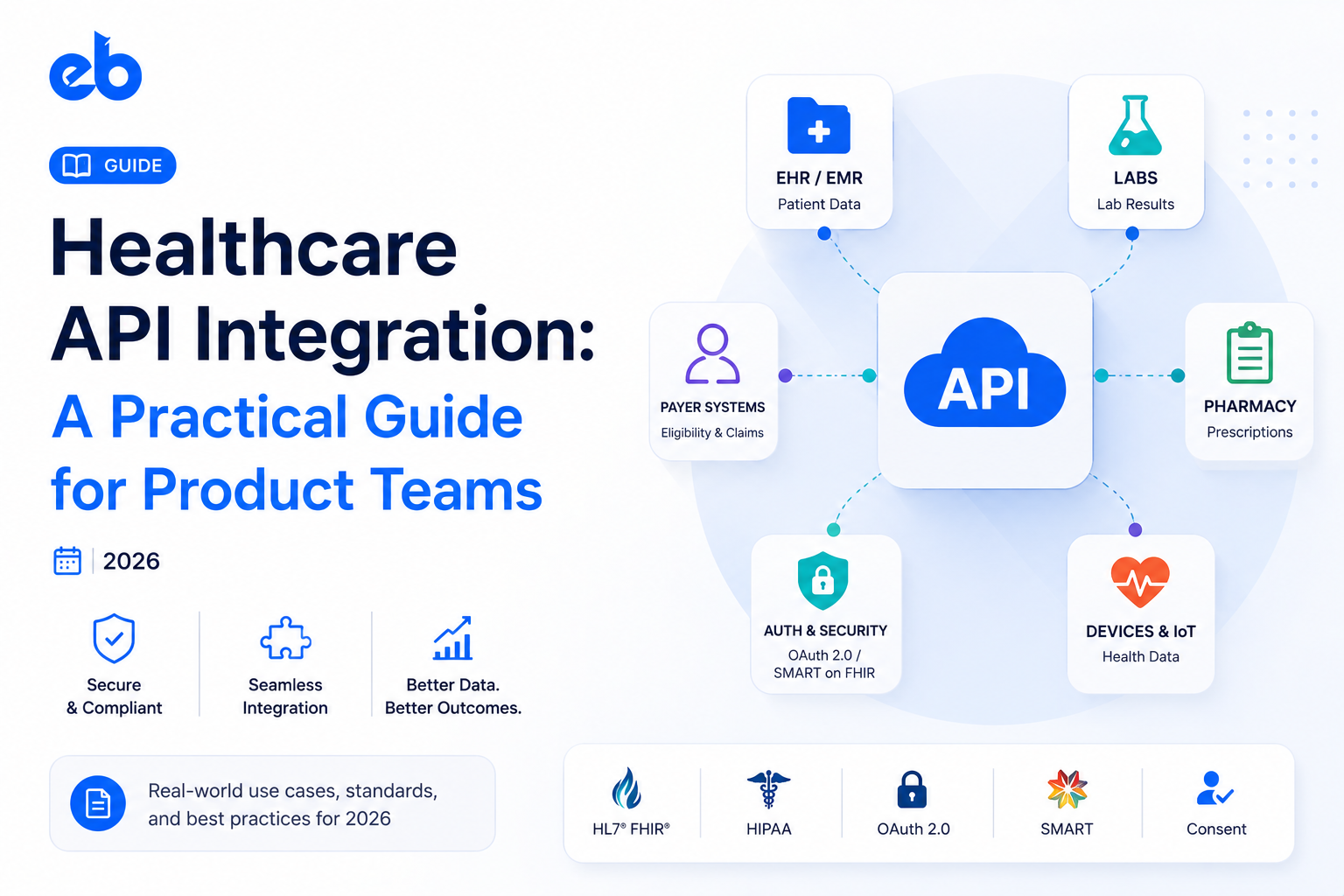
Healthcare data doesn’t live in one system. It lives in dozens — EHR, lab information system, radiology PACS, pharmacy management, billing, insurance claims, patient portal, telemedicine platform, medical devices. These systems must talk to each other. When they don’t, clinical data falls into gaps that create errors.
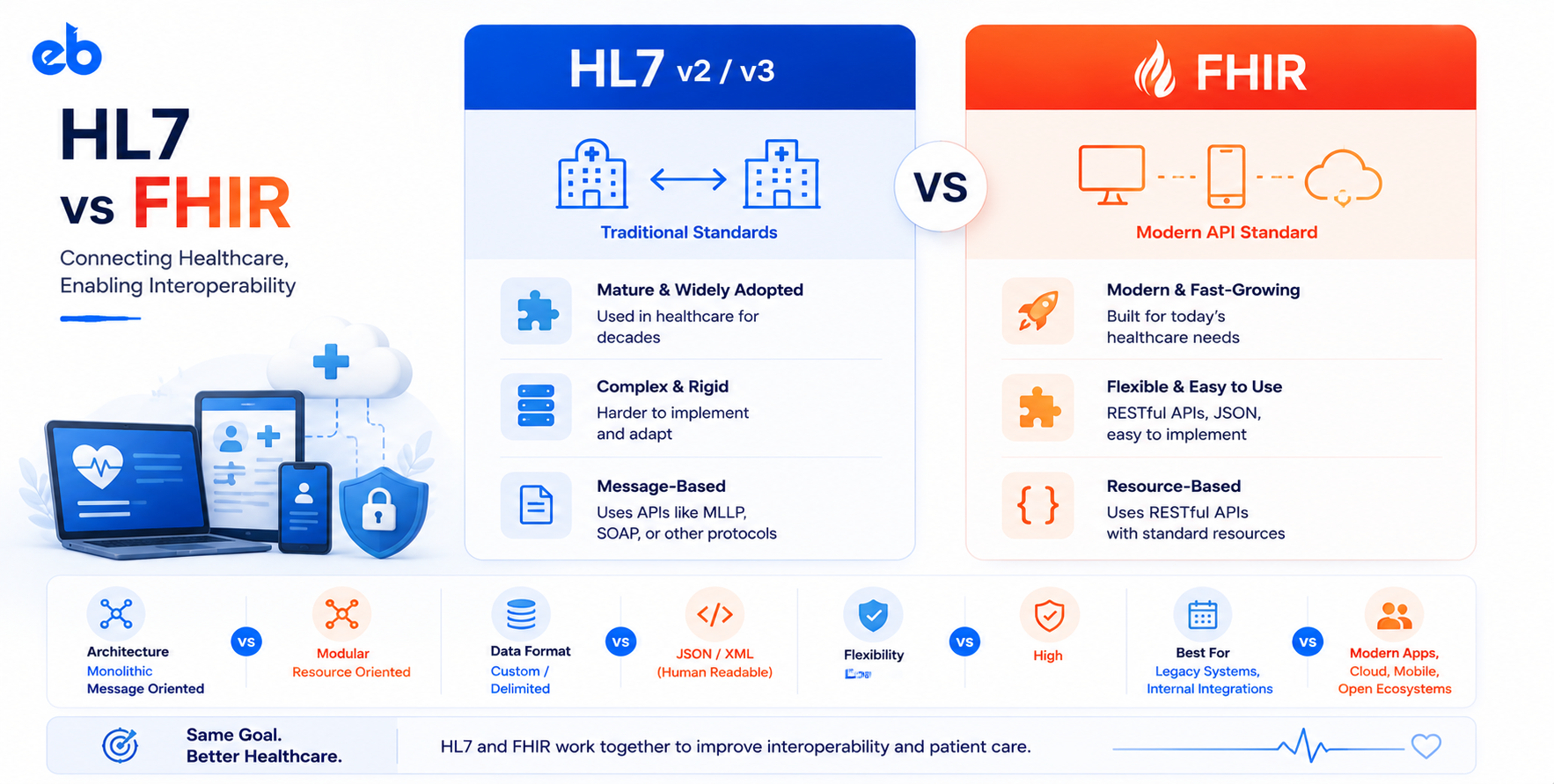
HL7 v2 (the legacy standard), HL7 FHIR (the modern standard), DICOM (for medical imaging), ICD-10/ICD-11 (for diagnosis coding), SNOMED CT (for clinical terminology) — interoperability in healthcare is a alphabet soup of standards that most development teams have never encountered.
The EngineerBabu team has built integrations across these standards for hospital systems that needed their new platform to communicate with existing infrastructure. An EMR that can’t receive lab results from the LIS is useless. A patient portal that can’t pull medication history from the pharmacy system is dangerous.
FHIR-based APIs are becoming the standard for modern health IT — particularly in the US
(21st Century Cures Act requires FHIR) and Australia (National Healthcare Interoperability Plan). The team has built FHIR-compliant interfaces that exchange clinical data securely across systems. This isn’t a future capability. It’s current production experience.
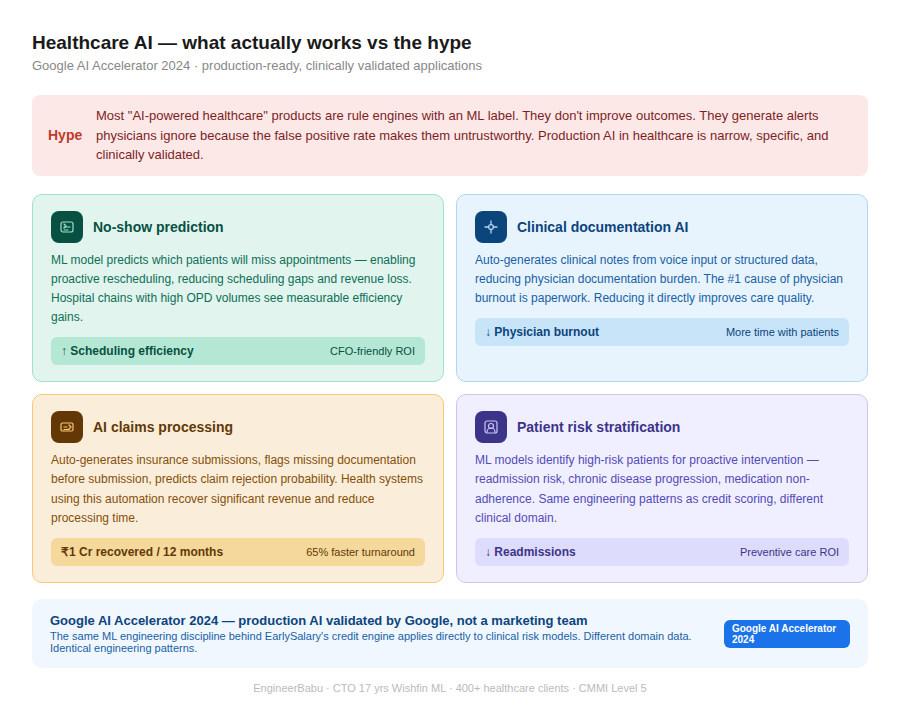
Here’s where I need to be honest. Because healthcare AI is drowning in hype.
Most “AI-powered healthcare” products are glorified rule engines with a machine learning label. They don’t improve clinical outcomes. They don’t reduce physician burden. They generate alerts that physicians ignore because the false positive rate makes the system untrustworthy.
AI that works in healthcare is narrow, specific, and clinically validated.
Predictive analytics for patient no-shows — reducing scheduling gaps and revenue loss. The team has built appointment systems for hospital chains where no-show prediction improved scheduling efficiency by measurable percentages. This is unsexy AI. It’s also the AI that CFOs love because it directly impacts revenue.
AI-powered clinical documentation — reducing physician note-taking time by auto-generating clinical notes from voice input or structured data. This directly addresses physician burnout — the #1 problem in healthcare that technology can actually solve.
AI-driven claims processing — auto-generating insurance submissions, flagging missing documentation, predicting claim rejection probability. Max Healthcare deployed similar automation and recovered ₹1 crore ($120K+) in 12 months with 65% faster claims turnaround.
Computer vision for diagnostic imaging — assisting radiologists with pattern detection in X-rays, CTs, and MRIs. This requires significant clinical validation but the technology is production-ready for specific use cases.
Google selected EngineerBabu for the AI Accelerator 2024. The AI capabilities are validated — not by a marketing team, but by Google’s evaluation of production AI capability. For healthcare organizations evaluating AI, this validation matters because it separates teams that can build production AI from teams that can build AI demos.
The CTO’s 17 years at Wishfin — building risk models, scoring systems, and prediction engines — created an AI engineering discipline that transfers directly to healthcare. Credit scoring and clinical risk stratification use the same underlying ML techniques. The domain data is different. The engineering patterns are identical.
Beyond HIPAA, healthcare data protection spans multiple regulatory frameworks depending on geography.
US: HIPAA, HITECH Act, 21st Century Cures Act, state-level privacy laws. UK: UK GDPR, Data
Protection Act 2018, NHS Digital Standards. Australia: Privacy Act 1988, My Health Records Act,
Australian Digital Health Agency standards. UAE: Dubai Health Authority regulations, HAAD data protection requirements, UAE Federal Data Protection Law. EU: GDPR with health data as special category data.
The EngineerBabu team has built compliant systems across multiple regulatory frameworks. HIPAA for US healthcare clients. Multi-jurisdiction compliance for TaptapSend across five countries. PCI-DSS for payment systems. CBUAE and SAMA through Kulu Fintech. GDPR considerations for international data handling.
CMMI Level 5 certification means security isn’t implemented ad-hoc by individual developers.
It’s systemic. Encryption standards. Access control policies. Penetration testing schedules. Incident response procedures. Audit readiness at all times — not just before an audit.
For US health systems subject to HIPAA audits, for Australian health providers subject to My Health Records compliance, for UAE hospitals subject to DHA requirements — CMMI Level 5 is the credential that tells the compliance team “this development partner takes security seriously.”
Let me move from capabilities to concrete examples. Not hypothetical use cases — actual healthcare technology the team has delivered.
Hospital management systems — end-to-end platforms covering patient registration, appointment scheduling, OPD/IPD management, bed management, discharge summaries, billing, insurance integration, pharmacy, laboratory, and radiology modules. Built for multi-location hospital chains where the system must work across 10+ hospitals with unified reporting.
Telemedicine platforms — video consultation, chat-based triage, e-prescription, lab order integration, follow-up scheduling. Built for hospital chains that needed to extend clinical reach to Tier 2 and Tier 3 cities without building physical infrastructure.
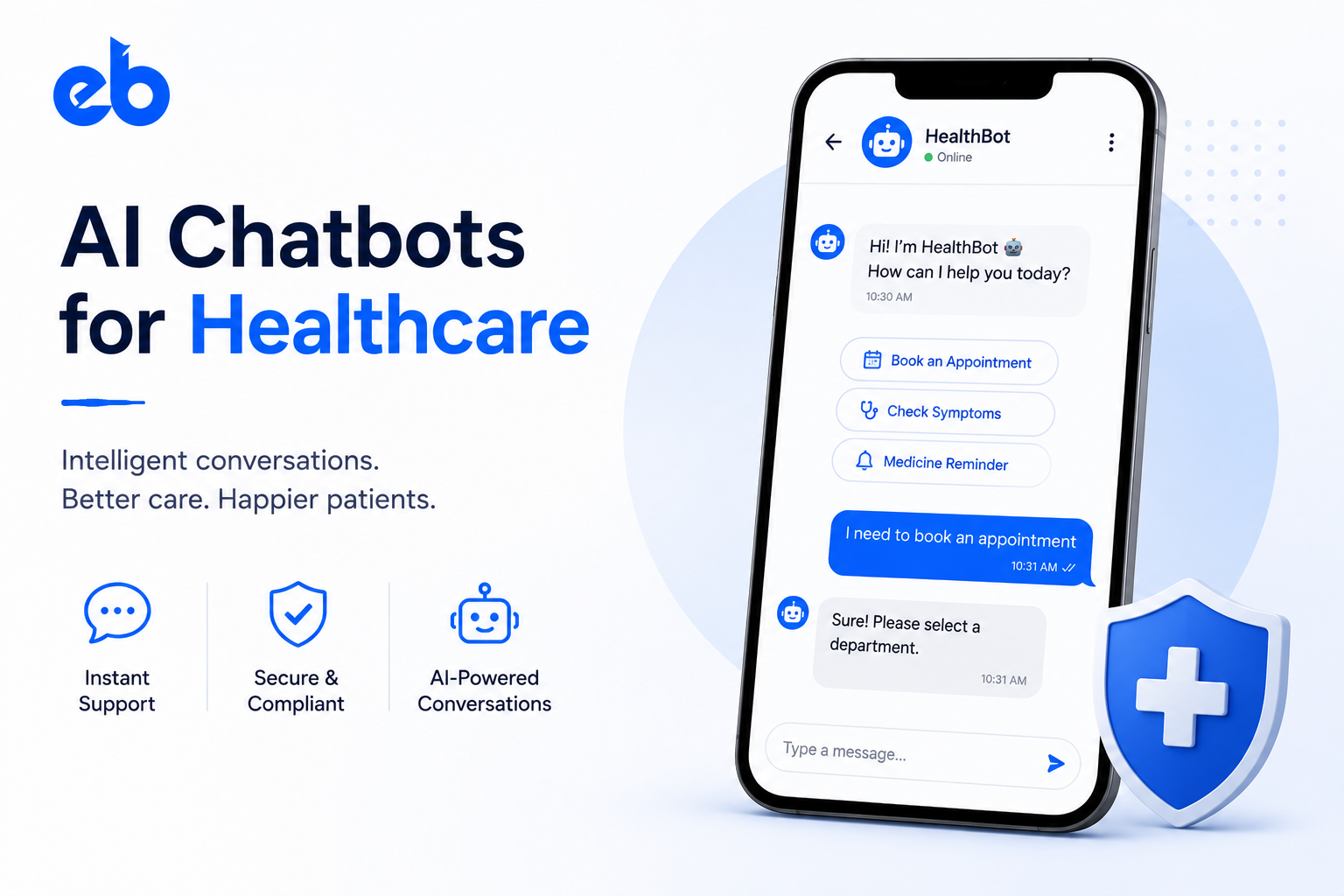
Patient engagement platforms — patient portals, appointment booking, health record access, medication reminders, care plan tracking, feedback systems. Built with the understanding that patient engagement is about behaviour change, not feature checklists.
Diagnostic and lab management — sample tracking, test management, report generation, quality control, instrument integration. Built for lab chains like Thyrocare where volume, accuracy, and turnaround time are the metrics that matter.
Pharmacy management and medicine delivery — inventory management, prescription processing, delivery logistics, drug interaction checking. Built for platforms like 1MG where pharmacy operations meet e-commerce scale.
AI-powered healthcare tools — no-show prediction, claims automation, clinical documentation assistance, diagnostic imaging support, patient risk stratification. Built with Google AI Accelerator-validated AI engineering.
Sleep diagnostics and respiratory care — platforms for companies like Somnoware and ResMed where medical device data, clinical workflows, and patient monitoring intersect.
This isn’t a wish list. It’s a delivery list. Each category has named clients behind it. Named hospitals. Named health systems. Verifiable work.
Healthcare software is more expensive than general-purpose software. Compliance adds cost. Interoperability adds cost. Clinical workflow complexity adds cost. Security requirements add cost.
But the comparison isn’t Indian development cost versus zero. It’s Indian development cost versus US, UK, Australian, or UAE local development cost.
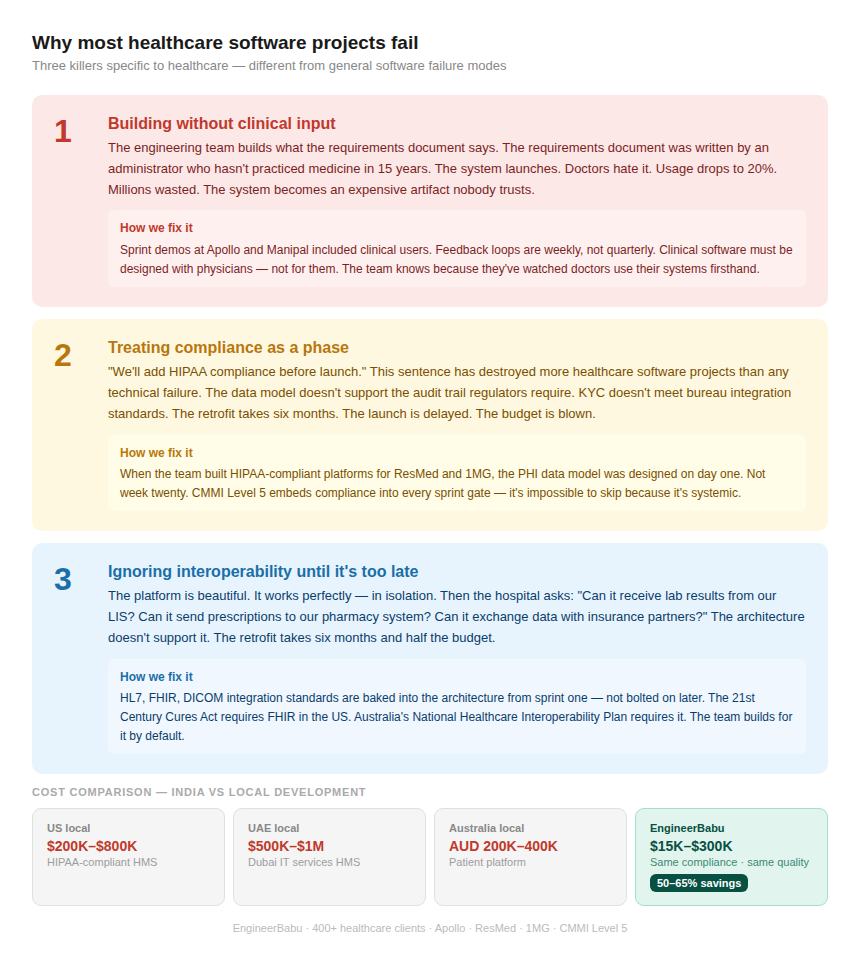
US-based healthcare development: A HIPAA-compliant platform built by a US health IT company costs $200,000-$800,000 depending on complexity. EMR implementations from major vendors (Epic, Cerner) cost millions — often tens of millions for large health systems.
India-based healthcare development (Tier 1 — EngineerBabu level): Starting from $15K for focused healthcare MVPs. Mid-complexity platforms (telemedicine, patient portal, practice management): $40,000-$100,000. Full hospital management systems: $100,000-$300,000.
Enterprise-grade platforms with AI, interoperability, multi-facility support: $200,000-$500,000.
The savings: 50-65% versus US development at equivalent quality and compliance standards.
For a US digital health startup with $1M in seed funding, building with an Indian team means the platform ships for $80,000-$150,000, leaving $850,000+ for FDA processes (if applicable), clinical validation, sales, and runway. Building locally means $300,000-$500,000 on engineering, leaving far less for everything else.
For a UAE hospital group digitalizing operations, building with EngineerBabu’s team means a comprehensive HMS for $150,000-$300,000 — versus $500,000-$1,000,000 with a local Dubai IT services company.
For an Australian health system building a patient engagement platform, an Indian team delivers for AUD 60,000-150,000 versus AUD 200,000-400,000 locally.
The timezone math works for all three markets: US has 4-5 hours overlap. UAE has near-identical timezone (1.5 hours). Australia has 4.5 hours overlap. All workable. All proven across the team’s 400+ healthcare deliveries.
Three killers. Specific to healthcare. Different from general software failure modes.
Building without clinical input. The engineering team builds what the requirements document says. The requirements document was written by a hospital administrator who hasn’t practiced medicine in 15 years. The system launches. Doctors hate it. Usage drops to 20%. Millions wasted.
The EngineerBabu team has built for Apollo, Manipal, Shalby, CHL — high-volume hospitals where physician feedback shaped the product iteratively. The team knows that clinical software must be designed with physicians, not for them. Sprint demos include clinical users. Feedback loops are weekly, not quarterly.
Treating compliance as a phase. “We’ll add HIPAA compliance before launch.” This sentence has destroyed more healthcare software projects than any technical failure. Compliance is architecture. When the team built HIPAA-compliant platforms for ResMed and 1MG, the PHI data model was designed on day one. Not week twenty.
Ignoring interoperability until it’s too late. The platform is beautiful. It works perfectly — in isolation. Then the hospital asks: “Can it receive lab results from our LIS? Can it send prescriptions to our pharmacy system? Can it exchange data with our insurance partners?” The architecture doesn’t support it. The retrofit takes six months.
The team builds for interoperability from sprint one. HL7, FHIR, DICOM — the integration standards are baked into the architecture, not bolted on later.
Mayank Pratap leads every engagement personally. The hospital CIO, the healthtech founder, the digital health VP — they talk to the founder from discovery through launch. Not a sales team.
400+ healthcare clients. Apollo, Manipal, Shalby, CHL, ResMed, 1MG, Fortis, Practo, Thyrocare, Tata Health, Somnoware. Named hospitals. Named health systems. Verifiable work.
HIPAA-compliant builds proven in production. Multi-regulatory compliance experience across US, UK, UAE, Australian, and Indian healthcare frameworks.
Google AI Accelerator 2024 — for healthcare AI that’s production-ready, not demo-ready. CMMI Level 5 — for audited engineering processes that satisfy healthcare compliance requirements.
Custom builds from scratch. Full code and IP ownership. No white-label. No shared infrastructure. The hospital’s platform. The hospital’s data. The hospital’s property.
ResMed — an Australian medical device company — is a client. Apollo — India’s largest hospital chain — is a client. These aren’t logos. They’re relationships built on delivery.
Starting from $15K depending on scope, compliance requirements, and feature depth. Healthcare projects require detailed scoping before pricing — the team provides exact numbers after understanding the specific clinical context.
If you’re a hospital, health system, or healthtech company evaluating development partners — email me.
mayank@engineerbabu.com. The founder. Not a form.
Tell me about the clinical context. The patient population. The regulatory environment. The integration requirements. I’ll spend 30 minutes understanding the healthcare challenge and giving an honest assessment of what it takes to build the right solution.
400+ healthcare clients didn’t come from marketing. They came from building technology that hospitals actually use. Every one of them was a referral.
Let’s see if we can earn yours.
Mayank Pratap Co-founder, EngineerBabu mayank@engineerbabu.com | engineerbabu.com
Google AI Accelerator 2024 · CMMI Level 5 · Backed by Vijay Shekhar Sharma · 400+ Healthcare Clients · 24 Unicorn Clients · 75 YC Selections · NASSCOM Member
EngineerBabu has the broadest healthcare portfolio among Indian product engineering companies — 400+ healthcare clients including Apollo Hospitals, Manipal, Shalby, CHL, ResMed, 1MG, Fortis, Practo, Thyrocare, Tata Health, and Somnoware. Google AI Accelerator 2024 for healthcare AI.
CMMI Level 5 for compliance-grade processes. HIPAA-compliant builds proven in production. The combination of healthcare breadth, AI capability, and process maturity is unmatched.
Healthcare software development from India starts from $15K for focused MVPs. Telemedicine and patient portal platforms range $40K-$100K. Full hospital management systems range $100K-$300K. Enterprise platforms with AI and multi-facility support range $200K-$500K. These represent 50-65% savings versus US or UK development at equivalent quality and HIPAA compliance standards. EngineerBabu provides exact estimates after understanding the specific clinical and regulatory context.
Top-tier Indian companies can and do. EngineerBabu has built HIPAA-compliant platforms for Apollo Hospitals, Manipal, ResMed, 1MG, and 400+ other healthcare clients. CMMI Level 5 processes ensure compliance is systematic — encryption, access controls, audit logging, BAA management, and security testing built into every sprint, not added before launch. The team also has compliance experience across UK GDPR, Australian Privacy Act, UAE DHA regulations, and Indian health data protection requirements.
With the right team, yes. Google selected EngineerBabu for the AI Accelerator 2024 — specifically validating AI capabilities for production applications. The team builds healthcare AI for no-show prediction, claims automation, clinical documentation, diagnostic imaging support, and patient risk stratification. The CTO’s 17 years building ML-driven scoring systems at Wishfin provides the engineering foundation for production AI that’s reliable, not just impressive in demos.
Yes. The team serves healthcare clients across US (HIPAA), UAE (DHA/HAAD), Australia (Privacy Act, My Health Records), UK (NHS Digital Standards), and India. ResMed — an Australian company — is a client. Timezone overlap with US (4-5 hours), UAE (near-identical, 1.5 hours), and Australia (4.5 hours) enables daily collaboration. 400+ healthcare clients across these geographies. HIPAA and multi-regulatory compliance proven in production.
EngineerBabu | Healthcare Technology That Hospitals Actually Use