How to Build an App Like Namma Yatri: The Open Network Playbook (2026)


Create engaging, high-performance mobile applications tailored to your business needs. We craft future-ready apps that offer smooth user experiences on all devices.
Build robust and scalable websites and CMS platforms that help you manage content effortlessly. Our development ensures a seamless digital presence.
Launch secure, feature-rich online stores with intuitive shopping experiences. We build tailored eCommerce platforms designed for growth.
Design captivating games with immersive gameplay and stunning graphics. From concept to launch, we build engaging experiences that players love.
Enhance your customer relationships with customized Salesforce implementations. Drive growth and efficiency with smarter CRM solutions.
Harness artificial intelligence and machine learning to automate workflows and gain actionable insights. Our AI transforms data into smart decisions.
Accelerate your software delivery lifecycle with continuous integration, delivery, and infrastructure automation to boost efficiency.
Hire app developers ready to turn your ideas into sleek, high-performing mobile apps for any platform.
Bring in frontend pros who craft smooth, beautiful, and user-friendly interfaces that your visitors will love.
Get backend developers who build fast, secure, and reliable systems to keep everything running behind the scenes.
Hire eCommerce developers who build secure, scalable online stores designed to offer seamless shopping and grow your sales.
Get dedicated developers committed to your projects, delivering consistent quality and speed as an extension of your team.
An auto driver in Bengaluru pays about Rs 25 for a full day of unlimited trips. No commission. No surge cut. The fare the rider pays is the money the driver takes home.
That is not a discount strategy. It is a structural decision, and it is why so many founders now want to build an app like Namma Yatri rather than another commission platform. ONDC’s own analysis projects that open-network mobility could save drivers around Rs 20,000 crore a year and add Rs 51,000 crore to Rs 67,000 crore in annual economic activity.
The engineering looks different too. Here are the questions worth answering before you start.
It is a ride-hailing app that does not own the marketplace it sells into.
In a normal platform, you control supply, demand, pricing, and matching inside one closed system. In an open network model, discovery and transaction happen through a shared protocol, so a rider on your app can potentially be served by a driver registered through a different app on the same network.
That inversion is the whole point. You compete on experience rather than on lock-in. Your product responsibilities shift toward protocol compliance, fare transparency, and driver relationships, and away from building moats.
Because your revenue no longer scales with rides, your cost per ride has to stay flat.
With a subscription model, every expensive feature has to justify itself against a fixed daily income per driver. Support calls cost real money. Promo spend has no per-ride margin to recover from. Fraud losses cannot be absorbed quietly.
So the architecture leans toward automation and self-service. Driver onboarding must be document-driven and mostly unattended. Disputes need structured in-app resolution rather than call centers. Analytics has to be sharp enough to spot unprofitable cities early.
It also changes what you measure. Rides per subscribed driver per day becomes the number that matters, not gross bookings.
Beckn is the protocol. ONDC is the network running on it. Practically, your platform takes on one or both of two roles.
Technically this means implementing the standard Beckn calls for search, select, init, confirm, status, update, and cancel, plus signed requests, registry lookups, and callback handling.
Your systems must tolerate asynchronous responses from parties you do not control, which makes robust API development the backbone of the entire build rather than a supporting task.
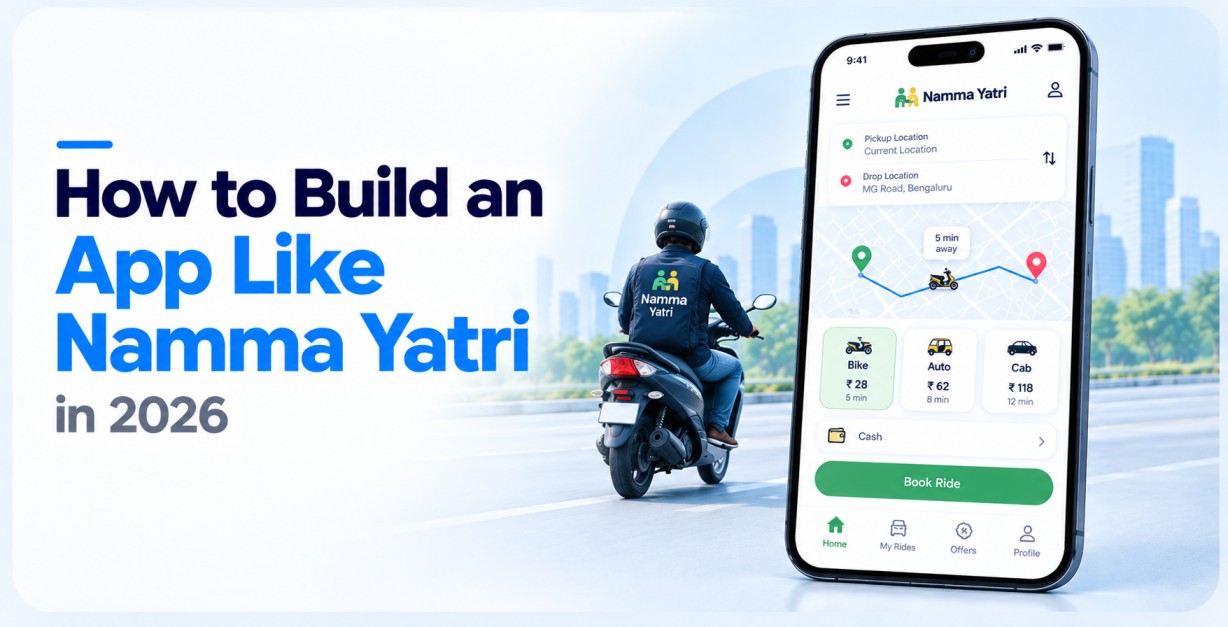
Auto and cab booking, upfront fare with no hidden fees, live tracking, fare breakdown, trip sharing, ratings, and multilingual support. Riders should be able to tip directly, since many open-network apps route tips fully to the driver.
Subscription purchase and status, ride requests, navigation, daily earnings with zero deductions shown clearly, document vault, and a visible trust score. Transparency is the retention mechanic here, so make the math obvious on every screen.
Driver verification queue, city-level fare configuration, network transaction logs, grievance tracking, and settlement reports. Because open networks publish data, many teams also expose public dashboards, which borrows directly from how any business intelligence dashboard turns raw events into decisions.
This is the most interesting engineering problem in the model.
Without surge pricing, you cannot use price to balance supply. So you balance it with information and incentives instead. Driver-side heat maps, demand forecasts for the next hour, and nudges toward underserved zones replace the multiplier.
Fares typically follow state-published rates, which means your pricing service reads from a configurable table per city rather than computing dynamic multipliers. Add waiting charges, night rates, and toll pass-through as explicit line items.
Allocation leans on driver choice more than on forced assignment. Requests broadcast to a ranked set, drivers accept, and the system learns from behavior. Accurate pickup zones depend on geofencing rules in dense markets, where GPS alone misplaces riders by a street or more.
Namma Yatri started with an auto drivers’ union, not a marketing budget. That origin shaped the product.
Trust features are concrete. Show the full fare the rider pays and confirm nothing was deducted. Let drivers see why they did or did not receive a request. Publish cancellation and dispute outcomes. Offer a subscription pause when a driver is unwell or traveling.
Community onboarding also belongs in the roadmap. Referral tools for drivers, local-language training content, and an ambassador model cost far less than paid acquisition and produce far stickier supply.
Favor open components, since open-source credibility is part of the proposition in this category.
| Layer | Practical choice |
| Apps | Flutter or React Native for both rider and driver |
| Protocol layer | Dedicated Beckn adapter service, Node.js or Haskell |
| Core backend | Go or Node.js microservices |
| Data | PostgreSQL with PostGIS, Redis, Kafka |
| Maps | OpenStreetMap-based routing with a commercial fallback |
Keep the protocol adapter isolated from business logic. Network specifications evolve, and you want upgrades to touch one service. Interface quality still decides adoption, so pair that with serious UI and UX design work for low-literacy and multilingual users.
| Scope | Includes | Cost (INR) | Timeline |
| Open-network MVP | Rider and driver apps, Beckn adapter, subscriptions, basic ops panel | Rs 25 lakh to Rs 38 lakh | 5 to 6 months |
| Launch-ready | Adds multi-city fares, verification automation, grievance workflows, analytics | Rs 40 lakh to Rs 55 lakh | 7 to 8 months |
| Multi-modal platform | Adds metro and bus integration, intercity, rentals, public dashboards | Rs 70 lakh and above | 10 to 12 months |
The cost of building an app also includes the running cost. Here it stay lower than commission platforms because the support load is smaller, but network certification and compliance work add time.
If you want to build an app like Namma Yatri, you need a partner comfortable with protocol work, asynchronous systems, and tight unit economics. That combination is narrower than general app development.
EngineerBabu builds API-first, event-driven platforms under a CMMI Level 5 process, and its MVP development approach suits teams who want a credible first city live before raising or expanding. The closed-marketplace experience transfers too, since the matching and trust layers in a ride sharing app like Uber share most of the same machinery.
The decision to build an app like Namma Yatri is a bet that fairness scales. It removes the easiest revenue lever in ride-hailing and replaces it with discipline, automation, and driver loyalty.
That bet has already produced one of India’s most-watched mobility platforms. It is reproducible, but only if your architecture and your economics are designed together from the first sprint.
Thinking about an open-network mobility product? Talk to EngineerBabu about scoping your Beckn architecture and first-city launch.
Namma Yatri charges drivers a flat subscription instead of per-ride commission and operates on the open ONDC network rather than inside a closed marketplace.
No, but the open network is what makes interoperability possible. You can run a subscription model independently, though you lose shared discovery across apps.
Expect Rs 25 lakh to Rs 38 lakh for an open-network MVP, and Rs 40 lakh to Rs 55 lakh for a launch-ready multi-city platform.
Through driver subscriptions, optional premium services, advertising, and enterprise or corporate ride programs layered on top of the free ride flow.
It is not difficult to read, but it is demanding to run reliably. Signed requests, asynchronous callbacks, and registry handling need a dedicated adapter service.