How to Build an App Like Labcorp in the USA


Create engaging, high-performance mobile applications tailored to your business needs. We craft future-ready apps that offer smooth user experiences on all devices.
Build robust and scalable websites and CMS platforms that help you manage content effortlessly. Our development ensures a seamless digital presence.
Launch secure, feature-rich online stores with intuitive shopping experiences. We build tailored eCommerce platforms designed for growth.
Design captivating games with immersive gameplay and stunning graphics. From concept to launch, we build engaging experiences that players love.
Enhance your customer relationships with customized Salesforce implementations. Drive growth and efficiency with smarter CRM solutions.
Harness artificial intelligence and machine learning to automate workflows and gain actionable insights. Our AI transforms data into smart decisions.
Accelerate your software delivery lifecycle with continuous integration, delivery, and infrastructure automation to boost efficiency.
Hire app developers ready to turn your ideas into sleek, high-performing mobile apps for any platform.
Bring in frontend pros who craft smooth, beautiful, and user-friendly interfaces that your visitors will love.
Get backend developers who build fast, secure, and reliable systems to keep everything running behind the scenes.
Hire eCommerce developers who build secure, scalable online stores designed to offer seamless shopping and grow your sales.
Get dedicated developers committed to your projects, delivering consistent quality and speed as an extension of your team.
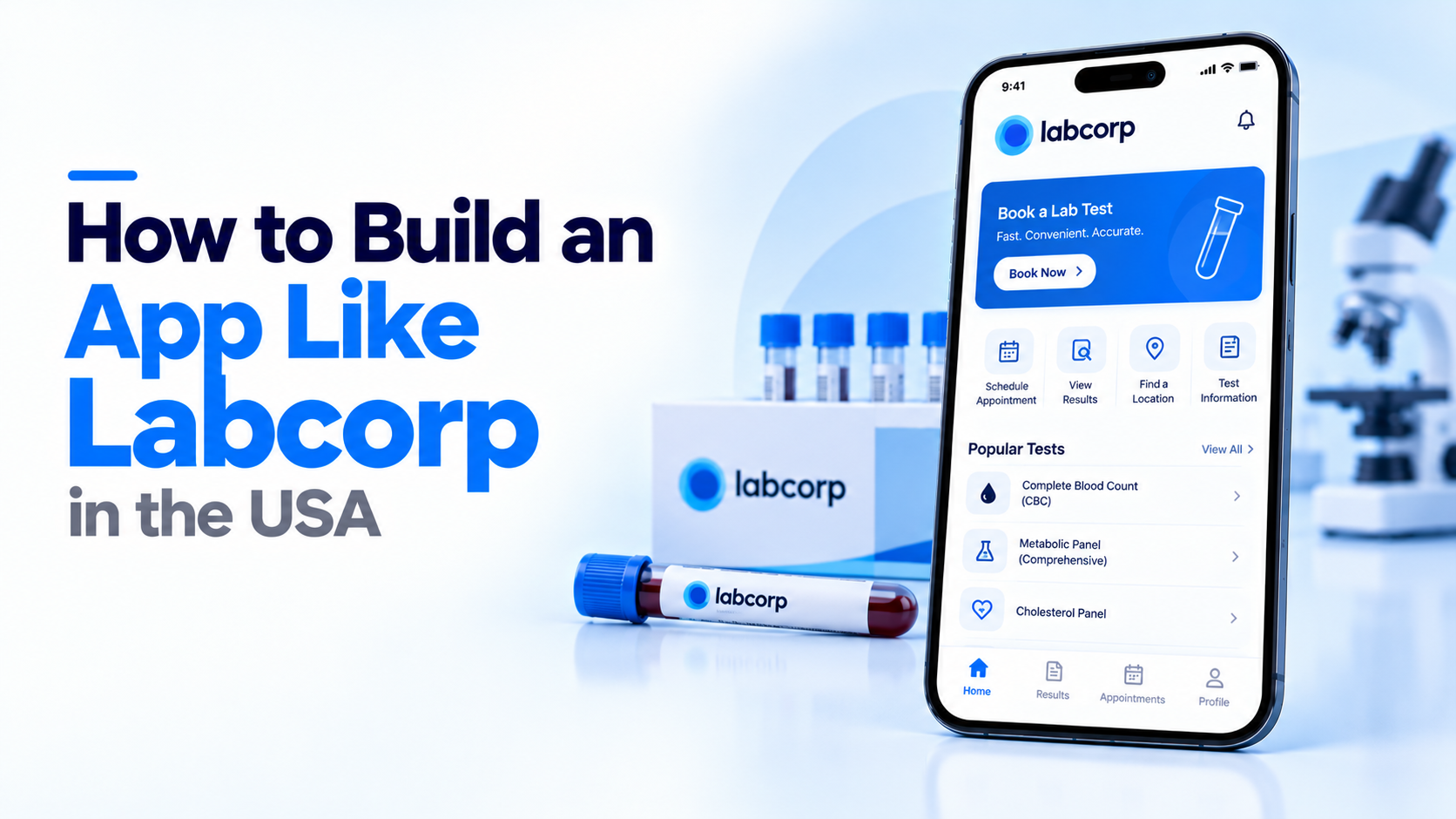
Pull up the Labcorp app and you will see something almost boring. Find a location. Book a time. See results. Pay a bill.
Then try to rebuild it and the floor drops out.
Behind those four tiles sit insurance eligibility checks, physician order validation, CLIA-regulated result release rules, HL7 feeds from hundreds of health systems, and federal information blocking rules that dictate how fast a result must reach the patient.
If you want to build an app like Labcorp, the user interface is maybe fifteen percent of the work. This piece covers the other eighty-five.
To build an app like Labcorp, you need a patient-facing scheduling and results app, an integration layer speaking HL7 v2 and FHIR to ordering providers, a laboratory information system handling specimens and result verification, and a billing stack that checks insurance eligibility before the draw.
Labcorp’s app is the consumer surface of a national reference laboratory network, so the platform value lives in the order-to-result pipeline rather than the screens.
The global clinical laboratory services market sits at an estimated USD 298.4 billion in 2026 and is projected to reach USD 468.2 billion by 2036 at a 4.6% CAGR, with laboratory results informing roughly 70% of all clinical decisions (Meticulous Research). That second number explains why this software carries clinical weight that a typical consumer app never does.
It is not the design system. It is four constraints that most teams discover late.
Location search with real-time wait times, appointment booking, pre-visit check-in, fasting and prep instructions, result viewing with historical trends, bill payment, and consent management. This layer should assume low health literacy and high anxiety. Clarity beats density every single time.
This is the engine room. You will consume HL7 v2 ORM and ORU messages from legacy systems and FHIR R4 resources from modern ones. Understanding the practical split between HL7 and FHIR early saves months, because most real networks require both at once. Expect an interface engine, message queues, retry logic, and a canonical internal schema that every inbound format maps into.
Specimen accessioning, barcode tracking, analyzer interfacing, quality control, pathologist verification, and result finalization. Whether you build this or integrate an existing platform is the single biggest scope decision in the project.
Our guide to LIMS software development walks through where that line usually falls.
Eligibility verification, prior authorization where required, advance beneficiary notices, claim generation, patient responsibility estimates, and audit logging. Teams that bolt this on at the end rebuild half the data model. Treat it as foundational, the way mature healthcare RCM software is designed from the first sprint.
HIPAA: governs PHI handling, encryption, access controls, and audit trails. Every vendor touching PHI needs a signed agreement.
Related: What a HIPAA BAA means for healthcare apps.
CLIA: governs the laboratory performing the test. Your software does not get certified, but it must support the documentation, QC records, and personnel attribution that CLIA inspections require.
21st Century Cures Act: prohibits information blocking. In practice, results generally must be available to patients without unnecessary delay, which forces you to design proactive delivery rather than gated release.
State law: adds variation on sensitive results, minor access, and consent, so your release engine needs jurisdiction awareness from day one.
SOC 2 and HITRUST: are commercial requirements rather than legal ones, and enterprise buyers will ask. Our comparison of HITRUST vs SOC 2 Type II explains which one your buyers actually want.
Start by deciding where your orders originate. Physician-ordered only, direct-to-consumer only, or both. Physician-ordered means EHR integration and a provider portal from day one. Direct-to-consumer means you need a physician network to authorize tests, since most states require an order.
Map the three or four EHR systems your target providers use, since Epic, Cerner, athenahealth, and eClinicalWorks each behave differently. Document the exact message types you will send and receive. This phase produces no visible product and determines the entire schedule.
Before any screen exists, define your internal representation of patient, order, specimen, result, and encounter. Everything inbound maps into it. Then stand up the interface engine with message parsing, validation, acknowledgment handling, and dead letter queues.
Build bidirectional FHIR endpoints alongside HL7 v2 support, because newer partners will expect them. Teams following an Epic FHIR integration path should budget sandbox certification time separately. Interface work almost always consumes more calendar than estimates suggest.
Now build what users see. Location finder with live capacity, scheduling with appointment type logic, digital check-in with insurance card capture, prep instructions tied to specific tests, and a results view that shows trends rather than isolated numbers. Add secure messaging and document sharing so patients can forward results to a physician.
Keep accessibility standards in scope, because a national lab audience spans every age group. Pin your architecture decisions against proven patterns for scalable healthtech architecture so the first traffic spike does not break scheduling.
Connect a clearinghouse for real-time eligibility checks before the appointment is confirmed. Generate accurate patient responsibility estimates using plan details and current deductible status. Build the claim lifecycle, denial handling, and patient statement flow. Then layer in payment plans, since lab bills frequently arrive unexpectedly.
The same logic that powers medical billing software applies here, with lab-specific coding rules around panels and reflex testing. Budget real time for payer-specific edge cases, because they are numerous.
Run full interface testing with each integration partner using synthetic patient data. Conduct penetration testing, access control review, and a formal HIPAA risk assessment. Launch in one region with a limited provider set so interface issues surface at manageable volume.
Monitor result delivery latency, order rejection rate, eligibility check success rate, and appointment no-show rate. Only after those stabilize should you add partners. Reviewing healthcare data interoperability in the USA before this phase helps set realistic partner onboarding timelines.
| Scope | Timeline | Range |
| Patient app on top of an existing LIS | 5 to 7 months | $90,000 to $160,000 |
| Patient app plus interface engine and billing | 9 to 12 months | $180,000 to $320,000 |
| Full platform including laboratory core | 12 to 18 months | $350,000 to $650,000+ |
Apart from these, there could be hidden costs in healthcare app development that you need to take care of.
Result clarity beats feature count. A patient who understands their result returns.
Scheduling accuracy beats scheduling elegance. A booked slot that does not exist destroys trust faster than a plain interface does.
Audit logging beats almost everything. When something goes wrong with a clinical result, your logs are the only defensible record you have.
Teams that set out to build an app like Labcorp usually have the clinical relationships already. What they need is an engineering partner comfortable with HL7 feeds, FHIR resources, and HIPAA-grade security.
EngineerBabu’s healthcare software development work spans EHR integration, laboratory systems, and patient platforms, delivered through a CMMI Level 5 process with senior engineers staying on the project. We are professionals with HIPAA compliant app build.
EngineerBabu is a technology development company building products across fintech, healthtech, and AI, from MVPs to scaled, production-ready platforms.
It holds a CMMI Level 5 rating, has worked with 4 unicorn clients, and has supported 200+ VC-funded products. The company is backed by Vijay Shekhar Sharma.
Founded by Mayank Pratap (Co-founder) · mayank@engineerbabu.com
A patient app layered on an existing laboratory system takes five to seven months. A full platform with its own interface engine, billing, and lab core runs twelve to eighteen months.
Your software is not CLIA certified. The laboratory performing testing must be. Your platform still has to support CLIA documentation, quality control records, and personnel attribution.
HL7 v2 for established systems and FHIR R4 for newer ones. Most real-world networks require both simultaneously, so plan for a dual-protocol interface engine.
Generally no. Most states require a physician order, which is why direct-to-consumer lab platforms contract a physician network to review and authorize test requests.
Expect $90,000 to $160,000 for a patient app over an existing LIS, and $350,000 or more for a full platform including laboratory core and interoperability.