Healthcare App Development: India vs USA Cost Comparison (2026 Honest Guide)


Create engaging, high-performance mobile applications tailored to your business needs. We craft future-ready apps that offer smooth user experiences on all devices.
Build robust and scalable websites and CMS platforms that help you manage content effortlessly. Our development ensures a seamless digital presence.
Launch secure, feature-rich online stores with intuitive shopping experiences. We build tailored eCommerce platforms designed for growth.
Design captivating games with immersive gameplay and stunning graphics. From concept to launch, we build engaging experiences that players love.
Enhance your customer relationships with customized Salesforce implementations. Drive growth and efficiency with smarter CRM solutions.
Harness artificial intelligence and machine learning to automate workflows and gain actionable insights. Our AI transforms data into smart decisions.
Accelerate your software delivery lifecycle with continuous integration, delivery, and infrastructure automation to boost efficiency.
Every healthcare app founder has the same conversation with me eventually.
“We got quotes from two teams. One US team quoted $280,000. An Indian team quoted $65,000. The Indian team doesn’t seem to have HIPAA experience though. How do we think about this?”
The honest answer has two parts. Part one: the price difference is real and the math genuinely works in India’s favor for most healthcare app builds. Part two: not all Indian teams can deliver HIPAA-compliant healthcare software, and the ones that can’t cost you more in the end than the US team would have.
The question is not “India or USA.” The question is “which India team has genuinely shipped HIPAA-regulated products in production?”
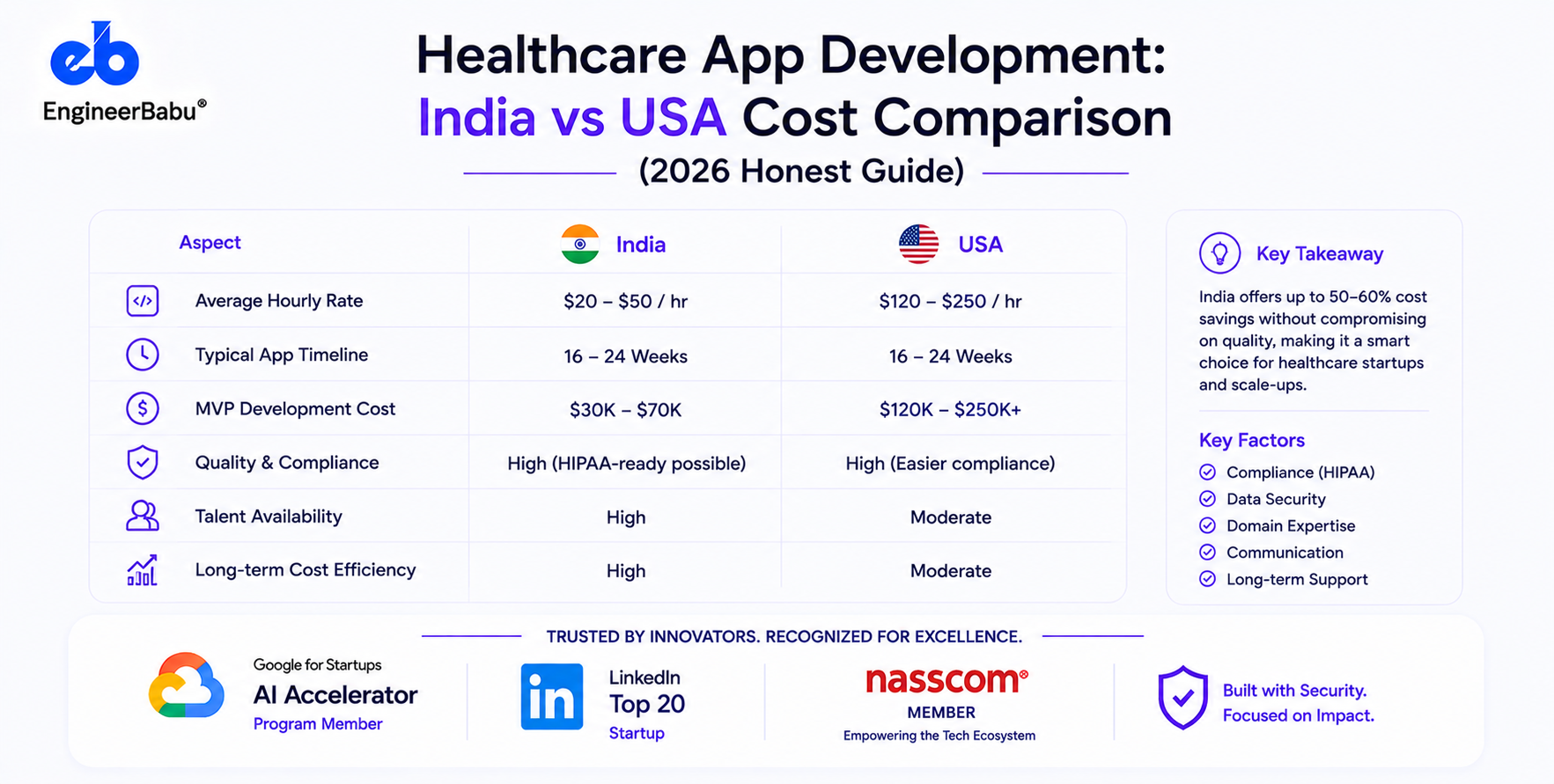
A HIPAA-compliant healthcare MVP development costs $40,000–$90,000 with a CMMI-certified India-based team with genuine healthcare delivery experience, versus $120,000–$270,000 with a comparable US team, a 60–70% cost reduction.
The savings hold when the India team has verifiable HIPAA compliance posture, production BAA experience, and US healthcare-specific regulatory knowledge.
The savings evaporate when an India team without healthcare compliance experience builds a product that requires $60,000–$150,000 in HIPAA retrofitting before a US hospital will onboard it.
The rate gap is not a myth. It’s a consistent market reality:
| Team Type | Hourly Rate | Notes |
| US senior healthcare developer | $150–$250/hr | Major metro; healthcare specialization premium |
| US mid-level developer | $100–$150/hr | Standard rates; varies by location |
| Eastern Europe senior developer | $60–$90/hr | Poland, Romania; similar time zone to US East |
| India senior developer (premium agency) | $40–$65/hr | CMMI-certified, healthcare experience |
| India senior developer (mid-tier) | $25–$40/hr | General software, limited healthcare experience |
| India developer (low-cost) | $15–$25/hr | High risk for regulated healthcare software |
On a 1,000-hour healthcare app project:
The difference between the India premium team and India mid-tier is $15,000–$25,000. The difference in HIPAA compliance outcomes, whether you need a $60,000–$150,000 remediation before your first hospital client is not.
“We do HIPAA” on a website is not evidence of HIPAA compliance experience. Here’s what distinguishes a team that has genuinely shipped HIPAA-regulated products from one that has read about it:
| Team Type | Build Cost | Timeline |
| US team | $120,000–$180,000 | 12–16 weeks |
| India (CMMI, healthcare) | $50,000–$80,000 | 12–16 weeks |
| India (general dev) | $25,000–$40,000 | 16–24 weeks* |
*General dev team builds something that works technically but fails hospital security review → add $60,000–$100,000 for remediation → total $85,000–$140,000 — more than the CMMI team.
| Team Type | Build Cost | Timeline |
| US team | $180,000–$300,000 | 16–24 weeks |
| India (CMMI, healthcare) | $80,000–$140,000 | 16–24 weeks |
| India (general dev) | $40,000–$70,000 | 20–32 weeks |
| Team Type | Build Cost | Timeline |
| US team | $350,000–$600,000 | 24–36 weeks |
| India (CMMI, healthcare) | $150,000–$280,000 | 24–36 weeks |
| India (general dev) | Not recommended | Regulatory complexity too high |
| Team Type | Build Cost | Timeline |
| US team | $600,000–$1,200,000 | 18–30 months |
| India (CMMI, healthcare) | $300,000–$600,000 | 18–30 months |
| India (general dev) | Not recommended | Clinical workflow depth requires healthcare expertise |
The cost advantage is real. There are specific things a US team provides that an India team does not:
Five questions that separate genuine healthcare development capability from generic software development:
60–70% cheaper for equivalent quality. A $150,000 HIPAA-compliant telemedicine MVP from a US team costs $50,000–$65,000 from an India team with equivalent healthcare compliance experience. The savings hold with the right team selection and evaporate with the wrong one.
Compliance quality differs based on team experience, not geography. A CMMI Level 5 India team that has shipped 50 HIPAA-regulated products in production has better HIPAA compliance execution than a US generalist agency that has read about HIPAA but hasn’t implemented it in healthcare.
CMMI Level 5 (software process maturity), ISO 27001 (information security), NASSCOM membership, and verifiable healthcare client references with production US deployments. Google AI Accelerator alumni status validates AI development capability for AI healthcare products.
Building a product that works technically but fails US hospital security review due to HIPAA compliance gaps. Remediation costs ($60,000–$150,000) plus the lost reference account opportunity typically exceed the initial savings. The risk is manageable with proper team selection, it’s not an inherent India risk.
Yes, these are US federal laws with publicly available regulatory text, HHS guidance, and extensive industry documentation. HIPAA compliance is not culturally tied to geography. It requires regulatory knowledge, engineering discipline, and production experience. Indian teams that specialize in US healthcare have all three.
Our pricing aligns with the India-premium tier: $50,000–$90,000 for a HIPAA-compliant telemedicine or healthcare MVP, $100,000–$200,000 for full platforms with EHR integration, $300,000–$700,000 for AI-driven healthcare platforms. Every project includes a signed BAA with our team, HIPAA compliance architecture review, and access to our portfolio of US healthcare client references. Start a conversation at mayank@engineerbabu.com.
Author: Mayank Pratap | Co-Founder, EngineerBabu | Google AI Accelerator 2024 · CMMI Level 5 | mayank@engineerbabu.com