Healthcare API Integration: How to Connect EHRs, Labs, and Payers Without Breaking Compliance


Create engaging, high-performance mobile applications tailored to your business needs. We craft future-ready apps that offer smooth user experiences on all devices.
Build robust and scalable websites and CMS platforms that help you manage content effortlessly. Our development ensures a seamless digital presence.
Launch secure, feature-rich online stores with intuitive shopping experiences. We build tailored eCommerce platforms designed for growth.
Design captivating games with immersive gameplay and stunning graphics. From concept to launch, we build engaging experiences that players love.
Enhance your customer relationships with customized Salesforce implementations. Drive growth and efficiency with smarter CRM solutions.
Harness artificial intelligence and machine learning to automate workflows and gain actionable insights. Our AI transforms data into smart decisions.
Accelerate your software delivery lifecycle with continuous integration, delivery, and infrastructure automation to boost efficiency.
Hire app developers ready to turn your ideas into sleek, high-performing mobile apps for any platform.
Bring in frontend pros who craft smooth, beautiful, and user-friendly interfaces that your visitors will love.
Get backend developers who build fast, secure, and reliable systems to keep everything running behind the scenes.
Hire eCommerce developers who build secure, scalable online stores designed to offer seamless shopping and grow your sales.
Get dedicated developers committed to your projects, delivering consistent quality and speed as an extension of your team.
A patient walks into an urgent care clinic in Denver with chest pain. Her cardiologist is eleven miles away, inside a different health system, on a different EHR.
Her medication list exists. Her last ECG exists. Her allergy record exists. None of it is where the physician standing in front of her can see it.
That is not a data problem. It is a plumbing problem, and healthcare API integration is the plumbing.
Done well, it pulls a patient’s chart into your product in under two seconds. Done badly, it produces a support queue, a HIPAA exposure, and a product clinicians quietly stop opening.
This guide covers what actually goes into healthcare API integration: the standards, the sequence, the security layer, and the mistakes that cost teams half a year.
Connectivity used to be a differentiator. It is now table stakes, and the adoption numbers show it.
According to ASTP/ONC Data Brief No. 79, 81% of U.S. hospitals enabled patient access through apps configured to their EHR’s API specifications in 2024, and 70% enabled access through FHIR-based apps.
Regulation drove most of that. The Cures Act information blocking rules penalize organizations that restrict electronic access. The CMS Interoperability and Prior Authorization rule pushes payers onto FHIR APIs on a 2026 timeline.
The practical result for founders: a health system buyer will ask about your healthcare API integration roadmap on the first call. A vague answer ends the deal. Understanding healthcare data interoperability in the USA before that call is not optional anymore.
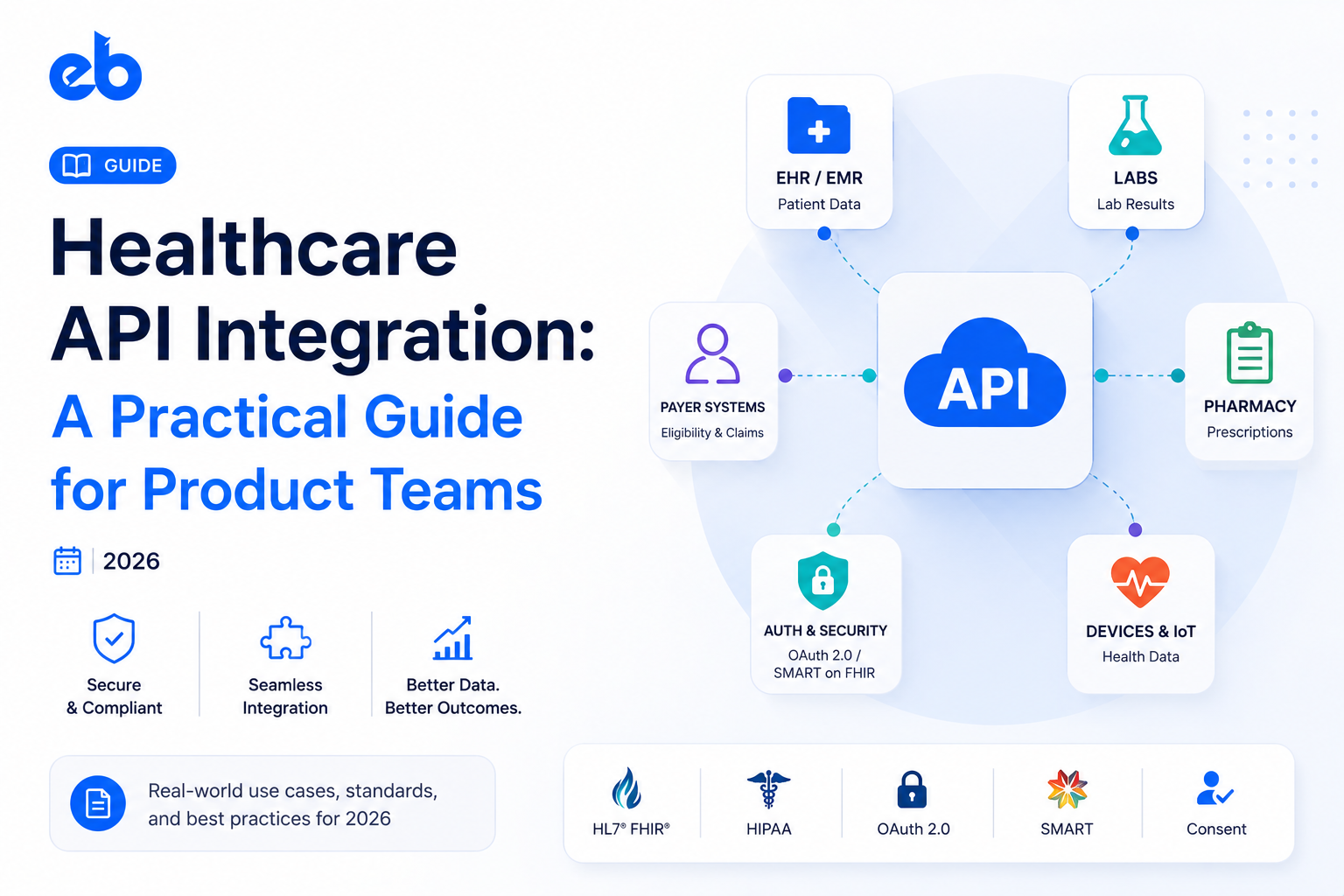
The phrase covers far more than pulling a chart from Epic. A typical digital health product touches five or six distinct endpoint families.
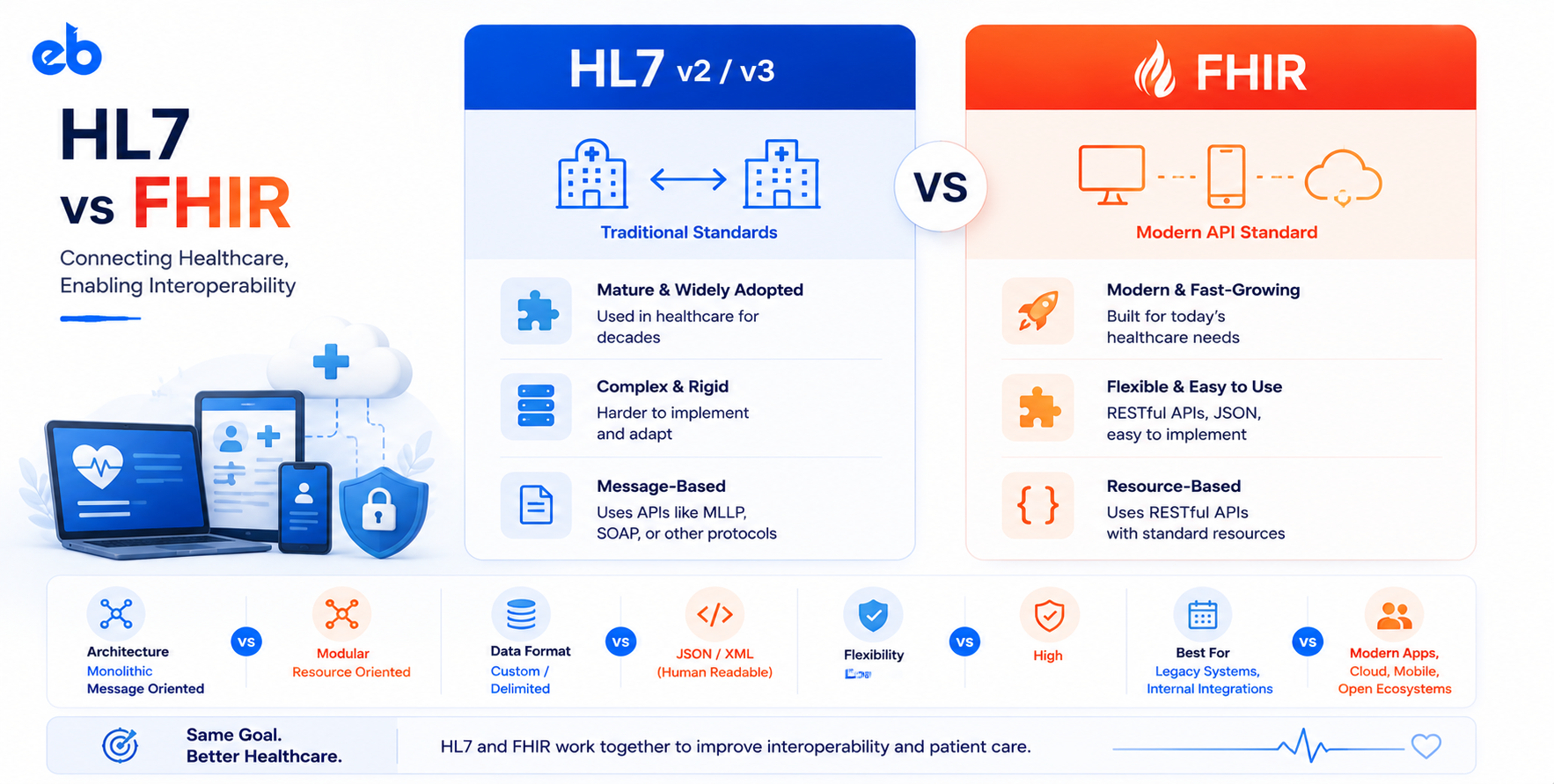
Most healthcare API integration work in 2026 sits on four standards, and you rarely get to pick just one.
The modern default. RESTful, JSON-friendly, and organized into resources like Patient, Observation, MedicationRequest, and Encounter. It is required under ONC certification criteria, which is why coverage keeps expanding. If Epic is your first target, our Epic FHIR integration guide walks through the specifics.
Older, pipe-delimited, and still running the majority of real hospital traffic. ADT messages for admissions and transfers, ORU for results, ORM for orders. You will meet it whether you want to or not.
The payer side. Ugly, rigid, and completely non-negotiable if your product touches eligibility, claims, or prior authorization.
C-CDA moves document-style summaries between organizations. DICOM handles imaging. Both show up in transitions of care and radiology workflows.
Every healthcare API integration should start with the clinical question your product answers, then list only the data that answers it. A medication adherence app needs MedicationRequest, MedicationStatement, and Patient. It does not need imaging studies or full encounter history.
Write that list as FHIR resources rather than feature ideas. That forces an honest conversation about what each partner system can genuinely expose today.
Then cut it. Every extra resource adds a scope request, a consent question, a mapping rule, and a support burden. Teams that ship fast usually launch with under eight resources and expand once real usage shows the gaps.
You have two realistic paths. Connect directly to each EHR vendor, or route through an aggregator such as Redox, Health Gorilla, Particle Health, or 1upHealth.
Direct connections give you control, better economics at volume, and no middleman outage risk. They also mean separate registration, separate sandboxes, and separate quirks for every system you touch.
Aggregators normalize responses and collapse many integrations into one contract. You pay for that convenience, and you inherit their coverage gaps.
A workable rule: three or fewer systems, go direct. Beyond that, healthcare API integration through an aggregator usually pays for itself inside a year.
EHR API access is gated. Epic, Oracle Health, and Athenahealth each require developer registration, app review, and a named client ID before you touch production data.
Expect to submit your app’s purpose, requested scopes, security documentation, and redirect URIs. Then expect the hospital or clinic to approve the connection separately. Vendor approval is not site approval.
Budget four to twelve weeks across registration, review, and site-level enablement. Start it in week one of the project, not after the code works. Credentialing delays sink more healthcare API integration timelines than engineering ever does.
Never let raw vendor payloads reach your business logic. Build an internal canonical model, then map each source into it.
Two systems can both claim FHIR R4 conformance and still disagree. One returns a phone number under telecom, another buries it in an extension. Lab codes arrive as LOINC in one feed and a local code in another.
Your mapping layer absorbs that variance so product code stays clean. This is ordinary API development discipline applied to an unusually messy domain. It also means adding a fifth EHR later becomes a mapping task instead of a rewrite.
Authorization is where healthcare API integration most often stalls in review. SMART on FHIR sits on top of OAuth 2.0 and defines how apps request scoped access to clinical data. Two launch modes matter.
EHR launch opens your app inside the clinician’s workflow with patient context already attached. Standalone launch starts from your app and asks the user to authenticate with their provider.
Request the narrowest scopes that work. A scope like patient/Observation.read beats user/*.read on both approval odds and breach exposure.
Store refresh tokens encrypted, rotate them on a schedule, and log every token exchange. Auditors will ask for those logs.
Health systems take maintenance windows. Interfaces go quiet at 2 AM. Payload schemas change without a release note.
Queue every inbound message instead of processing it inline. Use idempotency keys so a replayed HL7 message does not create a duplicate order. Add exponential backoff to retries, and cap them before you flood a partner endpoint.
Then build reconciliation. A nightly job comparing record counts against the source catches silent data loss that no error log will surface. In healthcare API integration, missing data is more dangerous than a failed request, because nothing alerts you.
Every healthcare API integration carrying PHI needs a Business Associate Agreement in place before the first production call. That includes your cloud provider, your aggregator, and any analytics vendor touching the payload.
Beyond the BAA, four controls come up in every security review:
Access controls belong in the architecture from day one. Retrofitting them is expensive, and it is the most common reason a promising pilot fails its first enterprise security review. Our guide on building a HIPAA compliant app covers the full control set.
Once clinical data flows reliably, the interesting work starts. Integration is the prerequisite, not the payoff.
Language models are genuinely useful for the mapping problem itself. Given an unfamiliar HL7 segment or a vendor extension, they can propose a mapping to your canonical model far faster than a developer reading a 400-page spec.
A human still approves every mapping, because a wrong unit conversion on a lab value is a patient safety event.
On the clinical side, AI development work turns integrated data into ambient documentation, chart summarization, and prior authorization drafting. Each of those depends entirely on the completeness of your feed.
Predictive use cases go further. ML development models built on longitudinal data can flag readmission risk or deterioration days ahead of a clinician noticing. Thin integration produces thin models, every time.
Healthcare API integration is not a checkbox on a feature list. It determines how fast you onboard a health system, how much clinical value your product can deliver, and whether you survive your first enterprise security review.
The teams that get it right start narrow. They pick one integration, ship it through a focused MVP development cycle, prove the data flows cleanly, and only then sign the next four contracts.
Start credentialing early, normalize aggressively, and assume every interface will break at some point. That assumption is what separates a product that scales from a pilot that stalls.
Most integration projects do not fail on code. They fail on sequencing: credentialing started too late, mapping logic buried inside product code, and no reconciliation until a clinician notices missing labs.
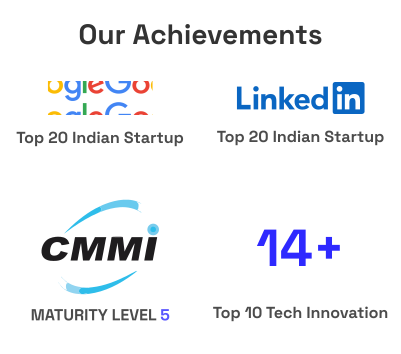
EngineerBabu builds healthcare products around that reality. The team works on a CMMI Level 5 delivery framework, which means the process is documented, measured, and repeatable rather than dependent on whoever is free that sprint. For work that touches PHI, that matters more than raw speed.
The engineering side covers custom healthcare platforms, EHR and FHIR connectivity, HIPAA-aligned architecture, cloud, and DevOps. On the AI side, the team was selected into the Google AI Accelerator, so models built on top of your integrated data are real engineering rather than a wrapper.
Track record: CMMI Level 5 rated, 4 unicorn clients, and 200+ VC-funded products supported. The company is backed by Vijay Shekhar Sharma and was founded by Mayank Pratap.
You can also plug in dedicated engineers remote or hybrid when you want to extend your own team instead of handing over the whole build.
So, planning your first healthcare API integration? Talk to the EngineerBabu team about scoping it properly.
It is the process of connecting a health product to external clinical and administrative systems, including EHRs, labs, pharmacies, payers, and devices, using standards like FHIR, HL7 v2, and X12 so data moves automatically instead of manually.
Plan for three to six months for a first production connection. Engineering is rarely the bottleneck. Vendor app review, security assessment, and site-level approval by the hospital account for most of that timeline.
Not yet, and not soon. FHIR handles most new API work, while HL7 v2 still carries a large share of live hospital messaging. Most production systems run both for the foreseeable future.
Yes, if the integration touches protected health information. That covers your cloud host, your integration vendor, and any subprocessor that stores or transmits the data.
Connect directly if you need two or three systems and want maximum control. Choose an aggregator when you need broad coverage quickly and prefer one contract over many separate vendor relationships.