Insurance Distribution Platform Development in India (2026 Guide)


Create engaging, high-performance mobile applications tailored to your business needs. We craft future-ready apps that offer smooth user experiences on all devices.
Build robust and scalable websites and CMS platforms that help you manage content effortlessly. Our development ensures a seamless digital presence.
Launch secure, feature-rich online stores with intuitive shopping experiences. We build tailored eCommerce platforms designed for growth.
Design captivating games with immersive gameplay and stunning graphics. From concept to launch, we build engaging experiences that players love.
Enhance your customer relationships with customized Salesforce implementations. Drive growth and efficiency with smarter CRM solutions.
Harness artificial intelligence and machine learning to automate workflows and gain actionable insights. Our AI transforms data into smart decisions.
Accelerate your software delivery lifecycle with continuous integration, delivery, and infrastructure automation to boost efficiency.
Hire app developers ready to turn your ideas into sleek, high-performing mobile apps for any platform.
Bring in frontend pros who craft smooth, beautiful, and user-friendly interfaces that your visitors will love.
Get backend developers who build fast, secure, and reliable systems to keep everything running behind the scenes.
Hire eCommerce developers who build secure, scalable online stores designed to offer seamless shopping and grow your sales.
Get dedicated developers committed to your projects, delivering consistent quality and speed as an extension of your team.
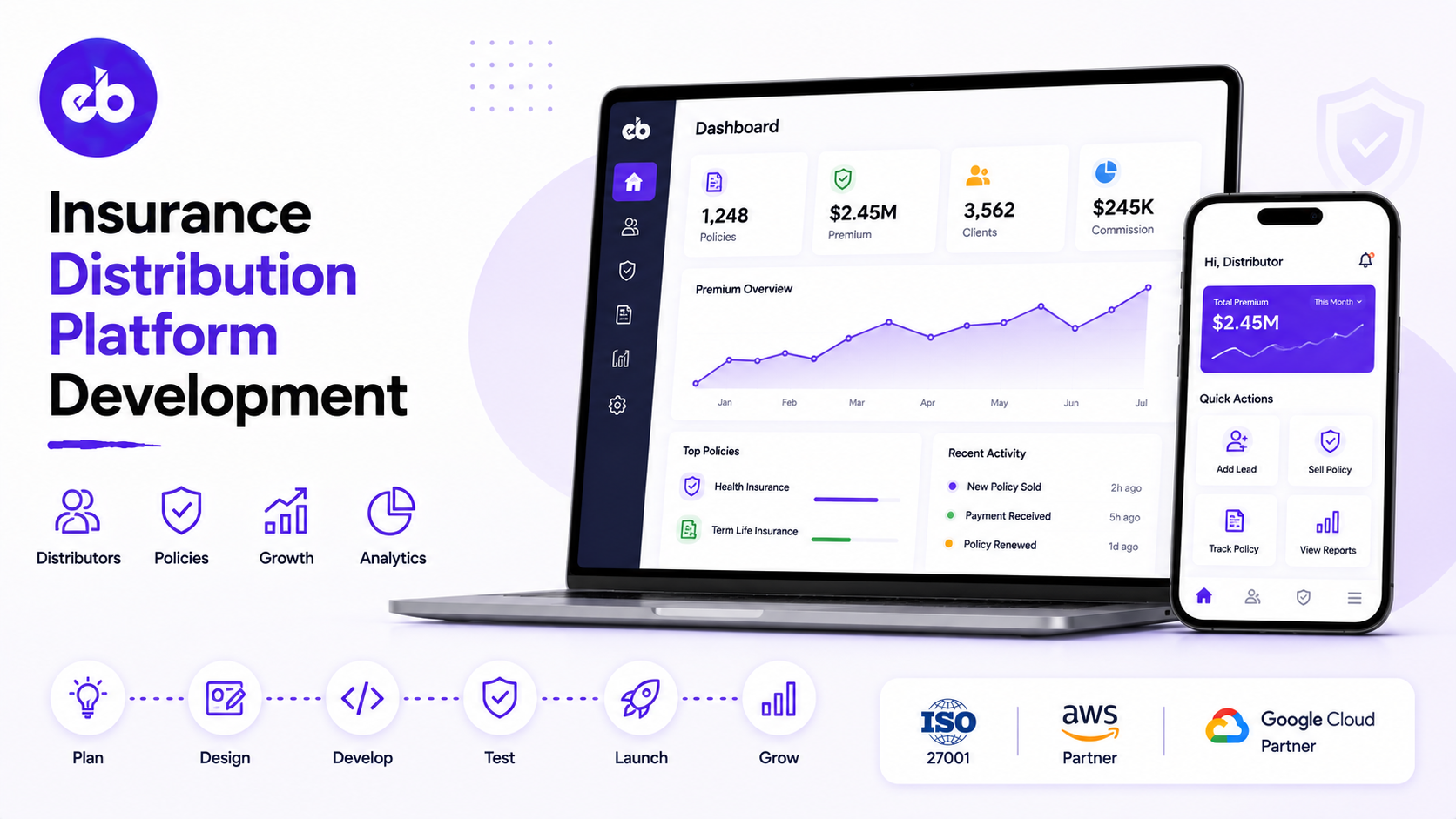
India has more than 1.4 billion people and one of the world’s fastest-growing economies. Yet most households are still one hospital bill or one accident away from financial trouble.
The numbers show the gap. India’s insurance penetration was 3.7% of GDP in 2024-25, about half the global average of 7.3%, according to IRDAI’s latest annual report. The technology to close that gap is growing fast. India’s insurtech market is forecast to grow from about $1.5 billion in 2026 to $5.3 billion by 2031, according to Ken Research.
Insurance distribution platform development is the process of building software that lets agents, POSPs, and brokers onboard, compare policies from multiple insurers, issue policies digitally, collect premiums, and track commissions in one place.
In India, these platforms are the backbone of the POSP model, which brings insurance to Tier 2 and Tier 3 markets that traditional agents can’t serve profitably.
An insurance distribution platform is the software layer between insurers and the people who sell their products. It connects agents, POSPs, brokers, and customers to multiple insurers through APIs, so a single sale can go from quote to issued policy in minutes.
Unlike a single insurer’s sales portal, a distribution platform is multi-insurer by design. That’s what makes it valuable to intermediaries, and it’s also what makes insurance software development for this use case more complex than it looks.
Most Indians who need insurance can’t easily access it. Full-time licensed advisors can’t economically serve Tier 2 and Tier 3 markets, where premiums are smaller and customers are spread out.
The Point of Sales Person (POSP) model, introduced by IRDAI in 2015 and expanded since, changes this math. A POSP is a part-time certified distributor who sells simple, pre-defined insurance products. Common POSPs include shop owners, pharmacists, bank correspondents, mutual fund distributors, and small business owners.
| Factor | POSP | Traditional Agent |
| Minimum qualification | Class 10, age 18+ | Class 12 (typically), age 18+ |
| Training | 15 hours, run by insurer or intermediary | 25 to 50 hours |
| Exam | Conducted by the sponsoring insurer or intermediary | Pre-licensing exam |
| Products | Simple, pre-defined POS products | Full product range |
| Works under | Insurer, broker, or corporate agent | Insurer or corporate agent |
Because POSPs are part-time and widely distributed, the whole model runs on technology. Onboarding, training, quoting, and payouts all need to be digital.
The same last-mile challenge shows up in microfinance software development, where reach into smaller towns depends on simple, mobile-first tools.
| Function | Module |
| Agent and POSP onboarding | Registration, KYC, training, certification |
| Product catalog | Multi-insurer, multi-product comparison engine |
| Customer needs assessment | Financial needs analysis, product recommendation |
| Quote generation | Real-time premium quotes from insurer APIs |
| Proposal and issuance | Digital proposal form, KYC, payment, policy issuance |
| Policy management | Customer portfolio, renewal alerts, endorsements |
| Premium collection | Payment gateway, auto-renewal mandates |
| Claims initiation | First notification of loss, document upload, status tracking |
| Commission management | Commission calculation, payout, tax documentation |
| Compliance | Regulatory reporting, AML and KYC, suitability records |
| Analytics | Agent performance, product mix, premium portfolio |
IRDAI requires every POSP to complete 15 hours of training and pass an examination before selling. The sponsoring insurer or intermediary runs both, and the platform should manage the entire process digitally.
| Step | Action | System |
| Registration | Prospective POSP enters basic details | Registration form, initial checks |
| Document upload | Aadhaar, PAN, bank account, photo, education proof | PAN verification, Aadhaar eKYC or CKYC through a licensed provider |
| Training program | 15-hour online curriculum | LMS module with video, text, and quizzes |
| Certification exam | Online exam from a question bank | Proctored assessment engine |
| Exam result | Pass or fail communicated instantly | Certificate generated on pass |
| Appointment | Appointment letter issued within 15 days of passing | Automated letter and POSP record |
| Activation | POSP gets platform access and can start selling | Role-based access granted |
The training curriculum: The 15 hours cover insurance basics, product knowledge for allowed categories, KYC and AML rules, ethical selling, and claim procedures. Deliver it as a structured LMS course with chapter-wise quizzes. Track completion and unlock the exam only after the training is done.
The examination: Run the exam with basic proctoring. This means webcam access, random questions from a question bank, a time limit, and no switching away from the exam window. Results should be instant. A pass generates a PDF certificate that the POSP can download anytime.
The platform integrates with multiple insurers through direct APIs and aggregator connections. Clean API development matters here, because each insurer’s API behaves differently. Each integration typically provides:
| Data | Details |
| Product details | Coverage, exclusions, features, eligibility |
| Premium rates | Calculated in real time from customer inputs |
| Underwriting rules | Which customers qualify for which products |
| Policy issuance | Direct issuance via API after payment |
| Commission rates | What the insurer pays per product and premium |
| Category | Typical POS Products |
| Life insurance | Pure term, non-linked non-participating endowment plans |
| Health insurance | Simple individual and family floater plans, fixed-benefit plans |
| Motor insurance | Third-party and comprehensive, two-wheeler and four-wheeler |
| Personal accident | Individual and group PA |
| Travel insurance | Single trip, annual multi-trip |
| Home insurance | Structure and contents |
These are the types of insurance apps available online. Complex products like ULIPs and high sum assured life plans stay outside POSP scope. Your catalog should enforce this automatically by role.
The comparison engine: When a POSP enters customer details like age, sum assured, tenure, and health conditions, the engine queries all integrated insurers at once. It returns a ranked comparison table.
Illustrative example of a term plan comparison:
| Insurer | Premium | Sum Assured | Key Features | Fit for Customer | POSP Commission |
| Insurer A | ₹11,200/year | ₹1 crore | Critical illness add-on | High | ₹1,680 |
| Insurer B | ₹12,450/year | ₹1 crore | Terminal illness cover, premium waiver | High | ₹1,868 |
| Insurer C | ₹13,100/year | ₹1 crore | Accidental death benefit | Medium | ₹1,965 |
Why the “Fit for Customer” column matters: Showing commissions helps POSPs plan their earnings. But ranking by commission alone invites mis-selling, which IRDAI is watching closely. Rank results by suitability first, show commission second, and log the needs analysis behind every recommendation.
| Step | Action | Time |
| Product selection | POSP and customer pick a product | Under 1 minute |
| Proposal form | Customer details, health declarations, nominee | 5 to 10 minutes |
| KYC | Aadhaar OTP or CKYC, photo upload | 2 to 3 minutes |
| Medical underwriting | Questionnaire or tele-medical for higher covers | 5 to 30 minutes |
| Premium payment | UPI, net banking, debit card | 1 to 2 minutes |
| Policy issuance | Policy number generated by insurer API | Instant for most products |
| Policy delivery | E-policy sent by email and WhatsApp | Immediate |
Insurer API integration: After payment confirmation, the platform sends proposal data to the insurer’s issuance API. The insurer returns a policy number and the e-policy document. For products that need underwriting review, the platform tracks the pending status and notifies both the POSP and the customer when a decision is made.
e-Insurance Account (eIA): IRDAI is pushing the industry toward electronic policies stored in a customer’s eIA. The platform should integrate with insurance repositories like NSDL, CDSL, CAMSRep, and KFintech to deposit policies automatically after issuance.
Since April 2023, IRDAI no longer sets product-wise commission caps. Instead, each insurer pays commissions under a board-approved policy within overall expense limits. That means rates vary more across insurers, and your engine must handle them cleanly.
| Factor | Details |
| Product type | Term, health, motor, and others have different structures |
| First year vs renewal | First-year commission is usually higher |
| Premium amount | Commission = Premium × Commission % |
| Insurer rate | Each insurer sets its own rates |
| Hierarchy | Master agent or team leader overrides, if applicable |
Commission statement and payout: At month-end, the platform generates a statement for each POSP. It shows every policy sold, the premium, the commission rate, and the gross commission. After TDS under Section 194D, the net amount is paid to the POSP’s bank account. Secure, automated payouts follow the same principles as payment app development.
Renewals are where distribution platforms make or lose money. A missed renewal means lost commission and an unprotected customer.
| Days Before Expiry | Action |
| 60 days | POSP gets a renewal alert to contact the customer |
| 30 days | Automated reminder to the customer via WhatsApp and email |
| 15 days | Renewal quote generated for the same or alternative products |
| 7 days | Urgent reminder, auto-renewal if a mandate is active |
| Expiry date | Final reminder before the grace period begins |
An AI chatbot on WhatsApp can handle routine renewal questions and payment links, freeing POSPs to focus on new sales.
The customer portfolio view: Each POSP gets a dashboard showing every customer and their policies.
| Customer | Policies | Total Premium | Renewal Due | Last Contact |
| Rajesh Kumar | Term ₹50L + Health ₹10L | ₹24,500/year | Health: Aug 15 | July 3 |
| Priya Sharma | Motor comprehensive | ₹12,200/year | Oct 1 | June 28 |
| Amit Patel | Term ₹75L | ₹18,900/year | Feb 1 | May 15 |
A POSP who can see who needs a renewal, who is underinsured, and who just had a life event is the POSP who keeps customers and grows their book.
POSPs don’t settle claims, but customers expect them to help. The platform should let a POSP or customer file a first notification of loss, upload documents, and track claim status with the insurer. Fast, visible claim support builds the trust that drives renewals.
Every sale needs a clean audit trail. That includes POSP training and appointment records, KYC documents, needs analysis, proposal data, and premium receipts. Building compliance automation into the workflow makes regulatory reporting a report you run, not a project you dread.
On the analytics side, track POSP activity, conversion rates, product mix, and renewal rates by region. Managing a large, distributed POSP network has a lot in common with field force automation software development, where visibility into field teams drives performance.
Bima Sugam is IRDAI’s unified digital insurance marketplace, set up under regulations notified in 2024. It’s run by the Bima Sugam India Federation, a not-for-profit entity. It is rolling out in phases, and IRDAI’s chair said in late September 2026 that it’s likely to go live by November 2026, according to Moneycontrol, as reported by NewsBytes.
For anyone investing in insurance distribution platform development, this changes three things:
Start by deciding who sells on your platform. Will you be a broker running POSPs, a corporate agent, or an insurer building its own POSP network? Your license type decides which insurers you can partner with, which products you can sell, and which compliance rules apply.
Map your target regions and product lines next. Most platforms start with motor and health, because they’re standardized and easier to compare. This one decision shapes every module that follows.
Don’t build all eleven modules at once. A strong MVP covers POSP onboarding, 3 to 4 insurer integrations, a comparison engine, digital issuance, and basic commission tracking. Renewals, claims, and advanced analytics can follow in phase two.
This guide to MVP development for startups explains how to scope a first release without overbuilding. A lean launch also lets you test POSP adoption before you commit your full budget.
Integrations depend on agreements, not just code. Start insurer conversations early, because API access, sandbox credentials, and commercial terms can take months. Some insurers offer modern REST APIs, while others need aggregator connections or custom workflows.
Document each insurer’s quote, issuance, and status endpoints before development begins. Plan a fallback, like cached rate tables, for insurers whose APIs are slow or unreliable.
Build onboarding, the product catalog, and the comparison engine first, since everything else depends on them. Then add issuance, payments, and commission logic. Keep insurer integrations as separate adapters, so one insurer’s API change never breaks the whole platform.
Weekly demos with real POSPs help catch usability issues early, especially for users who aren’t tech-savvy. Support regional languages from day one if you’re targeting smaller towns.
Insurance platforms hold Aadhaar, PAN, health, and bank data, so security can’t be an afterthought. Run vulnerability assessment and penetration testing (VAPT) and thorough security testing before launch. Load-test the comparison engine, since it calls many insurer APIs at once.
Align your data handling with the Digital Personal Data Protection Act and IRDAI’s cybersecurity guidelines. Test edge cases like payment failures and pending underwriting decisions.
Launch with a small group of POSPs in one or two regions. Track activation rates, time to first sale, quote-to-issuance conversion, and renewal rates. Use their feedback to simplify flows before you scale. Then add insurers, product lines, and regions in phases.
As data grows, layer in smarter recommendations, an area where AI in fintech software development is already delivering results.
| Layer | Recommended Options |
| POSP and customer apps | React Native or Flutter for Android-first reach |
| Web dashboards | React or Next.js |
| Backend | Node.js or Java (Spring Boot) |
| Database | PostgreSQL for transactions, Redis for caching quotes |
| Integrations | Insurer adapters, message queues for async issuance |
| Payments | Razorpay or similar, with UPI AutoPay for renewals |
| Infrastructure | AWS or Azure with data stored in India |
| Communication | WhatsApp Business API, SMS, email |
| Module | Cost Range (USD) | Notes |
| POSP onboarding, KYC, and certification | $8K to $15K | KYC integrations, training LMS, exam engine |
| Multi-insurer product integration (8 insurers) | $15K to $28K | About $2K to $4K per insurer integration |
| Comparison engine | $6K to $12K | Real-time multi-insurer quote aggregation |
| Digital proposal and policy issuance | $8K to $15K | Per-insurer workflows |
| Premium collection and payment gateway | $5K to $10K | UPI, cards, net banking |
| Commission calculation and payout | $8K to $15K | Multi-level hierarchy, TDS handling |
| Renewal management and customer portfolio | $5K to $10K | Alerts, reminders, dashboards |
| Claims initiation workflow | $5K to $10K | FNOL, document upload, status tracking |
| eIA integration | $4K to $8K | Insurance repository integration |
| Compliance reporting | $4K to $8K | Regulatory submission formats |
| Analytics dashboard | $5K to $10K | POSP performance, product mix |
| AWS, VAPT, and Year 1 operations | $5K to $10K | Hosting, security audit, support |
| Total | $78K to $151K | Full insurance distribution platform |
A focused MVP with 3 to 4 insurers and core modules usually lands well below the full total. Most teams launch the MVP in 4 to 6 months and the full platform in 8 to 12 months.
If you’re building for the US market instead, the architecture and costs look very different.
EngineerBabu builds regulated, transaction-heavy fintech platforms. The team built the financial platform behind EarlySalary/Fibe, now past ₹10,000 crore in disbursements.
That work required the same strengths an insurance distribution platform needs: KYC, third-party integrations, payment flows, and audit-ready records. The lessons carry over directly from digital lending platform development to insurance.
EngineerBabu is CMMI Level 5 certified, has built technology for 75+ Y Combinator-backed companies, and was selected for Google for Startups Accelerator: AI First in 2024.
Want to talk through your platform architecture? Write to mayank@engineerbabu.com.
Insurance distribution platform development sits at the center of India’s biggest insurance opportunity. The protection gap is real, and the POSP model is one of the most practical ways to close it. But POSPs are only as effective as the platform behind them.
Start with a focused MVP, a few strong insurer partnerships, and clean onboarding. Build suitability into every recommendation, make renewals a priority, and design for Bima Sugam from day one.
Get those foundations right, and your platform can grow with India’s insurance market for years to come.
A Point of Sales Person (POSP) is a certified distributor who can sell simple, pre-defined insurance products like term life, health, motor, personal accident, and travel. POSPs complete 15 hours of training and an exam run by their sponsoring insurer or intermediary. The model lets part-time sellers like shop owners and bank correspondents reach customers in smaller towns.
The platform sends standardized customer details to all integrated insurer APIs at the same time. It then combines the responses into one comparison view, usually within a few seconds. For insurers with slow or unavailable APIs, it falls back to cached rate tables so the comparison never fails completely.
Key requirements include POSP training and appointment records, KYC and AML documentation under PMLA, needs analysis records to prevent mis-selling, accurate policy and premium records, and a clear grievance process. The platform must also protect personal data in line with the Digital Personal Data Protection Act.
A full platform with 8 insurer integrations typically costs $78K to $151K. A focused MVP with fewer insurers and core modules costs significantly less. Insurer integrations and commission logic are usually the biggest cost drivers.
An MVP usually takes 4 to 6 months, and a full platform takes 8 to 12 months. Insurer partnership and API access timelines often matter more than development speed.
No. ULIPs and other complex products are outside POSP scope. POSPs can only sell simple products that insurers have designated as POS products.
Unlikely. Bima Sugam will make comparison and purchase easier, but many customers still want a trusted person to guide them. Platforms that integrate with Bima Sugam and help POSPs give better advice and service will stay relevant.