AI in Fintech Software Development


Create engaging, high-performance mobile applications tailored to your business needs. We craft future-ready apps that offer smooth user experiences on all devices.
Build robust and scalable websites and CMS platforms that help you manage content effortlessly. Our development ensures a seamless digital presence.
Launch secure, feature-rich online stores with intuitive shopping experiences. We build tailored eCommerce platforms designed for growth.
Design captivating games with immersive gameplay and stunning graphics. From concept to launch, we build engaging experiences that players love.
Enhance your customer relationships with customized Salesforce implementations. Drive growth and efficiency with smarter CRM solutions.
Harness artificial intelligence and machine learning to automate workflows and gain actionable insights. Our AI transforms data into smart decisions.
Accelerate your software delivery lifecycle with continuous integration, delivery, and infrastructure automation to boost efficiency.
Hire app developers ready to turn your ideas into sleek, high-performing mobile apps for any platform.
Bring in frontend pros who craft smooth, beautiful, and user-friendly interfaces that your visitors will love.
Get backend developers who build fast, secure, and reliable systems to keep everything running behind the scenes.
Hire eCommerce developers who build secure, scalable online stores designed to offer seamless shopping and grow your sales.
Get dedicated developers committed to your projects, delivering consistent quality and speed as an extension of your team.
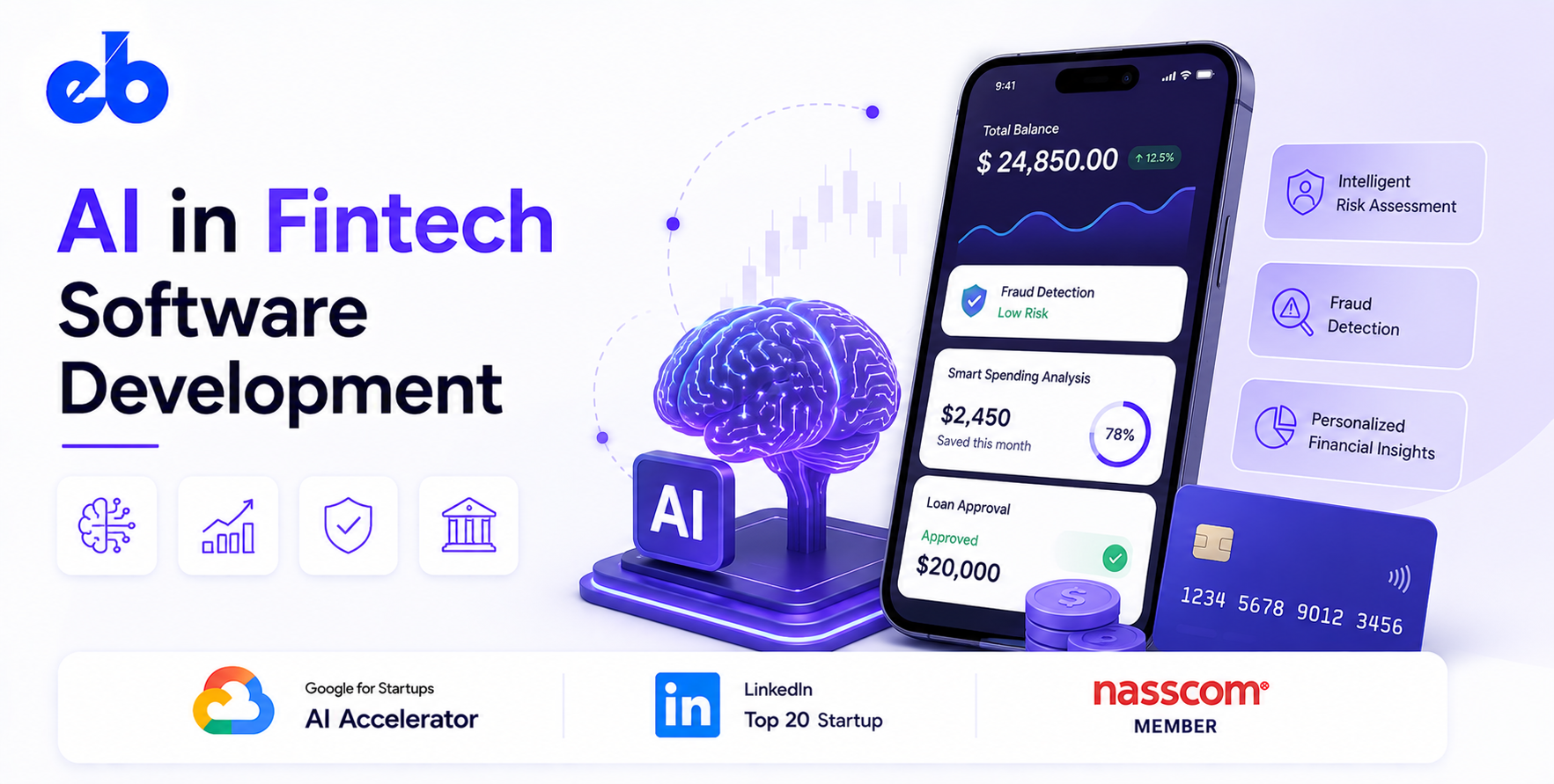
AI in fintech software development refers to the use of machine learning, large language models, predictive analytics, and automation to improve lending, payments, fraud detection, compliance, customer service, and financial decision-making. Rather than replacing financial systems, AI augments them by analyzing large volumes of transactional and behavioral data to make faster and more accurate decisions.
In 2019, a salary advance platform came to the team with a problem that seemed simple.
They had 50,000 salaried employees as borrowers. Most had bureau scores. Approval rates on bureau-only decisioning were acceptable. But 30% of their target market had no bureau history, first-time borrowers, recently employed, new-to-credit. The bureau said decline. The platform’s instinct said approve. The data wasn’t there to back the instinct.
The pattern was familiar. India has over 400 million working adults. Roughly 40% have no meaningful credit bureau history. Traditional credit scoring leaves them out entirely. The solution wasn’t a better bureau integration. It was a different data layer entirely.
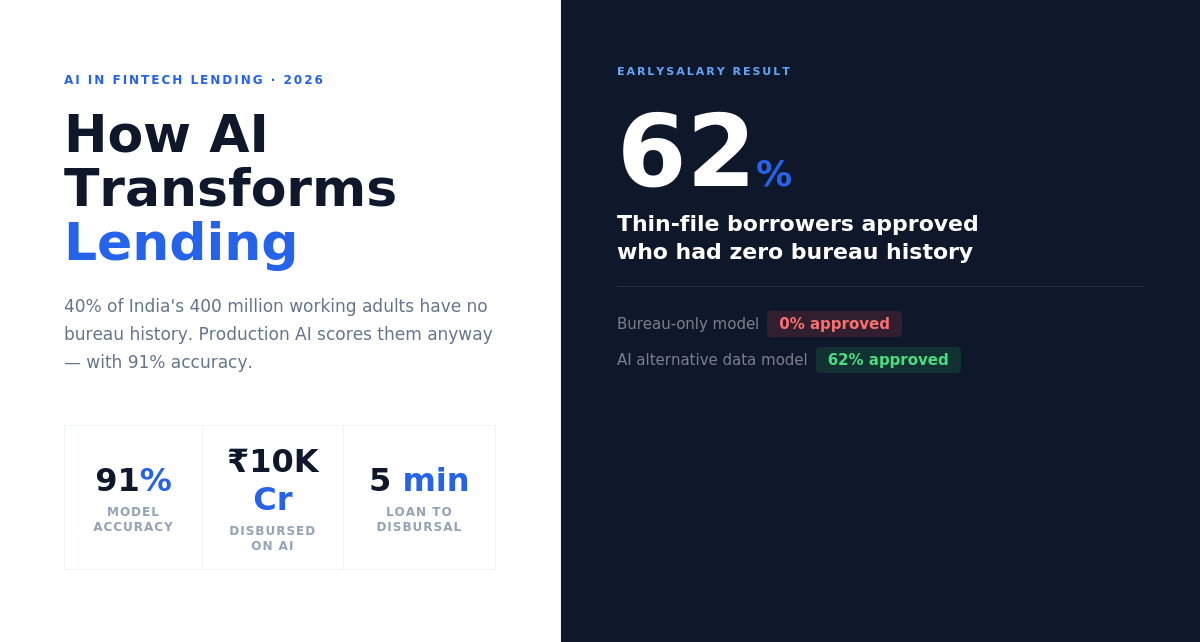
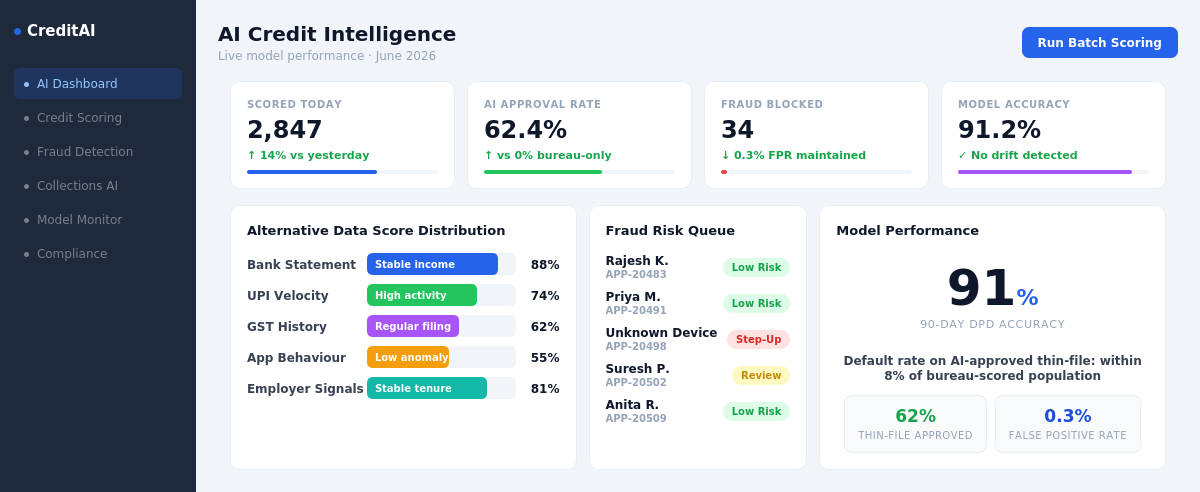
The team built an ML model trained on salary credit patterns, bank statement transaction features, UPI transaction velocity, employer stability signals, and behavioural data from the application flow itself. The model approved thin-file borrowers the bureau would have declined and predicted their repayment behaviour with 91% accuracy at 90-day DPD.
That platform became EarlySalary. It has disbursed over ₹10,000 crore.
That credit model, refined across millions of live disbursements, is the production AI the team brings to every fintech build. Not a proof-of-concept. Not a research model. Production code trained on real borrower data, validated against real repayment outcomes, deployed in a system processing real money.
The Google AI Accelerator 2024 selection, top 20 globally, reflects specifically this capability: production ML for financial decisions at scale.
This guide is about how AI transforms fintech and what building it actually requires.
Email mayank@engineerbabu.com to scope your fintech AI build.
Traditional credit scoring uses bureau data: repayment history, credit utilisation, account age, inquiry count. This works for borrowers with established credit histories. It fails for approximately 1.7 billion adults globally who lack sufficient bureau history for a score.
Alternative data credit scoring uses signals beyond the bureau:
Bank statement features: Income stability (variance in monthly credit inflows), salary regularity (same employer credit on predictable dates), expense discipline (fixed obligation ratio from debit patterns), cash buffer (average minimum balance), bounce frequency (returned debits as stress signal).
GST transaction data: For self-employed and MSME borrowers, GST return history provides verified revenue signals. Turnover trends, filing regularity, and buyer quality are extractable from GST data via the GSTN API. Between April and December 2026, PSBs sanctioned over ₹52,300 crore in MSME loans using GST-based underwriting.
UPI transaction history: Payment behaviour at velocity: how many transactions per month, to what categories, with what regularity. A borrower making 150 UPI transactions per month with consistent utility and insurance payments is a different risk profile from one making 12.
Telco data: Recharge frequency, plan tier, roaming patterns. Used selectively for thin-file borrowers where other alternative signals are unavailable.
Behavioural signals from the application itself: How long the borrower spent on each form section, how many times they edited an income field, whether they copy-pasted versus typed their PAN number. These micro-behavioural signals, invisible to the borrower, correlate with misrepresentation patterns at population level.
The model architecture for production alternative credit scoring:
The EarlySalary result: thin-file approval rate lifted from 0% (bureau decline) to 62% of applicants in the target segment. Default rate on thin-file approvals was within 8% of the bureau-scored population default rate. The model’s ability to distinguish genuine thin-file creditworthy borrowers from genuine high-risk ones was the commercial differentiation.
Every fintech transaction is a potential fraud event. The fraud patterns in 2026 are more sophisticated than rule-based systems were designed to detect:
The production fraud detection architecture:
Manual KYC processing costs Indian NBFCs ₹150–500 per application in staff time. At 5,000 applications per month, that is ₹75 lakh to ₹2.5 crore annually in KYC operations cost.
AI document processing reduces this by 70–85%:
Collections in lending is not just about calling borrowers who haven’t paid. It is about predicting which borrowers are about to miss a payment before they miss it, and intervening at the right moment with the right channel.
India’s regulatory environment for digital lending changes frequently. The RBI Digital Lending Directions 2025, SBR updates, co-lending norms, each change requires compliance documentation, system updates, and audit preparation.
AI RegTech applications in fintech:
AI in fintech software development enables products to adapt to each borrower’s profile rather than offering a single product to everyone:
Agentic AI in fintech software development execute multi-step workflows, and use tools without constant human instruction ]is moving from experiment to production in fintech in 2026.
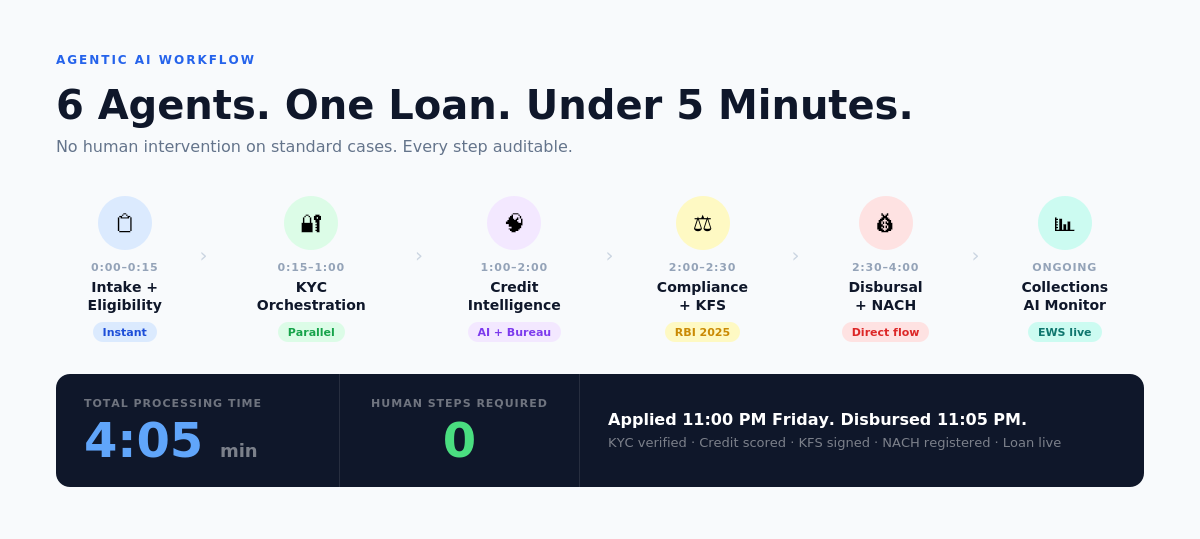
What it is: an agentic workflow in fintech is a system where multiple specialised AI agents coordinate to complete a complex task end-to-end.
Unlike a single ML model that scores a credit application, an agentic system can: receive an application, orchestrate KYC verification across multiple providers, pull bureau data, run the credit model, generate the KFS document, send the eSign request, receive the signed agreement, trigger disbursement, register the NACH mandate, and confirm the loan is live, all autonomously, in sequence, with human-in-the-loop gates only where the risk warrants it.
Who is doing what:
The result: A loan application submitted at 11pm on Friday is fully processed, KYC, bureau, credit decision, KFS, eSign, disbursement, NACH by 11:05pm. No human intervention. Every step auditable. Every compliance requirement met.
This is not a future vision. It is the architecture the team has been building toward across every lending platform build since EarlySalary.
Frameworks the team uses for agentic lending workflows: LangGraph for stateful multi-agent orchestration, Python-based agent loops with tool use (bureau APIs, NACH API, disbursement gateway as tools), CrewAI for coordinating parallel agents on independent tasks, and custom orchestration layers for the specific sequencing requirements of RBI-compliant lending.
ML/AI layer: Python (scikit-learn, XGBoost, LightGBM for credit scoring), TensorFlow/PyTorch (deep learning for fraud detection, document OCR), Hugging Face (NLP for document analysis, KFS generation), LangChain/LangGraph (agentic orchestration).
Feature store: Redis for real-time features (transaction velocity, fraud signals), Apache Kafka for streaming feature computation, PostgreSQL for historical feature storage.
Model serving: FastAPI microservice per model (credit scoring, fraud detection, collections propensity). Separate deployment from the application layer, models are updated independently of the LOS/LMS.
MLOps: Model versioning with MLflow, drift monitoring with Evidently AI, A/B testing infrastructure for model updates (champion-challenger framework, new model serves 10% of traffic before full rollout).
Infrastructure: AWS Mumbai (AP-South-1) for India data localisation. SageMaker for model training and batch inference. AWS Lambda for serverless inference on lightweight models.
Fintech AI development starts from $20,000 for a production ML credit scoring model integrated into an existing LOS, feature engineering pipeline, model training on the lender’s data, FastAPI serving layer, SHAP explainability output.
Full AI fintech stack, credit scoring + fraud detection + AI KYC document processing + collections propensity + agentic workflow orchestration: $80,000 – $200,000 depending on the number of models, the complexity of the agentic workflow, and the required regulatory compliance layer.
Timeline: Single model (credit scoring MVP): 8–12 weeks. Full AI stack: 5–9 months. Google AI Accelerator 2024 production ML capabilities. 40–60% lower cost than US/UK equivalent.
EarlySalary, ₹10,000 crore disbursed on the AI credit model the team built. LoanOS, ₹1,000 crore/year live. CTO 17yr Wishfin. Google AI Accelerator 2024 top-20 globally. Production models deployed, not research prototypes. Mayank leads personally. Full IP ownership.
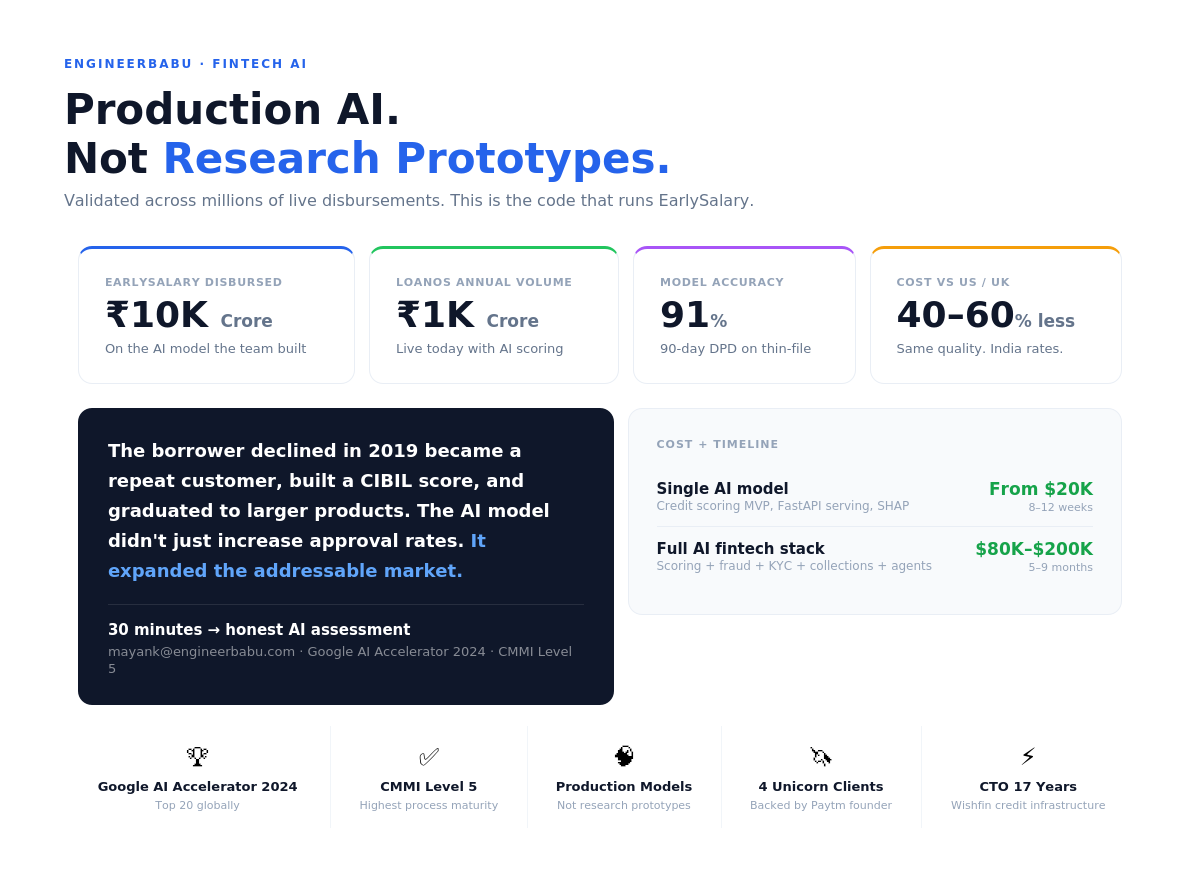
The thin-file borrower in 2019 who would have been declined by a bureau-only model but approved by the EarlySalary ML model that borrower became a repeat customer, built a CIBIL score over 18 months, and graduated to larger products. The AI model didn’t just increase approval rates. It expanded the addressable market.
That’s what production fintech AI does when it’s built correctly.
30 minutes. Honest assessment of your lending data, your current credit model, and what AI can genuinely add at your scale.
Mayank Pratap | Co-founder, EngineerBabu | engineerbabu.com EarlySalary ₹10,000Cr · LoanOS ₹1,000Cr/yr · CTO 17yr Wishfin · Google AI Accelerator 2024 · CMMI Level 5 · 4 Unicorn Clients · Backed by Vijay Shekhar Sharma
Using machine learning, deep learning, and agentic AI to automate and improve fintech products, specifically: alternative data credit scoring for thin-file borrowers, real-time fraud detection on transaction streams, AI-powered KYC document verification, collections propensity modelling for delinquency management, RegTech automation for RBI/regulatory compliance, and agentic workflow orchestration that processes loans end-to-end without manual intervention.
Credit scoring using signals beyond the bureau, bank statement transaction features, GST return history for MSMEs, UPI transaction patterns, telco data, and behavioural signals from the application flow. Production systems achieve 91%+ accuracy on 90-day DPD prediction for thin-file borrowers who would be declined by bureau-only models.
Multi-agent systems where specialised AI agents coordinate to complete end-to-end lending tasks autonomously: KYC agent, credit intelligence agent, compliance agent, disbursement agent, collections agent, each handling their domain, passing results to the next, with human review only where confidence thresholds require it. Result: a loan application to disbursement in under 5 minutes, fully compliant, fully auditable.
Model drift occurs when the borrower population’s characteristics change but the credit or fraud model is not retrained. A model trained before an interest rate cycle shift may approve borrowers who are now higher-risk under new conditions. Production AI requires automated drift monitoring and a retraining trigger not a scheduled annual review.