Digital Lending Platform Development


Create engaging, high-performance mobile applications tailored to your business needs. We craft future-ready apps that offer smooth user experiences on all devices.
Build robust and scalable websites and CMS platforms that help you manage content effortlessly. Our development ensures a seamless digital presence.
Launch secure, feature-rich online stores with intuitive shopping experiences. We build tailored eCommerce platforms designed for growth.
Design captivating games with immersive gameplay and stunning graphics. From concept to launch, we build engaging experiences that players love.
Enhance your customer relationships with customized Salesforce implementations. Drive growth and efficiency with smarter CRM solutions.
Harness artificial intelligence and machine learning to automate workflows and gain actionable insights. Our AI transforms data into smart decisions.
Accelerate your software delivery lifecycle with continuous integration, delivery, and infrastructure automation to boost efficiency.
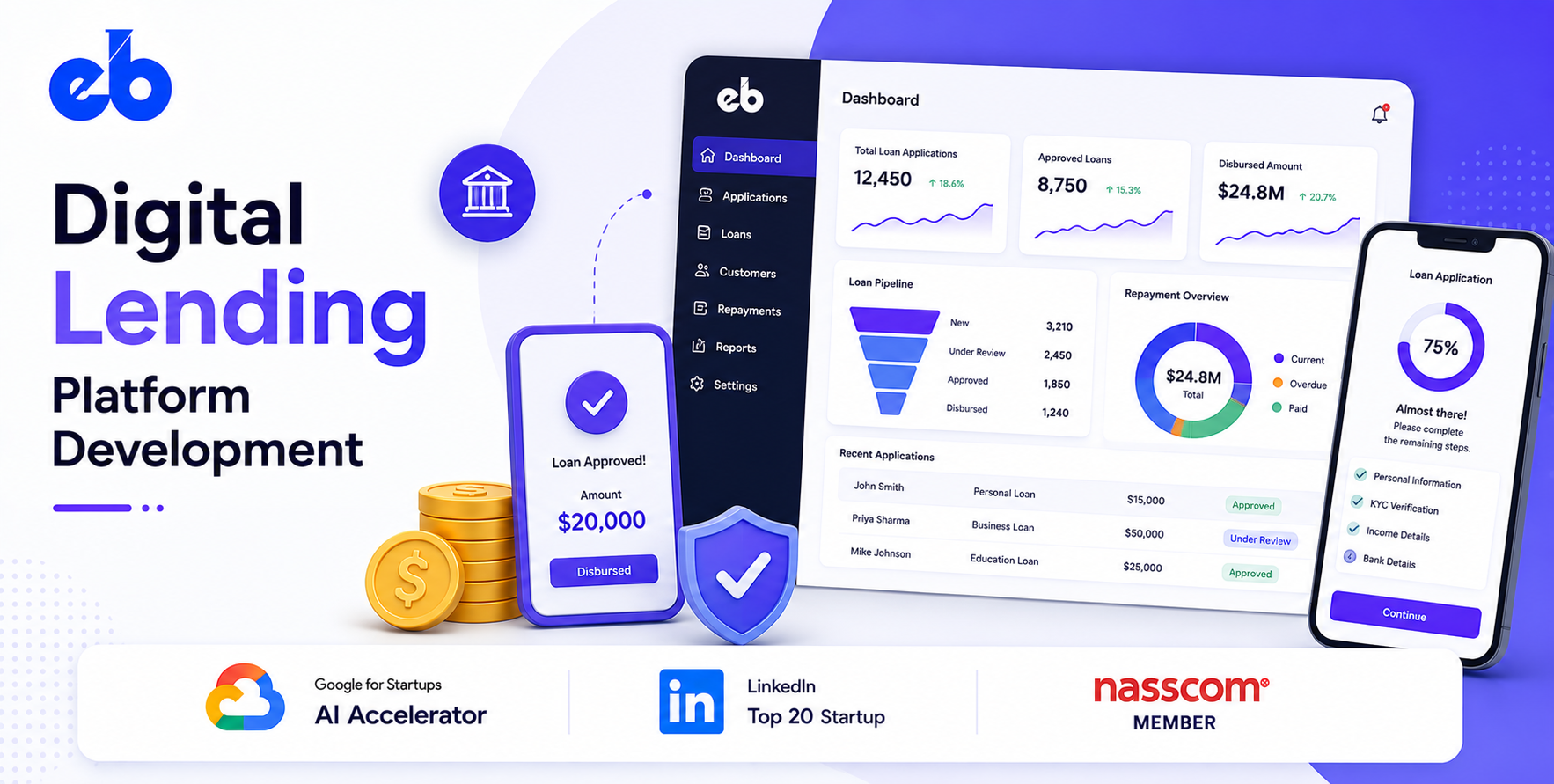
A loan app takes a borrower application and shows a status screen.
A digital lending platform decides, disburses, and manages, end to end, automated, compliant, and scalable.
The first can be built in 6 weeks. The second is a lending business infrastructure. One is a mobile interface. The other is an operating system for credit.
Most teams start by building the first and discover mid-build that they actually need the second.
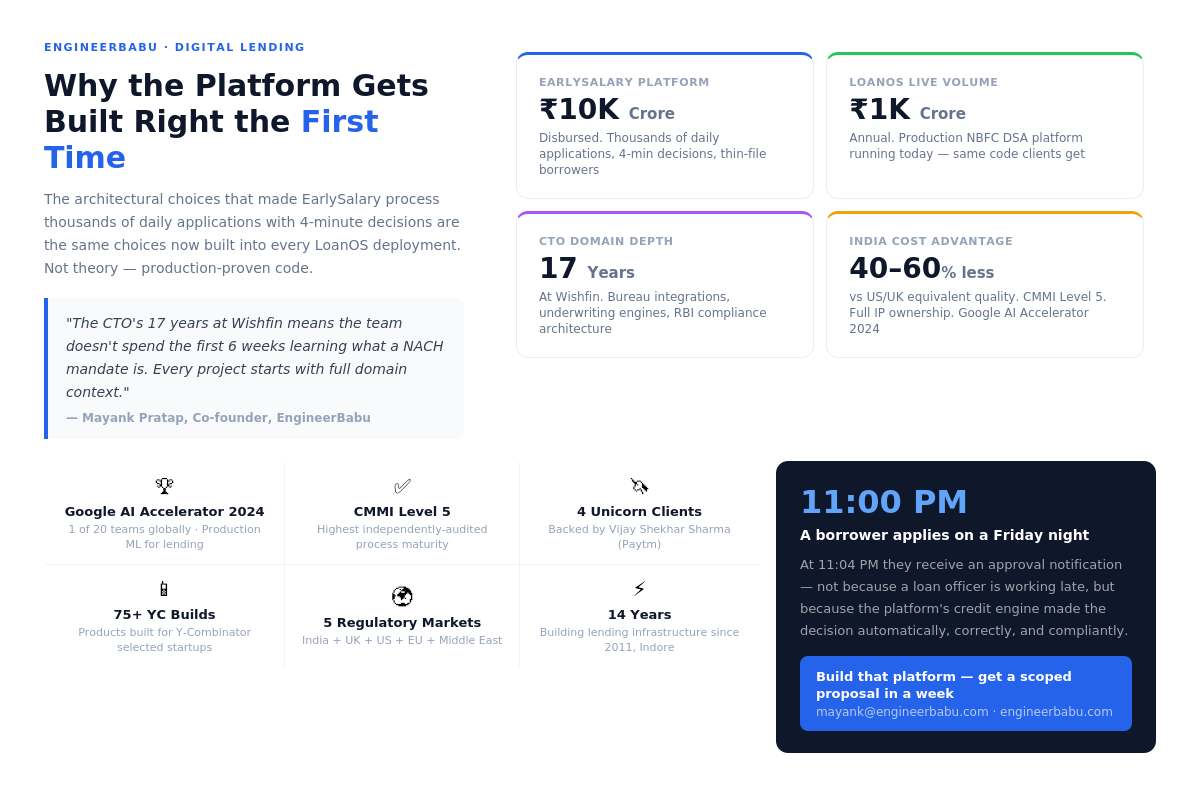
I co-founded EngineerBabu 14 years ago. The team built EarlySalary into a platform that has disbursed over ₹10,000 crore. LoanOS, the team’s own modular platform, processes ₹1,000 crore annually for a live DSA right now. The CTO built credit infrastructure at Wishfin for 17 years.
This guide is about building the second thing: a production digital lending platform that makes credit decisions automatically, disburses correctly, and satisfies RBI inspection.
Email mayank@engineerbabu.com if you’re building a digital lending platform.
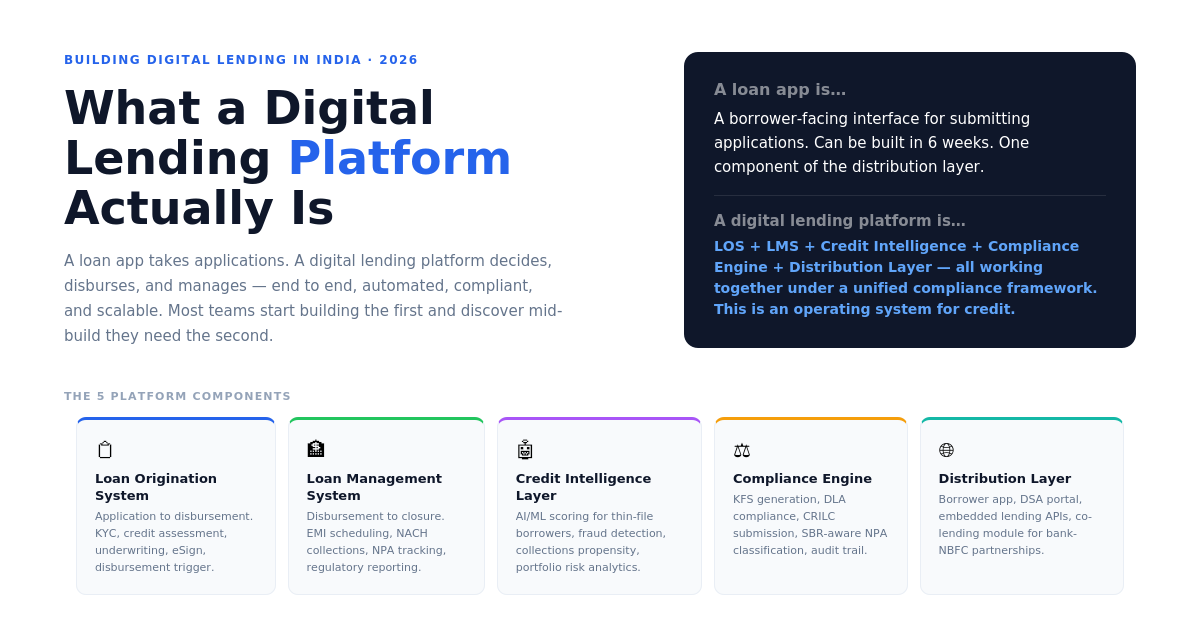
A digital lending platform is the complete technology infrastructure that enables a lender to originate, assess, approve, disburse, service, and collect loans, fully digitally, at scale, without manual intervention on standard cases.
It is not a single product. It is the combination of systems that collectively handle the full lending lifecycle:
A digital lending platform is all of these working together, with clean handoffs between them, under a unified compliance framework.
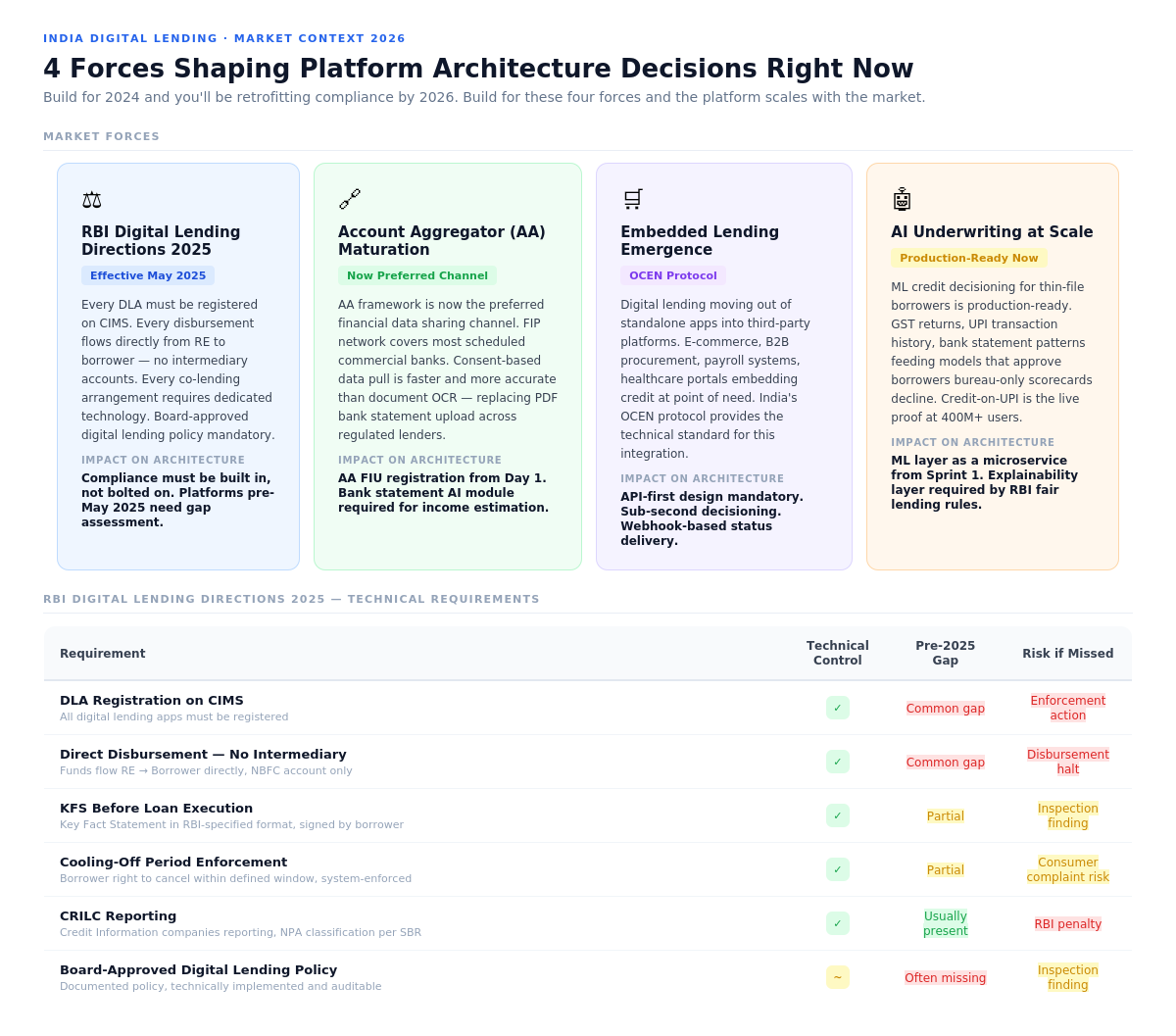
India’s digital lending market is at an inflection point. Three forces are driving platform architecture decisions right now.
Effective May 2025, fully operational March 2026, the RBI Digital Lending Directions consolidated the entire digital lending regulatory framework. Every DLA must be registered on CIMS. Every disbursement must flow directly from the RE to the borrower.
Every co-lending arrangement requires dedicated technology. Every NBFC must have a board-approved digital lending policy. Technology built before May 2025 must be assessed for compliance gaps.
The AA framework is now the preferred channel for financial data sharing in digital lending. Bank statement analysis via AA consent is replacing PDF upload and OCR across regulated lenders.
AA adoption is accelerating: the FIP network now covers most scheduled commercial banks, and the consent-based data pull is faster and more accurate than document OCR.
Digital lending is moving out of standalone apps and into third-party platforms. E-commerce apps, B2B procurement platforms, payroll systems, and healthcare portals are embedding lending at the point of need.
LoanPro’s research projects embedded finance will exceed $7 trillion in total US transactions, India’s trajectory mirrors this at smaller scale but growing rapidly. OCEN (Open Credit Enablement Network) is India’s protocol for this, the technical framework that allows any digital platform to trigger a loan product on behalf of their users through a regulated lender.
The team was part of, reflecting a broader shift: ML-powered credit decisioning for thin-file borrowers is production-ready. Alternative data sources, GST returns, bank statement transaction patterns, UPI transaction history, utility payment records are feeding production underwriting models that approve borrowers who would have been declined by bureau-only scorecards.
Credit-on-UPI in 2026 is the clearest proof: BNPL integrated with UPI’s 400M+ active user base, using behavioural signals from UPI transaction history for instant credit decisions.
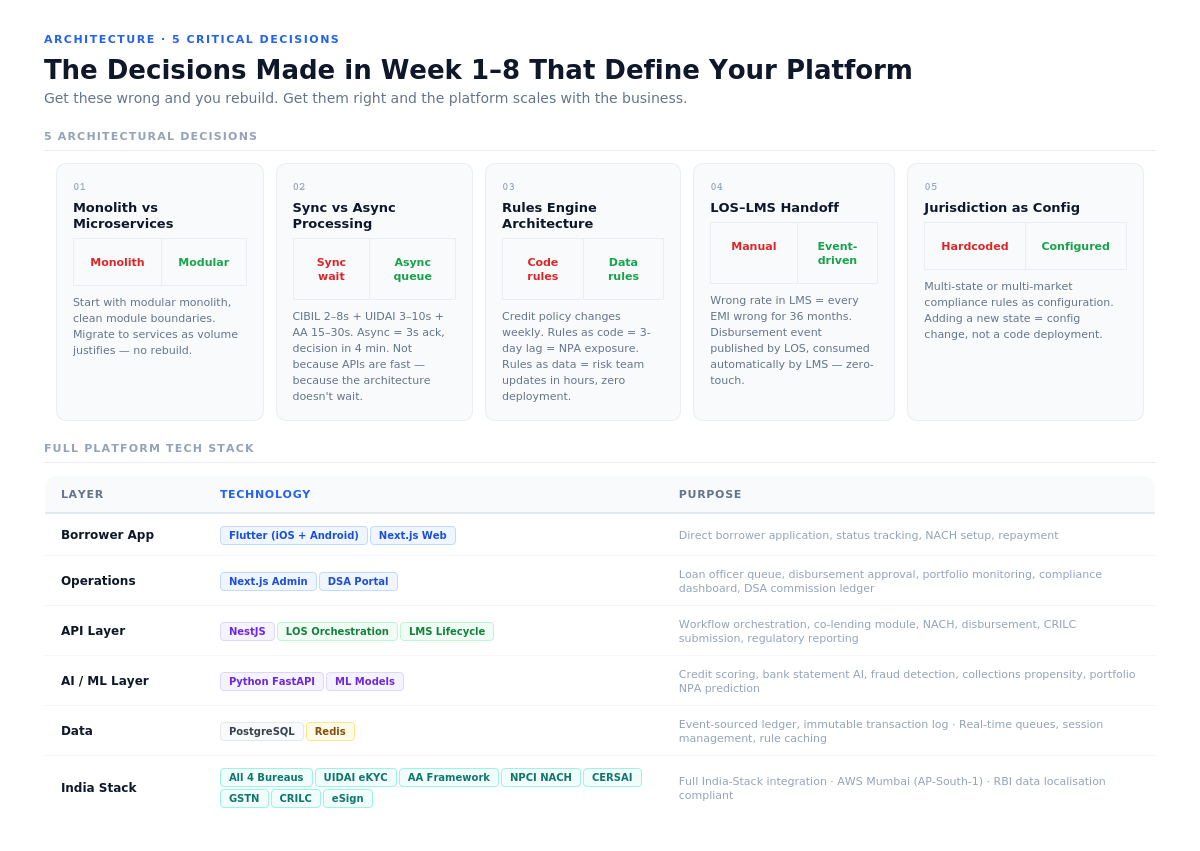
The monolith (one codebase, one deployment) is faster to build for Tier 1 volume. It becomes a constraint at scale when the KYC module goes down and takes the entire disbursement process with it.
The microservices architecture (separate services for KYC, bureau, underwriting, disbursement, collections) enables independent scaling of bottleneck components, independent deployment of compliance updates without touching the core ledger, and independent failure (the KYC service can be degraded without stopping collections for existing loans).
The production recommendation: Start with a modular monolith (single deployment, but with clean module boundaries). Migrate individual modules to independent services as volume justifies. LoanOS is built on this pattern, the modules are designed to be extracted as the lender’s volume grows, without rebuilding the platform.
Synchronous: the borrower submits an application and waits while the system runs KYC, bureau, and underwriting in sequence. Fast for the system. Catastrophic for experience if any external API is slow.
CIBIL API response time is typically 2–8 seconds. UIDAI Aadhaar response is 3–10 seconds. AA data pull can take 15–30 seconds if the borrower’s bank has a slow FIP implementation. Running these sequentially, synchronously, means a borrower waits 30–60 seconds staring at a loading screen. Then the AA times out. Then the application errors.
Asynchronous: the borrower submits and receives an acknowledgment in under 3 seconds. KYC, bureau, and AA run concurrently in background workers. The borrower gets a push notification when the decision is ready. This is how EarlySalary processed thousands of daily applications with decisions in under 4 minutes, not because the external APIs were fast, but because the architecture didn’t force the borrower to wait for them.
Production requirement: every external API call in the critical path of a borrower-facing flow is asynchronous with defined timeout handling, retry logic, and fallback paths.
Credit policy changes frequently. New NPA data changes the minimum bureau score threshold. A new product requires a different FOIR limit. An RBI circular changes the eligible tenure range.
If these changes require a developer, they take 1–3 weeks and create policy lag, the credit policy in production doesn’t match the credit policy the risk team decided on. At EarlySalary, where credit policy was iterated based on real-time portfolio performance, policy lag was not acceptable.
Production requirement: credit rules are data, not code. The rules engine is a separate service with a UI for the credit team. Policy changes are configurations, not deployments.
The LOS creates the loan. The LMS manages it. The handoff, disbursement confirmation triggering automatic LMS record creation, must be zero-touch. Manual handoffs create data quality problems that compound for the life of the loan.
Wrong interest rate entered manually into the LMS: every EMI calculation for 36 months is wrong. Wrong tenure: the EMI schedule ends before the loan is repaid.
Production requirement: disbursement event published by LOS, consumed by LMS automatically. The data contract between LOS and LMS is defined and tested before either system goes live.
For lenders operating across Indian states or across India + one international market, jurisdiction-specific compliance rules must be configurable, not hardcoded. Adding a new state or updating an existing state’s rules is a configuration change, not a code deployment.
This is the architecture the team built for TaptapSend across 5 regulatory markets. It is the same architecture that makes EngineerBabu’s multi-state NBFC platforms maintainable as RBI Master Directions change.
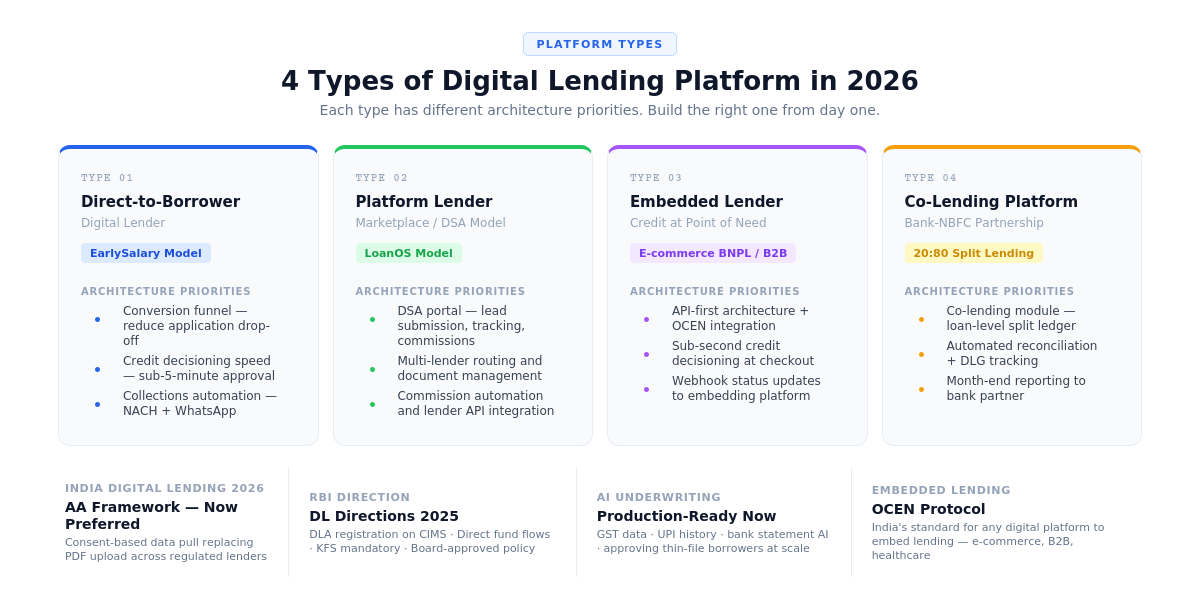
The NBFC or fintech directly acquires and lends to borrowers through its own app and website. EarlySalary is the archetype: direct app, instant credit decision, salary advance at scale.
Architecture priority: Conversion funnel (reduce application drop-off), credit decisioning speed (sub-5-minute approval), collections automation (NACH + WhatsApp for delinquency management).
The lender operates through DSA networks and lending marketplaces. LoanOS is the enabling platform. The borrower is sourced by agents; the NBFC is the lender of record.
Architecture priority: Multi-lender routing, DSA portal, commission automation, document management, lender API integration.
Credit embedded inside a non-financial platform: an e-commerce checkout BNPL, a B2B procurement platform offering invoice financing, a healthcare platform offering medical financing. The borrower never leaves the third-party platform to apply for credit.
Architecture priority: API-first architecture, OCEN integration, sub-second credit decisioning at checkout, webhook-based status updates to the embedding platform, compliance layer that satisfies the RE’s obligations regardless of the distribution channel.
The NBFC co-lends with a bank partner, typically 20:80 split using the NBFC’s sourcing and underwriting and the bank’s capital. The technology must manage the split ledger, partner reconciliation, and DLG tracking.
Architecture priority: Co-lending module (loan-level split, automated reconciliation, DLG tracking), partner API integration, month-end reporting to bank partner.
The ₹10,000 crore EarlySalary platform was a direct-to-borrower Type 1 build. The challenge: thin-file borrowers (first-time credit users with no bureau history), high application volume (thousands daily), and credit policy that needed to iterate weekly based on real-time NPA data.
The architectural choices that made it work: asynchronous processing for every external API call, alternative data scoring built before the ML models existed (starting with rules-based proxies, graduating to ML), a rules engine the credit team could update without raising a Jira ticket, and a LOS-LMS handoff that was an automated event from day one.
LoanOS distilled these choices into a deployable platform. Every NBFC running on LoanOS inherits the same architectural decisions the ₹10,000 crore platform runs on not as theoretical best practices, but as production-proven code.
The CTO’s 17 years at Wishfin adds the bureau sequencing logic, the underwriting discipline, and the compliance architecture that separates a system that works in a demo from a system that works under RBI inspection. That context is what the team brings to every digital lending platform build.
The team can scope your digital lending platform and have a proposal in your inbox within a week. mayank@engineerbabu.com.
Digital lending platforms start from $15K (LoanOS-based Tier 1 deployment) to $500K+ (enterprise AI-powered multi-market platform).
Timeline: 8–10 weeks for LoanOS-based Tier 1. 5–9 months for full Tier 2 production platform. 9–18 months for Tier 3 enterprise with AI scoring and multi-market compliance.
40–60% cost savings vs US/UK equivalent quality. CMMI Level 5. Full IP ownership.
The borrower who applies for a loan at 11pm on a Friday and gets an approval notification at 11:04pm, not because a loan officer is working late, but because the platform’s credit engine made the decision automatically, correctly, and compliantly is the borrower who becomes a repeat customer.
That platform is built in the architecture decisions made in the first 8 weeks of development.
mayank@engineerbabu.com
Mayank Pratap | Co-founder, EngineerBabu | engineerbabu.com ₹10,000Cr EarlySalary · LoanOS ₹1,000Cr/yr · CTO 17yr Wishfin · Google AI Accelerator 2024 · CMMI Level 5 · 4 Unicorn Clients · Backed by Vijay Shekhar Sharma
The complete technology infrastructure enabling a lender to originate, assess, approve, disburse, service, and collect loans digitally at scale. It combines a Loan Origination System (application to disbursement), Loan Management System (disbursement to closure), credit intelligence layer (AI scoring, fraud detection, collections AI), compliance engine (KFS, CRILC, DLA), and distribution layer (borrower app, DSA portal, embedded lending APIs).
The unified regulatory framework (effective May 2025) governing all digital lending in India. Key requirements: DLA registration on CIMS portal, direct fund flows (no intermediary nodal accounts), KFS before loan execution, cooling-off period, DLG tracking, and compliant grievance redressal. Platforms built before May 2025 must be assessed for compliance gaps.
Credit embedded inside a non-financial platform, e-commerce, B2B procurement, healthcare, payroll. The embedding platform calls the lender’s API with the user’s profile and transaction data. The lender’s credit engine returns an approval/amount/rate in sub-second time. The user accepts at checkout without visiting a separate app. India’s OCEN protocol provides the technical standard for this integration pattern.
RBI-mandated digital data sharing infrastructure that allows borrowers to consent to sharing financial data from any registered FIP (bank, insurance, investment). For digital lending platforms, AA replaces PDF bank statement upload with a direct, consent-based data pull that is faster, more accurate, and preferred under the Digital Lending Directions 2025.
A loan app is a borrower-facing interface for submitting applications. A digital lending platform is the complete infrastructure: LOS + LMS + credit intelligence + compliance engine + distribution layer. The loan app is one component of the platform’s distribution layer.
LoanOS-based Tier 1 (single product, standard modules): 8–10 weeks. Full production Tier 2 platform (multi-product, AI scoring, co-lending): 5–9 months. Enterprise Tier 3 (AI-powered, multi-market): 9–18 months.