Mortgage POS and LOS Development for US Lenders


Create engaging, high-performance mobile applications tailored to your business needs. We craft future-ready apps that offer smooth user experiences on all devices.
Build robust and scalable websites and CMS platforms that help you manage content effortlessly. Our development ensures a seamless digital presence.
Launch secure, feature-rich online stores with intuitive shopping experiences. We build tailored eCommerce platforms designed for growth.
Design captivating games with immersive gameplay and stunning graphics. From concept to launch, we build engaging experiences that players love.
Enhance your customer relationships with customized Salesforce implementations. Drive growth and efficiency with smarter CRM solutions.
Harness artificial intelligence and machine learning to automate workflows and gain actionable insights. Our AI transforms data into smart decisions.
Accelerate your software delivery lifecycle with continuous integration, delivery, and infrastructure automation to boost efficiency.
Hire app developers ready to turn your ideas into sleek, high-performing mobile apps for any platform.
Bring in frontend pros who craft smooth, beautiful, and user-friendly interfaces that your visitors will love.
Get backend developers who build fast, secure, and reliable systems to keep everything running behind the scenes.
Hire eCommerce developers who build secure, scalable online stores designed to offer seamless shopping and grow your sales.
Get dedicated developers committed to your projects, delivering consistent quality and speed as an extension of your team.
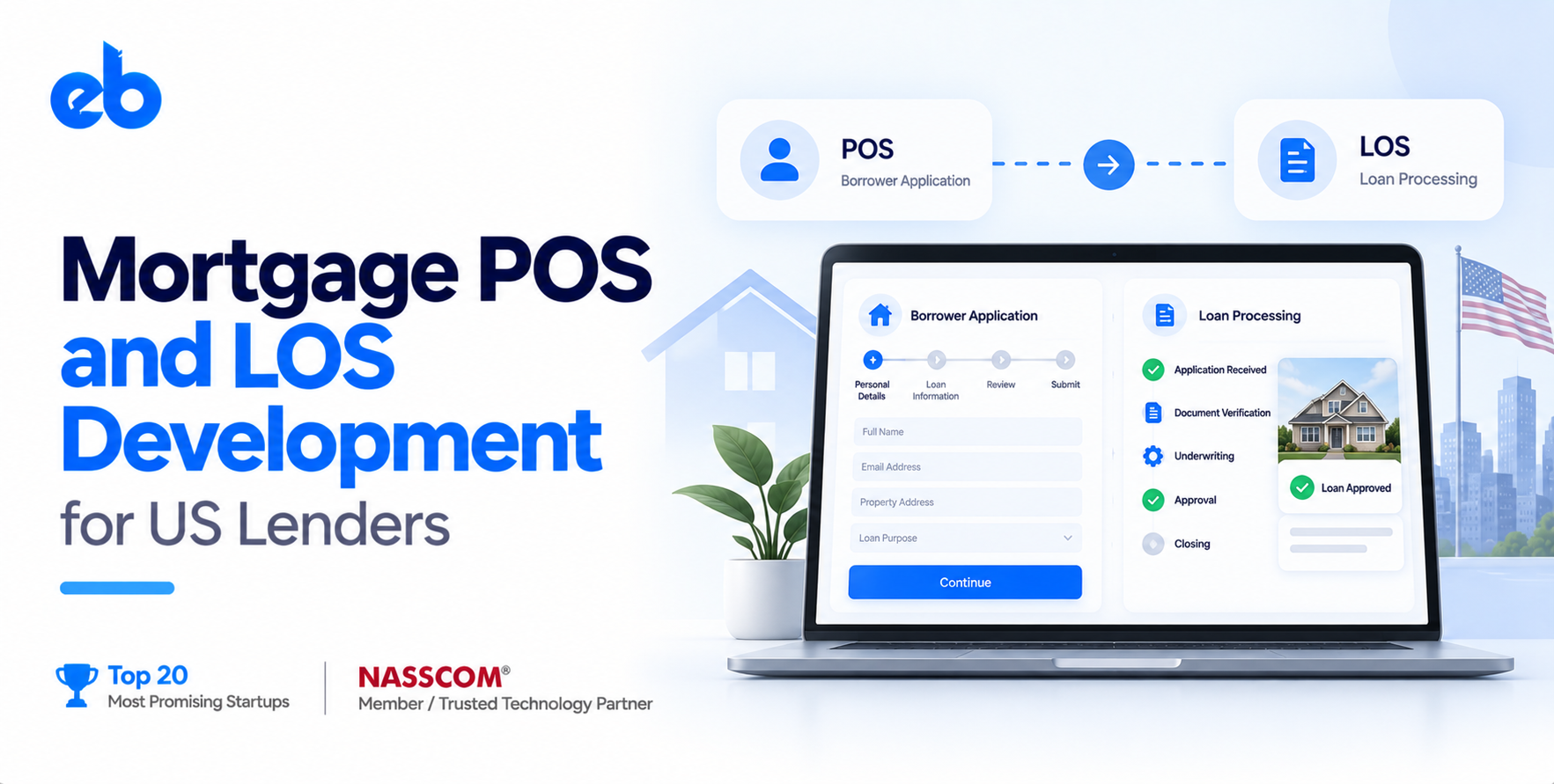
A borrower uploads two pay stubs at 9:40 PM. Six minutes later the file has a soft credit pull, a parsed income figure, a locked rate quote, and a conditional approval waiting in a processor’s queue by morning.
Nothing about that is futuristic. It is what happens when the point of sale and the loan origination system are built as one pipeline instead of two products stitched together with email.
Most US lenders already have both. What they usually do not have is a stack that passes data cleanly between them. This guide covers Mortgage POS and LOS development for US lenders in practical terms: what each layer does, which integrations matter, what compliance demands, and what the build actually costs.
The two systems solve different problems and get confused constantly. Understanding the split is the first step in any Mortgage POS and LOS development for US lenders project.
This is everything the borrower touches. The digital 1003 (URLA), document upload, asset and income verification, eConsent, rate display, status tracking, and loan officer co-browsing.
Borrowers abandon here more than anywhere else, so responsiveness and clarity matter. Lenders who expect heavy smartphone usage usually pair the web flow with native mobile app development rather than shipping a cramped responsive view.
This is the operational spine: pipeline management, processing checklists, underwriting conditions, disclosure generation and timing, closing, funding, and post-close delivery.
A strong LOS is really a workflow and rules engine wearing a loan application. Every condition, every state-level rule, and every handoff between processor, underwriter, and closer lives here.
Margins explain most of it. According to the Mortgage Bankers Association, total loan production expenses averaged $11,988 per loan in the first quarter of 2026, up from $11,102 the previous quarter.
When it costs that much to originate, every manual touch shows up on the P&L. Lenders reach for custom Mortgage POS and LOS development for US lenders when three things are true at once.
If none of those apply, configuring an existing platform is the cheaper answer. Build when the workflow itself is the differentiator.
Ask any lender where a mortgage build went sideways and the answer is rarely the interface. It is the connections. This is the most underestimated part of Mortgage POS and LOS development for US lenders.
Your platform needs to talk to credit resellers such as Xactus or MeridianLink, automated underwriting through Fannie Mae’s Desktop Underwriter and Freddie Mac’s Loan Product Advisor, and a pricing engine like Optimal Blue or Polly.
Add verification providers, flood certification, fraud and identity checks, title, appraisal management, doc prep vendors, and MERS eRegistry for eNotes. Each one has its own auth model, sandbox quality, and failure behavior.
Sound API development practice matters here. Build an abstraction layer per vendor category so swapping a credit reseller does not touch your underwriting logic.
One more rule: keep MISMO v3.4 as your internal data contract. UCD and ULDD delivery later becomes a mapping exercise instead of a rewrite.
Resist the urge to support every product on day one. Choose your highest-volume product, usually conventional conforming purchase, and map the full journey. Application to disclosure, processing to underwriting, closing to investor delivery. Document every condition, every trigger, and every state variation your team currently handles manually.
This map becomes your rules specification. Teams that skip this step end up encoding tribal knowledge halfway through development, which is when timelines slip. Expect two to three weeks with your operations lead in the room.
Define your loan file schema against MISMO v3.4 first. Every field your POS collects, your LOS processes, and your investor expects should trace back to a single canonical record. Version it.
Loan data changes constantly through the lifecycle, so you need field-level history, not just a current-state row. Decide early how you will store documents, how you will link them to conditions, and where encryption sits. Getting this right is unglamorous and saves six months of refactoring when your second loan product arrives.
Launch the borrower layer first, because it produces measurable results fastest. Target a complete application flow: URLA, eConsent, credit pull, verification, document upload, and status tracking. Skip the extras until real applicants tell you what breaks.
A disciplined MVP development approach here gets loan officers testing within eight to ten weeks instead of a year. Instrument every screen. Drop-off data from the first 200 real applications will reshape your roadmap more usefully than any internal requirements workshop.
Now connect the back half. Start with credit, AUS, and pricing, since those gate every downstream decision. Then add doc prep, flood, fraud, title, and appraisal. Build retry logic with exponential backoff, plus a manual override queue for every vendor failure.
Vendor sandboxes are inconsistent, so budget real time for certification with Fannie Mae, Freddie Mac, and your doc prep provider. Your condition engine should fire automatically off AUS findings rather than waiting for an underwriter to read a PDF.
Do not cut over. Run 30 to 50 real loans through both the legacy system and the new platform simultaneously. Compare disclosures line by line, check timing compliance, and reconcile fees to the penny.
Your QC and compliance teams should sign off on the output, not the demo. Fix what the parallel run exposes, then migrate by branch or channel rather than all at once. This phase feels slow and consistently prevents the kind of disclosure error that triggers a repurchase demand.
Regulation shapes architecture in US mortgage, so treat it as a design input. Every Mortgage POS and LOS development for US lenders project has to account for these from the first sprint.
Retrofitting disclosure timing into a finished system is painful. Building it into the workflow engine is routine.
Skip the chatbot conversation. The measurable wins in mortgage sit in document handling and decision support.
Document classification and data extraction come first. A borrower uploads 40 pages of bank statements, tax returns, and pay stubs. Models trained on mortgage documents can classify, extract, and cross-check those against the 1003 in seconds. Well-executed AI development here removes hours of stipulation review per file.
Next comes condition prediction. ML development models trained on your closed loan history can flag which files will draw underwriting conditions, so processors chase documents before the file stalls.
Two more that earn their keep: fallout prediction on rate-locked pipelines, and appraisal review that flags comparable selection issues before the underwriter opens the report.
Numbers vary with scope, but the shape is consistent. A production-ready POS with core verifications and credit typically runs $80,000 to $150,000 across three to four months.
A full LOS with a rules engine, disclosure generation, AUS, doc prep, closing, and investor delivery generally sits between $250,000 and $600,000 over nine to fourteen months.
Integration certification is the line item most teams underestimate. Fannie Mae, Freddie Mac, MERS, and doc prep vendors each have their own approval process and calendar.
Ongoing costs matter too. Budget 18 to 22% of build cost annually for maintenance, vendor API changes, and regulatory updates, which arrive whether or not your roadmap has room.
Mortgage POS and LOS development for US lenders is a workflow and integration problem dressed up as a software problem. The teams that succeed spend more time on condition logic and vendor failure handling than on screen design.
Start with one product, own your data model, ship the borrower layer early, and let parallel processing prove the system before you trust it with volume.
If you are scoping a build and want a partner who has shipped regulated lending platforms, EngineerBabu works as a fintech app development company across origination, servicing, and underwriting systems.
EngineerBabu is a technology development company building products across fintech, healthtech, and AI, from MVPs to scaled, production-ready platforms.
It holds a CMMI Level 5 rating, has worked with 4 unicorn clients, and has supported 200+ VC-funded products. The company is backed by Vijay Shekhar Sharma.
Founded by Mayank Pratap (Co-founder) · mayank@engineerbabu.com
The POS is the borrower-facing application layer: the digital 1003, document upload, verifications, and status tracking. The LOS is the internal engine that handles processing, underwriting conditions, disclosures, closing, and investor delivery. Mortgage POS and LOS development for US lenders works best when both share one data model.
Configure if your products and workflow fit a standard template. Build when your product mix, such as non-QM or construction lending, forces constant workarounds, or when per-loan platform fees scale faster than your volume does.
A focused POS reaches production in three to four months. A complete LOS with rules engine, AUS, disclosures, closing, and delivery typically takes nine to fourteen months, including vendor certification time with Fannie Mae, Freddie Mac, and MERS.
Credit, automated underwriting (DU and LPA), and pricing come first, because they gate every downstream decision. Verification providers, doc prep, flood, fraud, title, and appraisal follow once the core decisioning path works reliably.
Yes. Using MISMO v3.4 as your internal data contract makes UCD and ULDD delivery a mapping exercise later. Retrofitting MISMO onto a proprietary schema after launch is one of the most expensive rewrites in mortgage tech.