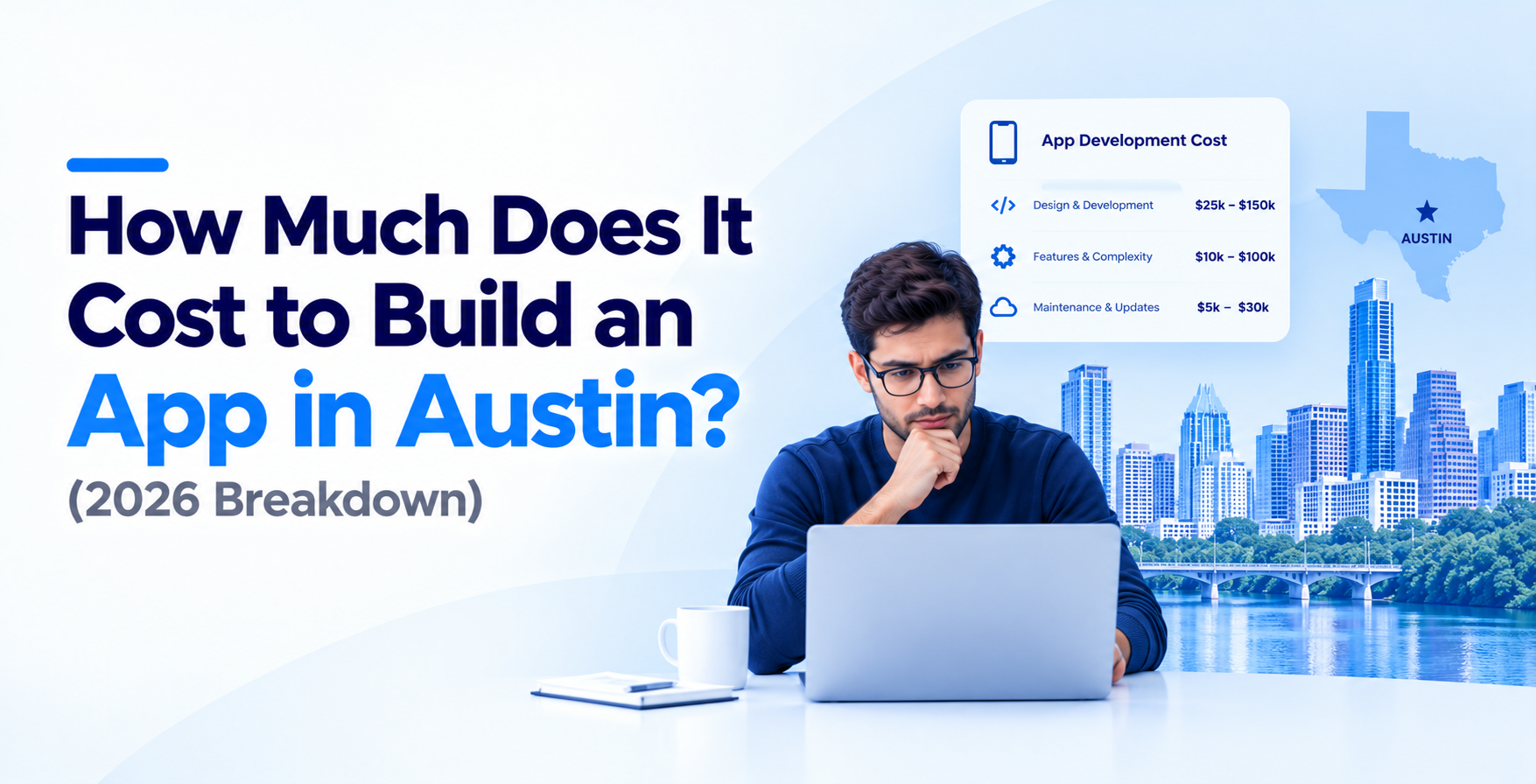
How Much Does It Cost to Build an App in Austin? (2026 Breakdown)


Create engaging, high-performance mobile applications tailored to your business needs. We craft future-ready apps that offer smooth user experiences on all devices.
Build robust and scalable websites and CMS platforms that help you manage content effortlessly. Our development ensures a seamless digital presence.
Launch secure, feature-rich online stores with intuitive shopping experiences. We build tailored eCommerce platforms designed for growth.
Design captivating games with immersive gameplay and stunning graphics. From concept to launch, we build engaging experiences that players love.
Enhance your customer relationships with customized Salesforce implementations. Drive growth and efficiency with smarter CRM solutions.
Harness artificial intelligence and machine learning to automate workflows and gain actionable insights. Our AI transforms data into smart decisions.
Accelerate your software delivery lifecycle with continuous integration, delivery, and infrastructure automation to boost efficiency.

Hiring a single senior engineer in Austin for one year now costs more than some founders have budgeted for their entire app.
That one fact explains most of the sticker shock. Austin is no longer a cheap alternative to the Bay Area. It is a top-tier tech labor market with Tesla, Oracle, Apple, and a dense startup layer all bidding for the same engineers.
So when you ask what the cost to build an app in Austin really is, you are mostly asking what that talent market charges per hour, and how many hours your idea actually needs.
TL;DR
Here is where most 2026 Austin projects land before maintenance.
| Build type | Typical range | What it covers |
| MVP / single-purpose app | $45,000 to $85,000 | One platform, core flow, light backend |
| Mid-complexity product | $90,000 to $200,000 | Auth, payments, admin panel, two platforms |
| Enterprise or regulated | $220,000 to $400,000+ | Compliance, AI, heavy integrations, SLAs |
These are full-service agency numbers inside the metro. The same scope delivered through a blended onshore-offshore team usually sits well below the floor of each bracket, which is why so many Austin founders compare the mobile app development cost in USA against local quotes before committing.
Agency pricing is downstream of payroll. In Austin, that payroll is expensive.
Built In reports the average base salary for a software engineer in Austin at $144,034, with average total compensation reaching $159,825 (Built In, 2026). An agency has to cover that, plus benefits, bench time, QA, design, and management overhead.
Run the math and a blended billing rate of $130 to $190 per hour stops looking like a markup. It looks like arithmetic.
This is also why the cost to build an app in Austin rarely drops below $45,000 for anything useful. A 400-hour build at $120 an hour is already $48,000, and 400 hours is a modest scope.
Scope category predicts your budget better than any screen count.
For marketplace app development, expect $70,000 to $160,000. Two-sided flows, onboarding, search, ratings, and notifications add up fast. Real-time matching or in-app chat pushes you toward the top of that band.
Expect $80,000 to $180,000. Fewer users, but far more permission logic, reporting, and admin tooling than founders expect. Integration with an existing CRM or ERP often becomes the largest single line item.
Expect $150,000 to $350,000. KYC, bureau pulls, ACH rails, and audit logging are non-negotiable. Austin has a growing lending tech cluster, and teams here frequently work with a loan management software development company in Austin rather than a generalist shop.
For healthcare app development, expect $180,000 to $400,000. HIPAA controls, BAAs, encryption standards, and clinical workflow validation add months. Compliance work alone can consume a quarter of the budget.
Every estimate you receive is a rate multiplied by hours. Knowing the rate tells you whether the number is defensible.
| Delivery model | Blended hourly rate | Trade-off |
| Austin agency | $130 to $190 | Local, polished, most expensive |
| Senior Austin contractor | $90 to $150 | Cheaper, thin bench, key-person risk |
| Hybrid onshore lead + offshore team | $45 to $85 | Best balance for funded startups |
| Fully offshore | $25 to $50 | Lowest cost, needs strong spec discipline |
The hybrid model is what most Series A teams here settle on. If you are weighing that choice, the practical differences between US developers vs offshore developers come down to timezone overlap and spec quality, not raw skill.
Four variables account for most of the spread in the cost to build an app in Austin.
Cut to the single workflow that proves someone will pay. Most founders scope four features they need and six they merely want. Removing the latter usually trims 35 to 50 percent off the first invoice without weakening the product thesis. An honest MVP development for startups in the USA approach means launching narrow, measuring real behavior, then funding the next build with evidence instead of assumptions. Investors respond better to usage data than to a feature-complete demo nobody has opened twice.
Keep product ownership, design direction, and stakeholder communication in Austin. Move sustained engineering offshore where senior talent costs a third as much. This structure preserves the local accountability that makes Austin agencies attractive while removing the payroll that makes them expensive. The handoff works when specs are written, tickets are detailed, and there is daily overlap of at least four hours. Teams that reduce mobile app development costs successfully almost always restructure the team before they cut scope.
Change requests mid-build are the most expensive line on any invoice. A two-week discovery phase that produces wireframes, user stories, and a signed scope document costs a few thousand dollars and routinely saves five figures. It also gives you a realistic timeline to build a mobile app, which matters when you are coordinating a launch with fundraising or a seasonal window. Vague briefs produce vague estimates, and vague estimates always resolve upward.
Ask for an itemized breakdown by phase, not one lump figure. Ask who writes the code and whether you can meet them. Ask what happens in month four when something breaks at 2 AM.
Firms that answer these cleanly are usually the ones worth hiring. A vendor who deflects on team composition is telling you something. These are the same filters that separate a good partner from an expensive one when you hire mobile app developers in the USA at any budget level.
For Austin founders, the question is rarely local versus offshore. It is how to get senior engineering without a local payroll.
EngineerBabu runs a hybrid structure built for exactly that gap. You get product leadership aligned to US hours, CMMI Level 5 delivery process, and engineering depth across fintech, healthtech, and AI, as a mobile app development company serving US clients.
The practical result is that the cost to build an app in Austin drops substantially without the coordination chaos that makes founders distrust offshore work.
EngineerBabu holds a CMMI Level 5 rating, has worked with 4 unicorn clients, and has supported 200+ VC-funded products. Founded by Mayank Pratap, backed by Vijay Shekhar Sharma.
The cost to build an app in Austin is not a number you look up once. It is the output of three decisions: what you build, who builds it, and where they sit.
Founders who treat scope as negotiable and team structure as a lever consistently ship for less than founders who accept the first local quote. The ones who skip discovery pay the difference later, usually twice.
Most Austin projects land between $45,000 for a focused MVP and $400,000 for enterprise or regulated platforms. Mid-complexity apps with payments, auth, and an admin panel typically fall in the $90,000 to $200,000 range.
Local engineering salaries drive it. Average software engineer base pay in Austin sits above $144,000, so agency billing rates of $130 to $190 per hour reflect real payroll rather than inflated margin.
Yes. Keep product ownership local, move sustained engineering to a vetted offshore team, and lock your spec before development starts. That combination usually cuts 40 to 60 percent while preserving delivery standards.
A focused MVP takes 10 to 14 weeks. Mid-complexity products run 16 to 24 weeks. Compliance-heavy fintech or healthcare builds frequently extend past 30 weeks because of audit and certification work.
Freelancers cost less upfront but create key-person risk and rarely cover design, QA, and DevOps. For anything you intend to scale, a structured team is cheaper over 18 months even at a higher hourly rate.
Budget 15 to 20 percent of build cost annually for maintenance, plus cloud hosting, third-party API fees, and app store charges. Skipping maintenance is the most common reason good apps quietly stop working.