GDPR for Mobile Apps: A Guide for Companies With EU Users (2026)


Create engaging, high-performance mobile applications tailored to your business needs. We craft future-ready apps that offer smooth user experiences on all devices.
Build robust and scalable websites and CMS platforms that help you manage content effortlessly. Our development ensures a seamless digital presence.
Launch secure, feature-rich online stores with intuitive shopping experiences. We build tailored eCommerce platforms designed for growth.
Design captivating games with immersive gameplay and stunning graphics. From concept to launch, we build engaging experiences that players love.
Enhance your customer relationships with customized Salesforce implementations. Drive growth and efficiency with smarter CRM solutions.
Harness artificial intelligence and machine learning to automate workflows and gain actionable insights. Our AI transforms data into smart decisions.
Accelerate your software delivery lifecycle with continuous integration, delivery, and infrastructure automation to boost efficiency.
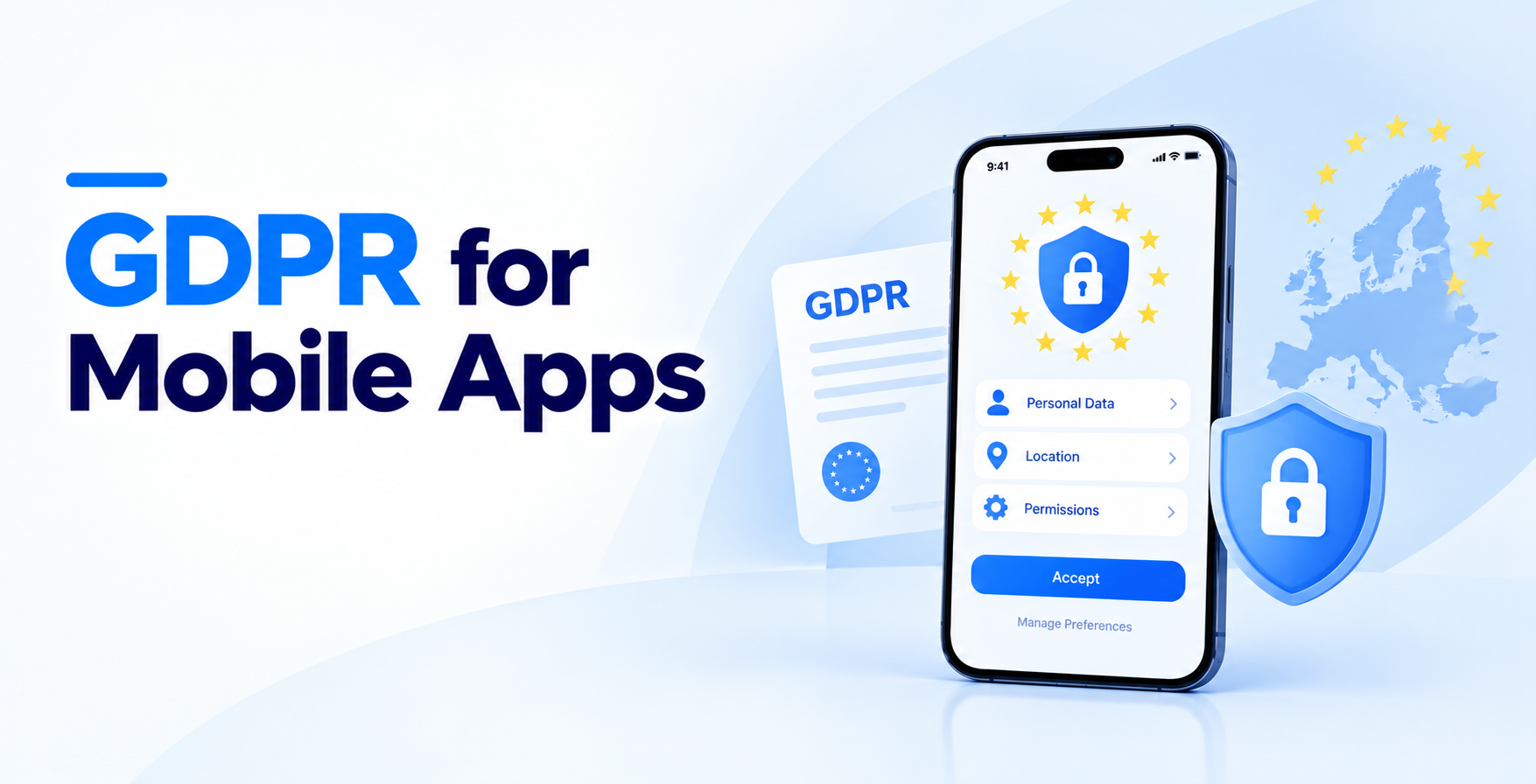
Your app opens. A splash screen appears. Somewhere in those first 200 milliseconds, an analytics SDK has already shipped the device advertising ID to a server in another country. Then the consent banner loads and politely asks permission.
That sequence is the single most common failure in GDPR for mobile apps, and it is also the easiest one for a regulator to prove. No subpoena needed. Just a proxy tool and a fresh install.
This guide covers what actually applies to you, which decisions have to happen in code, and the specific checks worth running before your next release.
TL;DR
Probably yes, and the test is simpler than most teams expect. Article 3 ties the regulation to the people whose data you process, not your company address. If your app is available to users in the EU or EEA and you handle their personal data, you are in scope.
A startup in Bangalore with 4,000 users in Spain is covered. A US health app with no EU marketing but a German download base is covered. Offering the app in euros, shipping a French translation, or targeting EU app store regions all strengthen the case that you deliberately offer services there.
The practical consequence is that GDPR for mobile apps becomes a product requirement, not a legal afterthought. The decisions that create risk get made by engineers choosing libraries, not by lawyers reviewing a policy page.
This is where teams underestimate their footprint. Personal data under GDPR covers anything that can single out an individual, directly or indirectly.
The Google Advertising ID, the Apple IDFA, and any persistent app-level identifier qualify. IAB Europe acknowledges this, and so does the CNIL. A unique ID that follows a device across sessions identifies a person for legal purposes, even without a name attached.
| Data type | Where it comes from | Usually needs consent? |
| Advertising ID | Ad and attribution SDKs | Yes |
| Precise location | Maps, delivery, weather features | Yes |
| Crash logs with device IDs | Crash reporting tools | Often yes |
| Email and account data | Signup flow | No, contract basis works |
| Push tokens | Notification service | Depends on purpose |
Reading or writing anything on a user’s device needs consent under the ePrivacy Directive unless it is strictly necessary to deliver the service. That rule sits above GDPR and catches SDK identifiers that teams assume are harmless telemetry.
Every processing purpose needs one lawful basis from Article 6. Consent is one option. It is often the wrong one.
Account creation, payment processing, and core feature delivery usually run on contractual necessity. Fraud prevention and basic security can rest on legitimate interest, with a documented balancing test. Advertising, personalization, and third-party tracking need consent, and regulators have been consistent about that.
Why this ordering matters: consent can be withdrawn at any time, and withdrawal has to be as easy as giving it. If you place your login flow under consent, a user can revoke it and you lose the legal ground for their account. Mapping each purpose to its basis early also makes your consent-based data sharing architecture far cleaner, because the code knows which flags gate which features.
One more thing worth being blunt about. An Android runtime permission prompt is not GDPR consent. Neither is Apple’s App Tracking Transparency dialog. Those are platform rules. They sit alongside the law, not in place of it.
Before anything else, gate initialization. Your app should boot with analytics, attribution, and ad SDKs completely inert. No init calls, no auto-start manifest entries, no background threads. Many SDKs self-initialize through content providers on Android, so removing the init line is not enough. Strip or disable those entries explicitly. Only essential services, such as crash-free app startup and security, run before a choice exists. This one change removes the most frequently cited violation in GDPR for mobile apps enforcement cases.
Build the banner as a real screen in your app, not a web view bolted on. Accept and reject need equal visual weight, equal placement, and the same number of taps. Pre-ticked toggles are invalid, and the CJEU settled that point years ago. Separate the purposes: analytics, advertising, personalization, and third-party sharing each get their own switch. Bundling them into one button fails the “specific” requirement. Write the purpose descriptions in plain language that a user can read in under ten seconds.
A choice that is not stored is a choice that was never respected. Write the user’s decision to local storage immediately, then propagate it to your backend through your API development layer so server-side processing follows the same rules. Rejection must persist across launches. If your app re-prompts a user who declined, you are nudging them into fatigue, which regulators treat as a dark pattern. Mirror the state to every SDK that supports a consent signal, and conditionally skip calls for the ones that do not.
Reading your own code proves nothing. Install a proxy, do a clean install on a test device with an EU IP, and watch what leaves the handset before you touch the banner. Then reject everything and watch again. You are looking for advertising IDs, precise coordinates, and email hashes in outbound payloads. Add this capture to your release checklist, since a single SDK version bump can silently reintroduce auto-initialization. This test is the closest thing to how a regulator audits GDPR for mobile apps.
A February 2026 study at Chalmers University and Utrecht University instrumented 576 popular Android apps using the IAB consent framework. 66.2% transmitted the Google Advertising ID to ad servers even after the tester rejected every purpose, and 55.3% sent it before any choice was made at all.
Those apps had banners. They had a consent management platform. They still leaked, because the banner and the SDK stack were never actually connected.
Treat every third-party library as a processor you are legally answerable for. Inventory them, name the data each one touches, and get a data processing agreement in place. Teams rebuilding a leaky stack usually find this is one of the costlier mobile app development mistakes to discover post-launch, since gating behavior often means replacing a vendor rather than reconfiguring one.
Articles 15 through 22 give EU users enforceable rights, and support tickets are not a compliance strategy. Access, deletion, portability, and objection requests carry a one-month deadline.
Build an in-app account screen that exports the user’s data in a machine-readable format and triggers a real deletion. Real means your production database, your analytics warehouse, your backups rotation policy, and every processor holding a copy. Apple and Google both require an in-app account deletion path anyway, so the engineering work serves two masters.
Most teams miss the downstream copies. Write the deletion fan-out as part of your service layer, and keep it current through your mobile app maintenance and support cycle as new tools join the stack.
Article 32 expects encryption in transit and at rest, access controls, and a tested process for the day something breaks. Breach notification runs on a 72-hour clock to your lead supervisory authority.
Run security testing against your app before launch, not after a pentest report lands in a customer’s inbox. Certificate pinning, secure local storage, and no personal data in logs are baseline expectations. Your backend posture matters just as much, which is why cloud security configuration belongs in the same review.
Two documents regulators ask for early: your record of processing activities under Article 30, and a Data Protection Impact Assessment if your app profiles users, tracks location at scale, or handles sensitive categories. Transfers outside the EEA need a valid mechanism, usually Standard Contractual Clauses, plus a transfer impact assessment.
European authorities have logged 2,685 publicly documented fines totaling roughly €6.11 billion, with an average fine of €2,277,122, according to the CMS Enforcement Tracker Report with a March 2026 cutoff. Insufficient legal basis for processing remains the most frequently penalized violation by count.
The fine is one line item. The rest shows up as emergency re-architecture, a frozen release, and app store removal in EU regions. Building consent gating correctly during development costs a fraction of retrofitting it, and it barely moves your mobile app development cost when it is scoped from day one.
Teams in regulated verticals can borrow structure from adjacent frameworks here. The control mapping used to build a HIPAA compliant app translates well, even though the legal tests differ.
If you are shipping to EU users and want compliance handled in architecture rather than in a disclaimer, EngineerBabu builds mobile app development projects with consent gating, data flow mapping, and deletion pipelines designed into the first sprint. The team works across fintech, healthtech, and AI products where privacy obligations are load-bearing rather than optional.
About EngineerBabu
EngineerBabu is a technology development company building products across fintech, healthtech, and AI, from MVPs to scaled, production-ready platforms. It holds a CMMI Level 5 rating, has worked with 4 unicorn clients, and has supported 200+ VC-funded products. The company is backed by Vijay Shekhar Sharma.
Founded by Mayank Pratap (Co-founder) · mayank@engineerbabu.com
GDPR for mobile apps rewards teams who treat it as an engineering constraint instead of a legal document. The regulation does not care how good your privacy policy reads. It cares what your app transmits in the first second after launch, and whether a user who said no actually got what they asked for.
Run the traffic capture. Fix what you find. That single test will tell you more about your exposure than any compliance questionnaire.
Yes. Article 3 extends the regulation to any organization processing personal data of people in the EU or EEA, regardless of where the company is based. If EU users can download and use your app, you are in scope and may also need an EU representative.
No. Android runtime permissions and Apple’s App Tracking Transparency dialog are platform requirements. GDPR consent must be freely given, specific, informed, unambiguous, and just as easy to withdraw. You need both, and the GDPR consent should come first.
Any SDK that collects or transmits identifiers for advertising, attribution, analytics, or personalization. That includes ad networks, attribution tools, and most crash reporters that attach device IDs. Strictly necessary services for delivering the app’s core function are the main exception.
One month from receipt, extendable by two further months for complex requests if you notify the user within the first month. Deletion must cover your production systems, analytics tools, and any third-party processors holding a copy.
Processing without a valid legal basis, usually caused by SDKs collecting data before consent is obtained or after it is refused. It is also the easiest violation for a regulator to detect, since it shows up plainly in network traffic on a clean install.