US Developers vs Offshore Developers: Cost, Quality, and Communication Compared


Create engaging, high-performance mobile applications tailored to your business needs. We craft future-ready apps that offer smooth user experiences on all devices.
Build robust and scalable websites and CMS platforms that help you manage content effortlessly. Our development ensures a seamless digital presence.
Launch secure, feature-rich online stores with intuitive shopping experiences. We build tailored eCommerce platforms designed for growth.
Design captivating games with immersive gameplay and stunning graphics. From concept to launch, we build engaging experiences that players love.
Enhance your customer relationships with customized Salesforce implementations. Drive growth and efficiency with smarter CRM solutions.
Harness artificial intelligence and machine learning to automate workflows and gain actionable insights. Our AI transforms data into smart decisions.
Accelerate your software delivery lifecycle with continuous integration, delivery, and infrastructure automation to boost efficiency.
A founder in Austin sent the same 22-page spec to two teams last spring. A San Francisco studio came back at $312,000 over nine months. A team in Bangalore quoted $88,000 for the same scope and the same deadline.
His first thought was that one of them had to be lying.
Neither was. The two numbers came from completely different labor markets, and both quotes were honest about what they covered.
That gap is why the US developers vs offshore developers debate keeps landing on founders’ desks. It also gets answered badly, because most comparisons argue about who writes better code.
The real variables are cost structure, accountability, and how many hours a day your team can actually talk.
Here is the honest breakdown.
Rates are not arbitrary. They track local salaries, office costs, and what the surrounding job market forces an employer to pay.
The median annual wage for software developers in the United States was $135,980 in May 2025, according to the U.S. Bureau of Labor Statistics.
That is base pay only. Add payroll taxes, health coverage, equipment, recruiting fees, and paid time off, and one mid-level engineer lands closer to $180,000 a year.
Agencies price on top of that. Published rate cards from US mobile app development companies commonly start near $100 an hour and climb past $200 for senior specialists.
Offshore rates reflect a lower cost of living, not a lower standard of engineering. Here is roughly how the market prices out today.
| Region | Typical hourly rate | Where teams use it |
| US agency | $100 to $200 | Enterprise, regulated, on-site work |
| US contractor | $75 to $150 | Short senior gaps |
| Eastern Europe | $45 to $85 | Complex backend, data engineering |
| Latin America | $40 to $75 | Time zone matched product teams |
| India | $25 to $50 | Full product builds, long-term teams |
At those rates, a $300,000 US build often lands between $80,000 and $120,000 offshore. The savings are real. What changes is how much management the project needs from you.
Most US developers vs offshore developers arguments stall here, and the premise is wrong. Location does not predict code quality. The hiring process does.
A US agency that staffs your project with two junior developers and a rotating account manager will ship worse software than a senior offshore team with a documented review process. The reverse is also true.
What actually correlates with quality is boring and checkable. Look for code review as a standing rule, automated testing, a real CI pipeline, and senior engineers who stay on your project past month two.
Specialized work raises the stakes on both sides. AI Development needs engineers who understand data pipelines and evaluation, not just model APIs.
The same applies to ML Development, where a model that scores well in a notebook can still fail in production. Ask for shipped examples in your domain. Vague claims about expertise are the loudest warning sign you will get.
Cost and quality rarely kill an offshore engagement. Latency does.
If your team is in New York and your developers are in India, you get roughly two to three overlapping work hours a day. A question asked at 4 PM gets answered tomorrow morning. Three of those in a row turns a two-day task into a week.
US developers vs offshore developers is genuinely different here, and pretending otherwise wastes everyone’s money.
Good offshore teams solve this with structure instead of goodwill. They commit to a fixed overlap window, usually four hours. They run written daily standups, so progress does not depend on a call.
They also give you direct access to engineers rather than routing everything through a coordinator. Latin American teams sidestep the problem entirely with near matching time zones, which is why many US startups pay a premium for them.
Both sides of the US developers vs offshore developers comparison leak budget in places the proposal never mentions.
US builds absorb hiring time. Filling a senior role takes weeks, and every empty seat delays your roadmap while burning runway.
Offshore builds absorb management time. Somebody on your side owns specs, reviews, and priorities, and that job is real work.
Integration work is the other quiet drain. API Development that touches payment rails or third-party data almost always needs a second testing round that nobody scoped.
Then there is turnover. Ask any vendor, onshore or offshore, what percentage of their engineers stay past twelve months. The answer tells you more than any portfolio.
The right answer changes with your stage, your product, and your compliance load.
Pick a US team when the work is regulated, classified, or physically local. Government contracts, defense, and some healthcare systems require domestic data handling and US-based staff.
Choose US developers when you need someone in the room with a hospital operations team or a bank’s risk committee. Early-stage discovery work with a shifting scope also runs smoother with full day overlap, especially when the founder is designing the product live.
Offshore fits best when the scope is definable and the timeline runs longer than a few months. Building an MVP Development engagement offshore lets you validate demand for a third of a US budget.
It also fits regulated products once requirements are documented. A fintech app development company with existing KYC and payments experience delivers faster than a generalist US shop learning your rules on your dime.
Very few scaling companies answer US developers vs offshore developers with one side. They split by function instead.
A US-based product lead or CTO owns architecture, roadmap, and customer conversations. An offshore team of five to fifteen engineers handles the build.
That structure keeps the strategic decisions on your side of the table and the execution cost down. Teams running Mobile App Development this way often keep design and QA in-house while offshoring the frontend and backend work.
The model works because it fixes the real weakness of offshore, which is direction, not skill.
Once your US developers vs offshore developers decision points offshore, vetting is where the risk gets controlled. Four steps do most of the work.
Request the names, seniority, and résumés of the specific engineers assigned to your project. Then ask to interview two of them without a salesperson on the call.
Sales teams sell senior talent and staff junior developers. This one question catches that faster than anything else. Pay attention to whether the engineers can explain past architectural tradeoffs in their own words. If the vendor resists direct access before the contract, expect the same wall after it.
Commit to a small, self-contained module for two or three weeks before signing a long agreement. Pay for it at full rate.
A paid pilot shows you their commit history, code review habits, testing discipline, and response time under a real deadline. It costs a few thousand dollars and prevents a six-figure mistake. Judge the pilot on communication quality as much as output. A team that asks sharp questions during week one will ask them in month six too.
Confirm in writing that you own all code, designs, and documentation produced. Check that the vendor’s jurisdiction actually enforces those contracts.
For regulated products, verify where data lives and who can access it. Ask about SOC 2, ISO 27001, or HIPAA readiness, and request the certificate rather than a claim. Also define what happens at the end. Handover terms, repository access, and documentation standards belong in the contract, not in a friendly promise.
During the pilot, measure response time on real questions across a full week. Note how often you are chasing updates instead of receiving them.
Set the overlap window explicitly, name the reporting cadence, and pick the tools before kickoff. Ambiguity here compounds every single week. If a written standup arrives late twice in three weeks, that pattern will not improve once the team grows and your project becomes one of several.
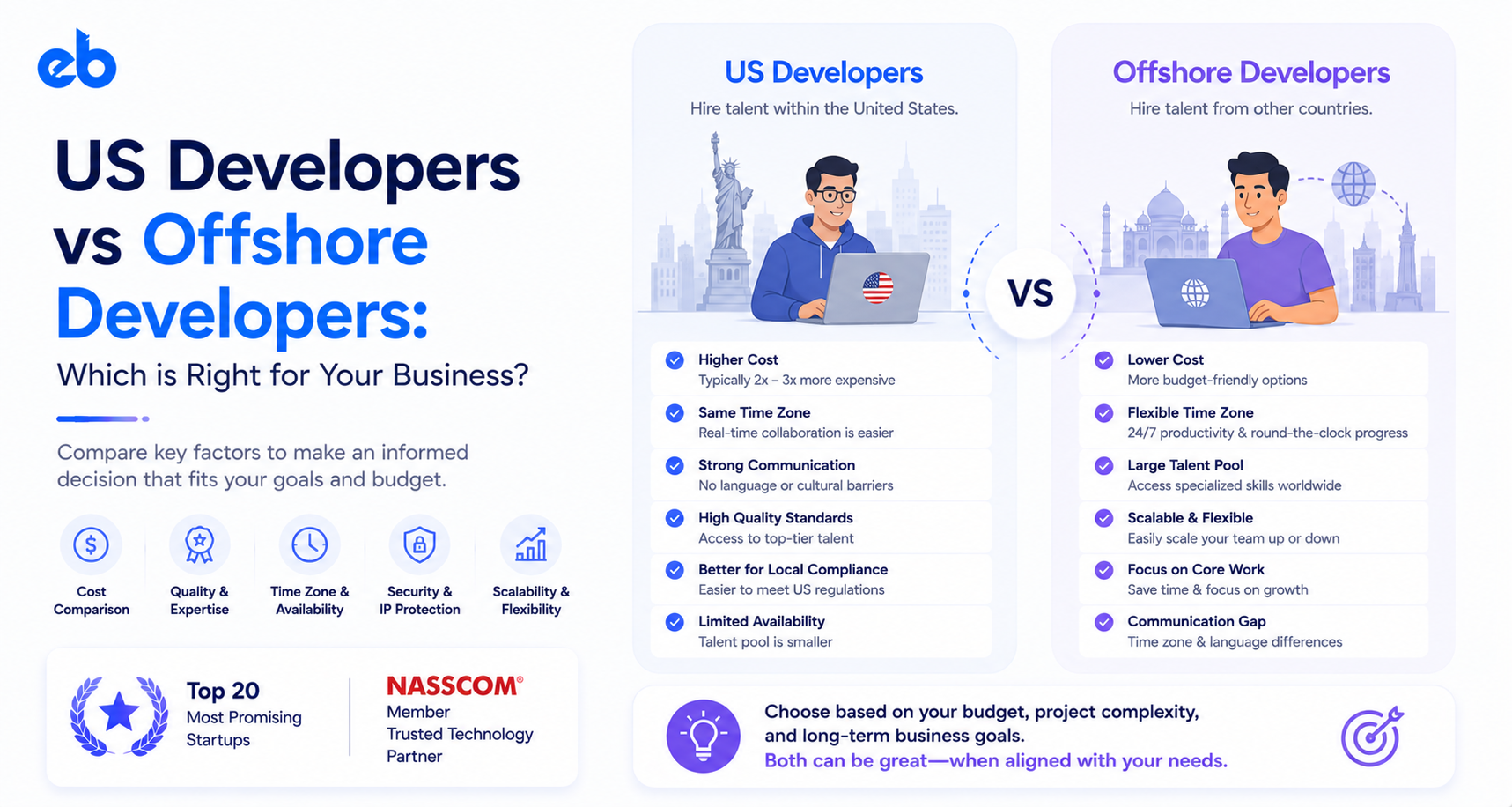
US developers vs offshore developers is not a talent question. It is a tradeoff between full-day access and a budget that stretches two to three times further.
Founders who pick badly usually pick on price alone, then discover they underestimated the management load. Founders who pick well decide what they need most, which is usually speed, proximity, or runway, and then hire for that one thing.
Choose the model that matches your hardest constraint, and put the accountability terms in writing before the first sprint starts.
EngineerBabu is a technology development company building products across fintech, healthtech, and AI, from MVPs to scaled, production-ready platforms.
It holds a CMMI Level 5 rating, has worked with 4 unicorn clients, and has supported 200+ VC-funded products. The company is backed by Vijay Shekhar Sharma.
Founded by Mayank Pratap (Co-founder) · mayank@engineerbabu.com
Offshore rates typically run 50 to 75% below US rates depending on region. A build quoted at $300,000 in the US often lands between $80,000 and $120,000 in India.
No. Quality tracks the vendor’s hiring bar, code review process, and testing discipline, not their location. Weak US agencies ship weak software too.
Time zone overlap. Two overlapping hours a day slows every decision. Fix it with a contracted overlap window and written daily updates.
Yes, when they already hold the relevant certifications and have shipped in that domain. Verify SOC 2, ISO 27001, or HIPAA readiness with documents, not claims.
Most funded startups keep a US product lead for architecture and customer input, then build offshore. That hybrid protects direction while stretching runway.