How to Build an App Like Shaadi.com: Features, Cost & Tech Stack


Create engaging, high-performance mobile applications tailored to your business needs. We craft future-ready apps that offer smooth user experiences on all devices.
Build robust and scalable websites and CMS platforms that help you manage content effortlessly. Our development ensures a seamless digital presence.
Launch secure, feature-rich online stores with intuitive shopping experiences. We build tailored eCommerce platforms designed for growth.
Design captivating games with immersive gameplay and stunning graphics. From concept to launch, we build engaging experiences that players love.
Enhance your customer relationships with customized Salesforce implementations. Drive growth and efficiency with smarter CRM solutions.
Harness artificial intelligence and machine learning to automate workflows and gain actionable insights. Our AI transforms data into smart decisions.
Accelerate your software delivery lifecycle with continuous integration, delivery, and infrastructure automation to boost efficiency.
Hire app developers ready to turn your ideas into sleek, high-performing mobile apps for any platform.
Bring in frontend pros who craft smooth, beautiful, and user-friendly interfaces that your visitors will love.
Get backend developers who build fast, secure, and reliable systems to keep everything running behind the scenes.
Hire eCommerce developers who build secure, scalable online stores designed to offer seamless shopping and grow your sales.
Get dedicated developers committed to your projects, delivering consistent quality and speed as an extension of your team.
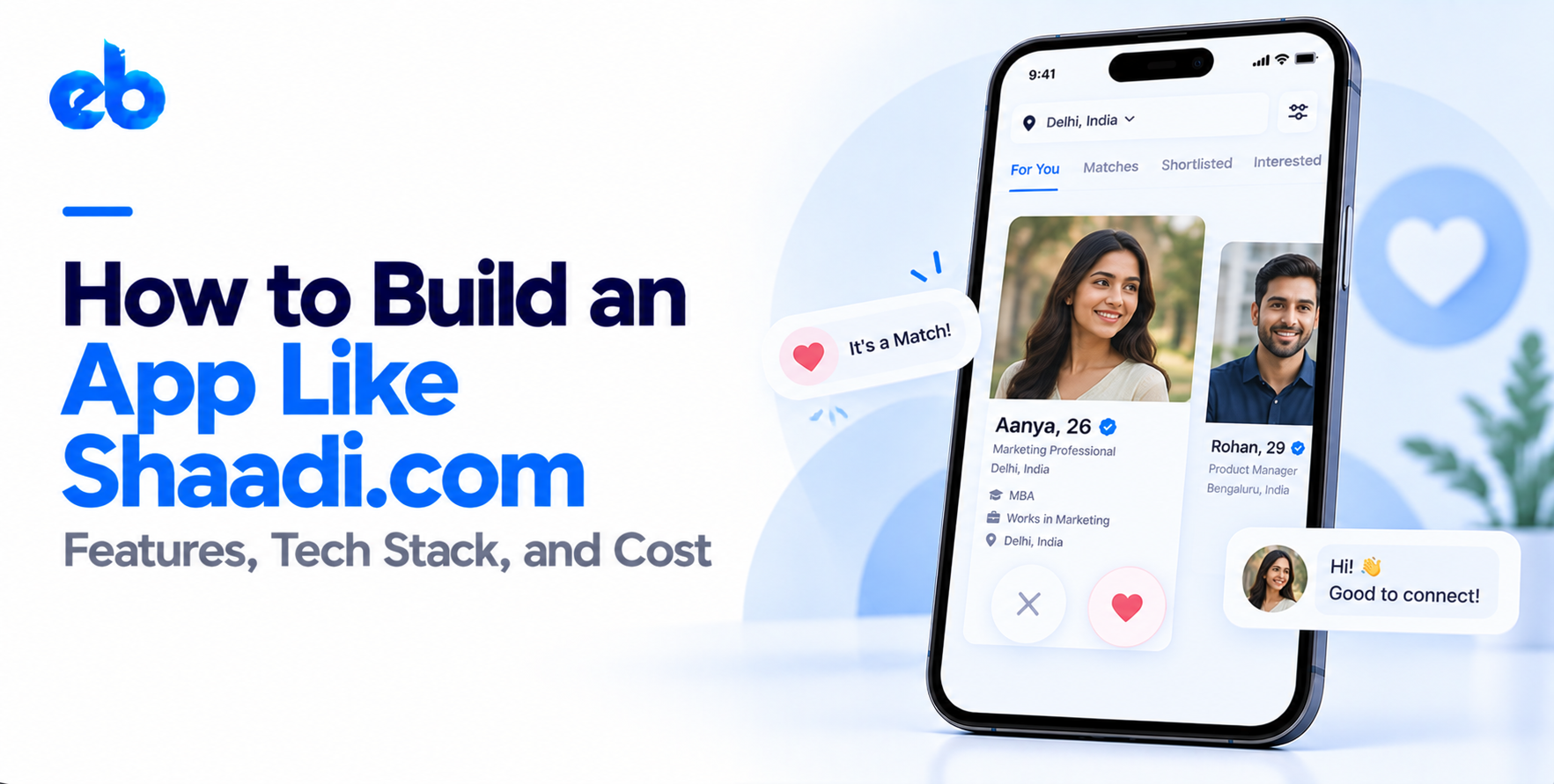
Two profiles sit on the same matrimony platform. Same city, same age band, same community, similar income. One collects forty interests in a week. The other collects three.
The difference is rarely the photo. It is a verified badge, a filled-in “about my family” section, and a profile that answers questions before they get asked.
That gap is the whole business. To build an app like Shaadi.com means building a system that makes strangers believable to each other, fast, and then charges for the shortcut.
This guide walks through the features, the matching logic, the stack, the timeline, and what it actually costs.
TL;DR
Matchmaking is one of the few consumer categories where users arrive with paid intent already formed. Nobody browses a matrimony app casually for six months.
The global online dating and matchmaking market is projected to reach $10.77 billion in 2026 and $15.35 billion by 2030, growing at a 9.3% CAGR, according to The Business Research Company.
Growth is not spread evenly, though. The winners are vertical: community-specific, region-specific, divorcee-focused, or diaspora-focused platforms. A generalist clone competing head-on with Shaadi.com will lose on ad spend alone.
Worth noting early: this is not dating app development with a different color palette. The decision horizon, the stakeholders, and the fraud risk are all different.
Three mechanics carry the product. Copy these before you copy any screen.
Users are handing over caste, income, horoscope details, and family information. They will not do that on a platform where fake profiles roam freely.
ID checks, selfie liveness, phone verification, and manual moderation are not a trust badge add-on. They are the reason anyone pays.
A large share of profiles are created or managed by parents and siblings. Your onboarding, notification language, and sharing flows need to survive that reality.
A “share this profile” link that works in a family WhatsApp group matters more than an in-app feed.
Browsing stays open. Messaging, contact details, and visibility boosts sit behind a subscription. That single wall is where almost all revenue comes from.
Split the scope into what users touch and what your team operates.
| Layer | Must-have features |
| Onboarding | Phone OTP signup, profile-for-self or relative, 6 to 8 step guided setup |
| Profile | Photos with privacy controls, family details, education, career, lifestyle, partner preferences |
| Trust | Government ID check, selfie match, manual review queue, report and block |
| Discovery | Filters, daily recommendations, saved searches, shortlist, viewed-me |
| Communication | Interest send/accept, consent-gated chat, contact reveal, video call |
| Monetization | Tiered plans, in-app purchase, boosts, profile highlight |
| Admin | Moderation console, fraud flags, plan management, analytics, support tools |
Two features get underestimated constantly. The first is privacy granularity, since many users want photos visible only after an accepted interest. The second is KYC and identity verification tooling, which decides your fraud rate from day one.
Invest in UI/UX design for the onboarding flow specifically. Profile completion rate is your single strongest growth lever.
Most teams assume matchmaking means machine learning. In practice it runs in three layers, and only the last one needs AI.
That third layer is where predictive analytics starts paying off, usually around the 50,000-profile mark. Before that, a well-tuned scoring model outperforms a thin model trained on sparse data.
If you are planning for scale, AI development work should also cover fraud scoring, not just recommendations.
Decide exactly who your first 10,000 users are. A single community, a single state, a single language, or a specific segment like second marriages or NRI matches.
Narrow beats broad here because matchmaking is a liquidity business. A thousand relevant profiles in one niche feel useful. Fifty thousand scattered profiles feel empty.
Write down the three filters your users will apply first, then design the database around those. This one decision shapes your acquisition cost, your retention curve, and how early paid conversions start.
Your first release needs signup, profile creation, verification, filtered search, interest requests, and chat. Nothing else.
Skip video calls, horoscope matching, and recommendation models in version one. They consume weeks and prove nothing about demand.
Run this as a focused MVP development cycle with a hard feature freeze. The goal is a measurable answer to one question: do verified users send and accept interests?
Set your success threshold before launch. Something like 30% profile completion and 15% interest-acceptance rate within six weeks.
Verification is infrastructure, not a late-stage feature. Build it before you open public signups.
Combine automated checks with a human review queue. ID document matching and selfie liveness catch most bad actors. A moderator handles the rest within a defined SLA.
Add a visible trust ladder: phone verified, ID verified, employment verified. Users understand badges instantly, and higher badge levels correlate directly with paid conversion.
Log every rejection reason. That dataset becomes your fraud model later, and regulators or app stores may ask for it.
Never let anyone message anyone. Interest first, acceptance second, chat third. That sequence is what keeps women on the platform, and without them the platform dies.
Add granular controls: hide photos until accepted, hide contact number permanently, block and report in two taps. Make reporting visible rather than buried in settings.
Rate-limit interest sending per plan tier. It protects inboxes and gives your pricing page an honest reason to exist beyond an artificial paywall.
Matrimony revenue is subscription-led, with three to four tiers and a short commitment window. Most users buy for three months because that matches their search urgency.
Support cards, UPI, net banking, and wallets if you target India. Handle failed renewals with retries and a grace period rather than instant downgrades.
Choosing payment gateways early matters because app store billing rules apply to digital subscriptions. Plan your in-app purchase flows around those rules from the start, not after a rejection.
Ship to a limited geography first. Track profile completion, verification pass rate, interest acceptance, reply rate, and days to first payment.
Those five numbers tell you whether the marketplace is working. Downloads tell you nothing.
Then tune the match weights against real acceptance data, segment by segment. Teams that re-tune monthly in year one see meaningfully better retention than teams that set weights once and move on to new features.
Nothing exotic is required. Reliability and search performance matter more than novelty.
The native versus cross-platform call usually lands on cross-platform for a first release. One team, one codebase, faster iteration on the flows that actually need testing.
Pricing moves with scope, platform count, and team location. These ranges reflect offshore delivery rates.
| Build scope | What’s included | Estimated cost | Timeline |
| MVP, one platform | Signup, profiles, verification, search, interests, chat | $25,000 to $45,000 | 3 to 4 months |
| Growth build, two platforms | MVP scope plus subscriptions, recommendations, admin console, video calls | $55,000 to $95,000 | 5 to 7 months |
| Full platform | Multi-language, AI matching, fraud detection, CRM, offline services module | $110,000 to $200,000+ | 8 to 12 months |
Ongoing costs are easy to forget. Budget 15 to 20% of build cost annually for maintenance, plus per-check fees for ID verification and moderation staffing.
For a wider view of what drives these numbers, this app development cost breakdown is a useful reference. Realistic planning also helps on project timelines, which slip most often during verification and payments work.
Most of these overlap with the broader mobile app development mistakes that stall first releases across categories.
Teams that set out to build an app like Shaadi.com usually need three things at once: a match engine that holds up, a verification layer that regulators and users both accept, and billing that survives app store review.
EngineerBabu handles that combination through custom mobile app development, covering architecture, AI/ML, cloud, and QA under a CMMI Level 5 process. You can also hire dedicated app developers to extend your in-house team instead of outsourcing the entire build.
The hardest part is not the code. It is making a stranger’s profile credible enough that someone shares it with their parents.
Build verification first, keep the match logic transparent and tunable, and launch narrow. Everything else, from video calls to AI recommendations, can wait until real users prove they want it.
Get those fundamentals right and the decision to build an app like Shaadi.com stops being a clone project. It becomes a defensible matchmaking business in a market that keeps expanding.
EngineerBabu is a technology development company building products across fintech, healthtech, and AI, from MVPs to scaled, production-ready platforms.
It holds a CMMI Level 5 rating, has worked with 4 unicorn clients, and has supported 200+ VC-funded products. The company is backed by Vijay Shekhar Sharma.
Founded by Mayank Pratap (Co-founder) · mayank@engineerbabu.com
A single-platform MVP typically costs $25,000 to $45,000. A full two-platform product with AI matching, fraud detection, and an admin console generally ranges from $110,000 to $200,000 or more.
Around 3 to 4 months for an MVP covering profiles, verification, search, and chat. A complete platform with subscriptions, video, and multi-language support usually takes 8 to 12 months.
Guided profile creation, identity verification, filtered search, interest-based consent before chat, privacy controls on photos and contact details, and a moderation console for your internal team.
Not at launch. A weighted scoring model on structured profile data performs well early. AI becomes genuinely valuable once you have enough behavioral data, usually past 50,000 active profiles.
Mainly through tiered subscriptions that unlock messaging and contact details. Secondary revenue comes from profile boosts, featured placement, assisted matchmaking services, and wedding-related service listings.
Yes, but only by going narrow. Community, regional, language, or segment-specific platforms win on relevance and liquidity, which a broad generalist clone cannot match on ad budget alone.