How to Build a Dating App Like Tinder in 2026


Create engaging, high-performance mobile applications tailored to your business needs. We craft future-ready apps that offer smooth user experiences on all devices.
Build robust and scalable websites and CMS platforms that help you manage content effortlessly. Our development ensures a seamless digital presence.
Launch secure, feature-rich online stores with intuitive shopping experiences. We build tailored eCommerce platforms designed for growth.
Design captivating games with immersive gameplay and stunning graphics. From concept to launch, we build engaging experiences that players love.
Enhance your customer relationships with customized Salesforce implementations. Drive growth and efficiency with smarter CRM solutions.
Harness artificial intelligence and machine learning to automate workflows and gain actionable insights. Our AI transforms data into smart decisions.
Accelerate your software delivery lifecycle with continuous integration, delivery, and infrastructure automation to boost efficiency.
Hire app developers ready to turn your ideas into sleek, high-performing mobile apps for any platform.
Bring in frontend pros who craft smooth, beautiful, and user-friendly interfaces that your visitors will love.
Get backend developers who build fast, secure, and reliable systems to keep everything running behind the scenes.
Hire eCommerce developers who build secure, scalable online stores designed to offer seamless shopping and grow your sales.
Get dedicated developers committed to your projects, delivering consistent quality and speed as an extension of your team.
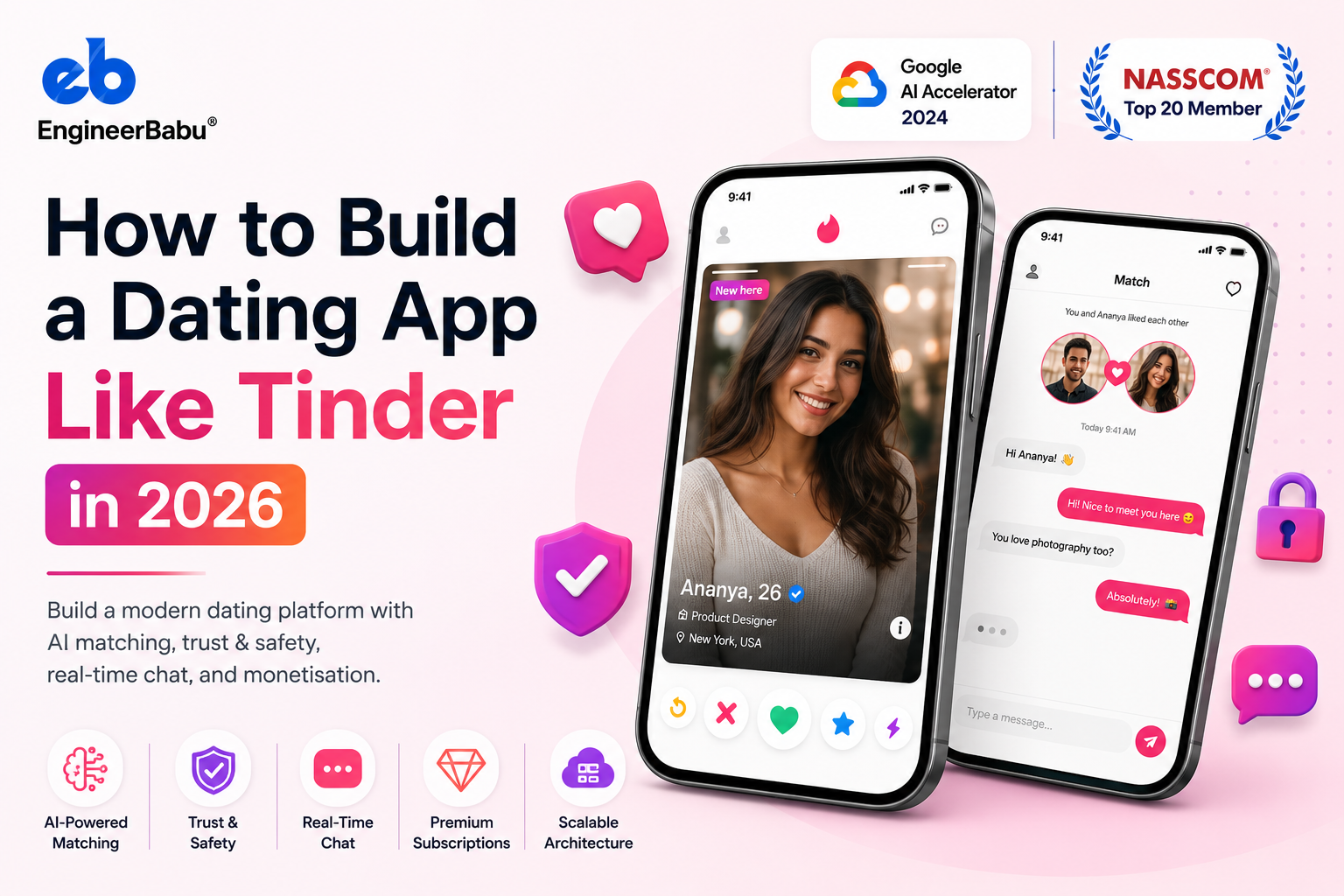
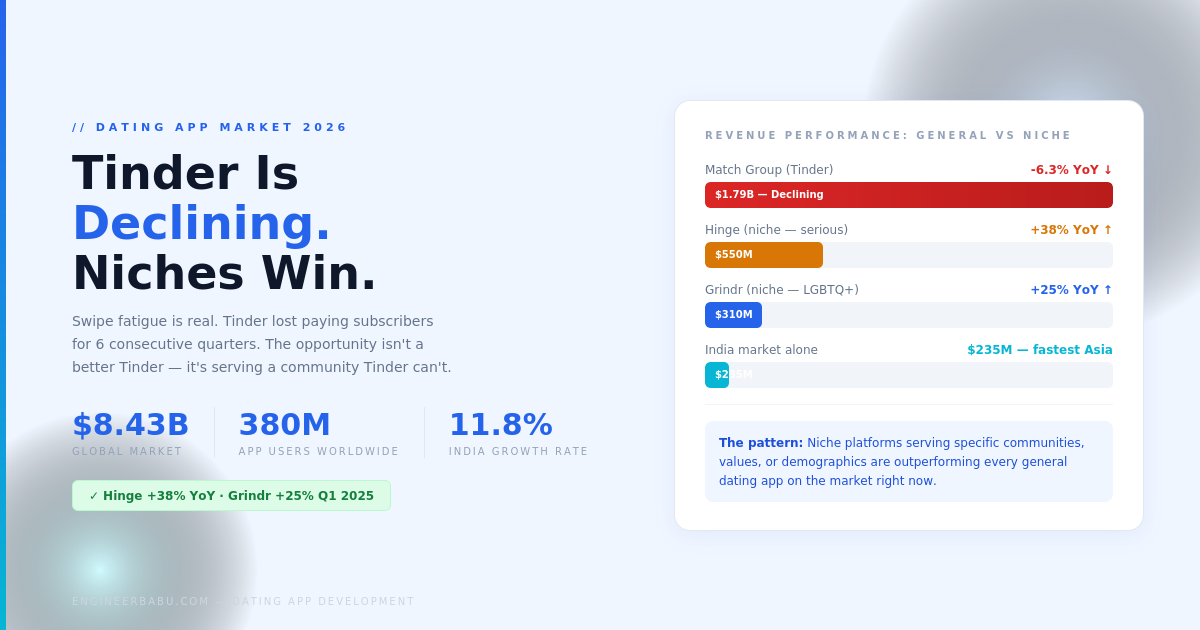
Tinder’s paying subscriber count peaked at 10.9 million in Q2 2023 and has declined for six consecutive quarters. Revenue dropped from $1.91 billion in 2023 to $1.79 billion in 2024. Bumble reported revenue declines too. Match Group’s CEO cited “paying subscriber headwinds in North America” as the explanation.
The mainstream swipe-based dating app is saturated. The incumbents are struggling with engagement. Swipe fatigue is real – the core mechanic that made Tinder revolutionary in 2012 feels exhausting to a generation that’s been doing it for 12 years.
But here’s the thing about a saturated mainstream market: the niches inside it are not saturated. They’re growing.
Hinge grew 38% year-over-year to $550 million in revenue in 2024. Grindr grew 25% in Q1 2025. Niche platforms – focused on specific communities, values, demographics, or relationship goals – are outperforming the generalists.
The opportunity isn’t building a better Tinder. The opportunity is building a platform that serves a specific community better than Tinder ever could – because Tinder is too general to care about the specific community’s needs.
India’s dating app market is valued at $235 million and growing at 11.8% – the fastest in Asia Pacific. Southeast Asia is growing at 11%. Both markets are underserved by Western-built platforms that don’t understand local cultural norms, local matching preferences, and local safety requirements.
I co-founded EngineerBabu 14 years ago. The team has built 75 YC-selected products, including social and community platforms across multiple geographies. The Google AI Accelerator 2024 selection reflects the team’s production AI capabilities – directly applicable to the matching algorithms and safety systems that define competitive dating apps in 2026.
This guide is not about building a Tinder clone. It’s about building something Tinder can’t.
Email mayank@engineerbabu.com if you’re ready to build.
The global dating services market is valued at $8.43 billion in 2026. The dating app market specifically – app-based platforms – is valued at approximately $12 billion including both subscription and advertising revenue across all platforms.
Over 380 million people worldwide use dating apps. 30% of US and UK adults have tried one.
But the macro numbers obscure the competitive reality:
Match Group controls approximately 45% of Western market revenue – through Tinder, Hinge, Match.com, OkCupid, and OurTime. Bumble holds approximately 15–18%. The incumbent concentration is high. General market share is effectively unavailable to a new entrant.
What is available: niche market leadership.
A platform serving Indian professionals in their 30s seeking marriage-oriented relationships has different product requirements than Tinder. A platform serving the LGBTQ+ community in Southeast Asia has different safety requirements than a general app. A platform for specific religious communities has different matching attributes. A platform for people over 50- the fastest-growing dating app demographic has different UX requirements.
These niches are large enough to build sustainable businesses. They are small enough that Match Group doesn’t prioritise them. That gap is the opportunity.
A dating app is a marketplace platform that connects individuals seeking romantic or social connection through profile browsing, mutual matching mechanics, and messaging with algorithmic assistance to surface relevant potential matches. The product’s core function is reducing friction between compatible individuals while maintaining safety for users who are meeting strangers.
Before architecture. Before feature lists. Before tech stack. This decision.
The niche determines:
Community-based niches that work:
The niche dictates the matching algorithm. A marriage-oriented platform in India needs to match on family values, education, and caste preference (however controversial) – attributes that general platforms can’t model well because they’re optimising for global engagement, not specific cultural compatibility.
The architectural implication: build the matching attribute schema for your specific niche before building anything else.
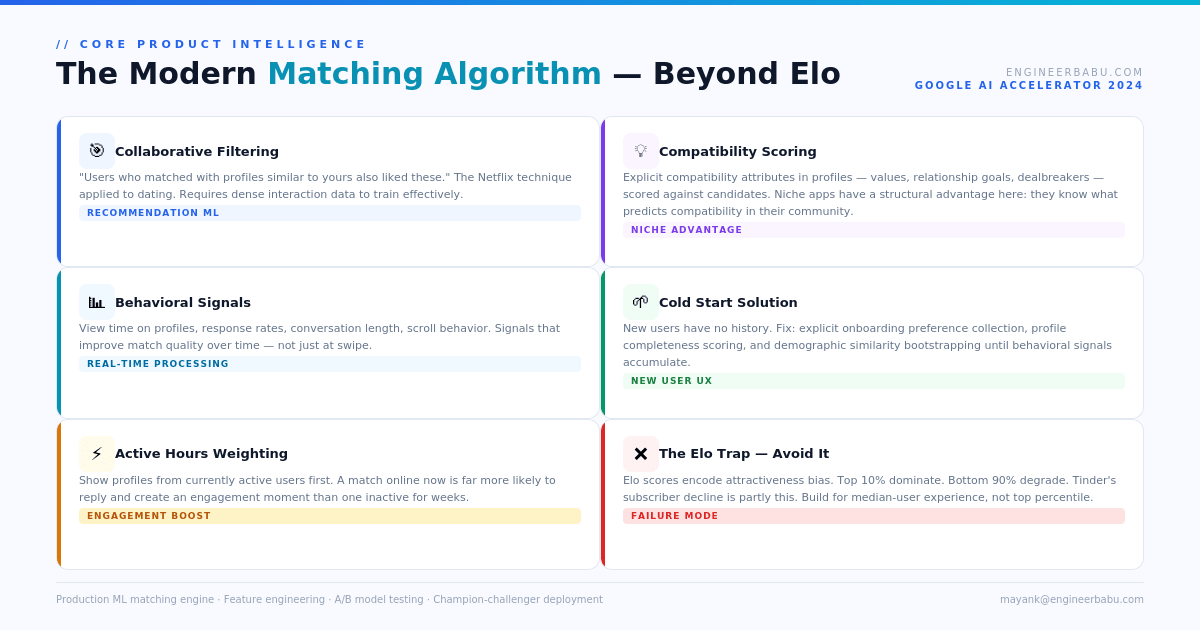
Tinder’s original algorithm was an Elo score a chess rating system adapted for dating. Every user had a hidden score based on how often they were swiped right on. High-Elo users saw high-Elo profiles first.
The problem: Elo scores encode attractiveness bias. The most conventionally attractive users get shown to everyone. Everyone else gets a degraded experience. Tinder’s subscriber decline is partly attributed to engagement degradation for users outside the high-Elo tier.
Modern dating app matching in 2026 goes well beyond Elo:
Collaborative filtering – “users who matched with profiles similar to yours also liked these profiles.” The same technique Netflix uses for movie recommendations. Requires a dense matrix of user-profile interactions to train on. Cold start problem for new users with no interaction history.
Compatibility scoring – building explicit compatibility attributes into profiles (values, relationship goals, lifestyle preferences, dealbreakers) and scoring candidate profiles against them. This is where niche apps have a structural advantage: they know which attributes predict compatibility in their community.
Behavioral signals – which profiles a user spends more time viewing (even if they swipe left), response rates to messages (a match who replies quickly is a positive signal for the sender’s profile quality), conversation length (long conversations predict successful in-person meetings). These signals improve matching quality over time.
Active hours weighting – showing profiles from users who are currently active (or were recently active) first. A match who’s online now is more likely to respond and create an engagement moment than one who was last active 3 weeks ago.
The cold start problem – every new user has no interaction history. The matching algorithm has nothing to work with. Solutions: explicit onboarding preference collection (what age range, what location radius, what relationship goal), profile completeness scoring (penalise incomplete profiles), and a bootstrapping phase where the algorithm uses demographic similarity until behavioral signals accumulate.
The team builds production ML matching systems using the same pipeline applied to other recommendation problems in the Google AI Accelerator 2024 program: feature engineering from behavioral events, model training on interaction data, A/B testing of model variants, champion-challenger deployment.
Dating apps are uniquely high-stakes from a safety perspective. Users are meeting strangers. The platform has a moral and legal obligation to reduce the risk of harm.
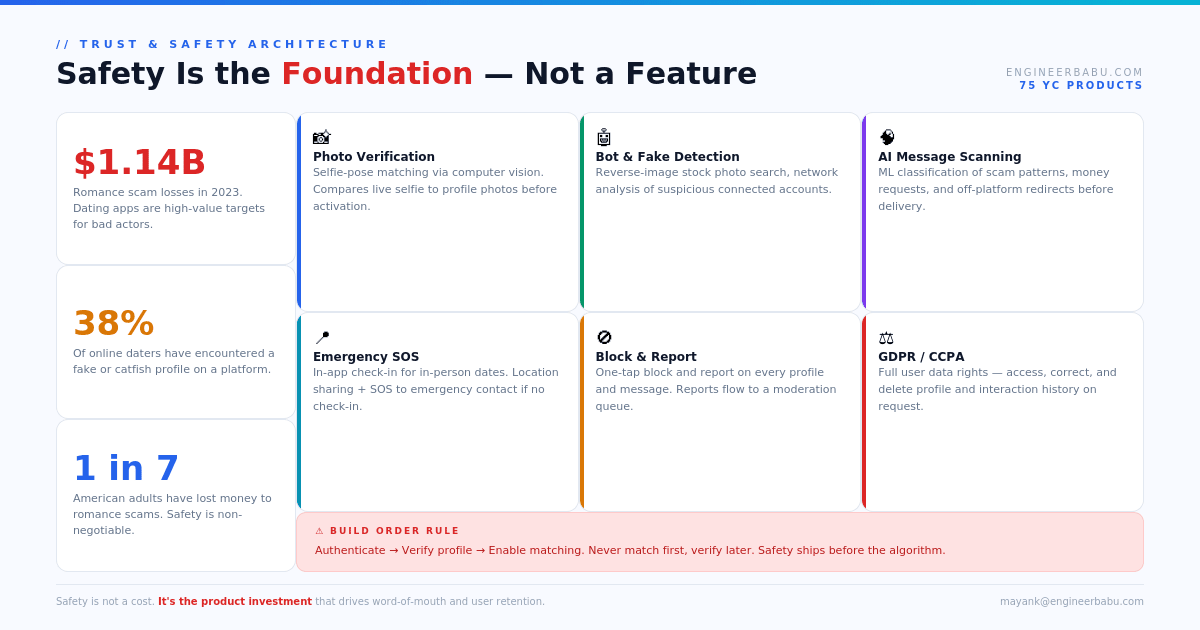
Romance scams cost victims over $1.14 billion in reported losses in 2023 alone. Catfishing (fake profiles) is reported by 38% of online daters as having experienced it. 1 in 7 American adults have lost money to romance scams. These aren’t abstract risks.
The trust and safety architecture:
Photo verification – users submit a selfie matching a specific pose. A computer vision model compares the selfie to profile photos to verify they’re the same person. This is now a baseline feature expectation.
Profile authenticity detection – stock photo detection (reverse image search for profile photos), bot behavior detection (accounts that message every new user within seconds), and network analysis of connected suspicious accounts.
AI message scanning – detecting patterns that indicate scam behavior (requests for money, requests to move off-platform, specific phishing keywords) before they harm users. This requires ML-based content classification of messages, not just keyword filtering.
Emergency SOS – for users meeting in person, an in-app safety check-in: share your location, trigger an SOS alert to an emergency contact if you don’t check in. Noonlight and similar integrations are now standard.
Block and report mechanics – every user must be able to block and report with one tap. Reports must flow into a moderation queue, not a black hole.
Disclosure transparency – under GDPR and US state privacy laws (CCPA, VCDPA), users have rights to access, correct, and delete their data including their matching profile and interaction history. The platform must support these rights technically.
The team’s approach: trust and safety architecture is designed before the matching algorithm. The flow is: authenticate the user → verify the profile → enable matching. Not: match first, verify later.
The swipe mechanic Tinder invented is now so widely copied that it’s a commodity interaction pattern. Building a dating app with swipes is table stakes in 2026. What differentiates is the engagement loop around the mechanic.
Hinge’s breakthrough: replacing unlimited swipes with “likes” on specific profile attributes (comment on a specific photo or prompt) and limiting the number of daily likes. This reduced the gamification and increased the thoughtfulness of connections. The result: higher match quality and higher in-person meeting rates.
The engagement loop architecture:
Daily active prompts – timed prompts that encourage users to engage (“3 new profiles match your preferences”, “You have 5 new likes”). Notification timing matters: send at times when users are likely to be in app-browsing mode, not at 3am.
Conversation starters – matched users who don’t message within 24 hours have a dramatically lower conversion rate. AI-suggested conversation starters based on shared interests or profile attributes reduce the blank-screen anxiety that kills matches.
Match expiry – Bumble’s innovation: matched users must message within 24 hours (for heterosexual matches, the woman must message first) or the match expires. This drives immediate engagement and reduces the “match graveyard” problem where users have hundreds of matches they’ve never messaged.
Engagement decay management – users who haven’t opened the app in 7 days receive a targeted re-engagement notification. The notification content matters: “Your profile was liked 8 times this week” outperforms “Come back to [App Name].”
The match is worthless without the conversation. The conversation is worthless without a date. The entire product funnel points toward one moment: the user asking for a phone number or an in-person meeting.
Real-time chat architecture:
Message delivery – WebSocket-based for real-time delivery. Message persistence in the database. Read receipts. Typing indicators. All the patterns from WhatsApp/iMessage that users now expect.
Media in chat – photo sharing, GIF support, voice messages. Voice messages specifically have driven engagement increases in markets where text-based conversation has higher cultural friction (LATAM, parts of Southeast Asia).
Message encryption – end-to-end encryption is increasingly expected by privacy-conscious users and required in some market contexts. Implementation using the Signal Protocol is the standard.
Message moderation – AI scanning of messages for scam patterns, harassment, and explicit content (if the platform doesn’t support it). The scanning must be fast enough not to noticeably delay message delivery.
Video calling – post-COVID, video dates have become a common intermediate step between matching and in-person meeting. WebRTC-based video calling within the app, HIPAA-equivalent security (no recording without consent), good quality on poor connections.
Dating apps are fundamentally location-based. The value of a match depends partly on whether two people can actually meet.
The discovery algorithm’s geographic layer:
Geospatial queries – finding candidate profiles within a radius uses a spatial index (PostGIS extension in PostgreSQL, or a dedicated geospatial database). The spatial query needs to be fast enough to run in real time as users scroll through discovery.
Location privacy – users should not be able to determine each other’s precise location from the “X kilometers away” display. Fuzzing location to the nearest kilometre (or showing only city-level for safety in high-risk contexts) balances discovery utility with safety.
Distance preferences – users in urban areas set a 5km radius; users in rural areas set a 50km radius. The discovery algorithm must respect each user’s preference while maximising pool size.
Travel mode – users travelling to a new city want to match with people there before they arrive. This requires either actual travel detection (geofencing trigger when the user is in a different city) or a manual travel mode that the user activates.
Multi-city platforms – for platforms targeting specific diaspora communities or professional networks, users may care about matches in cities other than their current location. Supporting multi-city matching without degrading the local experience requires separate pool management.
Dating apps are one of the highest-monetising mobile app categories. iOS generates approximately 80% of dating app revenue – iPhone users pay significantly more for premium features.
The production monetisation architecture:
Freemium base – free users can create profiles, swipe, and message. Premium unlocks: unlimited swipes, see who liked you before matching, advanced filters, boosts (temporary profile visibility increase), rewind (undo a left swipe).
Subscription tiers – standard premium + gold/platinum with additional features. Pricing in local currency with PPP adjustment for different markets (US pricing doesn’t work in India or Southeast Asia).
In-app purchases – boosts, super likes, roses (Hinge’s paid engagement feature). These are one-time purchases that drive revenue from free users who want specific features without committing to a subscription.
Advertising – for free users, native sponsored profiles (clearly labelled) can be shown in the discovery feed. Requires an advertiser dashboard with targeting by demographic, location, and interest.
The Apple/Google tax – in-app purchases go through the App Store (30% cut, or 15% for subscriptions after year 1) and Play Store (30% cut). For subscriptions purchased via web before downloading the app, no platform cut applies. Building a web-to-app subscription conversion flow recovers 15–30% of revenue on high-value subscriptions.
All of these revenue streams require different data tracking from day one. Subscription status per user, in-app purchase attribution, feature access gating, and the web subscription conversion flow – none of these can be cleanly added after the initial schema is set.
The chicken-and-egg problem for dating apps: users won’t join if there’s no one to match with.
This is a geographic problem, not a demographic problem. A dating app with 100,000 users across all of India is less valuable to a 28-year-old in Bangalore than an app with 10,000 users specifically in Bangalore. Supply and demand must be co-located.
The launch strategy that works:
City-by-city launch – launch in one city with concentrated marketing. Build a dense user pool in that city before expanding. Bumble famously launched city by city, investing in local events and campus ambassador programs to build dense local pools.
Supply-side seeding – for apps targeting heterosexual dating, seeding with female users first (or with the demand-side demographic) creates a better experience for the supply side at launch. Tinder and Bumble both launched on college campuses and seeded with women.
Referral mechanics – in-app referral programmes that reward users for inviting their network. Dating app referrals are powerful because users have strong social proof incentive (they want their friends on the platform to match with).
The architectural requirement: user geography data is a first-class data entity from day one. City-level reporting, city-level user pool metrics, city-level match rates – all required to manage the city-by-city launch strategy.
Flutter (iOS + Android) + Next.js (web)
Flutter for the primary app – the swipe card UI, the messaging interface, the profile editor, and the onboarding flow. Flutter’s animation capabilities are well-suited to the swipe card interaction that defines dating app UX.
Node.js NestJS (core API) + Python (ML matching engine)
NestJS for profile management, matching queue, message delivery, notification system, and subscription management. Python for the matching algorithm inference, cold start recommendation, and message safety ML models.
PostgreSQL + Redis + PostGIS
PostgreSQL with PostGIS extension for geospatial profile discovery. Redis for real-time presence (who’s online), match notification queuing, and session management.
WebRTC + WebSockets
WebRTC for in-app video calling (via Twilio Video or Daily.co for managed infrastructure). WebSockets for real-time chat message delivery.
Photo verification: AWS Rekognition + custom pose detection model
Custom computer vision model for selfie-to-profile comparison, augmented by AWS Rekognition for photo content classification (detecting inappropriate images before they appear on profiles).
Payments: Stripe (web + international) + RevenueCat (in-app purchase management)
RevenueCat abstracts Apple App Store and Google Play Store subscription management, providing a unified API for subscription status, purchase history, and webhook events. Stripe for web-based subscription purchases.
The 75 YC-selected products include social and community platforms across multiple geographies and demographics. The patterns from those builds apply directly to dating apps.
The social platform built for a specific professional community in India – the matching challenge was that the community had specific compatibility attributes (industry, seniority, company tier) that general social algorithms couldn’t capture. The team built a compatibility scoring model using those attributes, trained it on the community’s own engagement data, and deployed it in production within 12 weeks.
The trust and safety lesson from those builds: the users most at risk of harm from bad actors are the same users who are most valuable to platform retention. Protecting them is not a cost – it’s a product investment. The platform that users feel safe on is the platform they recommend to friends.
The Google AI Accelerator 2024 selection reflects specifically the production ML capabilities the team brings: matching model development, behavioral signal processing, message safety classification. Not research systems. Production systems that run on real user data at scale.
The team can scope your dating app architecture in a week. mayank@engineerbabu.com.
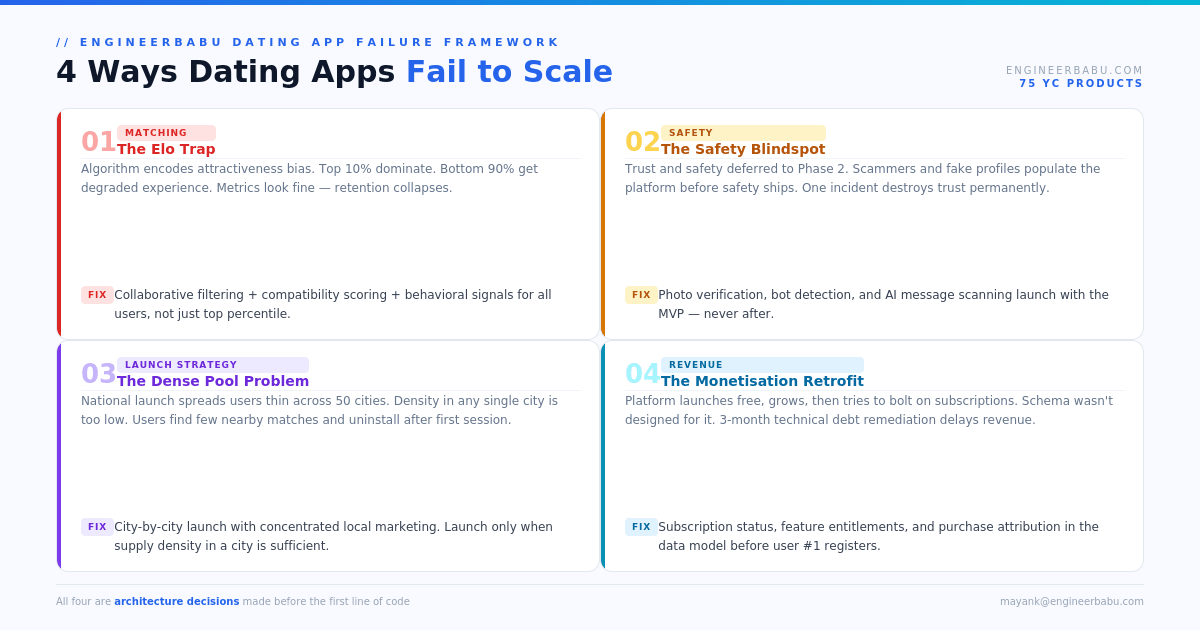
Matching algorithm encodes attractiveness bias. Top 10% of profiles see disproportionate engagement. Bottom 90% have degraded experience. Overall engagement metrics look good (the top 10% is highly engaged) but subscriber retention across the full user base is poor. Platform growth plateaus.
The fix: Collaborative filtering + compatibility scoring + behavioral signals. Matching quality for the median user, not just the top percentile.
Trust and safety deferred to Phase 2. Fake profiles, scammers, and romance fraudsters populate the platform before the safety infrastructure is built. A well-publicised incident destroys user trust. Recovery takes years.
The fix: Photo verification, profile authenticity detection, and AI message scanning launch with the MVP. Safety is not a feature. It’s the foundation.
Platform launches nationally with marketing spread across 50 cities. User density in any individual city is too low for a good matching experience. Users try the app once, find few matches nearby, and uninstall.
The fix: City-by-city launch with concentrated local marketing. Launch only when a specific city has sufficient supply density to provide a quality experience.
Platform launches free, grows to meaningful user base, then builds monetisation. In-app purchase schema, subscription gating, feature access controls – all retrofitted onto a data model that wasn’t designed for them. Revenue launch delayed by 3 months of technical debt remediation.
The fix: Monetisation schema designed from day one. Subscription status, feature entitlements, purchase attribution – in the data model before the first user registers.
Dating app white-label solutions: Available. Generic matching algorithm, generic safety features, generic UI. Cannot support niche-specific matching attributes. Cannot compete on the product quality that niche communities expect.
Custom build: Required for any platform that competes on matching quality or community fit. The matching algorithm is the product. White-label algorithms are designed for general dating, not your specific niche.
Dating app development starts from $15K for a production MVP – profiles, swipe matching, real-time chat, photo upload, push notifications, basic subscription.
Full platforms – AI matching engine, photo verification, video calling, detailed analytics, full monetisation stack scoped based on niche, matching sophistication, and target geography.
Timeline: MVP in 12–16 weeks. Full platforms in 5–9 months.
40–60% cost savings vs US/UK equivalent. Google AI Accelerator 2024 matching engine capabilities. Full IP ownership.
75 YC-selected product builds – social platforms, community apps, matching products.
Google AI Accelerator 2024 – production ML for matching algorithms, trust and safety classification, behavioral signal processing.
Mayank leads personally. CMMI Level 5. 4 unicorn clients. Full IP ownership. No vendor lock-in.
A startup came to the team with a specific community – Indian professionals in the diaspora seeking marriage-oriented relationships across multiple countries. The matching algorithm needed to understand compatibility attributes that no general dating app captures. The trust and safety requirements included specific cultural sensitivities that affected the entire safety architecture.
The platform launched with a production AI matching engine, photo verification, and in-app calling in 16 weeks. First month: 25,000 registrations in the target community.
The window for niche dating platforms is real. The incumbents are declining. The communities they underserve are growing.
30 minutes. Honest assessment of your niche, your matching requirements, and what a platform that retains users actually requires.
mayank@engineerbabu.com
Mayank Pratap | Co-founder, EngineerBabu | mayank@engineerbabu.com | engineerbabu.com Google AI Accelerator 2024 · CMMI Level 5 · 75 YC Selections · 4 Unicorn Clients · 200+ VC-funded Products · Backed by Vijay Shekhar Sharma · LinkedIn Top Startup India (Twice)
Dating app development is building a marketplace platform connecting individuals seeking romantic or social connection – through profile matching, swipe mechanics, algorithmic recommendation, and real-time chat – with safety architecture to protect users meeting strangers.
Yes – in niches. Tinder’s subscribers declined for six consecutive quarters. Match Group revenue dropped. But Hinge grew 38% year-over-year. Grindr grew 25%. Niche platforms serving specific communities, demographics, or relationship goals outperform general platforms. The opportunity is building what Tinder can’t – a platform designed for a specific community.
At minimum: collaborative filtering for matching recommendations, behavioral signal processing (view time, response rates, conversation length), cold start recommendations for new users, and photo verification (selfie-to-profile computer vision comparison). Advanced platforms add: compatibility scoring trained on community-specific attributes, message safety AI, and conversation quality scoring to improve match-to-date conversion rates.
MVP with core features (profiles, swipe matching, real-time chat, photo upload, push notifications, basic subscription): 12–16 weeks. Full platform with AI matching, photo verification, video calling, and full monetisation: 5–9 months.
The cold start problem: new users have no interaction history, so the matching algorithm has nothing to work with. Solutions: explicit onboarding preference collection (age range, relationship goal, location radius), profile completeness scoring, and a bootstrapping phase using demographic similarity until behavioral signals accumulate. Geographic cold start (insufficient density in a city) is solved by city-by-city launch rather than national launch.
Photo verification (selfie matching against profile photos), profile authenticity detection (stock photo detection, bot behavior detection), AI message scanning for scam patterns, emergency SOS with location sharing for in-person meetings, block and report mechanics on every profile and message, and data rights compliance (GDPR/CCPA for user data access and deletion).
Freemium base (free swipes, limited likes) with premium subscriptions (unlimited features, advanced filters, see who liked you). In-app purchases (boosts, super likes). Optional advertising for free users. iOS generates approximately 80% of dating app revenue. Web-based subscription purchase (bypassing App Store 30% cut) is increasingly important for revenue optimisation.
Deferring trust and safety to Phase 2. Dating apps attract bad actors specifically because they provide access to people seeking connection – a high-value target for scammers, romance fraudsters, and harassers. Building safety infrastructure after the platform has users means building it after the damage has been done.