How to Build an App Like Physics Wallah


Create engaging, high-performance mobile applications tailored to your business needs. We craft future-ready apps that offer smooth user experiences on all devices.
Build robust and scalable websites and CMS platforms that help you manage content effortlessly. Our development ensures a seamless digital presence.
Launch secure, feature-rich online stores with intuitive shopping experiences. We build tailored eCommerce platforms designed for growth.
Design captivating games with immersive gameplay and stunning graphics. From concept to launch, we build engaging experiences that players love.
Enhance your customer relationships with customized Salesforce implementations. Drive growth and efficiency with smarter CRM solutions.
Harness artificial intelligence and machine learning to automate workflows and gain actionable insights. Our AI transforms data into smart decisions.
Accelerate your software delivery lifecycle with continuous integration, delivery, and infrastructure automation to boost efficiency.
Hire app developers ready to turn your ideas into sleek, high-performing mobile apps for any platform.
Bring in frontend pros who craft smooth, beautiful, and user-friendly interfaces that your visitors will love.
Get backend developers who build fast, secure, and reliable systems to keep everything running behind the scenes.
Hire eCommerce developers who build secure, scalable online stores designed to offer seamless shopping and grow your sales.
Get dedicated developers committed to your projects, delivering consistent quality and speed as an extension of your team.
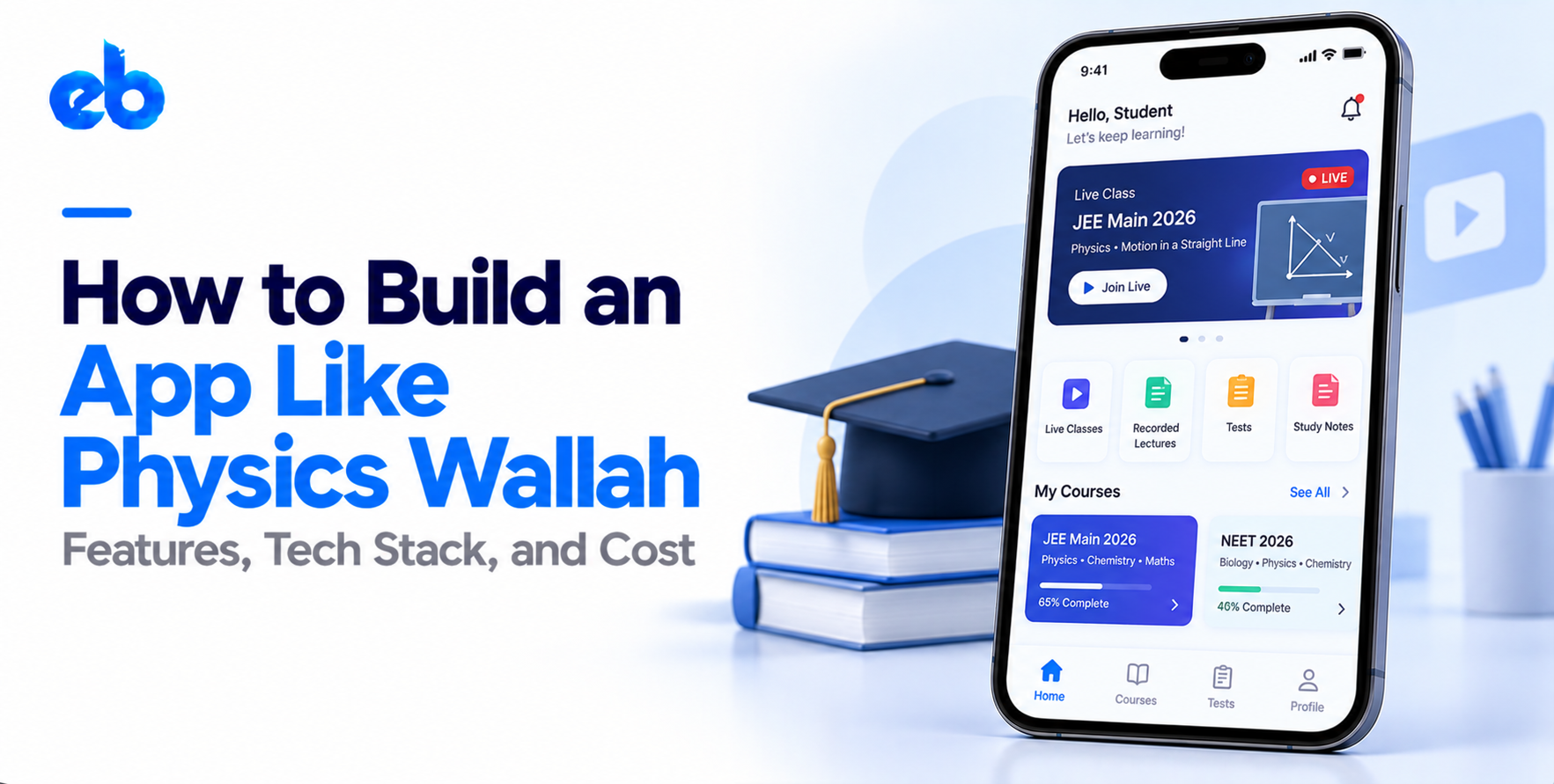
Most edtech founders start with the wrong question. They ask what features Physics Wallah has. The better question is why a student pays ₹4,000 for a full year of coaching and still shows up every single day.
That answer is not in the feature list. It is in how the product is priced, packaged, and delivered at a scale most apps buckle under.
PhysicsWallah closed FY26 with revenue of roughly ₹3,900 crore, up 35% year over year, with EBITDA rising 184% to ₹549 crore, and paid users growing 20% to 5.34 million (YourStory). Low price, huge volume, thin margins held together by engineering.
The short answer: to build an app like Physics Wallah, you build a low-cost, batch-driven learning system where recorded lectures, live classes, tests, and doubt support sit inside one subscription. The hard part is not the app. It is streaming video cheaply to lakhs of students on weak networks while keeping unit economics positive.
Physics Wallah does not sell courses. It sells batches. A batch has a start date, a fixed syllabus, a teacher, a schedule, and a cohort of students moving together.
That single design choice changes everything downstream. It creates urgency at enrollment, predictable content production, and a community effect that generic self-paced libraries never get. If you have studied how an app like Unacademy is structured, you will notice the difference immediately.
The second choice is price. Courses are priced at a fraction of offline coaching, so the business only works if cost per student stays brutally low. Your architecture decisions are economic decisions here.
This is the backbone. Every lecture, note, DPP, and schedule maps to a batch and a subject. Admin teams need to upload once and publish across multiple batches without duplication. Good course management software logic here saves you hundreds of operational hours a month.
Live classes carry the brand. Students expect a teacher on screen at a fixed hour, with chat, polls, and raised hands. This is one-to-many broadcasting, not video conferencing, so your virtual classroom software must favor low-latency streaming over peer-to-peer calls.
Mock tests, previous year papers, and daily practice problems drive retention more than lectures do. Students return for scores and rank, not for content. Build timed tests, negative marking, section locking, and instant solutions from day one.
A doubt that goes unanswered for two days kills trust. Physics Wallah combines a doubt feed with mentor support. Many teams now layer an AI tutoring platform on top to handle repeat questions instantly and route only the hard ones to humans.
Students see weak chapters and accuracy trends. Teachers see batch-level gaps. Founders see churn signals before they turn into refunds.
Do not launch with JEE, NEET, UPSC, and SSC together. Pick one exam, one class, one language. Physics Wallah itself started narrow before expanding sideways. A tight scope means fewer content pipelines, cleaner onboarding, and a faster path to real feedback. It also keeps your first build affordable.
Decide early whether you are shipping an MVP or a full-scale product, because that call shapes your timeline, team size, and budget more than any feature choice you make later.
Map the data model first. A batch links to subjects, subjects link to chapters, chapters link to lectures, notes, and tests. Enrollment links a student to a batch with a validity window. Get this wrong and every later feature fights your schema.
Also plan for batch cloning, since you will relaunch the same batch next year with updated content. Teams that skip this step end up rebuilding their backend during their first scale-up season.
Video is your biggest cost and your biggest risk. Use adaptive bitrate streaming so a student on 3G still gets a watchable class. Add DRM or token-based protection, because pirated lecture dumps spread fast in exam communities.
Offline download with encrypted local storage is non-negotiable in tier two and tier three towns. Pair this with serious mobile app performance optimization so playback starts in under two seconds on budget Android devices.
Live sessions spike traffic in a predictable way. Twenty thousand students join within ninety seconds of a class starting. To build an app like Physics Wallah that survives that, you need autoscaling infrastructure and a CDN with regional edge coverage.
Treat cloud scalability as a launch requirement, not a later optimization. Add chat moderation, a pinned question feed, and automatic recording so the class becomes on-demand content minutes after it ends.
Your test engine needs an authoring tool, a delivery runtime, and a result pipeline. Teachers should build a paper without developer help. Students need autosave, so a dropped connection does not wipe forty minutes of work.
Results should publish with rank, percentile, accuracy, and time spent per question. Much of this logic overlaps with what it takes to build an LMS, so reuse patterns instead of inventing them from scratch.
At low price points, payment failure rates hurt more than they do elsewhere. Support UPI, cards, net banking, wallets, and EMI on higher-value batches. Add retry prompts and a saved cart so a failed transaction does not become a lost student.
Choosing the right payment gateways matters because gateway fees eat directly into already thin margins. Build invoicing, GST handling, and refund workflows before launch, not after your first complaint wave.
Instrument everything a student does. Watch time per lecture, drop-off points, test attempt rates, and doubt frequency. These numbers tell you which teacher is working and which chapter needs a rerecord.
Over time, predictive analytics can flag students likely to churn two weeks before they stop opening the app. That early warning is what lets a support team intervene while the student can still be saved.
| Layer | Practical choice |
| Mobile app | React Native or Flutter for Android-first reach |
| Web app | Next.js or React |
| Backend | Node.js or Django with microservices for video and tests |
| Database | PostgreSQL for core data, Redis for sessions and leaderboards |
| Video | HLS with ABR, DRM, and a multi-region CDN |
| Live classes | WebRTC for interactivity, RTMP plus CDN for scale |
| Infra | AWS or GCP with autoscaling groups |
Android dominates this audience, so your Android build quality decides your reviews. React Native development keeps one codebase across platforms, and cross-platform development cuts cost without hurting the experience for a content-heavy app like this.
| Scope | What you get | Cost | Timeline |
| MVP | One exam, recorded lectures, tests, payments | $35,000 to $60,000 | 3 to 4 months |
| Growth build | Live classes, doubt solving, Android, iOS, web | $70,000 to $120,000 | 5 to 7 months |
| Full platform | Multi-exam, multi-language, AI tutor, analytics suite | $150,000+ | 8 months and beyond |
Streaming and bandwidth are recurring costs, not build costs. Budget separately for them. For a deeper split by feature and region, this breakdown of edtech platform development cost is useful, and so is this guide on online education app development cost.
A ₹4,000 batch only works if lifetime value stretches past one purchase. Three levers do that.
Re-enrollment into the next class or next attempt. Upsells into test series and crash courses. Offline or hybrid centers that convert online trust into higher-ticket revenue. PhysicsWallah grew its offline network past 350 centres while keeping online as roughly half of revenue.
Marketplace models like a platform like Udemy rely on catalog breadth. This model relies on depth and trust in a few teachers. Pick your side early.
Teams that want to build an app like Physics Wallah usually hit the same wall. The app works for a thousand students and breaks at fifty thousand. EngineerBabu builds for the second number from the start.
As an e-learning app development company, the team covers batch architecture, streaming infrastructure, test engines, payments, and analytics, delivered through a CMMI Level 5 process with senior engineers staying on the project.
You do not win by copying a feature list. You win by matching the discipline underneath it: narrow scope, obsessive video performance, fast doubt resolution, and pricing that assumes volume.
Get those four right and the rest of the product follows naturally.
A focused MVP with one exam, recorded lectures, tests, and payments takes three to four months. A full platform with live classes, doubt solving, and multi-exam support takes eight months or more.
Expect $35,000 to $60,000 for an MVP and $70,000 to $120,000 for a growth-stage build. Streaming, bandwidth, and content production are ongoing costs on top of development.
React Native or Flutter for mobile, Node.js or Django for backend, PostgreSQL with Redis for data, and HLS streaming with DRM behind a multi-region CDN.
No. Launch with recorded lectures, tests, and doubt support. Add live classes once you have steady enrollment, because live infrastructure carries the highest cost and failure risk.
Use DRM, token-based URLs with short expiry, encrypted offline downloads, screen-recording blocks on Android, and visible watermarks tied to each student account.
Yes. One exam means one content pipeline, one audience, and one marketing message. Physics Wallah expanded only after dominating a narrow segment first.