How to Build an App Like Get My Parking in India (2027 Guide)


Create engaging, high-performance mobile applications tailored to your business needs. We craft future-ready apps that offer smooth user experiences on all devices.
Build robust and scalable websites and CMS platforms that help you manage content effortlessly. Our development ensures a seamless digital presence.
Launch secure, feature-rich online stores with intuitive shopping experiences. We build tailored eCommerce platforms designed for growth.
Design captivating games with immersive gameplay and stunning graphics. From concept to launch, we build engaging experiences that players love.
Enhance your customer relationships with customized Salesforce implementations. Drive growth and efficiency with smarter CRM solutions.
Harness artificial intelligence and machine learning to automate workflows and gain actionable insights. Our AI transforms data into smart decisions.
Accelerate your software delivery lifecycle with continuous integration, delivery, and infrastructure automation to boost efficiency.
Hire app developers ready to turn your ideas into sleek, high-performing mobile apps for any platform.
Bring in frontend pros who craft smooth, beautiful, and user-friendly interfaces that your visitors will love.
Get backend developers who build fast, secure, and reliable systems to keep everything running behind the scenes.
Hire eCommerce developers who build secure, scalable online stores designed to offer seamless shopping and grow your sales.
Get dedicated developers committed to your projects, delivering consistent quality and speed as an extension of your team.
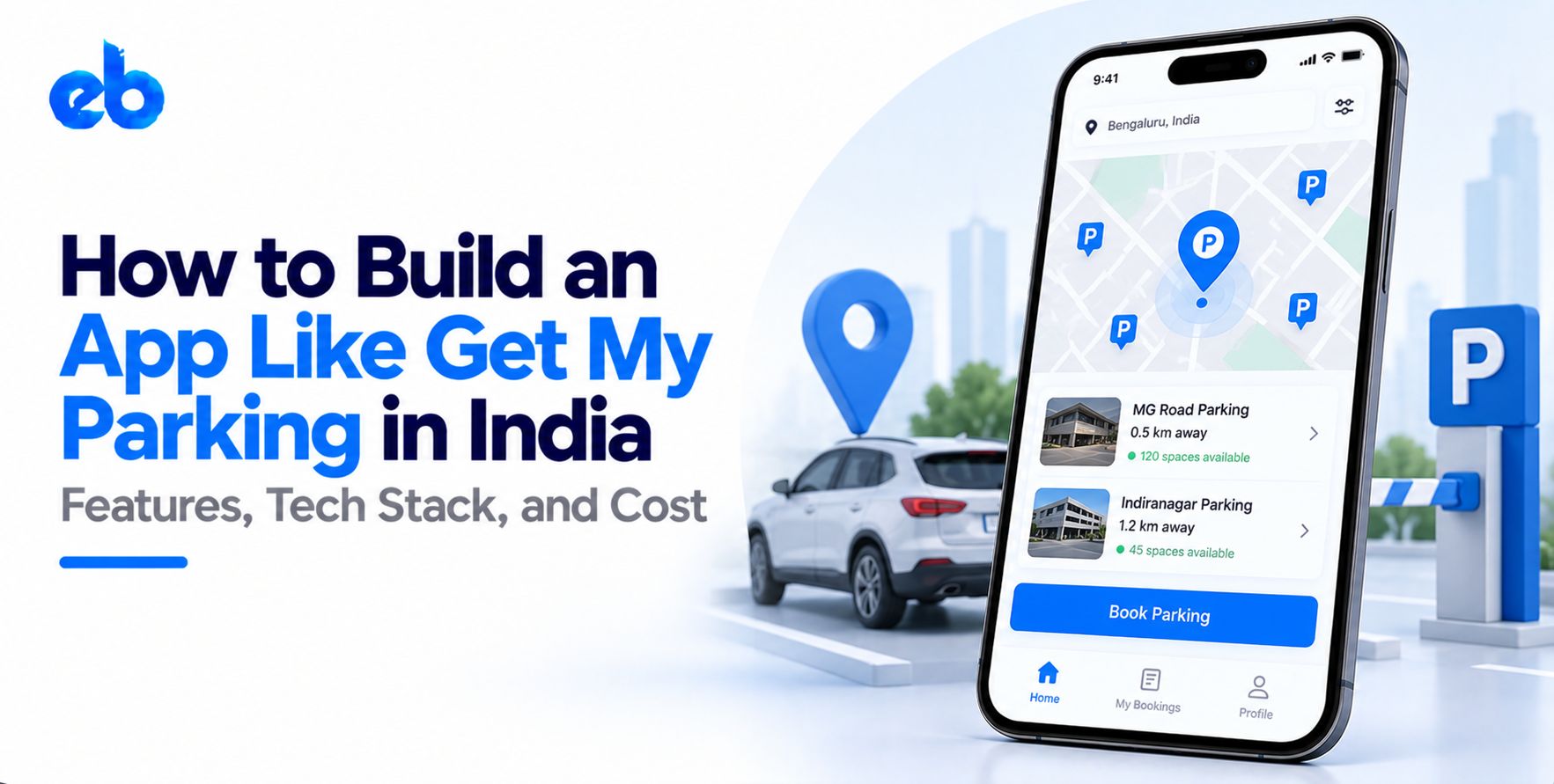
A driver in Indore circles the same market lane for nine minutes. She passes two half-empty basement lots she cannot see from the road. One of them has an attendant sitting idle, waiting for cars.
That gap between empty space and searching driver is the entire business. Parking in India is not scarce everywhere. It is invisible, unpriced, and almost never connected to anything digital.
To build an app like Get My Parking, you need four things working together: live inventory of parking spaces, a booking and entry flow, a payment layer that handles UPI and cash, and integrations with on-site hardware. Everything else is polish.
This guide walks through each layer, with Indian ground realities baked in.
TL;DR
Get My Parking does not own parking lots. It digitizes them. Operators, malls, hospitals, and municipal bodies plug their existing lots into the platform and get software for pricing, access control, and reporting.
Drivers get the easy half: find a slot, reserve it, pay without fishing for change. Operators get the valuable half: occupancy data, automated billing, and far less cash leakage.
That two-sided design is why the product sits closer to on-demand app development than to a simple listing directory. You are building a marketplace where supply changes minute by minute.
The timing is reasonable. The India smart parking systems market reached USD 327.4 million in 2025 and is projected to hit USD 948.0 million by 2034, growing at a 12.16% CAGR through the forecast period (IMARC Group).
Most teams scope one app and discover two more halfway through. Scope all three upfront.
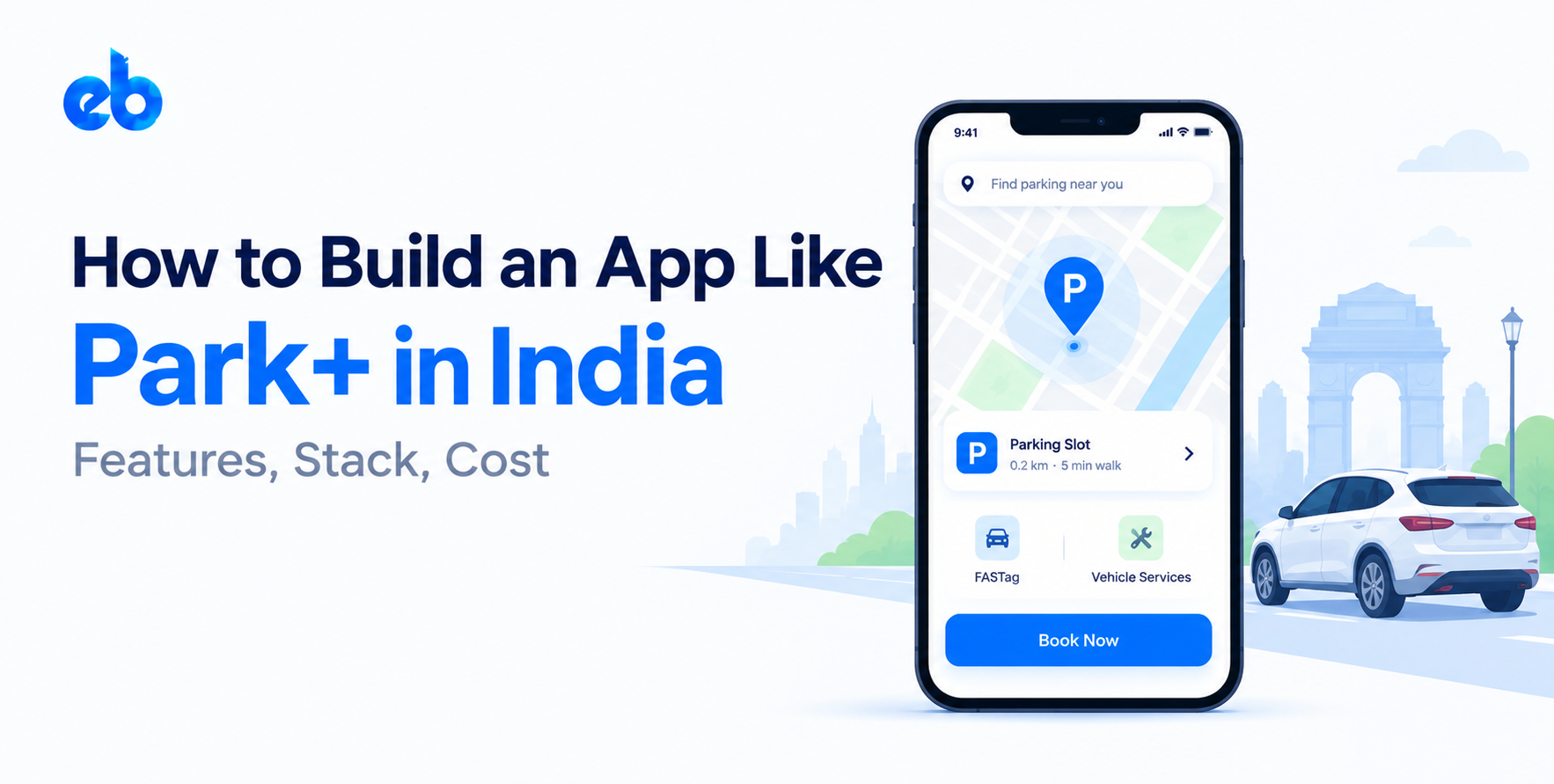
This is the consumer face. Search by location, see nearby lots with live availability, view pricing, reserve, navigate, pay, and exit.
Availability has to be honest. A driver who books a slot and arrives to a full lot does not come back. Use geofencing to trigger arrival detection, auto check-in, and timer start without manual taps.
The attendant or supervisor uses this on a cheap Android phone. It handles walk-ins, verifies bookings, overrides stuck barriers, and records cash collections.
Build this for noisy, low-bandwidth, glare-heavy conditions. Big buttons, offline queueing, and a two-tap flow matter more than visual flourish here.
Lot owners and city authorities need pricing rules, shift reports, revenue reconciliation, and occupancy trends. This is where you prove your software earns its subscription fee.
Resist the temptation to ship everything. These carry the weight.
| Feature | Why it earns its place |
| Live slot availability | The single reason drivers trust the app |
| Reservation with hold window | Prevents the lot filling up before arrival |
| QR or ANPR based entry | Removes the attendant bottleneck at the gate |
| Dynamic pricing rules | Peak hours, weekends, event days, monthly passes |
| Wallet and UPI payments | Indian drivers abandon card-only flows fast |
| Cash reconciliation | Cash will not disappear; account for it properly |
| Monthly pass management | Office and residential parking repeat revenue |
| Operator shift reports | How owners catch revenue leakage |
Other than these, Payment design deserves extra care. There are many payment gateways for startups that help you set up the payment process.
Do not launch across malls, hospitals, street parking, and airports at once. Each has different access control, pricing logic, and approval chains.
Choose one. Off-street commercial lots in a single city is the cleanest start. You get paying operators without municipal tendering cycles.
Sign three to five lots before writing code. Their actual workflows become your product spec. Teams that build an app like Get My Parking without live lots end up shipping assumptions, then rebuilding. Treat this as MVP development discipline, not a shortcut.
Spend two days at a partner lot. Watch how cars enter, how the attendant decides pricing, what happens when the barrier jams, and how cash moves at shift change.
You will find rules nobody documented. Free first fifteen minutes. Discounted rates for shop staff. A ledger notebook that is the real source of truth.
Your software has to absorb those rules, not fight them. Operators abandon apps that make their day harder. Document every exception you observe, then decide which ones the product supports in version one.
This is the spine. A driver searches, sees availability, reserves for a set hold window, and arrives.
At the gate, entry happens through a QR scan, a number plate read, or an attendant tap. All three paths must write to the same session record, or your billing breaks.
Design for the unhappy paths too. Late arrivals, no-shows, overstays, and walk-ins without the app. Clean UI/UX design here means fewer support calls and fewer disputed bills at exit.
Parking revenue splits between you, the lot owner, and sometimes an aggregator. Build the settlement logic early, because retrofitting it is miserable.
Support UPI, wallets, cards, and cash. Cash entries flow through the operator app and reconcile against shift totals. Any mismatch flags automatically.
Add auto-debit for monthly passes and overstay charges. The engineering patterns closely mirror what goes into a P2P payment app, including idempotent transactions, retry handling, and a clear refund path for failed exits.
Now connect boom barriers, ANPR cameras, sensors, and display boards. Most Indian hardware exposes serial or basic HTTP interfaces, not modern SDKs.
Wrap each device behind your own abstraction layer through solid API development, so swapping a vendor does not touch application logic.
Then pilot for six to eight weeks on real traffic. Measure failed gate openings, booking-to-arrival ratio, average exit time, and operator override frequency. Fix those numbers before adding your second city.
Cross-platform makes sense for the driver app, since both Android and iOS matter and the UI is not graphics heavy. Flutter and React Native both work well here.
For the backend, Node.js or Python with PostgreSQL handles bookings and pricing cleanly. Add Redis for availability counters, since slot counts change constantly and cannot wait on database round trips.
Use MQTT or WebSockets for device communication. Barriers and sensors need persistent, lightweight channels, not polled REST calls.
Software timelines rarely slip because of screens. They slip because a camera at a Pune lot misreads plates in afternoon glare.
Plan for four realities. ANPR accuracy in India sits lower than vendor claims, thanks to non-standard plates and fonts. Barriers fail and need manual override logged in-app. Connectivity drops in basements, so edge devices must queue locally. FASTag-based entry is spreading and worth designing for, even if version one skips it.
EV charging is the natural next layer. Lots of adding chargers want booking and billing in the same system, which overlaps heavily with EV charging software development.
The transaction commission alone rarely pays the bills at early volume. The healthier mix looks like this.
Operators pay a monthly SaaS fee per lot for the management software. You take a small cut of digital transactions on top. Monthly passes generate predictable recurring revenue, which behaves much like any SaaS subscription management platform.
Then come the margins most founders miss. Advertising on display boards, valet and car-wash add-ons, and occupancy data sold to malls and developers planning capacity. A solid business intelligence dashboard turns that data into something buyers will actually pay for.
Mobile app development costs vary with hardware scope, but Indian development rates give useful ranges.
| Scope | Timeline | Indicative cost |
| Single-city MVP, 3 apps, QR entry | 4 to 7 months | ₹18 lakh to ₹45 lakh |
| ANPR, barrier and sensor integration | Add 6 to 10 weeks | ₹8 lakh to ₹20 lakh |
| Multi-city platform with pricing engine | 9 to 14 months | ₹60 lakh to ₹1.2 crore |
Hardware procurement sits outside these figures and is usually funded by the lot owner. Other than that, the city dynamics also affect the cost. For instance, the cost to build an app in mumbai and cost to build an app in Bangalore will not be the same.
Teams that want to build an app like Get My Parking usually need three skills in one place: consumer app craft, backend systems that handle live inventory, and hardware integration patience.
EngineerBabu covers that span through custom mobile app development, backend engineering, and AI work, delivered on a CMMI Level 5 process. You can also extend your own team through a dedicated development team model rather than outsourcing the whole build.
The companies that win in Indian parking are not the ones with the prettiest booking screen. They are the ones whose software survives a jammed barrier, a cash-paying walk-in, and a basement with no signal.
Start with one city. Sign real lots. Instrument everything. The decision to build an app like Get My Parking is really a decision to run an operations business with software attached, and the sooner you accept that, the better your product gets.
Ready to scope a parking platform for your city?
Talk to the EngineerBabu team about your build.
A single-city MVP with driver, operator, and admin apps typically takes four to seven months. Adding ANPR and barrier integration pushes that by six to ten weeks, depending on hardware vendors and on-site testing conditions.
Expect ₹18 lakh to ₹45 lakh for a focused one-city MVP. A multi-city platform with dynamic pricing, hardware integration, and analytics usually lands between ₹60 lakh and ₹1.2 crore.
No. Many teams launch with QR-based entry and an operator app, then add barriers, sensors, and ANPR once bookings prove out. Starting software-only keeps your pilot cheap and fast.
Through SaaS fees charged to lot operators, a commission on digital transactions, monthly pass revenue, advertising on display boards, and occupancy data sold to malls, developers, and city planners.
Keeping digital bookings synced with physical gate events. Network drops, failed barrier signals, and ANPR misreads all create billing disputes unless your session logic handles them explicitly.
Not well. Their workflows and permissions differ sharply. Build three interfaces on a shared backend so each user gets a focused experience without duplicating your core parking logic.