10 Top Innovative Multimodal AI Applications & Use Cases


Create engaging, high-performance mobile applications tailored to your business needs. We craft future-ready apps that offer smooth user experiences on all devices.
Build robust and scalable websites and CMS platforms that help you manage content effortlessly. Our development ensures a seamless digital presence.
Launch secure, feature-rich online stores with intuitive shopping experiences. We build tailored eCommerce platforms designed for growth.
Design captivating games with immersive gameplay and stunning graphics. From concept to launch, we build engaging experiences that players love.
Enhance your customer relationships with customized Salesforce implementations. Drive growth and efficiency with smarter CRM solutions.
Harness artificial intelligence and machine learning to automate workflows and gain actionable insights. Our AI transforms data into smart decisions.
Accelerate your software delivery lifecycle with continuous integration, delivery, and infrastructure automation to boost efficiency.

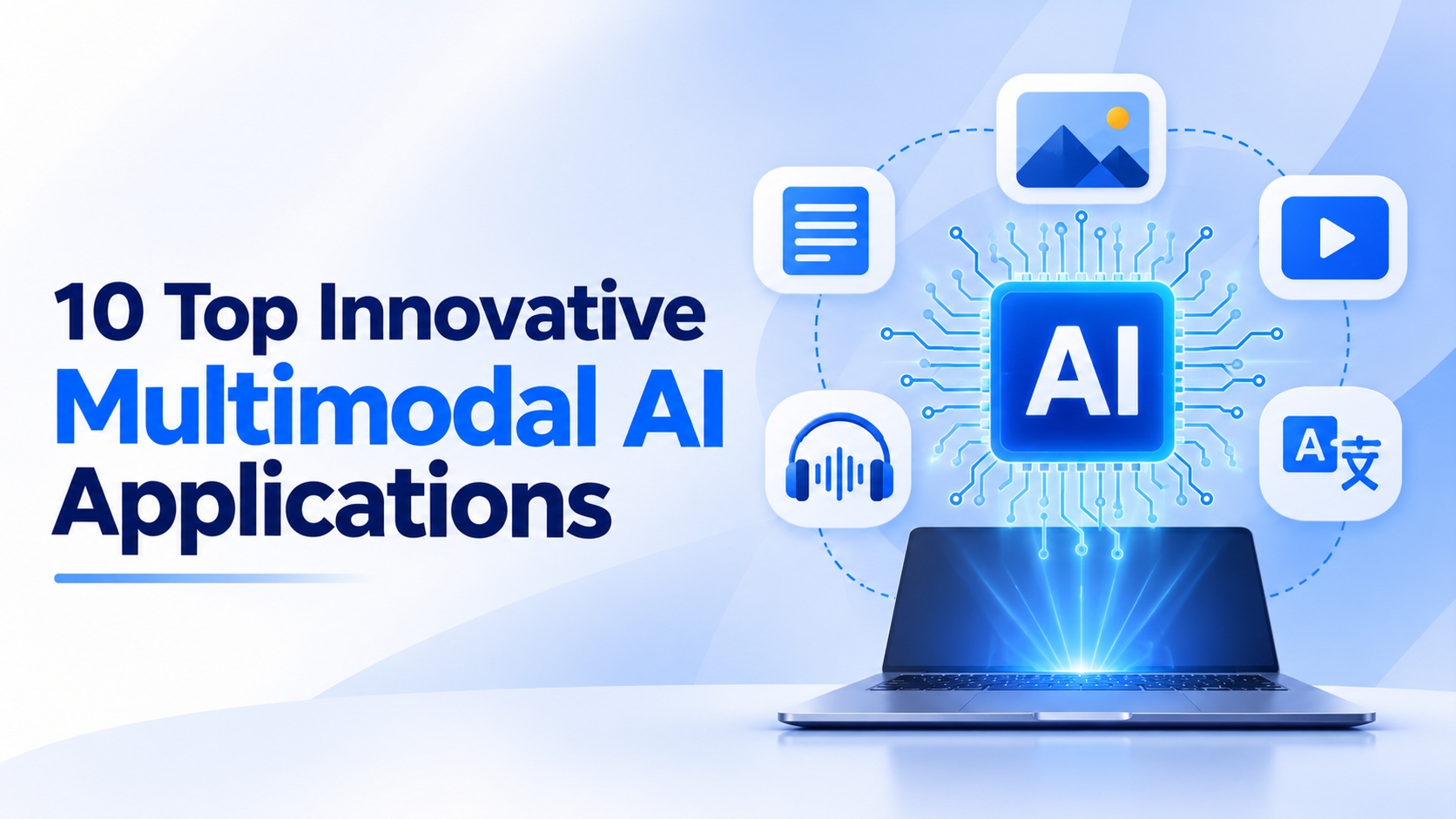
Single-input models hit a ceiling fast. A text model cannot read a cracked weld. A vision model cannot hear a bearing about to fail. The top innovative multimodal AI applications work because they stop forcing messy, real-world information into one narrow format.
Multimodal AI processes several input types inside a single model or a tightly coupled stack. It looks at a photo, reads the invoice attached to it, listens to the technician’s voice note, and returns one decision.
The market reflects that shift. Multimodal AI is projected to grow from $3.0 billion in 2026 to $34.0 billion by 2033, a 41.4% CAGR (Grand View Research).
TL;DR
Not every AI feature with a camera attached qualifies. A genuinely multimodal system fuses inputs before it reasons, rather than running separate models and stapling the outputs together.
Three things separate the real ones from the rebrands:
That last point matters most in regulated work, where a decision without a traceable source is a liability. Most teams reach this stage through staged AI integration, adding one modality at a time instead of rebuilding everything at once.
Each of these is already running in production somewhere, not sitting in a research paper.
Clinicians lose hours to charting. Ambient systems listen to the consultation, pull structured context from the patient record, and draft the note in the right template. The best ones flag what they could not hear clearly instead of inventing it.
What it combines:
Best for: Hospital groups and specialty clinics where documentation burden drives physician churn. Teams building this usually start with AI medical scribe development before expanding into coding and orders.
Fraud rings beat single-signal checks easily. Multimodal verification compares the ID document image, a liveness video, device fingerprints and typing behavior together. A forged document can pass OCR. It rarely passes OCR plus liveness plus behavioral analysis at once.
What it combines:
Best for: Lenders, neobanks and exchanges onboarding at volume. This is one of the top innovative multimodal AI applications where accuracy gains convert straight into reduced loss. Teams working on AI in fintech software usually treat this as the first build.
Customers describe problems badly. They photograph them well. Multimodal support agents accept a photo or short video, read the model number off the label, cross-reference the service manual, and either resolve the issue or route it with the right part already identified.
What it combines:
Best for: Consumer electronics, appliances and automotive aftersales. Pairing this with an AI customer service agent cuts the back-and-forth that drives most support cost.
Claims adjusters still review photos manually at most carriers. Multimodal models estimate damage severity from images, reconcile that against telematics data and the policyholder’s written description, and surface inconsistencies that suggest padding or staging.
What it combines:
Best for: Motor, property and equipment insurers processing high claim volumes. The same stack powers vehicle inspection software used at fleet handover and lease return.
Visual inspection catches surface defects. It misses everything internal. Combining high-speed cameras with acoustic and vibration sensors catches cracks, voids and misalignments that no single sensor would reveal on its own.
What it combines:
Best for: Automotive, electronics and pharma manufacturing lines with tight tolerance requirements. Most plants extend the same sensor stack into a predictive maintenance platform once the inspection models stabilize.
Company knowledge lives in slide decks, scanned PDFs, Slack threads, recorded calls and architecture diagrams. Keyword search finds none of it reliably. Multimodal retrieval indexes the visual content of a diagram and the spoken content of a recording alongside plain text.
What it combines:
Best for: Professional services, engineering and legal teams with a decade of unstructured archives. This is among the top innovative multimodal AI applications with the fastest internal adoption, usually delivered as an AI knowledge management platform.
Store audits done by hand are slow and inconsistent. Camera feeds or associate phone photos get compared against the planogram, then cross-checked with point-of-sale data to separate genuine stockouts from misplaced facings.
What it combines:
Best for: Grocery, pharmacy and convenience chains managing hundreds of locations. It connects naturally to AI in supply chain software so replenishment reacts to shelf reality, not system stock.
Students show their work on paper. A text-only tutor cannot see where the reasoning broke. Multimodal tutors read a photo of handwritten working, listen to the student explain their approach, and respond to the actual error rather than the final answer.
What it combines:
Best for: K-12 platforms, test prep and vocational training. Most AI tutoring platform development projects now treat handwriting input as a baseline requirement.
Assistive tools have jumped from reading labels to describing scenes. A live camera feed plus natural language lets a user ask what is in front of them, read a menu, or find a specific door number in a hallway.
What it combines:
Best for: Accessibility products, navigation apps and public-sector service delivery. The vision layer here depends on solid computer vision software development, since latency and lighting break most prototypes.
Legacy systems rarely expose clean APIs. Agents that read the screen handle this by interpreting the interface visually, locating fields, and completing multi-step tasks the way a trained operator would.
What it combines:
Best for: Insurance, healthcare administration and logistics back offices tied to old software. These agents work best inside a multi-agent AI system where one agent acts and another checks the result.
| Industry | Strongest starting use case | Hardest part to solve |
| Healthcare | Ambient documentation | Consent, PHI handling and audit trails |
| Fintech | Identity and fraud checks | Sub-second latency at scale |
| Manufacturing | Vision plus acoustic inspection | Collecting enough labeled defect data |
| Retail | Shelf and planogram audits | Image quality across thousands of stores |
| Insurance | Damage assessment | Fraud patterns that shift every quarter |
| Professional services | Multimodal enterprise search | Access control across mixed file types |
Pick one row and go deep. Teams that launch three use cases at once usually ship none of them properly.
The model is the easy part now. The difficulty sits in everything around it.
Data preparation dominates the timeline. You need aligned pairs, meaning the image, the transcript and the record all refer to the same event with the same timestamp. Misaligned training data is the single most common reason multimodal pilots underperform in production.
Cost control comes next. Processing video frames at full resolution burns budget quickly. Production systems sample intelligently, cache aggressively, and route simple cases to smaller models.
Then there is evaluation. You cannot score a multimodal system with one accuracy number. You need per-modality benchmarks plus a cross-modal test set built from real failure cases.
Most teams get there through a mix of generative AI development for the reasoning layer and custom machine learning development for the domain-specific perception models.
EngineerBabu builds multimodal systems as products, not experiments. The work covers data pipeline design, model selection and fine-tuning, evaluation harnesses, and deployment inside compliance boundaries like HIPAA and SOC 2.
The team holds a CMMI Level 5 rating, was selected into the Google AI Accelerator, and has delivered across fintech, healthtech and industrial software. That matters here because most of the top innovative multimodal AI applications fail on engineering discipline, not on model choice.
You can engage on a full build through AI development services, or hire AI developers to extend your existing team on a dedicated basis.
The gap between companies using multimodal AI and companies talking about it keeps widening. The ones shipping picked a single workflow where unstructured data already caused measurable pain.
None of the top innovative multimodal AI applications above required inventing new science. They required clean data alignment, honest evaluation, and a team willing to ship something narrow before going broad.
Start with the file type your business generates most and cannot currently search. That is usually the right first build.
Generative AI describes what a model produces. Multimodal describes what it can take in. A system can be both, generating text from an image and audio input combined.
Far less than people assume, because foundation models handle perception already. Most domain projects need a few thousand well-aligned, correctly labeled examples for fine-tuning and a separate evaluation set.
Yes for narrower tasks. Smaller vision and audio models run on modern phones and edge hardware. Complex cross-modal reasoning still usually needs cloud inference or a hybrid split.
With guardrails, yes. Regulated deployments require confidence thresholds, human review for low-confidence outputs, grounded citations back to source media, and full audit logging of every input and decision.
A focused production pilot typically takes twelve to twenty weeks. Data collection and alignment consume most of that time, not model training or application development work.
You need ML engineers comfortable with vision and audio, data engineers for pipeline alignment, and domain experts who can label edge cases correctly. Backend and MLOps support is essential too.