How to Build a Predictive Maintenance Platform - IoT Sensors, Anomaly Detection, RUL Prediction 2026


Create engaging, high-performance mobile applications tailored to your business needs. We craft future-ready apps that offer smooth user experiences on all devices.
Build robust and scalable websites and CMS platforms that help you manage content effortlessly. Our development ensures a seamless digital presence.
Launch secure, feature-rich online stores with intuitive shopping experiences. We build tailored eCommerce platforms designed for growth.
Design captivating games with immersive gameplay and stunning graphics. From concept to launch, we build engaging experiences that players love.
Enhance your customer relationships with customized Salesforce implementations. Drive growth and efficiency with smarter CRM solutions.
Harness artificial intelligence and machine learning to automate workflows and gain actionable insights. Our AI transforms data into smart decisions.
Accelerate your software delivery lifecycle with continuous integration, delivery, and infrastructure automation to boost efficiency.
Unplanned equipment downtime costs US manufacturers $50 billion annually. A single unplanned stoppage at an automotive assembly plant costs $2 million per hour. Preventive maintenance, replacing parts on a fixed schedule wastes money replacing components that still have 40% useful life remaining while still missing failures that develop between intervals.
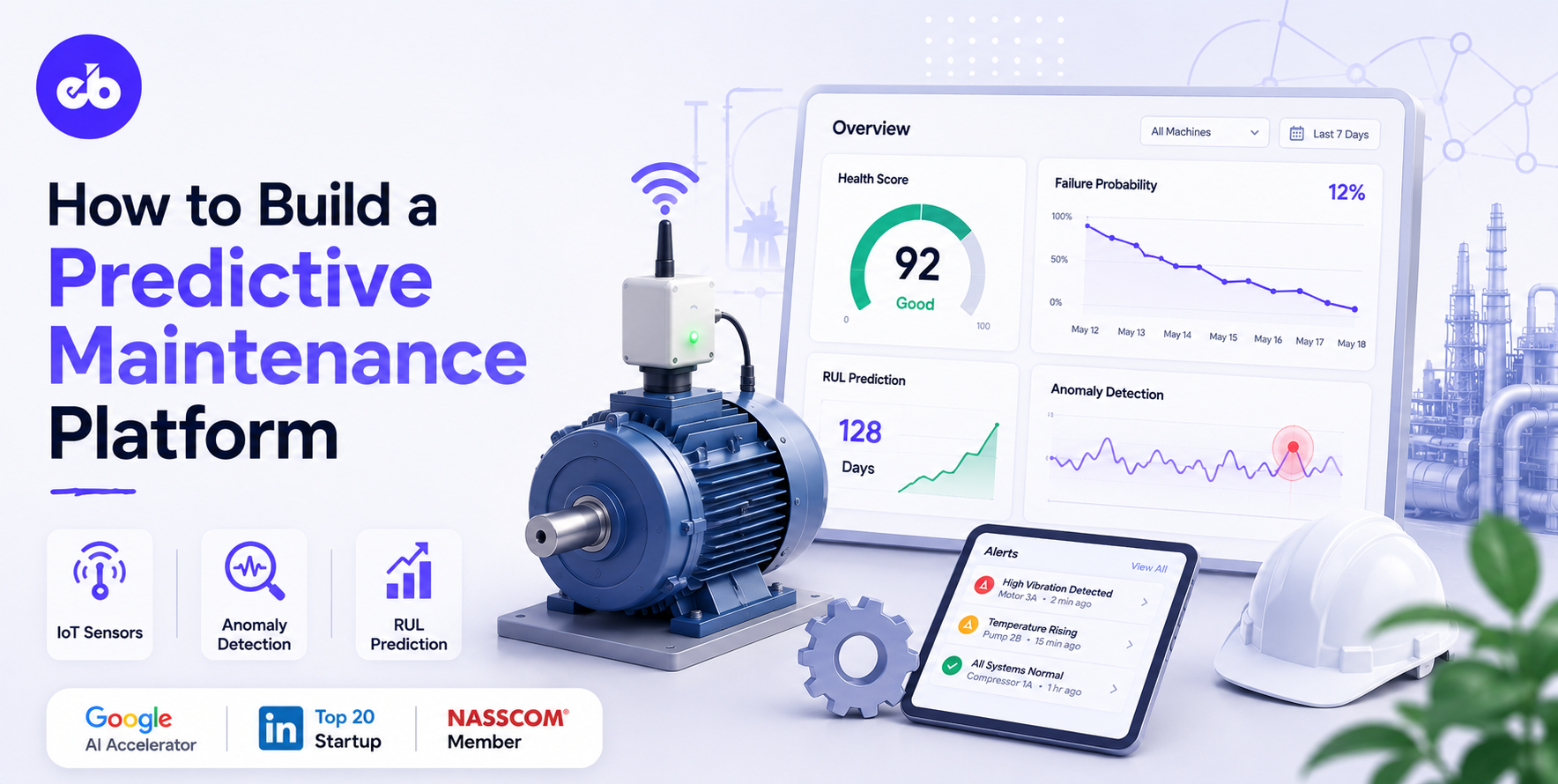
Predictive maintenance monitors equipment continuously using sensors, detects anomalies before they become failures, predicts when failure will occur, and generates a work order exactly when maintenance is needed.
EngineerBabu built AI-powered operations management for Adani Group. Google AI Accelerator 2024. Contact: mayank@engineerbabu.com
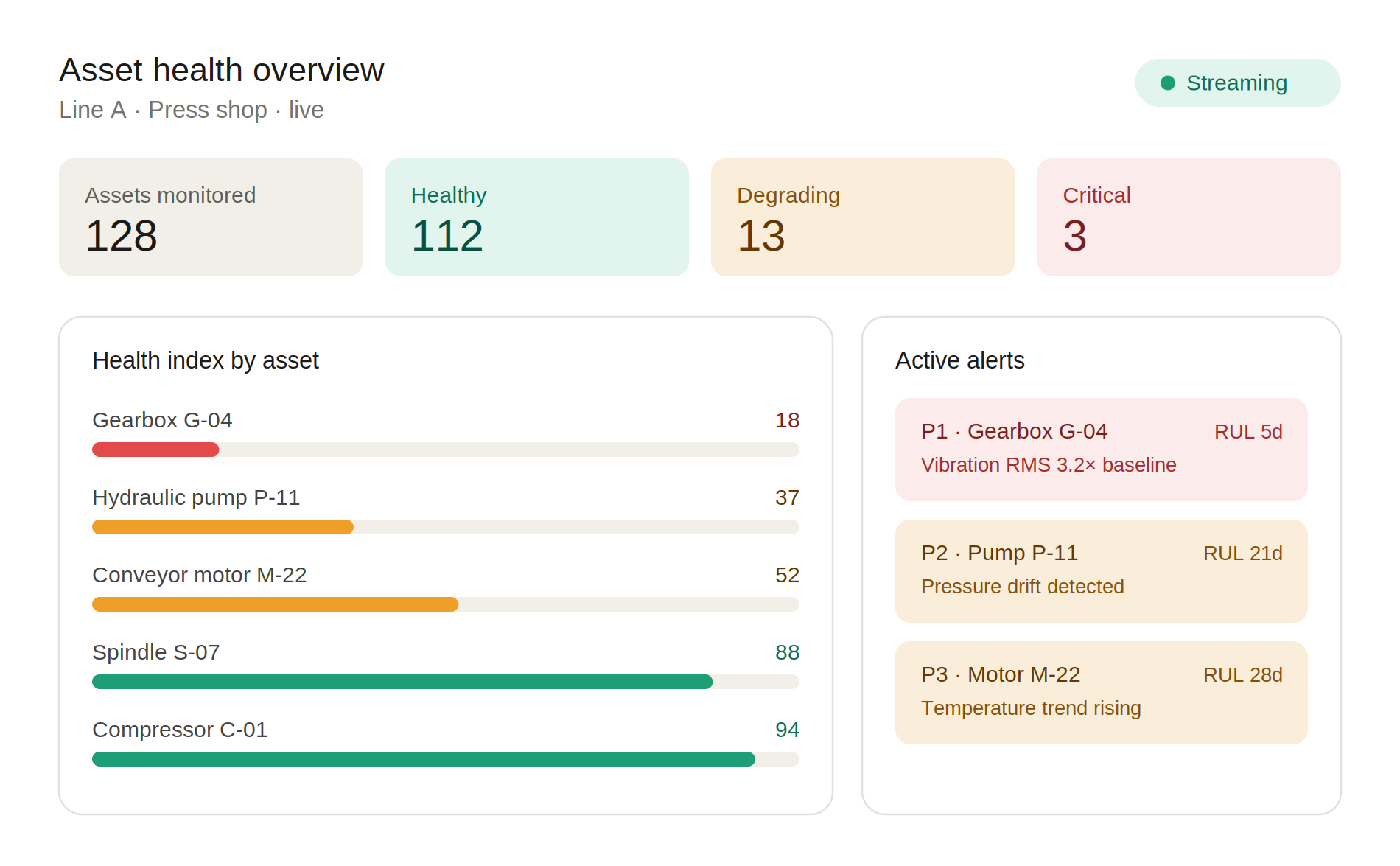
Traditional maintenance strategies rely on either fixed schedules or reactive repairs. Predictive maintenance takes a different approach by continuously monitoring equipment health, analyzing operational data, and forecasting failures before they happen.
An AI-powered predictive maintenance platform combines Industrial IoT (IIoT) sensors, edge computing, machine learning models, and maintenance management systems into a single workflow.
The platform continuously collects equipment data, detects abnormal behavior, estimates the remaining useful life (RUL) of critical components, automatically creates maintenance work orders, and optimizes maintenance schedules to minimize production disruption.
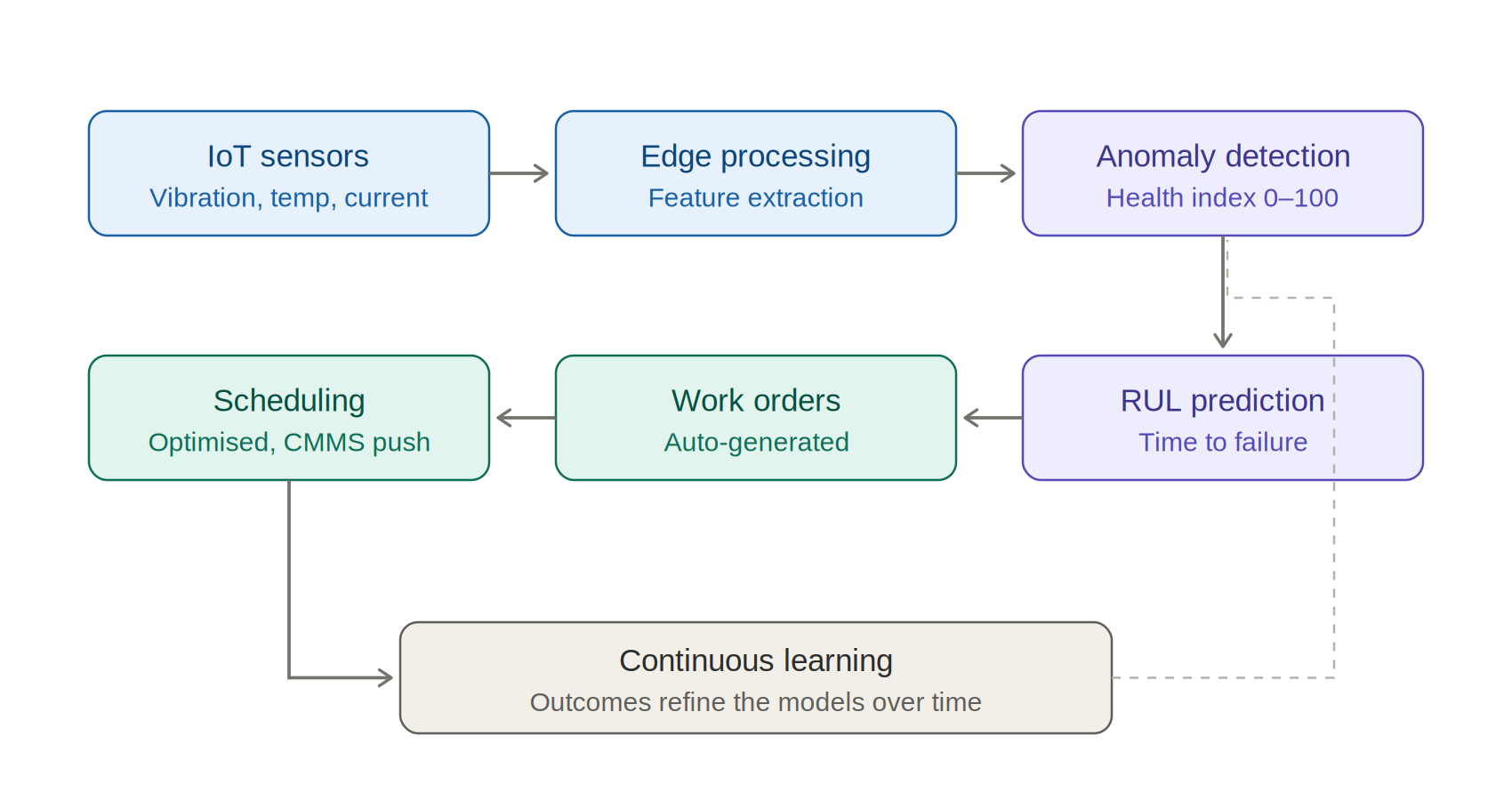
The complete workflow typically follows these stages:
This closed-loop approach enables organizations to reduce unexpected failures, maximize asset utilization, and optimize maintenance costs.
Sensor types and integration protocols:
| Sensor | Parameter | Protocol |
| Vibration | Bearing wear, imbalance | OPC-UA, MQTT, Modbus |
| Temperature | Motor overheating, coolant failure | MQTT, 4–20mA analogue |
| Current/power | Motor load, efficiency | Modbus, OPC-UA |
| Pressure | Hydraulic system health | MQTT, 4–20mA |
| Acoustic | Ultrasonic leak detection | Proprietary SDK + MQTT |
| Oil quality | Contamination, viscosity | Lab + in-line sensors |
The edge computing layer:
Sensors generate data at 100 Hz to 10 kHz, too high to transmit raw to cloud economically. Edge layer performs:
The baseline training process:
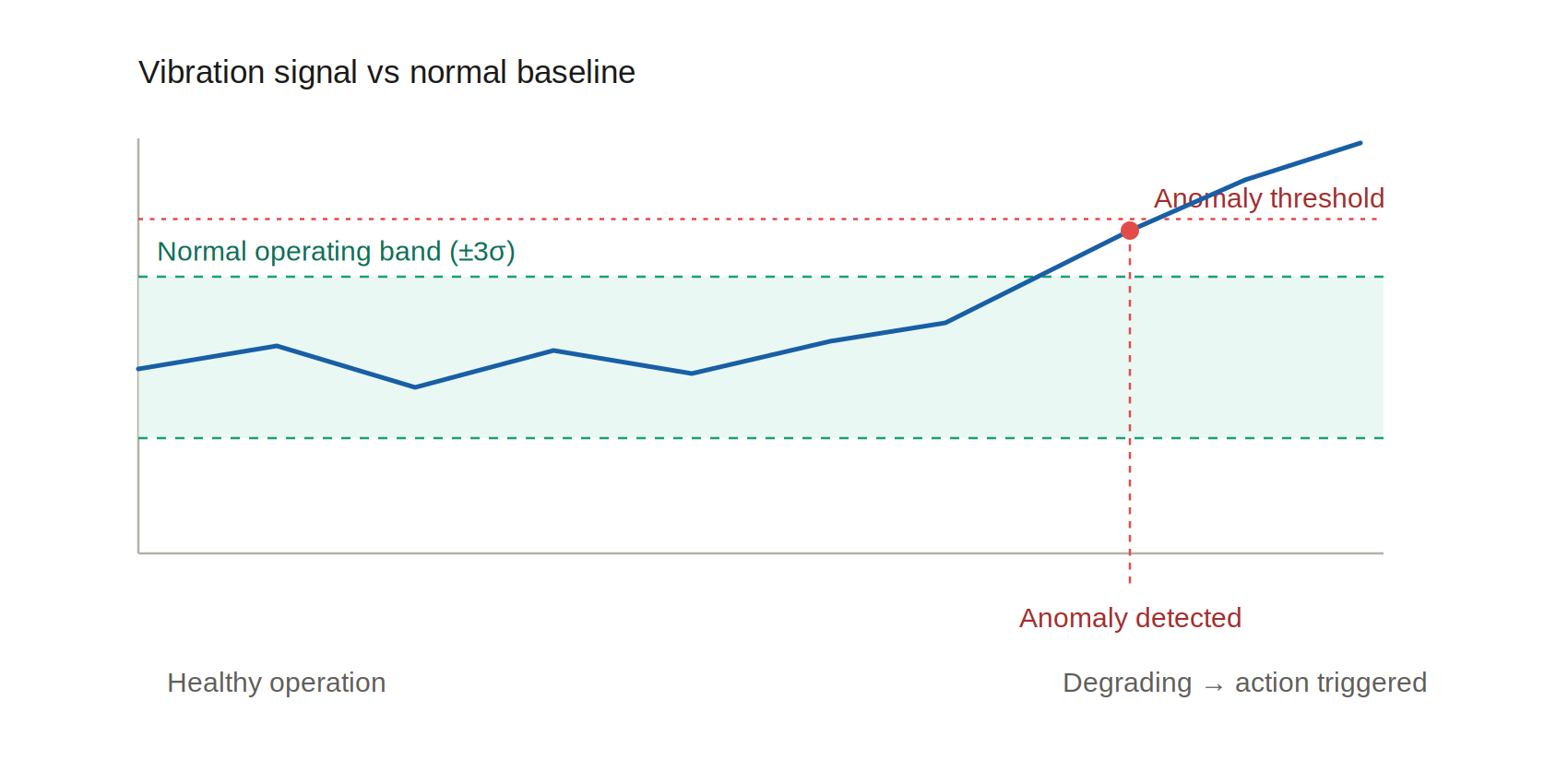
Anomaly detection methods:
| Method | Best For |
| Statistical control charts (3-sigma) | Well-understood, predictable processes |
| Isolation Forest | High-dimensional multi-sensor anomaly detection |
| Autoencoder | Complex machinery with non-linear normal behaviour |
| LSTM time-series | Equipment where temporal patterns matter |
The health index:
Anomaly scores across all sensors on an asset are combined into a composite health index, a single number (0 to 100) representing the asset’s current health relative to normal.
RUL model types:
| Model | Best For |
| Physics-based degradation | Well-characterised failure modes (Archard’s wear law) |
| Data-driven regression | Assets with historical run-to-failure data |
| Survival analysis | Variable degradation rates |
| LSTM sequence model | Complex multi-sensor assets |
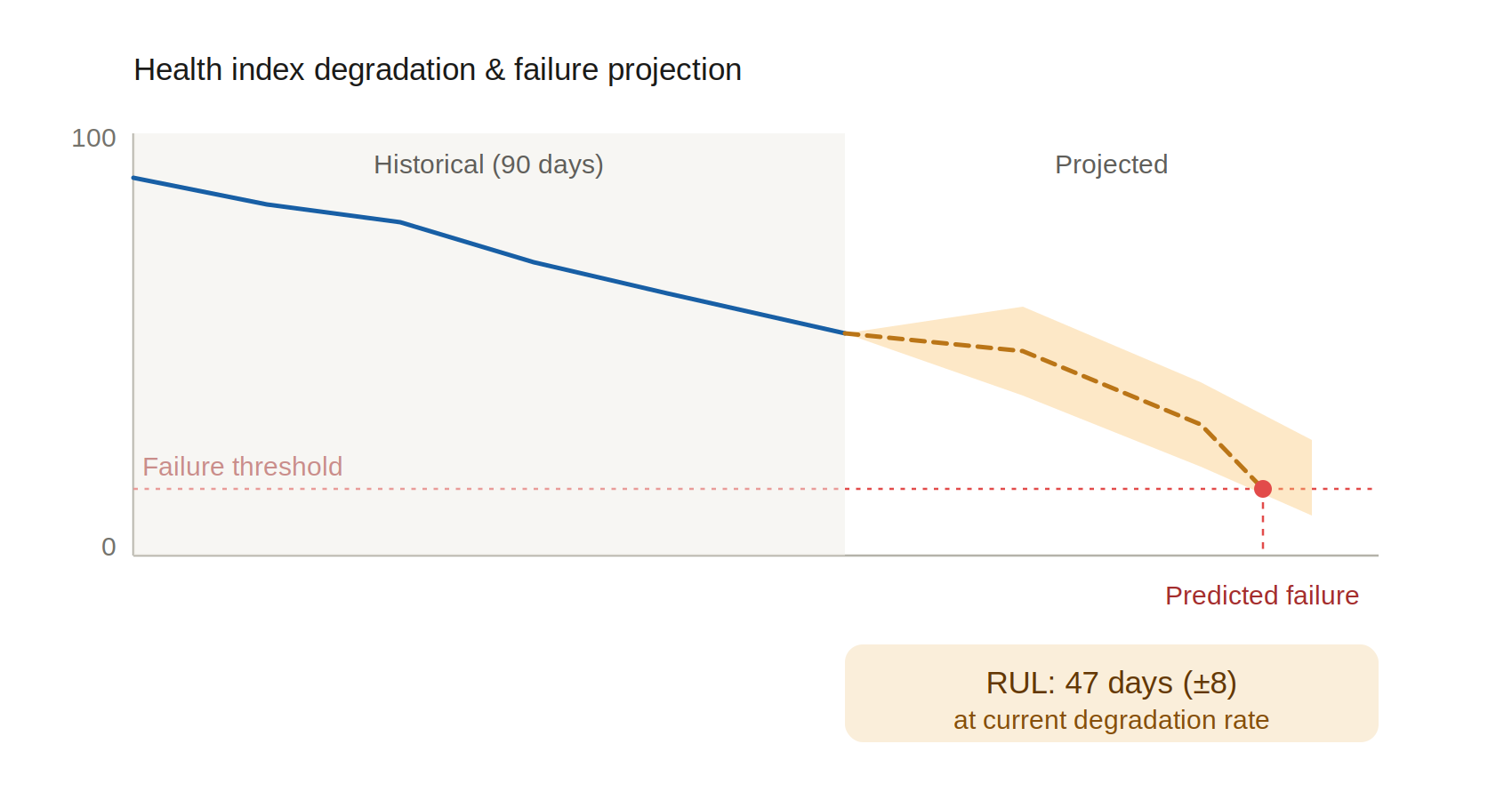
The degradation curve visualisation:
For each monitored asset:
Work order generation triggers:
| Trigger | Condition | Priority |
| Imminent failure | Health index < 20, RUL < 7 days | P1 – Immediate |
| Degradation alert | Health index 20–40, RUL 7–30 days | P2 – Within 1 week |
| Anomaly detected | Specific sensor outside normal range | P3 – Next maintenance window |
| Scheduled due | Calendar or operating-hours based | P4 – Routine |
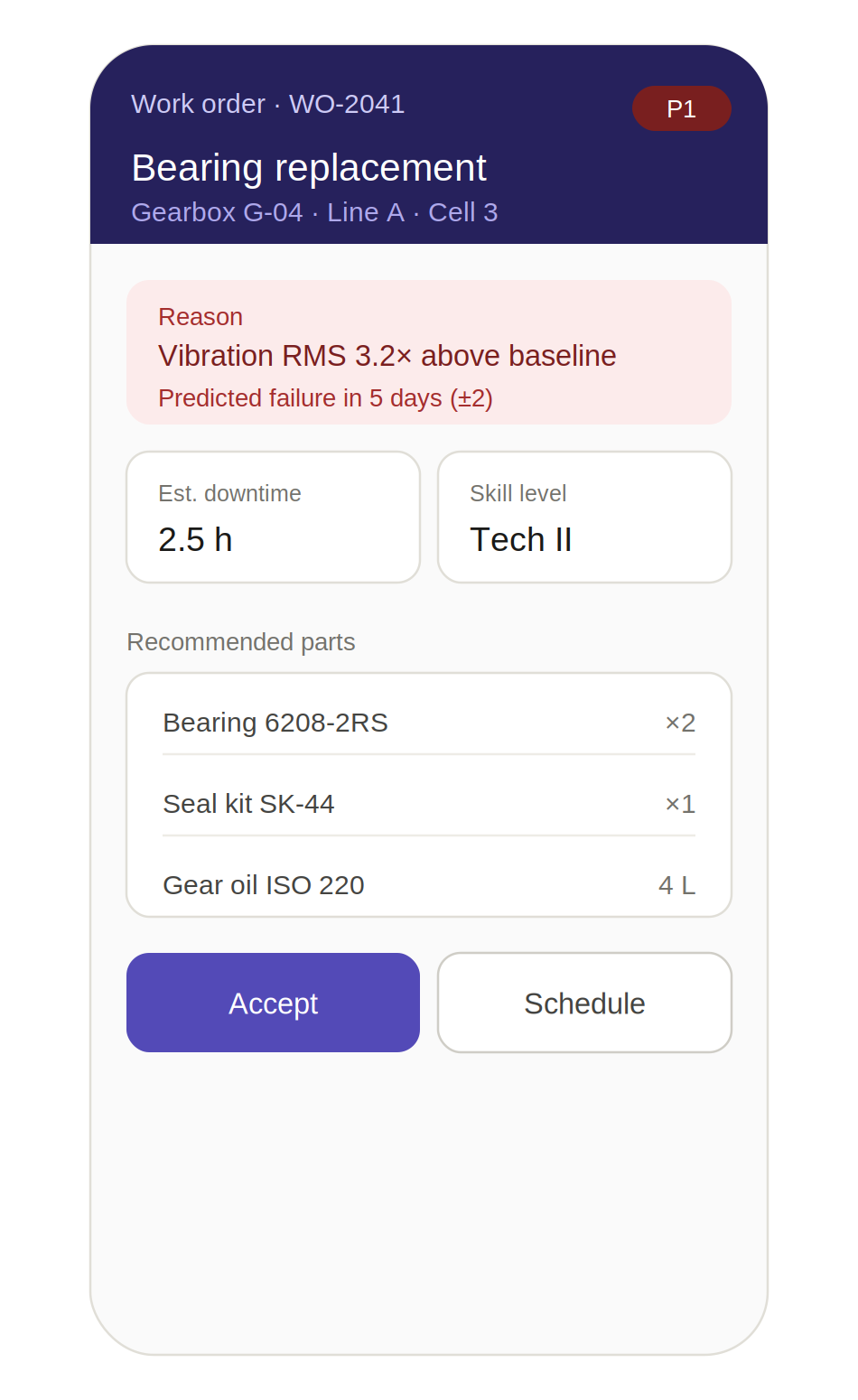
Work order contents:
| Field | Content |
| Asset ID | Specific equipment identifier |
| Location | Plant, line, cell |
| Work type | Inspection / Lubrication / Bearing replacement |
| Reason | Vibration RMS 3.2x above baseline |
| Recommended parts | Bill of materials for likely repair |
| Estimated downtime | Based on historical work orders |
| Skill required | Maintenance technician level |
CMMS integration:
Work orders pushed to SAP PM, IBM Maximo, or Infor EAM via API. The predictive platform generates the trigger, the CMMS manages execution.
The scheduling engine plans maintenance across assets to:
| Module | Cost Range (USD) | Notes |
| IoT sensor integration (10 protocols) | $10K – $20K | OPC-UA, MQTT, Modbus |
| Edge computing agent software | $6K – $12K | Feature extraction |
| Time-series database + pipeline | $6K – $12K | InfluxDB or TimescaleDB |
| Baseline modelling engine | $8K – $15K | Per-asset, per-operating-mode |
| Anomaly detection models | $8K – $15K | Multi-method ensemble |
| RUL prediction model | $10K – $18K | Per asset class |
| Asset health dashboard | $8K – $15K | Real-time, plant floor view |
| Work order generation engine | $6K – $12K | |
| CMMS integration (SAP PM/Maximo) | $6K – $12K | |
| Maintenance scheduling optimisation | $8K – $15K | |
| AWS + security + VAPT | $5K – $10K | |
| Total | $81K – $156K | Full predictive maintenance platform |
EngineerBabu built AI operations management for Adani Group. Contact: mayank@engineerbabu.com
Unplanned equipment failures are among the most expensive operational risks in manufacturing, utilities, logistics, and heavy industries. AI-powered predictive maintenance replaces reactive repairs and inefficient preventive schedules with intelligent, data-driven maintenance decisions based on the actual condition of every asset.
From IoT sensor integration and anomaly detection to remaining useful life prediction, automated work order generation, and maintenance scheduling optimization, a complete predictive maintenance platform helps organizations reduce downtime, improve equipment reliability, extend asset lifespan, and lower maintenance costs.
Vibration sensors are the most valuable for rotating machinery, over 70% of rotating equipment failures manifest as detectable changes in vibration signature before mechanical failure. A triaxial accelerometer mounted on the bearing housing detects bearing wear, imbalance, misalignment, and looseness. Motor current monitoring is the second most important, detecting mechanical loading changes, winding degradation, and efficiency loss. Temperature and oil quality sensors complement these for comprehensive condition monitoring.
A data-driven RUL model performs well with 20 to 50 complete run-to-failure cycles. For assets that rarely fail, accumulating this data takes years. Transfer learning addresses this: a model trained on publicly available bearing degradation datasets (NASA CMAPSS, PRONOSTIA/FEMTO) provides the initial model structure, which is then fine-tuned on limited site-specific data. A physics-informed ML approach, incorporating known degradation physics as model constraints also improves accuracy with limited training data.
Predictive maintenance is valuable across industries that rely on expensive or mission-critical equipment. Manufacturing plants, automotive assembly lines, power generation, oil and gas facilities, mining operations, pharmaceuticals, food processing, logistics, aviation, and utilities commonly use predictive maintenance to reduce equipment failures, improve asset reliability, and lower maintenance costs
Yes. Modern predictive maintenance platforms are designed to integrate with existing PLCs, SCADA systems, historians, MES platforms, and CMMS solutions such as SAP PM, IBM Maximo, Infor EAM, and Oracle Maintenance Cloud. Standard industrial protocols like OPC-UA, MQTT, and Modbus allow organizations to leverage existing infrastructure without replacing production equipment.
The return on investment depends on equipment criticality and production volume, but manufacturers commonly achieve significant reductions in unplanned downtime, lower maintenance costs, longer equipment life, and improved production efficiency. Facilities with high-value production lines often recover implementation costs quickly by preventing even a few major equipment failures, especially where downtime costs can reach millions of dollars per hour.