AI Use Cases in Loan Management Software


Create engaging, high-performance mobile applications tailored to your business needs. We craft future-ready apps that offer smooth user experiences on all devices.
Build robust and scalable websites and CMS platforms that help you manage content effortlessly. Our development ensures a seamless digital presence.
Launch secure, feature-rich online stores with intuitive shopping experiences. We build tailored eCommerce platforms designed for growth.
Design captivating games with immersive gameplay and stunning graphics. From concept to launch, we build engaging experiences that players love.
Enhance your customer relationships with customized Salesforce implementations. Drive growth and efficiency with smarter CRM solutions.
Harness artificial intelligence and machine learning to automate workflows and gain actionable insights. Our AI transforms data into smart decisions.
Accelerate your software delivery lifecycle with continuous integration, delivery, and infrastructure automation to boost efficiency.
Hire app developers ready to turn your ideas into sleek, high-performing mobile apps for any platform.
Bring in frontend pros who craft smooth, beautiful, and user-friendly interfaces that your visitors will love.
Get backend developers who build fast, secure, and reliable systems to keep everything running behind the scenes.
Hire eCommerce developers who build secure, scalable online stores designed to offer seamless shopping and grow your sales.
Get dedicated developers committed to your projects, delivering consistent quality and speed as an extension of your team.
A borrower misses a payment. Ten years ago, that meant a collections agent working off a spreadsheet, guessing who to call first. Today, the system already knows the borrower is at risk, days before the due date, and has a repayment plan ready before anyone picks up a phone.
That shift is the entire story of AI use cases in loan management software right now. It is not about replacing loan officers. It is about giving lenders a system that thinks ahead instead of reacting after the damage is done.
A January 2026 Experian study of over 200 financial institution decision-makers found that 89% say AI will play a critical role across the lending lifecycle. That is not a niche opinion anymore. It is close to industry consensus.
This blog breaks down where AI actually earns its place inside loan management software, not as a buzzword feature, but as something that changes how loans get serviced, collected, and monitored.
Loan management software runs the part of lending that happens after a loan is approved. It tracks repayment schedules, calculates interest, manages disbursements, handles collections, and generates the reports lenders need for compliance.
This is different from a loan origination system, which handles the application and underwriting stage. Once a loan is live, loan management software owns its entire lifecycle until it is paid off or written off.
Because this software touches every active loan a lender holds, even small inefficiencies here compound fast across a large portfolio. That is exactly why AI use cases in loan management software have become such a priority for lenders scaling past a few thousand accounts.
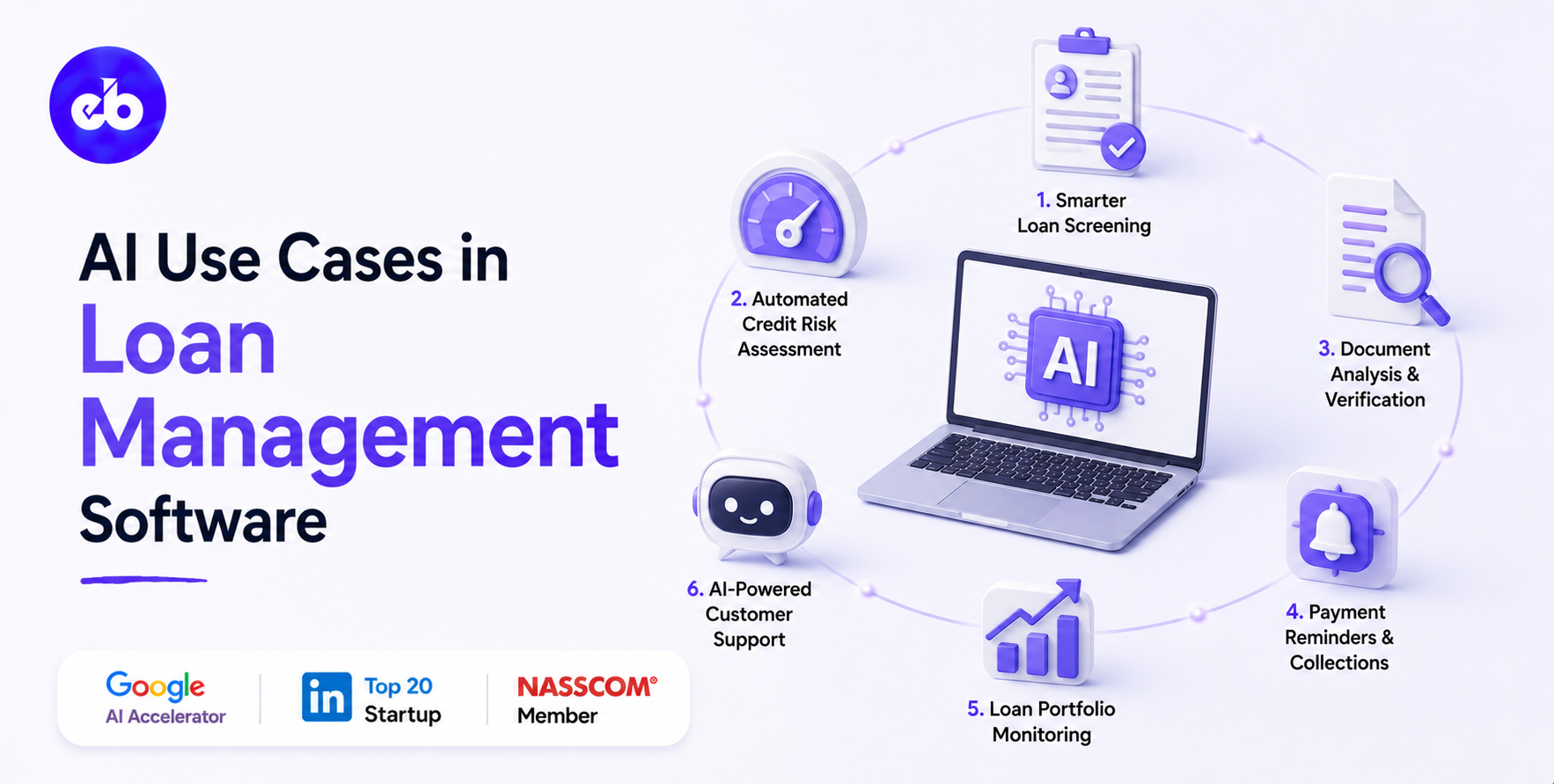
AI use cases in loan management software fall into a few distinct categories, from predicting who will default to automating the paperwork nobody wants to touch. Each one solves a specific operational pain point, not a vague efficiency promise.
Traditional loan management systems flag a missed payment after it happens. AI models flag the risk before the due date even arrives. They look at payment velocity, spending pattern shifts, and account activity to score which borrowers are likely to fall behind.
This lets servicing teams reach out proactively with a payment plan or a reminder call, rather than starting collections after the damage is already on the books. Lenders using this approach report meaningfully lower delinquency rates because intervention happens earlier in the cycle.
Collections is one of the most labor-intensive parts of loan servicing, and AI changes the math significantly. Instead of a fixed call schedule for every overdue account, AI ranks accounts by recovery likelihood and suggests the best channel, whether that is a call, an SMS, or an automated payment link.
This kind of prioritization means collections agents spend their time on accounts that are actually recoverable. Building this into an existing platform usually requires custom ML Development work, since generic scoring models rarely fit a lender’s specific borrower base.
When a borrower’s financial situation changes, rigid repayment terms often push them straight into default. AI-driven restructuring engines analyze a borrower’s updated income and cash flow signals, then propose a modified schedule that keeps the loan performing instead of writing it off entirely.
This matters more for personal and SMB loans, where income volatility is common and a one-size-fits-all repayment schedule does not reflect reality.
Fraud does not stop at origination. It shows up in servicing too, through account takeovers, payment redirection scams, and identity misuse on existing loans. AI models trained on behavioral patterns can flag anomalies like a sudden change in login device, payment source, or contact details.
These systems catch what rule-based fraud checks miss because they are built to recognize deviations from a borrower’s own historical behavior, not just generic red flags.
Loan servicing generates constant paperwork: statements, notices, audit logs, and regulatory disclosures. Natural language processing models can generate, validate, and file these documents automatically, cutting down the manual review load on compliance teams.
This becomes especially valuable across multi-state or multi-country lending operations, where documentation requirements shift by jurisdiction. Well-structured API Development connects these document engines to the core loan ledger so records stay synchronized without manual data entry.
Borrowers expect instant answers about their balance, due date, or payment options, not a hold queue. Conversational AI assistants built into loan management platforms handle these routine queries around the clock, freeing human agents for complex disputes.
Some lenders are extending this further with Generative AI Development to draft personalized repayment reminders and hardship program offers, tailored to each borrower’s history rather than a generic template.
Beyond individual accounts, AI models roll up performance data across an entire loan portfolio to forecast delinquency trends, expected losses, and liquidity needs weeks or months ahead. This gives finance teams a real planning tool instead of a rearview mirror report.
Lenders that adopted AI-based portfolio analytics have reported meaningful uplifts in approval accuracy and reduced bad debt exposure, since the same behavioral data feeding collections models also strengthens forward-looking risk forecasts.
Adding AI to a live loan management platform is not a one-time deployment. It is a structured build that has to respect existing data, compliance rules, and borrower trust.
Start by auditing what data your current system actually captures cleanly, since AI models are only as reliable as the historical loan and payment data feeding them. Most lenders find gaps here before anything else.
Next, prioritize one or two high-friction use cases, like delinquency prediction or collections prioritization, rather than trying to automate the entire servicing stack at once. Pilot the model against a segment of your live portfolio, compare outcomes against your current process, and only then expand it further.
This phased approach, often shaped through a focused MVP Development effort, keeps the rollout low-risk while still proving measurable value early.
AI in loan management software is not plug-and-play, and pretending otherwise sets teams up for a rough rollout.
Data quality is usually the first wall lenders hit, since years of inconsistent servicing records do not translate cleanly into training data. Model explainability is the second, because regulators expect a clear reason behind any automated decision that affects a borrower’s account.
Integration is the third challenge, since most lenders are layering AI Development onto legacy cores that were never built for real-time data exchange. None of these are reasons to avoid AI use cases in loan management software.
They are reasons to work with a team that has handled this integration before, rather than treating it as a side project.
AI use cases in loan management software are no longer experimental add-ons. They are becoming the operational baseline for lenders who want lower default rates, leaner collections teams, and compliance that does not eat up half the servicing budget.
The lenders pulling ahead are not the ones with the flashiest AI features. They are the ones who picked the right use cases, built on clean data, and integrated AI into their actual servicing workflow instead of bolting it on top.
If you are evaluating where AI fits into your loan servicing stack, working with an experienced lending software development company like EngineerBabu can help you move from a scattered pilot to a system that actually holds up in production.
Predictive delinquency scoring, automated collections prioritization, and fraud detection during servicing tend to deliver the fastest measurable returns for most lenders.
No. It handles repetitive scoring and monitoring tasks so officers and collections agents can focus on complex cases and borrower relationships that need human judgment.
Origination AI focuses on approving and underwriting new loans, while loan management AI focuses on servicing, collections, and risk monitoring for loans that are already active. You can read more about the origination side in our post on AI in loan lending apps.
Yes. Even a modest AI model for delinquency prediction or payment reminders can meaningfully reduce missed payments for smaller lending portfolios.
The two often share the same underlying data pipeline. If you want to see how this plays out earlier in the process, our post on the role of AI in automating B2B loan approvals covers the underwriting side in detail.