How to Build a Multi-Agent AI System - Orchestration, Memory, Tool Use, Production Deployment 2026


Create engaging, high-performance mobile applications tailored to your business needs. We craft future-ready apps that offer smooth user experiences on all devices.
Build robust and scalable websites and CMS platforms that help you manage content effortlessly. Our development ensures a seamless digital presence.
Launch secure, feature-rich online stores with intuitive shopping experiences. We build tailored eCommerce platforms designed for growth.
Design captivating games with immersive gameplay and stunning graphics. From concept to launch, we build engaging experiences that players love.
Enhance your customer relationships with customized Salesforce implementations. Drive growth and efficiency with smarter CRM solutions.
Harness artificial intelligence and machine learning to automate workflows and gain actionable insights. Our AI transforms data into smart decisions.
Accelerate your software delivery lifecycle with continuous integration, delivery, and infrastructure automation to boost efficiency.
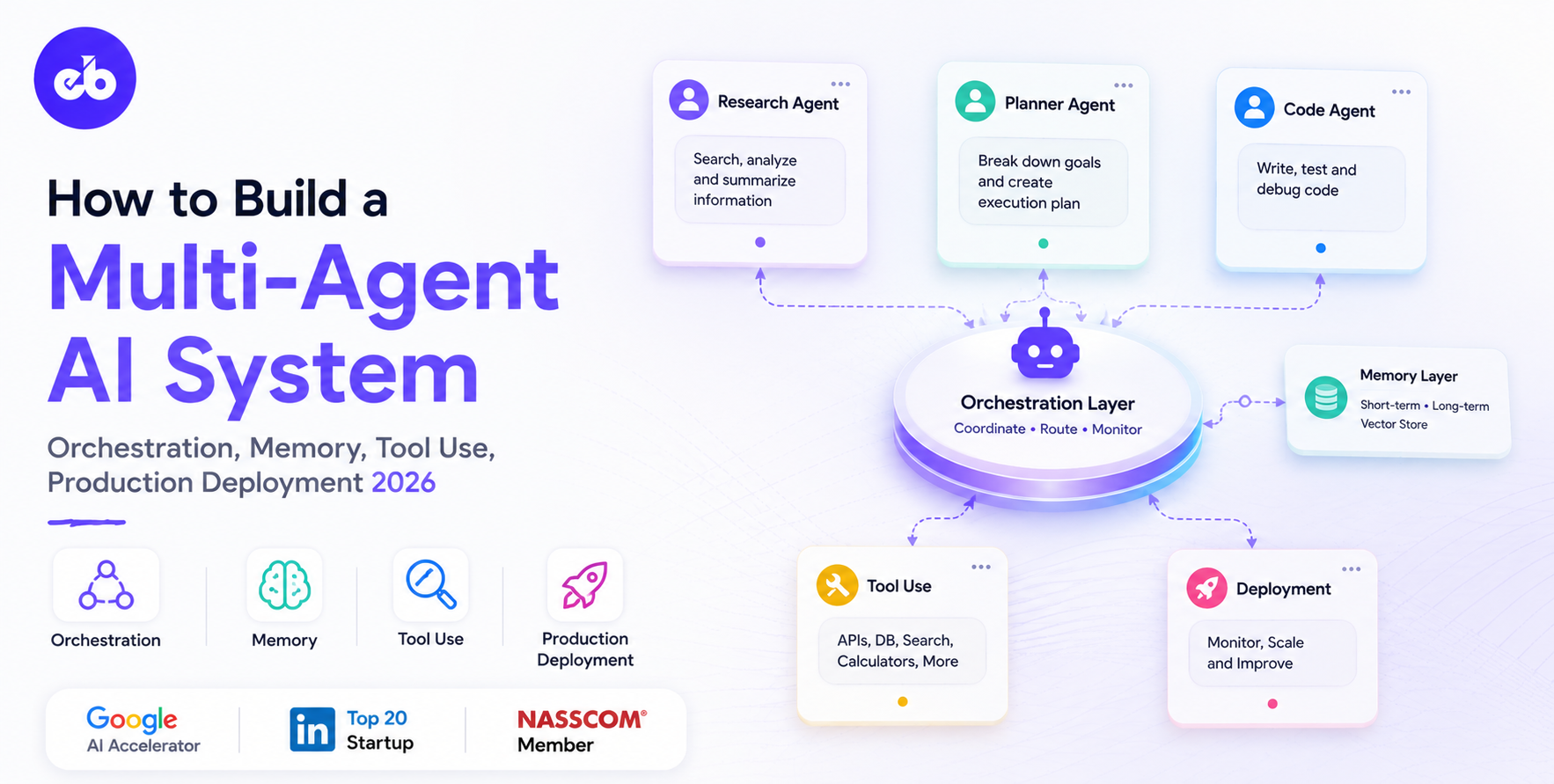
A single AI agent is powerful. A system of coordinated AI agents that can decompose complex goals, delegate to specialists, share context, and recover from individual failures is transformative. That’s why enterprises are looking to build a multi-agent AI system in 2026.
Multi-agent systems are the architecture that makes enterprise AI automation possible at scale. According to Gartner, by 2028, at least 15% of day-to-day work decisions will be made autonomously through agentic AI, up from virtually 0% in 2024.
Most AI applications begin with a single large language model handling an entire request. While this works well for straightforward tasks, enterprise workflows are rarely simple. They involve research, planning, calculations, document generation, approvals, API integrations, and continuous monitoring, all of which require different types of expertise.
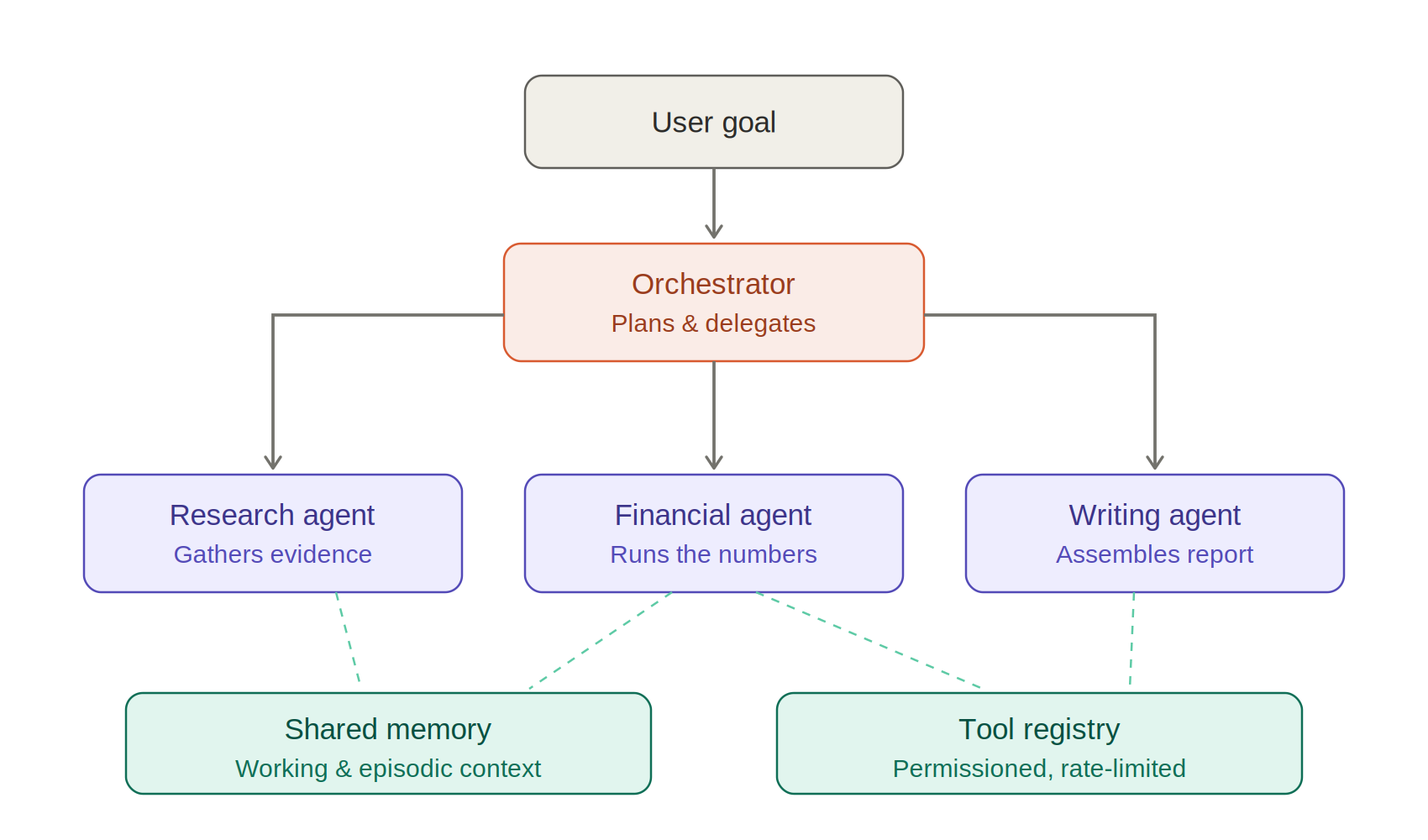
A multi-agent AI system addresses this by breaking a complex objective into smaller tasks handled by specialized AI agents. Instead of one general-purpose agent attempting everything, an orchestrator coordinates multiple agents that collaborate, share information, use approved tools, and combine their outputs into a single result.
A typical enterprise multi-agent workflow includes:
This architecture enables organizations to automate complex business processes while improving reliability, scalability, and operational transparency.
Single agent limitations:
| Limitation | Impact |
| Context window constraints | Complex tasks exceed what fits in one agent’s window |
| Specialisation vs generality | A generalist agent performs mediocrely across all tasks |
| Sequential execution | Cannot run parallel tasks simultaneously |
| Fault isolation | Single agent failure terminates the whole task |
Multi-agent advantages:
Orchestrator receives the high-level goal, delegates subtasks to specialist workers, tracks progress, handles failures, assembles final output.
Agents form a sequential chain. Each transforms the previous agent’s output. Used for well-defined linear workflows.
Multiple specialist agents review each other’s outputs and refine them. Used for quality assurance, writing agent produces draft, critic agent identifies weaknesses, writing agent revises.
Multiple agents independently generate solutions. A judge agent evaluates and selects the best. Used where correctness is verifiable.
Standard tool interface:
| Field | Description |
| Name | Unique identifier (e.g., get_crm_contact) |
| Description | Natural language for LLM to understand when to use it |
| Input schema | JSON Schema defining parameters |
| Output schema | JSON Schema defining response |
| Permissions | Which agents/users can call this tool |
| Rate limits | Maximum calls per minute/hour |
| Audit flag | Does this tool write data? (triggers human approval) |
Tool access matrix:
| Tool | Orchestrator | Research Agent | Writing Agent | Financial Agent |
| Web search | ✅ | ✅ | ❌ | ✅ |
| Database write | ✅ | ❌ | ❌ | ❌ |
| Email send | ✅ | ❌ | ❌ | ❌ |
| Code execution | ❌ | ❌ | ❌ | ✅ |
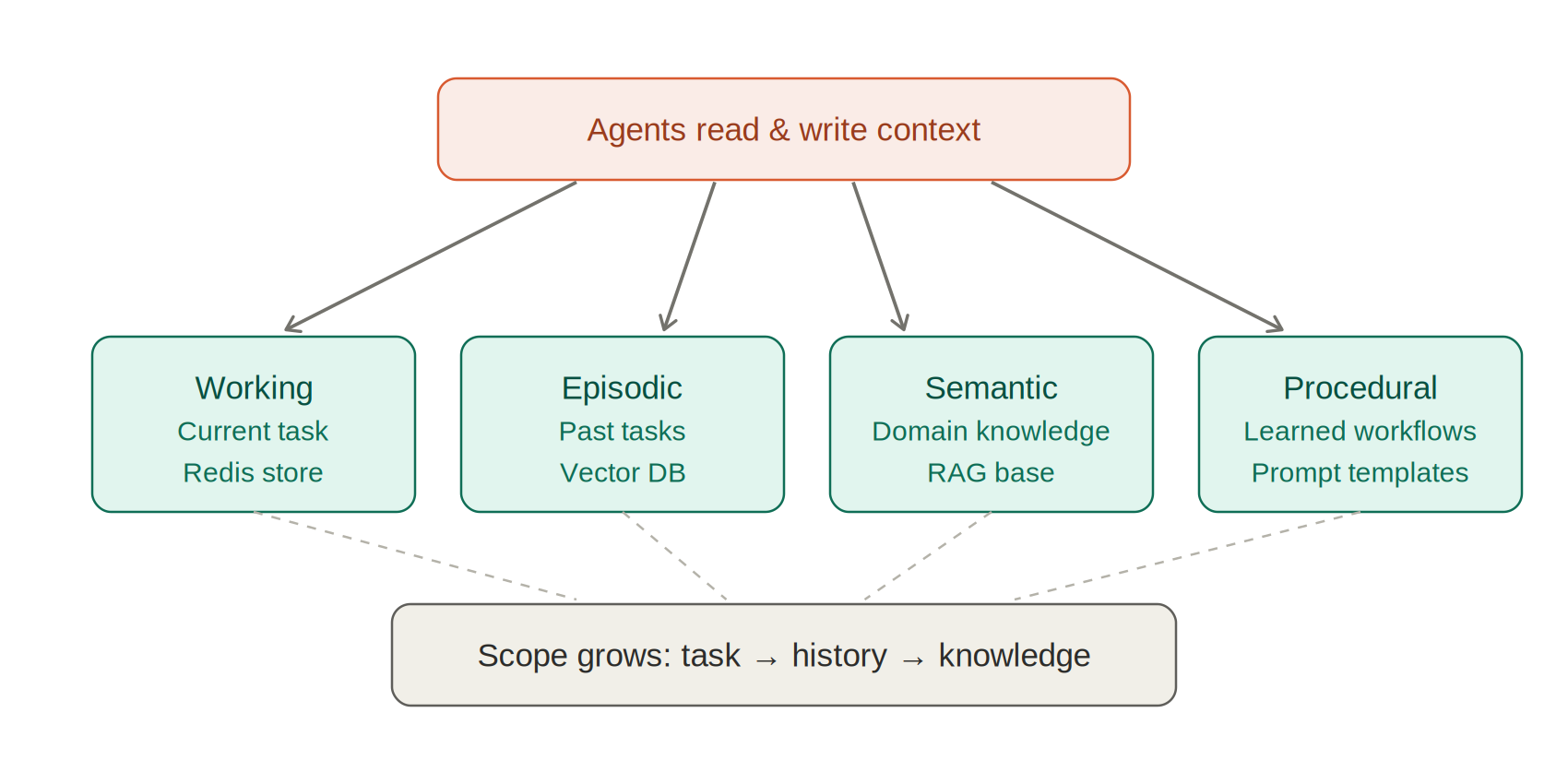
Memory types:
| Type | Scope | Implementation |
| Working memory | Current task | Redis key-value store keyed by task_id |
| Episodic memory | Past task history | Vector database with task summaries |
| Semantic memory | Domain knowledge | RAG knowledge base |
| Procedural memory | Learned workflows | Prompt templates updated from feedback |
Working memory structure per task:
{
“task_id”: “task_xyz789”,
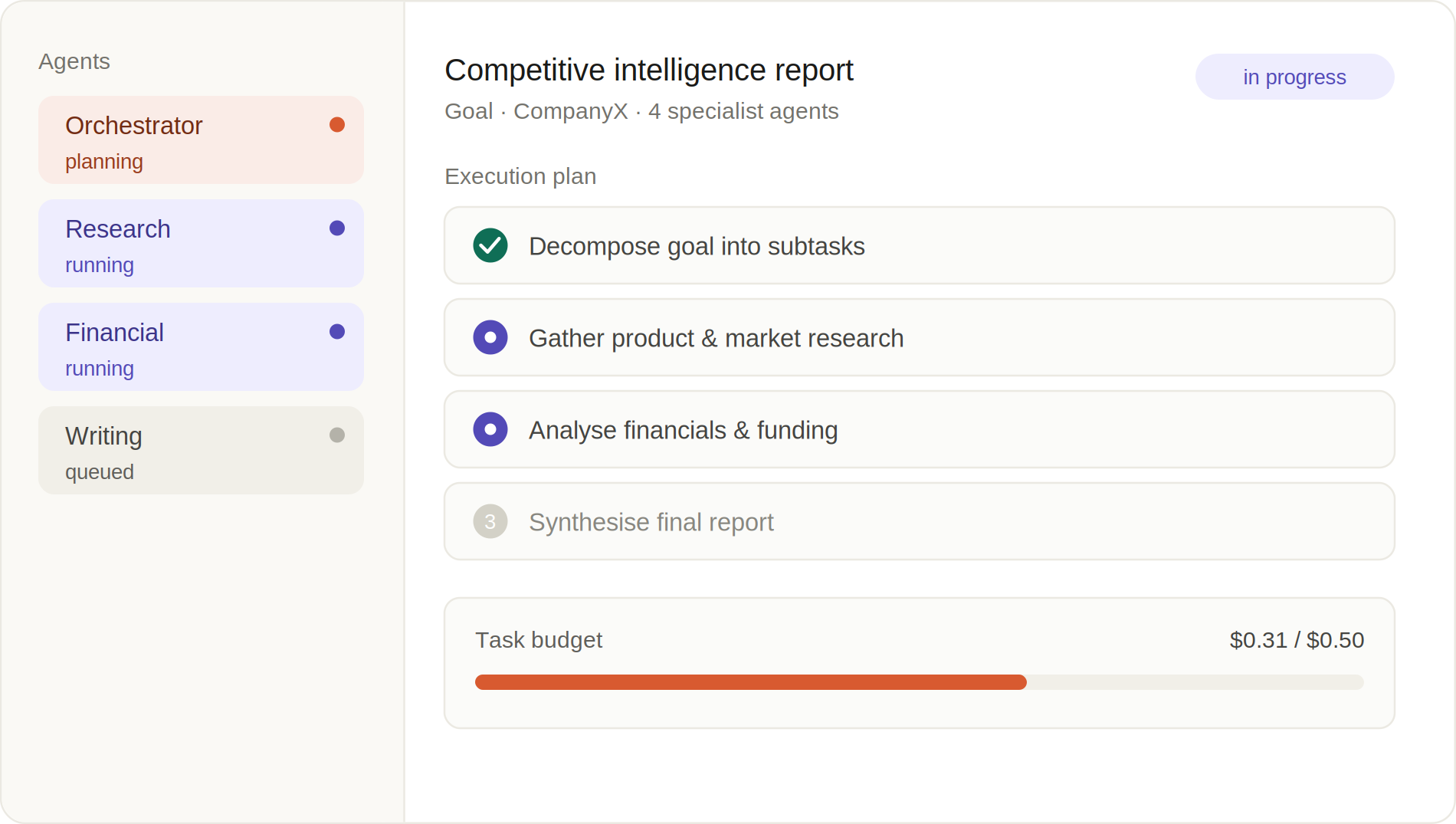
“goal”: “Competitive intelligence report on CompanyX”,
“status”: “in_progress”,
“agent_outputs”: {
“research_agent”: {“status”: “completed”, “output”: {}},
“financial_agent”: {“status”: “in_progress”}
},
“shared_findings”: {
“company_name”: “CompanyX”,
“founded”: 2018
}
}
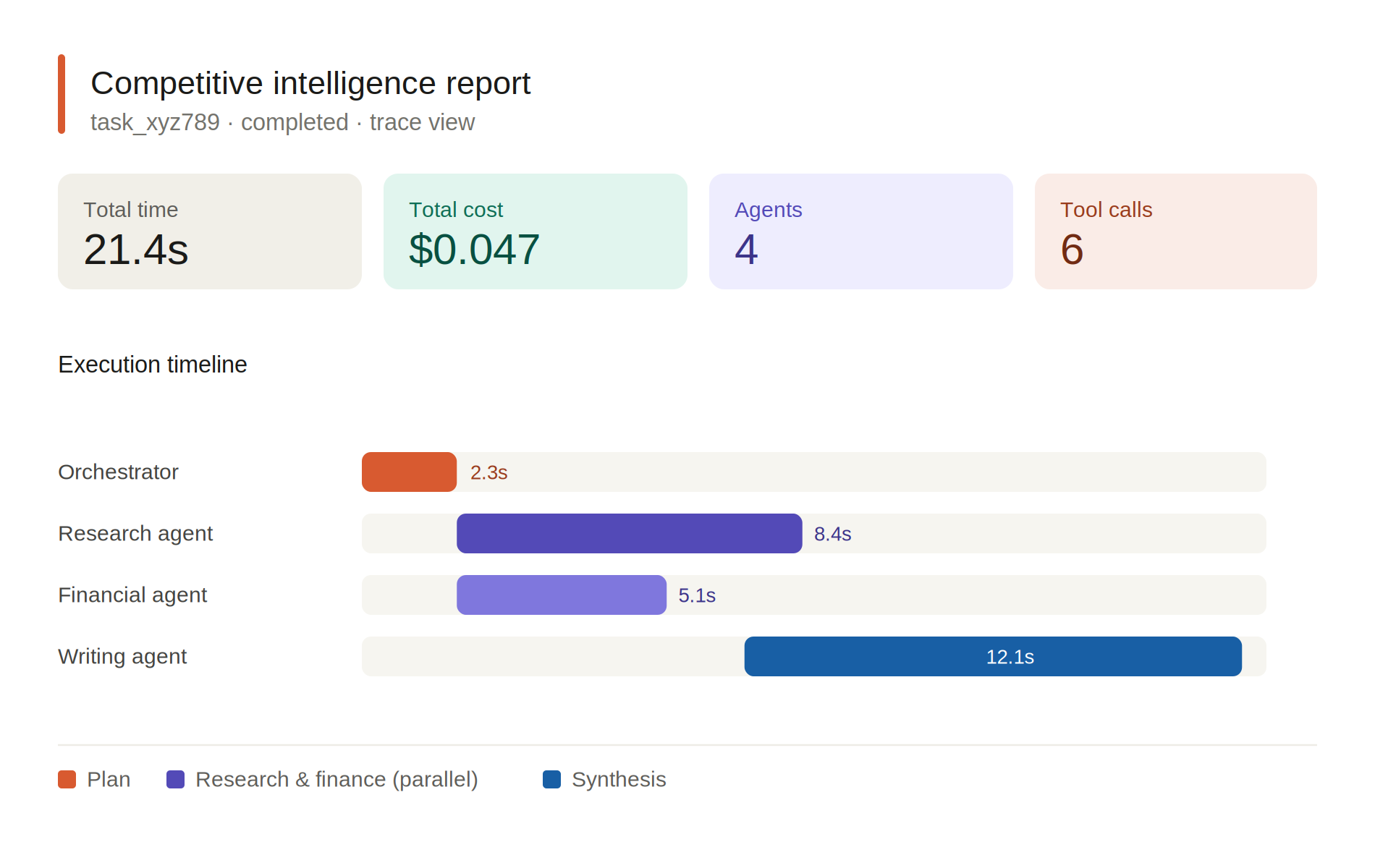
The distributed trace:
Every task execution produces a complete immutable log of every agent call, tool call, message, and decision with timestamps.
The trace view (Gantt chart):
Task: Competitive Intelligence Report
├─ Orchestrator (plan): 2.3s
├─ Research Agent (parallel):
│ ├─ web_search(“CompanyX products”): 1.2s
│ └─ Total: 8.4s
├─ Financial Agent (parallel): 5.1s
└─ Writing Agent: 12.1s
Total: 21.4s | Cost: $0.047
Cost management:
Each LLM call logs: model, input tokens, output tokens, cost. Budget limits configured at: per tool call, per agent, per task, per user/team. Daily budget limits prevent runaway costs.
| Module | Cost Range (USD) | Notes |
| Agent runtime (per agent type) | $4K – $8K per agent | ~5 specialist agents initially |
| Orchestrator with planning | $8K – $15K | |
| Inter-agent communication layer | $6K – $12K | |
| Shared memory (Redis + vector DB) | $5K – $10K | |
| Tool registry + access control | $6K – $12K | |
| Rate limiting + budget enforcement | $4K – $8K | |
| Distributed tracing system | $8K – $15K | Full task trace |
| Failure recovery + retry logic | $5K – $10K | |
| Cost tracking + analytics | $4K – $8K | |
| Human approval gates | $4K – $8K | |
| AWS + security + VAPT | $5K – $10K | |
| Total | $79K – $156K | Full multi-agent system |
Contact: mayank@engineerbabu.com
Enterprise AI delivers the greatest value when multiple specialized agents work together instead of relying on a single general-purpose model. By combining orchestration, shared memory, secure tool access, observability, and intelligent cost management, multi-agent systems can automate complex workflows with greater accuracy, resilience, and scalability.
Whether you’re building AI copilots for employees, automating cross-functional business processes, or deploying autonomous enterprise workflows, a well-designed multi-agent architecture provides the foundation for reliable AI at scale.
EngineerBabu specializes in designing and developing enterprise-grade multi-agent AI systems that integrate with your existing applications, data sources, and business workflows.
From architecture design and custom agent development to secure deployment and ongoing optimization, our team can help you build production-ready AI automation tailored to your organization’s needs.
Ready to build an enterprise multi-agent AI system? Contact EngineerBabu to discuss your AI automation requirements.
The orchestrator-worker pattern uses a central orchestrator agent to receive high-level goals, decompose them into subtasks, delegate to specialist worker agents, monitor progress, handle failures, and assemble final outputs. It is the right pattern when: tasks require multiple types of expertise, subtasks can run in parallel, and the task structure is discoverable from the goal. It works best when subtasks have clear input/output contracts and when failures in individual workers can be isolated without restarting the entire task.
Each LLM call is logged with model name, input token count, output token count, and calculated cost. The platform aggregates cost at four levels: per tool call, per agent execution, per task, and per user/team. Budget limits can be configured at each level, a task budget of $0.50 stops execution when reached and returns a partial result. Cost analytics show which agents and task types consume the most budget, enabling model substitution decisions, replacing GPT-4o with GPT-4o-mini for lower-value subtasks reduces costs 10x with minimal quality impact.