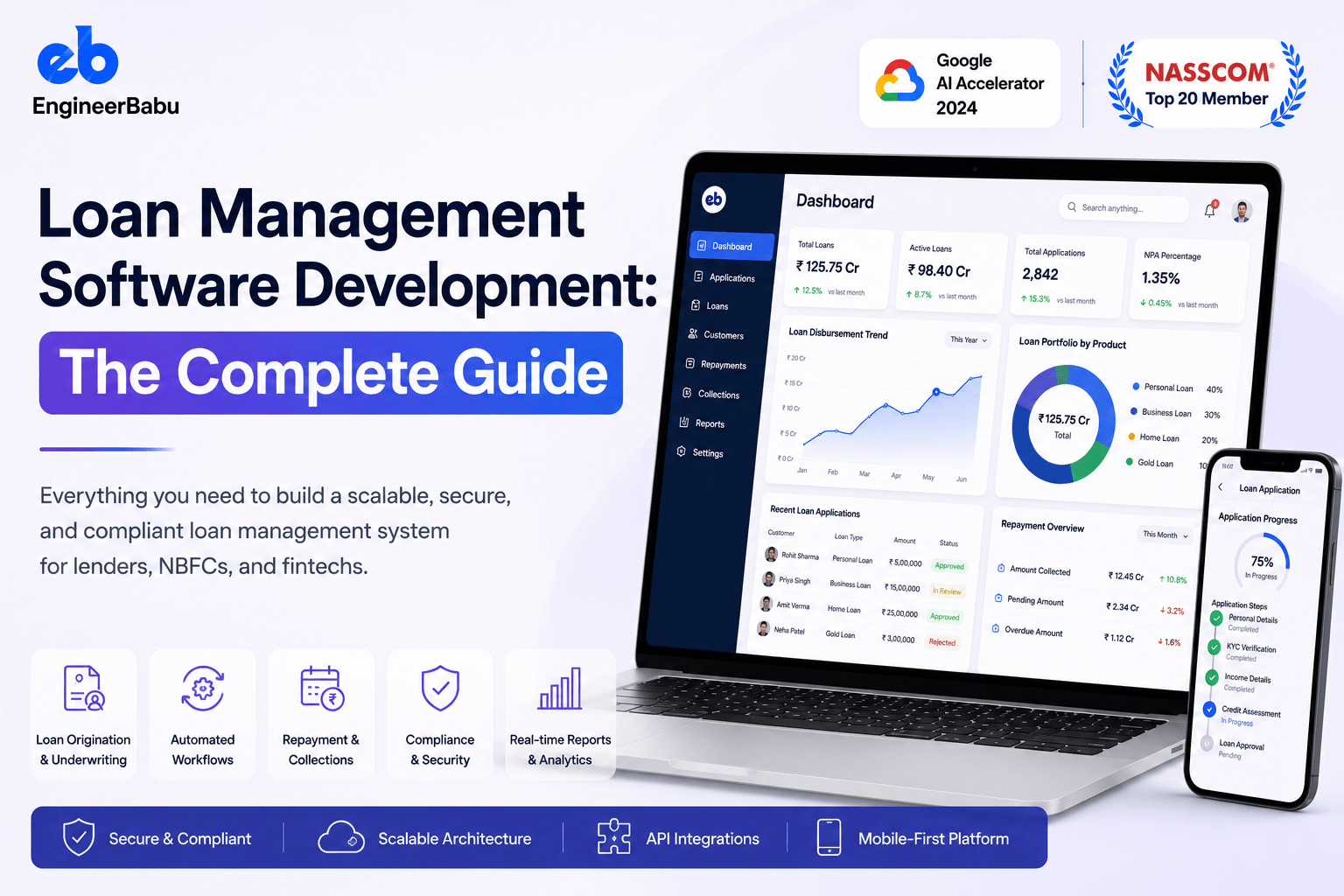
Loan Management Software Development: The Complete Guide for Lenders, NBFCs, and Fintechs in 2026


Create engaging, high-performance mobile applications tailored to your business needs. We craft future-ready apps that offer smooth user experiences on all devices.
Build robust and scalable websites and CMS platforms that help you manage content effortlessly. Our development ensures a seamless digital presence.
Launch secure, feature-rich online stores with intuitive shopping experiences. We build tailored eCommerce platforms designed for growth.
Design captivating games with immersive gameplay and stunning graphics. From concept to launch, we build engaging experiences that players love.
Enhance your customer relationships with customized Salesforce implementations. Drive growth and efficiency with smarter CRM solutions.
Harness artificial intelligence and machine learning to automate workflows and gain actionable insights. Our AI transforms data into smart decisions.
Accelerate your software delivery lifecycle with continuous integration, delivery, and infrastructure automation to boost efficiency.
An NBFC came to the team after their loan management system failed them at exactly the wrong moment.
They had scaled from 2,000 active loans to 10,000 in 8 months. Growth was real. Demand was there. But the system they’d bought – a mid-tier off-the-shelf LMS – couldn’t keep up.
The collections module had no automated NACH bounce detection. Bounced EMIs were being discovered 3–4 days after the fact through manual reconciliation. By then, the 24-hour re-presentation window had closed. Each missed re-presentation window was a recovery opportunity lost.
The reporting module couldn’t generate the NPA classification report the RBI inspector needed in the format required. Three staff members were rebuilding it manually in Excel the week before the audit. The system had no CERSAI integration, no SMA classification logic, and no way to generate the CRILC data submission without exporting the entire loan book to a spreadsheet first.
The business was growing. The technology was pulling it backwards.
I co-founded EngineerBabu 14 years ago from Indore. The team has built lending platforms that together process thousands of crores in loans annually. One platform – built for a fintech that became one of India’s first salary advance pioneers – has disbursed over ₹10,000 crore. LoanOS, the team’s own modular lending platform, processes ₹1,000 crore annually through a DSA right now.
The CTO spent 17 years at Wishfin one of India’s largest credit marketplaces building the exact systems described in this guide: bureau integrations, underwriting engines, collections automation, and RBI compliance reporting. Not from reading about them. From building them in production, watching them fail at scale, and rebuilding them correctly.
That experience is what this guide is built on.
If you already know you need an LMS built and want to talk to a team that has done this at scale email mayank@engineerbabu.com.
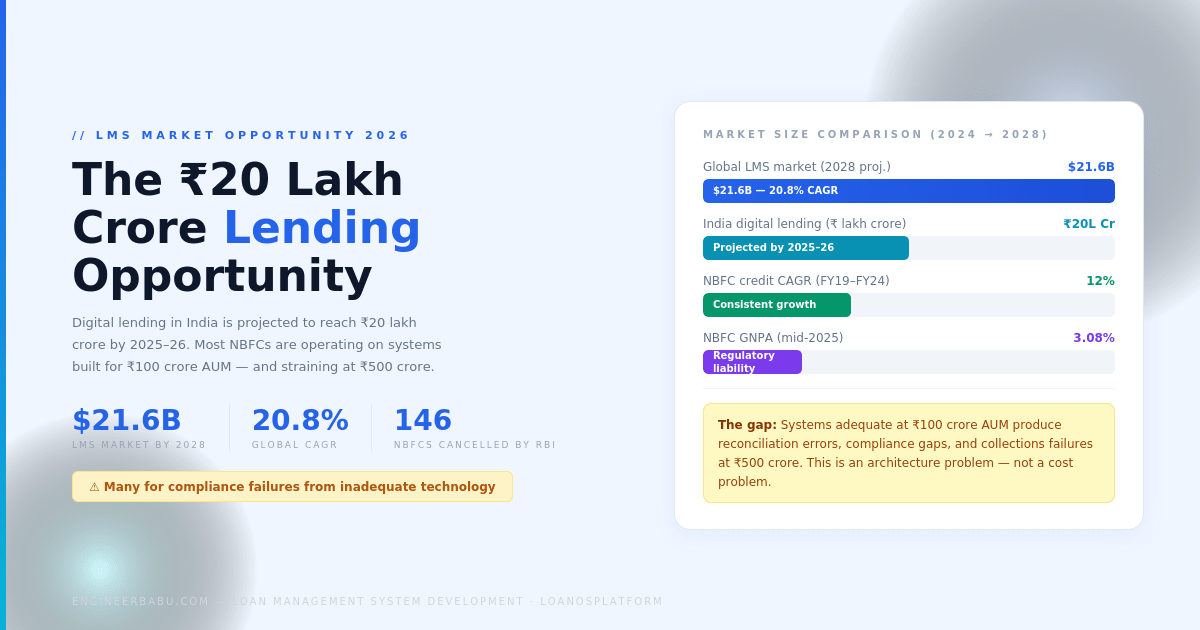
The global loan management software market was valued at $10.22 billion in 2024 and is projected to reach $21.6 billion by 2028, growing at a 20.8% CAGR. In India specifically, NBFC credit grew at a 12% CAGR between FY19 and FY24. The RBI cancelled the registrations of 146 NBFCs over a five-year period many for compliance failures traceable directly to inadequate technology infrastructure.
Digital lending in India is projected to reach ₹20 lakh crore by 2025–26. The DSA and NBFC segments the primary market for LoanOS are processing volumes that no manual system or basic off-the-shelf tool can handle.
Here is what the headline numbers don’t tell you.
The majority of lenders in India – NBFCs, DSAs, microfinance institutions, and fintech lending platforms – are operating on systems that were adequate at ₹100 crore AUM but are straining at ₹500 crore. The system that processes 500 loans per month without friction will produce reconciliation errors, compliance gaps, and collections failures at 5,000 loans per month.
This is not a technology problem that can be solved by buying a more expensive off-the-shelf system. It is an architecture problem. The modules that break at scale – NACH bounce handling, NPA classification, multi-product EMI scheduling, bureau reporting, SMA tracking – are not premium features that cost more. They are architecture decisions that either were or were not made at the start.
Loan management software is a digital platform that manages the complete post-origination lifecycle of a loan – repayment scheduling, payment collection and tracking, NPA monitoring, collections automation, compliance reporting, and portfolio analytics. It is distinct from a Loan Origination System (LOS), which manages the pre-disbursement process. The two must integrate cleanly because the handoff between them the moment a loan is disbursed is where data errors most commonly enter the system.
Most loan management software guides list modules. This guide explains what breaks in each one when it is not built correctly.
The 8 stages every LMS must manage:
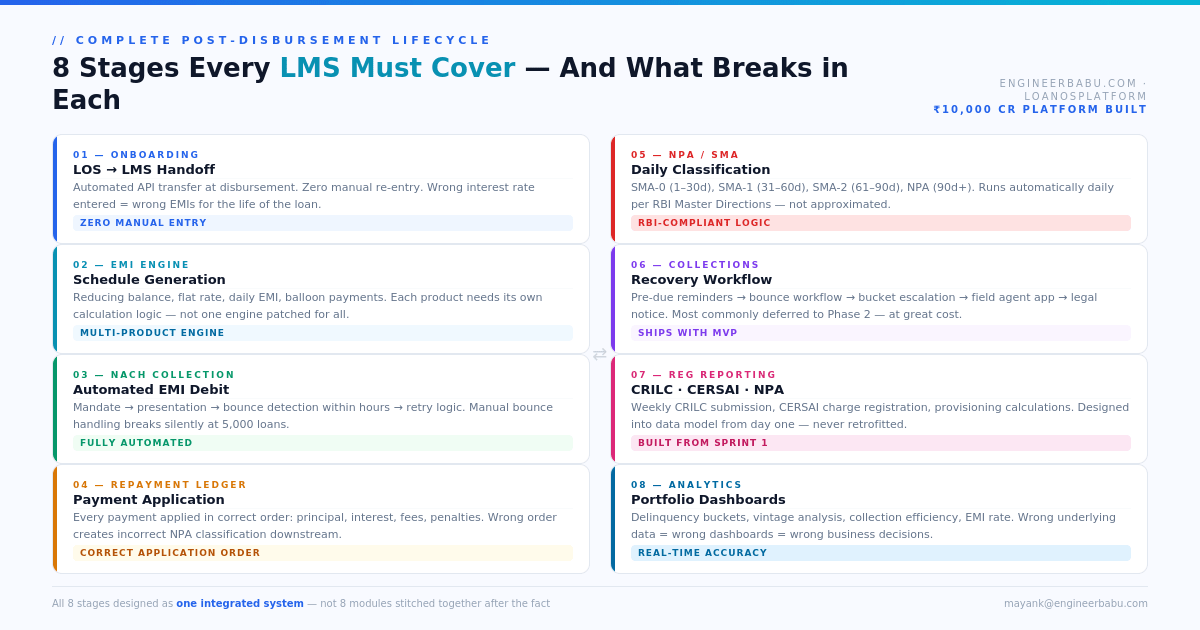
Every team that has built an LMS for the first time discovers the same set of problems, typically 6 months after go-live when the loan volume is high enough to surface them. This section names them so you can design around them.
EMI calculation is the first module every team builds and the one that produces the most production bugs.
The standard reducing balance formula is straightforward. The edge cases are not.
What happens when a borrower prepays ₹50,000 on day 15 of month 3? The remaining principal drops, the EMI amount stays the same, the tenure shortens or alternatively, the tenure stays the same and the remaining EMIs are recalculated. Which behavior applies depends on the loan product definition.
What happens when the NACH bounce on month 2’s EMI means that month 3’s EMI presentation includes the outstanding month 2 amount plus the penalty plus the current month’s EMI? The application order which amount is applied first affects both the borrower’s ledger and the NPA classification.
What happens for gold loans with bullet repayment? For LAP with partial pre-release? For co-lending arrangements where the NBFC and the bank each own a percentage of the loan and EMI collections must be split and reconciled separately at each settlement cycle?
Each of these is a legitimate lending product that NBFCs operate. The LMS must handle all of them correctly.
The team has built EMI engines for EarlySalary’s salary advance product (daily EMI calculation on short-tenure high-volume loans), for multi-product NBFC platforms with personal loans, LAP, and business loans running simultaneously, and for LoanOS’s configurable repayment module that supports every major Indian loan product type. The insight from that experience: the EMI engine must be treated as a standalone, heavily-tested module – not a calculation embedded in the servicing workflow. Every product type gets its own calculation scenario library. Every edge case is a test case before it’s a production transaction.
The NACH (National Automated Clearing House) system is the backbone of automated EMI collection for every Indian NBFC.
Building NACH integration correctly requires understanding three distinct workflows that most developers merge into one and then wonder why it breaks.
Mandate registration – the NACH mandate is submitted to NPCI at the time of loan disbursement. The mandate specifies the maximum debit amount, the bank account, and the validity period. Mandate registration can take 3–5 business days for bank processing. The LMS must track mandate registration status and not attempt EMI debit until the mandate is confirmed.
EMI presentation – on each due date, the LMS generates a debit batch and submits it to NPCI via the sponsor bank. The batch must be submitted by a specific cutoff time (typically 10 PM the previous evening) for next-day debit. Missed cutoffs mean missed collections for that cycle.
Bounce handling – NPCI returns bounce notifications within 24 hours. The LMS must process these notifications, update the loan’s delinquency status, trigger the borrower communication sequence, and queue the re-presentation logic. The re-presentation window (within 30 days of the original due date, maximum 3 attempts) is a business rule that the collections team configures – the system must enforce it.
The failure mode the team sees most frequently: NACH presentation and bounce handling are built as manual processes (“the collections team checks the portal every morning”). At 500 loans, this is manageable. At 5,000 loans, it produces collections failures that are invisible until the NPA report surfaces them 60–90 days later.
LoanOS has NACH automation as a core module. Mandate status tracking, presentation scheduling, bounce detection within hours, and retry queuing are all automated. The collections team manages exceptions, not processes.
This is the module where lenders discover, typically during an RBI inspection, that their system has been classifying assets incorrectly.
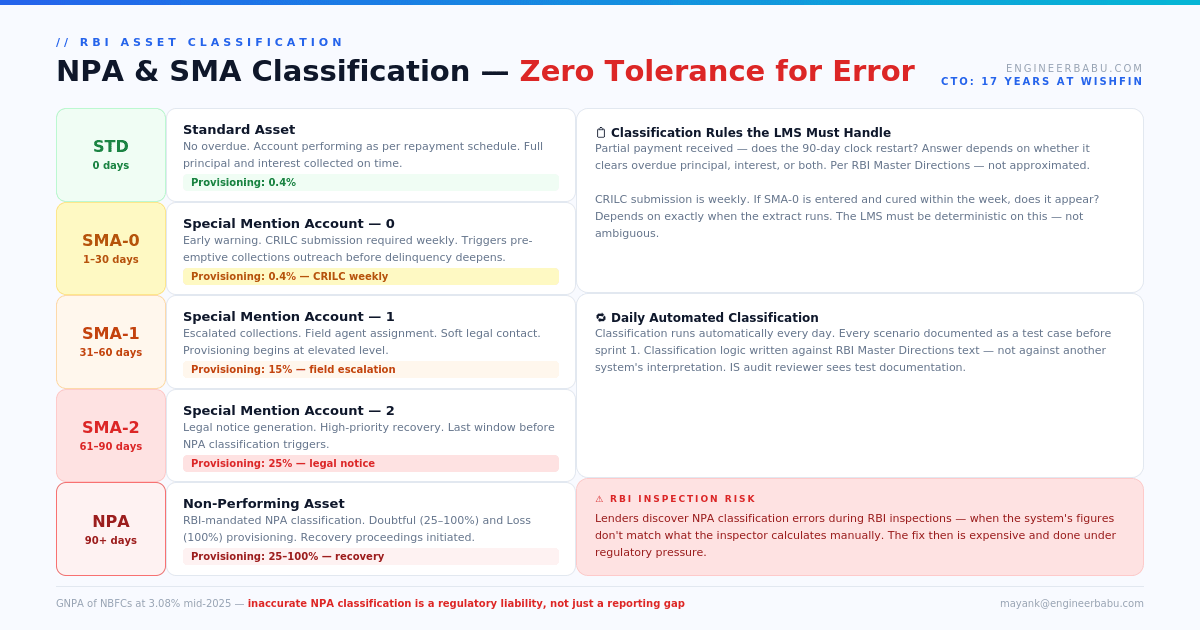
The RBI’s asset classification norms are specific. An account where the principal or interest is overdue for more than 90 days is an NPA. But the counting of days is not always straightforward: what happens when a partial payment is made that covers part of the overdue amount? Does the 90-day clock restart? Does it continue from the original due date?
The answers depend on whether the partial payment clears the overdue principal only, the overdue interest only, or both – and the RBI’s guidance on each scenario is specific. An LMS that gets this wrong produces NPA numbers that don’t match what an RBI inspector calculates manually.
SMA classification – Special Mention Accounts – has its own logic. SMA-0 is 1–30 days overdue. The day the account tips into SMA-0 matters for CRILC reporting. The CRILC submission happens weekly. If the LMS’s SMA classification runs daily but the CRILC extract runs weekly, a loan that entered SMA-0 and was cured within the week may or may not appear in the submission depending on exactly when the extract runs.
The team’s CTO spent 17 years at Wishfin building exactly this kind of regulatory calculation logic. The rule: NPA and SMA classification logic is always written against the RBI Master Directions text, not against another system’s interpretation of it. Every classification scenario has a documented test case with the expected output. The IS audit reviewer sees the test documentation. This is what CMMI Level 5 process maturity means in practice for regulated financial systems.
Collections is the module that most directly determines NPA rate. And it’s the module most commonly treated as Phase 2.
By the time Phase 2 arrives, the lender has accumulated months of suboptimal collections outcomes.
Production collections infrastructure for an NBFC:
Pre-due reminders – SMS and WhatsApp messages 7 days, 3 days, and 1 day before EMI due date. The reminder content is configurable per product type. The timing is configurable per segment (salary advance borrowers respond differently to reminders than MSME borrowers).
Bounce day workflow – when NACH returns a bounce by 10 AM, the LMS triggers: borrower notification with payment link, agent alert if the account has previous bounces, and re-presentation scheduling within the permitted window.
Bucket escalation – Day 1–7 overdue: automated digital communication. Day 8–30: soft collections (call center or digital). Day 31–60: field collections assignment. Day 61–90: legal notice generation. Day 91+: NPA classification, recovery proceedings.
Field agent app – collections agents in the field need a mobile interface that shows their daily case list, the borrower’s payment history, the ability to log a visit, generate a payment link on the spot, and record a promise-to-pay.
The difference between a lender with a 4% NPA and one with a 9% NPA on an identical credit book is usually not the credit scoring model. It is the collections infrastructure.
LoanOS’s collections module was built after observing this pattern across multiple platforms. It is not an optional module. It ships with every implementation.
The collections rule: If your collections team is managing recovery in WhatsApp groups and phone call logs, you don’t have an LMS. You have a disbursement system with a manual collections workaround that will not scale.
Every NBFC that starts with one loan product eventually operates three or four.
The NBFC that started with personal loans adds an LAP product. Then a gold loan. Then a business loan product with weekly repayment. Each product has different:
A system built for one product type produces calculation errors when a second product type is added. The EMI engine that handles reducing balance personal loans breaks when it encounters the flat-rate microfinance product. The collections workflow that sends SMS reminders 3 days before due date fails for the daily-EMI MSME product.
The team’s approach: the product catalogue is a first-class entity in the LMS data model. Every loan is linked to a product definition that specifies its calculation rules, its communication templates, its collections escalation logic, and its regulatory classification. Adding a new product is a configuration change, not a code change. The configuration is tested before the product goes live.
This is what it means to build a multi-product LMS versus a single-product system with patches.
An NBFC operating in India faces multiple mandatory regulatory reporting obligations. The LMS must support all of them.
CRILC (Central Repository of Information on Large Credits) – weekly submission of SMA and NPA accounts above ₹5 crore. The data format is specific. The cutoff dates are specific. Late or inaccurate submissions attract regulatory attention.
CERSAI (Central Registry of Securitisation Asset Reconstruction and Security Interest) – registration of all secured loan charge creation, modification, and satisfaction. Every LAP and gold loan must be registered. The registration timeline is 30 days from charge creation.
NPA Provisioning – quarterly calculation of required provisions based on the NPA classification of the portfolio. Standard assets at 0.4%, sub-standard at 15%, doubtful at 25–100%, loss at 100%. The LMS must calculate these figures accurately because they feed directly into the financial statements.
Account Aggregator (AA) framework – the RBI’s digital data sharing infrastructure. NBFCs that are Financial Information Users (FIUs) need to integrate with the AA framework to pull borrower financial data. NBFCs that are Financial Information Providers (FIPs) need to share loan data through the AA.
DPDP Act compliance – the Digital Personal Data Protection Act requires specific consent management and data localisation for borrower personal data.
The team’s CMMI Level 5 certification means that every compliance requirement is documented as a technical control before sprint 1. The regulatory reporting module is not built after the operational modules are complete. It is designed into the data model from the start, so that every transaction produces the data that the regulatory reports require.
A standalone LMS is incomplete. The production value comes from its integrations.
Bureau integrations – CIBIL, Experian, Equifax, and CRIF for credit monitoring on existing borrowers. Post-disbursement bureau refreshes on high-value accounts and delinquent accounts. The LMS triggers these refreshes automatically rather than requiring a manual query.
Payment gateways – Razorpay and PayU for UPI-based repayment links sent via collections communications. The payment must be received by the gateway, reconciled against the loan account, and the ledger updated within minutes.
eSign and document management – loan modification agreements, restructuring letters, and notice letters require digital signing. Digio and Leegality integration for legally valid e-signatures.
WhatsApp Business API – the primary communications channel for borrower reminders, payment links, and collections follow-up. The message templates require WhatsApp approval. The LMS manages template registration and delivery tracking.
Core banking / ERP integration – for NBFCs operating core banking systems (Finacle, Flexcube, or proprietary CBS), the LMS must synchronize loan account data, payment receipts, and provisioning data bidirectionally.
CRM integration – the loan officer’s CRM (Salesforce, HubSpot, or custom) must receive loan status updates so that relationship managers can see borrower activity without logging into the LMS separately.
The integration layer is where most LMS implementations accumulate technical debt. Integrations are built one at a time as needs arise, with different error handling approaches, different retry logic, and different monitoring. The result is a fragile web of point-to-point connections that breaks in unpredictable ways.
The team’s approach: an integration bus that handles all external connections with consistent error handling, retry logic, dead-letter queuing for failed events, and centralized monitoring. Every integration is treated as an event, logged, and traceable.
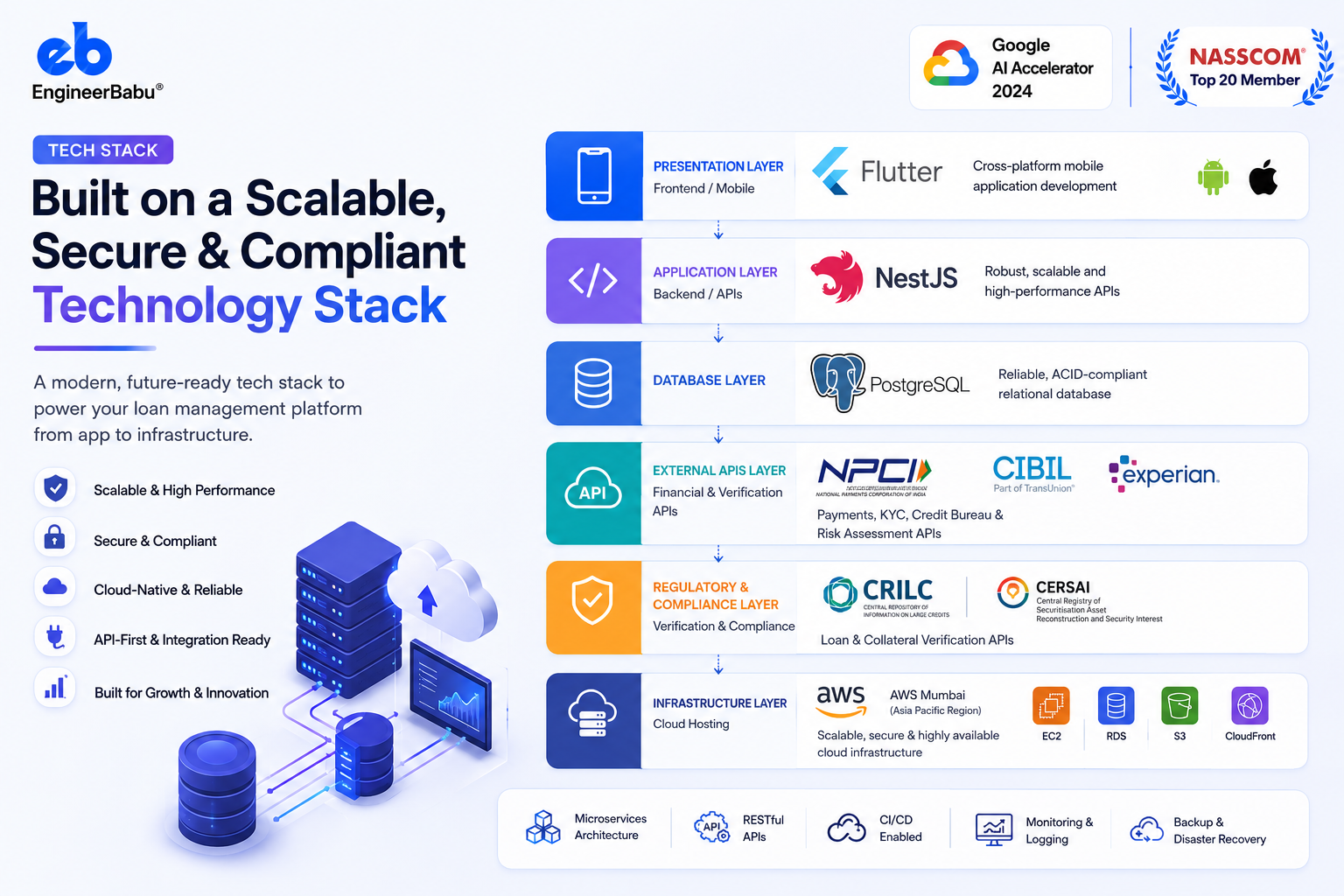
Frontend: Flutter (borrower app + collections agent mobile app) + Next.js (loan officer web dashboard + admin panel)
Flutter for the borrower-facing mobile app loan statement, payment history, EMI calendar, repayment via UPI. Collections agent mobile app – daily case list, visit logging, payment link generation, PTP recording. Both iOS and Android from one codebase.
Next.js for the loan officer and operations dashboard portfolio view, delinquency buckets, NACH presentation queue, regulatory report generation. Server-side rendering for fast initial load with React for interactive components.
Backend: Python FastAPI (credit scoring, ML components) + Node.js NestJS (loan lifecycle, collections automation, reporting)
NestJS handles the core LMS logic: EMI schedule management, NACH integration, collections workflow orchestration, payment reconciliation, and notification dispatch. Python handles AI components: NPA prediction models, collections propensity scoring, early warning indicators on portfolio deterioration.
Database: PostgreSQL + Redis
PostgreSQL for all loan records the lending ledger must be ACID-compliant. Every payment, every EMI, every interest accrual, every status change is an immutable transaction record. Not mutable balance fields an event log from which any point-in-time balance can be reconstructed.
Redis for real-time operational state: current NACH presentation status, collections agent case assignments, live portfolio metrics for the management dashboard.
Integrations:
Cloud: AWS Mumbai (AP South 1) – all financial data of Indian borrowers must reside on servers in India. RBI data localisation requirement. HIPAA-equivalent security configuration: encryption at rest (AES-256), encryption in transit (TLS 1.3), CloudTrail access logging, VPC isolation, MFA on all administrative access.
The salary advance platform that has disbursed over ₹10,000 crore was not built with a perfect architecture on day one.
It was built with an architecture that was designed to survive its own growth.
The discovery phase two weeks before any code was written identified the specific failure modes this platform would face at scale. A daily-EMI salary advance product means 30 debit attempts per month per borrower. At 100,000 active borrowers, that is 3 million NACH presentations per month. The NACH integration architecture was designed for 3 million presentations from the start, not from the moment the platform hit 50,000 borrowers and the existing architecture began to strain.
The CTO’s 17 years at Wishfin contributed a specific kind of knowledge: the failure modes of bureau integrations at scale. Bureau API response times degrade under load. Bureau data is sometimes incomplete. Bureau reports return formats that vary by bureau and by the specific query type. Each of these failure modes was anticipated in the architecture and handled explicitly not discovered in production.
The Google AI Accelerator 2024 selection reflects the team’s production AI capabilities applied to lending. For LMS specifically, the team builds:
Early warning scoring – a model that scores existing borrowers on default probability 30–60 days before the overdue date becomes visible in bureau data. The model uses behavioral signals from the LMS itself payment timing, partial payment patterns, NACH bounce history to identify at-risk accounts earlier than any bureau-based signal.
Collections propensity scoring – predicting which borrowers are most likely to respond to which collections channel (WhatsApp, call, SMS, field visit) and on which day of their overdue cycle. Collections resources are finite. The scoring model prioritises the allocation.
NPA prediction model – predicting which SMA-0 and SMA-1 accounts will progress to NPA versus which will self-cure. This informs the collections team’s resource allocation and the risk management team’s provisioning decisions.
The CMMI Level 5 process means every sprint has defined quality gates. For a regulated financial system, quality gates include: calculation accuracy testing against manual verification of a sample of transactions, compliance report format validation against the regulatory specification, integration testing against sandbox environments for all bureau and payment APIs, and performance testing under 3x the expected transaction volume.
The team can scope your LMS architecture and have a proposal in your inbox within a week. Email mayank@engineerbabu.com.
Four failure modes. Named, specific, based on pattern recognition across 20+ lending platform builds.
What it looks like: The LMS launches with origination, disbursement, and basic repayment tracking. Collections is Phase 2. Phase 2 begins 9 months later, when the NPA rate is already 3 percentage points above where it should be. The damage is already done.
Why it happens: Collections is operationally unglamorous. In the planning phase, everyone is focused on origination the revenue-generating side. Collections is “what happens when things go wrong.” Nobody wants to spend the planning meeting on what happens when things go wrong.
The cost: At a ₹100 crore AUM with a 3% excess NPA, that is ₹3 crore in additional provisions. At ₹500 crore AUM, it is ₹15 crore. The cost of building proper collections from the start is a fraction of this.
The fix: Collections infrastructure NACH automation, bounce handling, escalation workflows, field agent app ships in the same MVP as the origination module. Non-negotiable.
What it looks like: The LMS is built and operational. The first RBI inspection arrives. The CRILC submission format is wrong. The NPA classification logic doesn’t match the RBI Master Directions precisely. The CERSAI registrations for secured loans were never implemented. The inspection report cites multiple technology-related compliance gaps.
Why it happens: Regulatory requirements were treated as a documentation exercise at the end of the project. The data model was designed for operations, not for compliance reporting. Adding compliant reporting on top of a non-compliant data model requires expensive retrofitting.
The cost: 3–6 months of compliance engineering done under regulatory pressure. Potential RBI notice. Management distraction at a critical growth phase.
The fix: Regulatory reporting requirements CRILC format, CERSAI integration, NPA classification rules, provisioning calculations are mapped to data model requirements before sprint 1. Every transaction produces the data the regulatory report needs. Compliance is a design constraint, not a post-development feature.
What it looks like: The NBFC starts with personal loans. The LMS is built for personal loans. Two years later, the NBFC launches an LAP product. The EMI engine doesn’t support balloon payments. The NACH module doesn’t handle the higher mandated amounts for secured loans. The NPA classification logic doesn’t account for the different overdue thresholds for secured versus unsecured lending. Each new product requires engineering work to add to the LMS.
Why it happens: The initial LMS was built for the current product, not for the product roadmap. The architecture hardcoded the personal loan product’s calculation rules rather than making product configuration a data concern.
The cost: Engineering resources spent retrofitting the LMS for each new product rather than building new products. Delayed product launches. Technical debt that compounds.
The fix: Product catalogue as a first-class data entity from day one. EMI calculations, NACH logic, NPA rules, and collections workflows are all configurable per product. Adding a new product is a configuration exercise, not a development project.
What it looks like: The LOS and LMS are built by different teams, or the LOS is a purchased product and the LMS is custom-built. The handoff between them the loan disbursement event requires manual data entry by an operations staff member who copies the loan details from the LOS screen into the LMS intake form.
At 50 loans per day, this takes 2 hours. At 500 loans per day, it takes 4 staff members working full-time on data entry. And every manual entry is a potential error. A wrong interest rate entered into the LMS means every EMI calculation for that loan is wrong. A wrong tenure means the EMI schedule expires before the loan is repaid.
Why it happens: The integration between LOS and LMS was not scoped in the initial project. Each system was treated as independent.
The cost: Permanent operational overhead. Data quality issues that surface as incorrect statements, collections disputes, and borrower complaints months after disbursement.
The fix: The LOS-LMS integration automated API-based handoff of all loan data at disbursement is scoped as a first-class requirement of both systems. Zero manual re-entry. The handoff is tested against a defined data contract before either system goes live.
This question has a more nuanced answer in lending than in most other software categories.
Buy off-the-shelf (TurnKey Lender, LendFoundry, Roopya, Finflux): Right when you need to launch quickly, your loan products are standard, and you’re comfortable with the vendor’s compliance update cadence. Off-the-shelf platforms typically cost ₹30–100 lakhs annually in licensing and handle the regulatory maintenance burden. The constraint: when your products or workflows diverge from what the platform was designed for, customization becomes expensive and slow. Most NBFCs find this constraint within 18–24 months of launch.
Customize an open-source or white-label base (OpenMRS-style, or white-label LMS vendors): Faster than building from scratch. Lower licensing cost than enterprise SaaS. The risk: the base platform may have architecture decisions that conflict with your specific requirements and customizing around them accumulates technical debt faster than starting fresh.
Custom build: Right when your loan products, workflow requirements, or compliance architecture are specific enough that generic platforms constrain you. When you are building a product whose technology is the competitive moat as EarlySalary did with its AI-driven credit decisioning and instant disbursement custom build is the only path to the differentiation that drives growth.
The team’s honest assessment: for an NBFC at ₹100–500 crore AUM with standard personal loan and LAP products, a well-configured off-the-shelf platform is often the right starting point. For an NBFC at ₹500 crore+ AUM, for a fintech lender building a product where technology is the differentiation, or for a DSA that wants to own its own lending infrastructure custom build produces better long-term outcomes.
LoanOS offers a middle path: modular lending infrastructure that can be used as a full platform or as individual modules (NACH, collections, bureau integration) that integrate with existing systems. The code you pay for is yours. No licensing fees. No vendor lock-in.
Good loan management software automates the work your team repeats every day. Here are the features lenders rely on most:
If you plan to offer more than one loan type, build the product engine to be configurable from day one. It saves a rebuild later.
Loan management software development starts from $15K for a production-ready LMS MVP single loan product, EMI schedule management, NACH integration, basic collections, and NPA tracking for an NBFC at early scale.
Full platforms multi-product management, AI early warning scoring, collections propensity models, full regulatory reporting suite (CRILC, CERSAI, provisioning), field agent mobile app are scoped after understanding the specific loan products, compliance requirements, and portfolio scale. Exact numbers after that conversation, not before.
Timeline: Single-product LMS MVP in 12–16 weeks. Full multi-product enterprise platforms in 5–9 months. NACH mandate application to NPCI (required before NACH integration can go live) takes 4–6 weeks and must be initiated in week 1.
For context: a US or UK development team building the same scope costs 40–60% more. The EngineerBabu team delivers at India pricing with CMMI Level 5 process quality – the certification RBI auditors recognise when they assess an NBFC’s technology partner.
Post-go-live: plan 15–20% of development cost annually for regulatory updates (RBI Master Direction changes, new data submission formats), AI model retraining as portfolio data accumulates, and new product additions.
Mayank leads personally. Every engagement.
The team built a lending platform that has disbursed over ₹10,000 crore. LoanOS processes ₹1,000 crore annually through a live DSA right now. These are not case studies from a pitch deck. They are systems running in production today. The EarlySalary build daily EMI, instant disbursement, thousands of credit decisions per day – is the reference architecture for every lending platform the team builds.
The CTO brings 17 years- one of India’s largest credit marketplaces. Bureau integrations, NACH systems, NPA management, RBI compliance infrastructure – built, maintained, and scaled in production over 17 years. This is not lending knowledge from reading about it. It is lending knowledge from owning the systems when they fail and rebuilding them to not fail again.
Google AI Accelerator 2024. Production AI for credit scoring, collections propensity, and portfolio risk management – not proof-of-concept models. Production systems with monitoring, drift detection, and retraining pipelines.
CMMI Level 5. The highest independently audited process maturity level. Relevant when your RBI audit arrives and the inspector asks what quality processes your technology partner follows.
4 unicorn clients. 75 YC-selected product builds. 200+ VC-funded products. 500+ projects across 20 countries. Full code and IP ownership. No vendor lock-in. The LMS the team builds is yours permanently.
An NBFC came to the team after their off-the-shelf LMS couldn’t produce a compliant CRILC submission. Three staff members were rebuilding the report in Excel the week before the RBI inspection. The NPA figures in the system didn’t match the figures the compliance team calculated manually.
The rebuild compliant NPA classification logic, automated CRILC generation, CERSAI integration took 14 weeks. The next inspection found no technology-related compliance gaps.
Every week an NBFC or DSA operates on an LMS that can’t handle its current volume is a week of NPA accumulation, regulatory exposure, and collections inefficiency that compounds silently.
30 minutes. Honest assessment of your loan products, your current technology gaps, and what a production LMS that survives scale and regulatory scrutiny actually requires.
mayank@engineerbabu.com
Mayank Pratap Co-founder, EngineerBabu mayank@engineerbabu.com | engineerbabu.com
Google AI Accelerator 2024 · CMMI Level 5 · ₹10,000Cr Lending Platform · LoanOS (₹1,000Cr/yr Live) · CTO 17yr Wishfin · 4 Unicorn Clients · 75 YC Selections · 200+ VC-funded Products · Backed by Vijay Shekhar Sharma · LinkedIn Top Startup India (Twice)
Loan management software development is the process of designing and building a digital platform that manages the complete post-disbursement lifecycle of a loan – EMI scheduling, NACH-based payment collection, repayment tracking, NPA and SMA classification, collections workflow automation, and regulatory reporting. It is distinct from a Loan Origination System (LOS), which manages the pre-disbursement process. A complete lending operation requires both, integrated so that no data is manually re-entered at the disbursement handoff.
A production-ready single-product LMS MVP takes 12–16 weeks. Full multi-product platforms with AI components, regulatory reporting, and field agent mobile apps take 5–9 months. The NACH mandate application to NPCI – required before live NACH integration takes 4–6 weeks and must be initiated in week 1 of the project.
Development starts from $15K for a single-product production MVP. Full enterprise platforms are scoped based on loan product count, compliance requirements, and portfolio scale. Exact numbers after a 30-minute scoping conversation. US/UK equivalent quality costs 40–60% more.
A Loan Origination System manages the pre-disbursement lifecycle: application intake, KYC, document verification, credit scoring, underwriting, and approval. A Loan Management System manages everything after disbursement: EMI schedules, NACH collections, repayment tracking, NPA classification, collections workflows, and regulatory reporting. They must integrate cleanly because the loan data created in the LOS is the foundation the LMS operates on.
NACH (National Automated Clearing House) is the NPCI-operated system for automated EMI debit from borrowers’ bank accounts. The NACH mandate is registered at loan disbursement, covering the full loan tenure. The LMS presents debit instructions to NPCI on each due date, receives bounce notifications within 24 hours, and manages retry logic within the permitted window. NACH automation is the difference between a collections team that manages exceptions and one that manages every single bounce manually.
CRILC data submission (weekly, SMA and NPA accounts above ₹5 crore), CERSAI charge registration for secured loans, NPA provisioning calculations aligned with RBI Master Directions, SMA classification (SMA-0/1/2 and NPA) with daily automated updates, IS audit trail generation, Fair Practices Code communication compliance, and Account Aggregator integration for financial data sharing. As of mid-2025, GNPA of NBFCs stood at 3.08% accurate NPA classification is a compliance obligation, not only an operational requirement.
NPA (Non-Performing Asset) classification is the RBI-mandated categorisation of loan accounts by overdue status. Accounts overdue 90+ days are classified as NPA. SMA-0 (1–30 days overdue), SMA-1 (31–60 days), and SMA-2 (61–90 days) precede NPA classification. The LMS must run this classification automatically on a daily basis, handle edge cases (partial payments, restructured accounts) per RBI Master Direction rules, and produce classification data in the format required for CRILC submission.
Three high-value AI applications for LMS: early warning scoring (predicting default probability 30–60 days before overdue becomes visible in bureau data, using internal behavioral signals), collections propensity scoring (predicting which borrowers respond to which collections channel and when), and NPA prediction (predicting which SMA accounts will progress to NPA vs. self-cure, informing resource allocation and provisioning decisions). These are not experimental they are production ML systems the team builds and deploys.
Off-the-shelf platforms (TurnKey Lender, LendFoundry, Roopya) are right for NBFCs with standard loan products at early scale who need to launch quickly and can work within platform constraints. Custom build is right when products or workflows are specific enough that platform constraints become bottlenecks typically at ₹500 crore+ AUM, for multi-product lenders, or for fintechs where technology is the competitive differentiation. LoanOS offers a modular middle path: purpose-built lending infrastructure with no licensing fees and full code ownership.
LoanOS is EngineerBabu’s own modular lending platform built by the same team that built platforms disbursing ₹10,000 crore and currently processing ₹1,000 crore annually through a live DSA. It covers the complete lending lifecycle: origination, underwriting, loan management, NACH collections, collections automation, and regulatory reporting. Available as a full platform or as individual modules that integrate with existing LOS or LMS systems. The client owns the code. No licensing fees. No vendor lock-in.