AI Agents for Loan Processing: How Autonomous Systems Are Rewriting Loan Origination


Create engaging, high-performance mobile applications tailored to your business needs. We craft future-ready apps that offer smooth user experiences on all devices.
Build robust and scalable websites and CMS platforms that help you manage content effortlessly. Our development ensures a seamless digital presence.
Launch secure, feature-rich online stores with intuitive shopping experiences. We build tailored eCommerce platforms designed for growth.
Design captivating games with immersive gameplay and stunning graphics. From concept to launch, we build engaging experiences that players love.
Enhance your customer relationships with customized Salesforce implementations. Drive growth and efficiency with smarter CRM solutions.
Harness artificial intelligence and machine learning to automate workflows and gain actionable insights. Our AI transforms data into smart decisions.
Accelerate your software delivery lifecycle with continuous integration, delivery, and infrastructure automation to boost efficiency.
A borrower uploads a pay stub at 2 AM. By the time their coffee brews the next morning, the loan is approved, priced, and ready to fund. No loan officer touched the file overnight. No queue. Just an AI agent that pulled the data, ran the checks, and made the call.
That’s not a future scenario. It’s what AI agents for loan processing already do inside leading lending platforms today. And the shift from “AI that suggests” to “AI that acts” is the single biggest change in lending technology this year.
Automation Anywhere reports that agentic workflows in loan underwriting cut processing times by 60%, and one automotive lender using the approach reduced approval cycles by as much as 88% (Automation Anywhere). Numbers like that aren’t marketing fluff. They reflect a real structural change in how loans move from application to disbursement.
This post breaks down what AI agents for loan processing actually are, how they work step by step, and what it takes to build one properly.
Most people confuse AI agents with chatbots or scoring models. They’re not the same thing.
A traditional AI model in lending predicts something. It scores a borrower’s risk or flags a document anomaly, then hands the output to a human for the next step. An AI agent goes further. It perceives the situation, decides what needs to happen next, and takes that action on its own, often chaining together several steps without a person in the loop.
In loan processing, this means an agent can pull a credit report, cross-check it against bank statement data, calculate debt-to-income ratios and generate a decision. The routine 80% of applications never touch a person’s desk.
This is the core idea behind AI in loan lending apps more broadly, but agents take that automation a step further by acting independently across the entire workflow instead of just one stage of it.
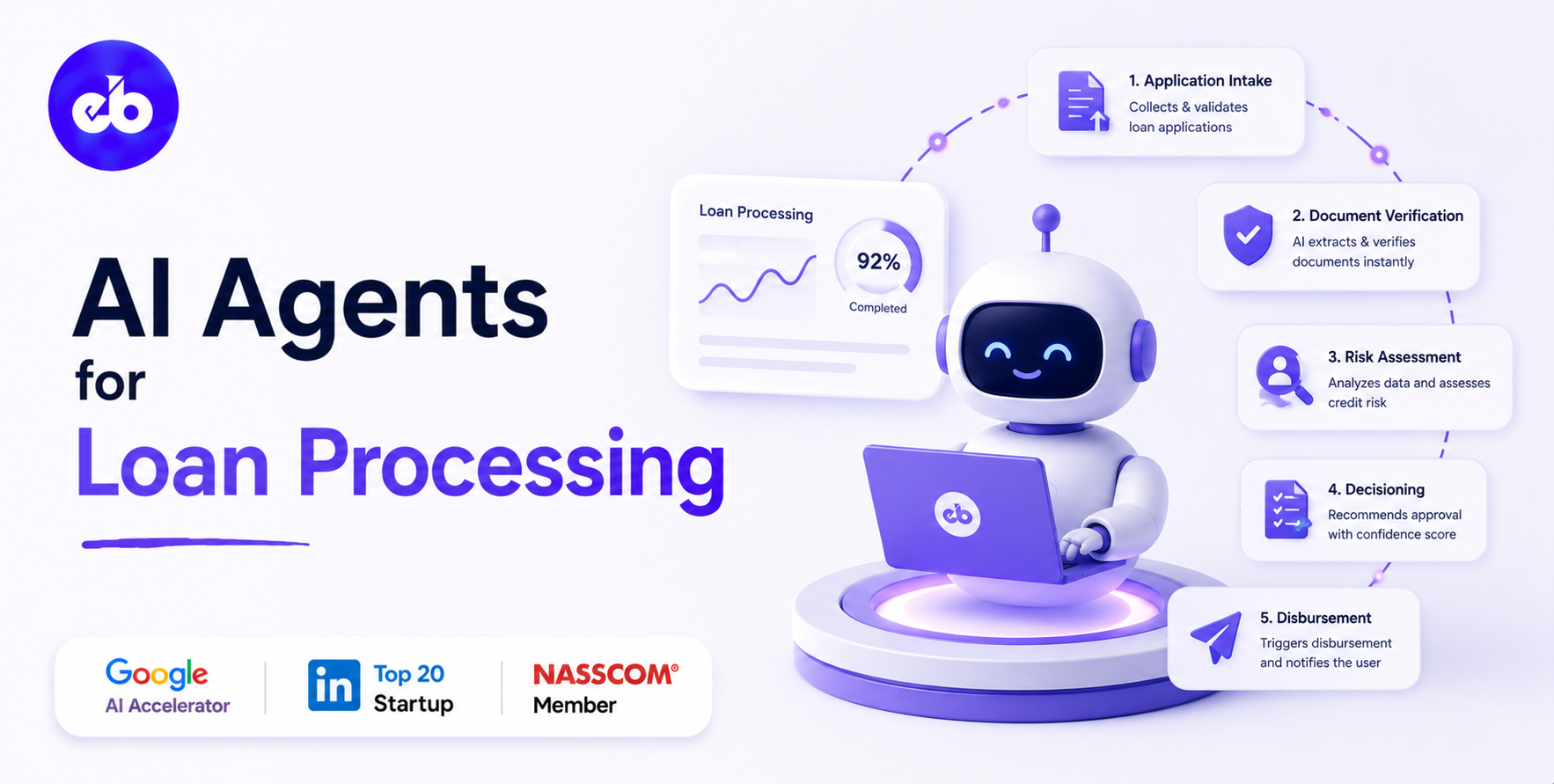
Building an agentic underwriting system means breaking the loan lifecycle into discrete tasks an agent can own end to end. Here’s what that looks like in practice.
The agent doesn’t wait for a processor to request documents. The moment an application is submitted, it pulls credit bureau data, bank transaction history, and employment verification simultaneously.
It reads uploaded pay stubs and tax forms, extracts the relevant fields, and flags anything missing before the borrower even finishes the session. This removes the back-and-forth email chains that used to stretch intake over several days into a single automated pass.
Once data is verified, the agent builds a risk profile using far more variables than a static credit score. It weighs income stability, spending patterns, and repayment history across multiple accounts.
Unlike a single model that just outputs a number, the agent reasons through the data, checking for contradictions like income that doesn’t match reported employment before finalizing a score. This is where machine learning genuinely earns its keep in lending decisions.
Not every application should be automated end to end. The agent’s job here is judgment about judgment. It identifies which applications are clean enough to approve automatically and which ones carry ambiguity that needs a human underwriter’s eye.
When it escalates a file, it hands over a pre-built case summary with the flagged issue already highlighted, so the reviewer isn’t starting from scratch. This alone can cut review time from hours to minutes.
Every autonomous decision needs a paper trail. The agent generates adverse action notices when it declines an application, logs the specific data points that drove the decision, and formats everything to match jurisdiction-specific regulatory requirements.
This step matters more than it sounds. Regulators increasingly expect lenders to explain algorithmic decisions in plain language, not just produce a score.
The agent doesn’t stay static after deployment. Every funded loan, every default, and every declined application that later performed well feeds back into the model.
Over months, the system gets sharper at spotting genuine risk versus surface-level red flags that don’t actually predict default.
The distinction matters because it changes what your platform needs architecturally.
Traditional automation follows fixed rules. If income is below X, flag for review. It’s fast to build but brittle, and it breaks the moment lending criteria get more nuanced.
An AI agent, by contrast, plans its own sequence of actions based on the situation in front of it. It can decide that a thin-file borrower needs an alternative data pull before scoring, while a borrower with a long credit history skips straight to automated approval. Not only that but AI is now automating B2B loan approvals.
That flexibility is exactly why platforms building serious underwriting automation are moving toward agentic architecture instead of rigid rule chains.
The efficiency gains are measurable, not theoretical. Commercial lending institutions using agentic frameworks report saving 40 to 60% of analyst time per loan file, largely because the agent handles data assembly and first-pass risk checks before a human ever opens the case.
For consumer lenders, the compounding effect matters more than any single metric. Faster decisions reduce application abandonment. Fewer manual touchpoints reduce cost per loan. And consistent, auditable decision logic reduces the regulatory risk that comes with inconsistent human judgment on borderline cases.
None of this means human underwriters disappear. Complex commercial loans, disputed cases, and anything touching fair lending risk still need a person making the final call. What changes is where that person’s time actually goes.
Deploying agents isn’t a plug-in you bolt onto an existing loan origination system overnight. It requires a few pieces working together.
Agentic systems introduce real risks alongside the speed gains, and skipping past them tends to cost more later.
Bias is the biggest one. An agent trained on historical loan data can quietly replicate past discrimination patterns unless fairness testing is built in from day one, not added after launch. Explainability is another.
Regulators expect a plain-language reason for every adverse decision, so black-box scoring without a reasoning layer creates compliance exposure fast.
There’s also the integration problem. Most lenders run on legacy loan origination systems that weren’t designed for autonomous agents pulling and pushing data constantly. Retrofitting that architecture usually takes longer than building the agent itself.
Most teams get the sequencing wrong. They try to automate the entire underwriting stack in one shot instead of starting narrow.
A better approach starts with structured MVP Development, automating just one high-friction stage, document verification or fraud flagging, and proving it against real loan outcomes before expanding scope.
Once that piece is stable, the agent’s responsibilities can grow into risk scoring, exception routing, and compliance generation one layer at a time.
Given how much regulatory nuance sits underneath every autonomous lending decision, this isn’t a build-it-yourself weekend project.
Working with an experienced lending software development company that understands both the AI architecture and the compliance obligations tends to save months of rework down the line.
AI agents for loan processing aren’t a distant trend anymore. They’re already cutting review times, reducing cost per loan, and giving underwriters back the hours they used to spend on routine file assembly.
The lenders moving fastest here aren’t replacing judgment. They’re pointing it at the cases that actually need it.
If you’re evaluating whether to build agentic capability into your lending platform, the technical and compliance groundwork matters as much as the AI model itself. Getting that foundation right from the start is what separates a genuinely production-ready system from a pilot that never scales.
EngineerBabu is a CMMI Level 5 company recognized as a Google AI Accelerator, and that’s the kind of track record you want backing a system handling real loan decisions. Head over to engineerbabu.com to see these trust factors for yourself before you pick a development partner.
An AI model predicts or scores something and stops there. An AI agent takes that output and acts on it, chaining multiple steps like data verification, scoring, and routing without human handoffs at each stage.
No. They handle routine, low-risk applications automatically and route complex or borderline cases to human underwriters with a pre-built case summary attached.
A focused pilot automating one stage, like document verification, can launch in a few months. Expanding into full underwriting automation typically takes longer and depends on integration complexity with existing systems.
Yes. Any AI system involved in credit decisions must meet fair lending obligations, and lenders are expected to provide explainable reasons for adverse decisions.
Start narrow. Automate one high-friction task, such as document extraction or fraud flagging, validate it against real outcomes, then expand the agent’s scope gradually.