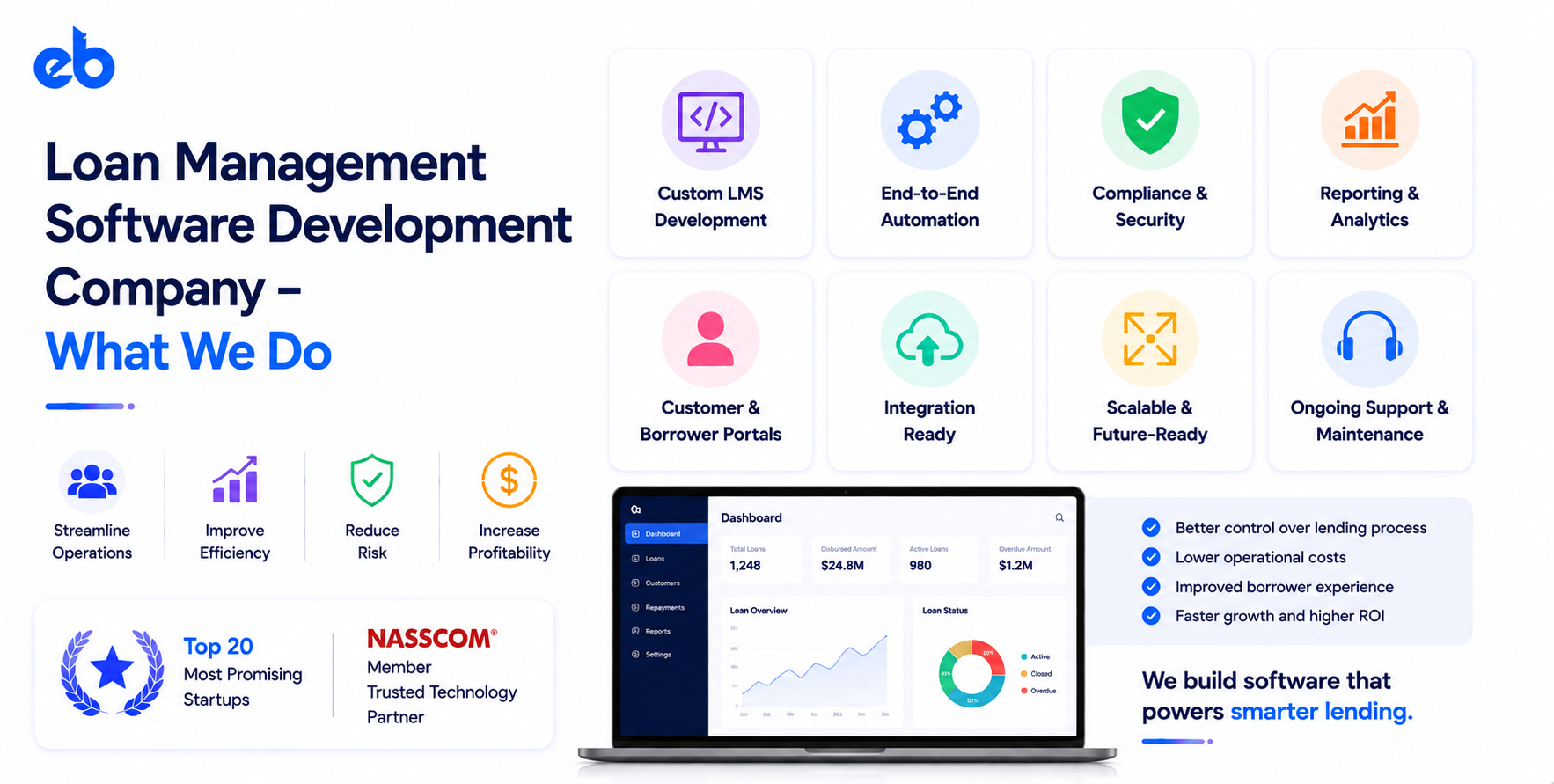
Loan management software development company – what we do


Create engaging, high-performance mobile applications tailored to your business needs. We craft future-ready apps that offer smooth user experiences on all devices.
Build robust and scalable websites and CMS platforms that help you manage content effortlessly. Our development ensures a seamless digital presence.
Launch secure, feature-rich online stores with intuitive shopping experiences. We build tailored eCommerce platforms designed for growth.
Design captivating games with immersive gameplay and stunning graphics. From concept to launch, we build engaging experiences that players love.
Enhance your customer relationships with customized Salesforce implementations. Drive growth and efficiency with smarter CRM solutions.
Harness artificial intelligence and machine learning to automate workflows and gain actionable insights. Our AI transforms data into smart decisions.
Accelerate your software delivery lifecycle with continuous integration, delivery, and infrastructure automation to boost efficiency.
A lender we spoke with last quarter was approving loans in 38 hours. Their competitor was doing it in nine minutes. Same credit policy, same bureau data, same regulatory perimeter. The only difference sat in the software.
That gap is why the category is growing so fast. The global loan management software market was valued at $5.9 billion in 2021 and is projected to reach $29.9 billion by 2031, a CAGR of 17.8% (Allied Market Research).
Lenders are not buying software for novelty. They are buying it because manual servicing no longer competes.
EngineerBabu works as a loan management software development company for banks, credit unions, digital lenders, BNPL providers, microfinance institutions, and leasing firms. We build the full lending stack: origination, underwriting, servicing, collections, and portfolio analytics.
Our teams have shipped fintech products across North America, the EU, MENA, and APAC, including platforms that process millions of loan events per day.
Lending systems rarely fail loudly. They fail slowly, in ways that show up on the P&L a quarter later.
Underwriters start keeping shadow spreadsheets because the system cannot model a new product. Collections teams work a static list because the platform has no propensity scoring. Compliance pulls audit evidence by hand because the log tables were never designed for examiner requests. Every workaround is small. Together they add days to your cycle time and points to your cost of servicing.
The other failure mode is rigidity. Off-the-shelf platforms price and package around the average lender, so anything specific to your market becomes a change request on someone else’s roadmap. You wait two quarters to launch a product your competitor shipped in six weeks.
A custom loan management platform removes that dependency. You own the workflows, the risk logic, and the release calendar.
We build modular. You can deploy the full suite or start with the one component that is costing you the most today, then expand as volumes grow.
Application intake, document collection, KYC and KYB verification, underwriting rules, and approval workflows in one configurable flow. The system connects to credit bureaus and alternative data providers, so decisioning happens against a complete risk picture instead of a partial one. Straight-through processing typically reaches 60% to 80% for pre-qualified segments.
Amortization schedule generation, repayment processing, interest and fee accrual, restructuring, and refinancing. This is where most legacy systems break, because servicing thousands of active loans with different terms, grace periods, and currencies is genuinely hard. We design the ledger and the calculation engine first, then build the interface on top.
Dunning workflows, promise-to-pay tracking, collector assignment, write-off management, and external agency coordination. Early-stage collections run automatically. Complex workouts get routed to humans with full borrower context on screen.
Rule-based scorecards, hybrid models, and machine learning credit models trained on bureau and alternative data. Decisions return in real time. Every model version stays auditable, which matters when a regulator asks why a specific applicant was declined.
A 360 degree borrower view for relationship managers, plus self-service portals and mobile apps where borrowers check balances, download statements, and request modifications without calling support. Lower call volume is usually the fastest measurable win in the whole project.
Exposure limits, compliance rules, and workflows differ sharply by product. We build to the vertical, not to a template.
We also build for P2P marketplaces and embedded lending at checkout, where the payment rails and the credit decision have to work as one flow.
Use this as a checklist when you evaluate vendors or scope your own build.
If your reporting layer is the bottleneck, you can also hire dedicated fintech developers to extend it alongside your internal team.
Lending platforms live or die on integrations. A system that cannot talk to your core banking, bureau, and payment providers is just a nicer place to retype data.
|
Layer |
What we connect |
|
Core banking and finance |
Core banking, general ledger, treasury and liquidity systems |
|
Credit and risk data |
Experian, Equifax, TransUnion, alternative data, fraud screening |
|
Identity and compliance |
KYC and KYB providers, AML and PEP screening, document OCR |
|
Payments |
Card issuers, ACH, SEPA, real-time rails, POS repayment |
|
Business systems |
CRM, ERP, accounting, data warehouses and BI |
Underneath, we use REST and GraphQL APIs for real-time calls, Kafka or RabbitMQ for event-driven flows, ETL pipelines for batch synchronization, and webhooks for instant status updates. Our API development work makes every module callable, so your platform stays extendable long after go-live.
These are production capabilities across our 2024 to 2026 deployments, not pilots.
Our delivery model is Agile with the governance regulated lenders actually need.
We share cycle time, defect leakage, SLA performance, and change-request turnaround throughout the engagement. If you want to validate a lending concept first, an MVP build covering one product in one market is often the smarter opening move.
Stack choices follow your standards, regulatory constraints, and performance targets. There is no universal answer here.
These ranges reflect projects delivered in 2024 to 2026. Scope moves the number, but you should walk into the first call with realistic expectations.
|
Project type |
Budget |
Timeline |
Best fit |
|
MVP loan management module |
$80,000 to $200,000 |
3 to 5 months |
Fintechs validating a lending concept |
|
Full enterprise platform |
$250,000 to $700,000+ |
6 to 12 months |
Banks and established lenders |
|
Legacy modernization |
From $150,000 |
4 to 9 months |
Institutions on 2005 to 2015 era systems |
Four variables move cost more than anything else: the number of loan products, the number and complexity of integrations, regulatory and geographic coverage, and your availability SLA.
We work on fixed-price, time-and-material, or dedicated team models depending on how settled your requirements are.
Banks and digital lenders replacing aging core loan systems. Consumer and commercial lenders automating origination and servicing. Credit unions, microfinance institutions, and CDFIs running high-volume community programs.
Fintechs and embedded finance platforms putting credit inside merchant flows. Leasing and asset finance companies managing contracts, assets, and payments in one place.
We support Series A and B fintechs moving quickly, and large regulated institutions with strict governance. If your roadmap also covers accounts and cards, our banking app development teams work on the same stack.
You do not need to commit to the full platform on day one. Most clients start with a single loan product or a single market, prove the model, then roll out across the portfolio.
An MVP covering one product in one market takes 3 to 5 months. A full enterprise platform with origination, servicing, collections, and integrations takes 6 to 12 months. Data migration complexity is usually the biggest swing factor.
Buy if your products are standard and your volumes are modest. Build if your credit logic, product mix, or market coverage is a differentiator. Most lenders who outgrow a SaaS platform do so because of roadmap dependency, not features.
Yes. We refactor legacy .NET and Java systems, migrate on-premise deployments to cloud, and strangle old modules out gradually so servicing never stops. Parallel runs validate accuracy before cut-over.
Basel III, IFRS 9, PCI DSS, GDPR, and SOC 2 requirements are part of our delivery process, alongside local lending regulations in your target markets.
Through an API-first architecture with dedicated adapters per provider. That isolates provider changes from your core logic, so swapping a bureau or payment processor later does not trigger a rebuild.
Modern loan management is not just automation. It is a compliant, scalable engine that improves decision speed, servicing accuracy, and portfolio performance at the same time.
If you are evaluating a loan app management software development company, talk to a team that has shipped custom software for regulated lenders and knows why a restructuring workflow in microfinance looks nothing like one in commercial credit.
Book a consultation and we will map your fastest path to launch.