Custom vs White-Label Loan Management Software


Create engaging, high-performance mobile applications tailored to your business needs. We craft future-ready apps that offer smooth user experiences on all devices.
Build robust and scalable websites and CMS platforms that help you manage content effortlessly. Our development ensures a seamless digital presence.
Launch secure, feature-rich online stores with intuitive shopping experiences. We build tailored eCommerce platforms designed for growth.
Design captivating games with immersive gameplay and stunning graphics. From concept to launch, we build engaging experiences that players love.
Enhance your customer relationships with customized Salesforce implementations. Drive growth and efficiency with smarter CRM solutions.
Harness artificial intelligence and machine learning to automate workflows and gain actionable insights. Our AI transforms data into smart decisions.
Accelerate your software delivery lifecycle with continuous integration, delivery, and infrastructure automation to boost efficiency.
A lender once told us he picked his loan software the same way he picked used furniture. He looked at the price tag and drove off. Eighteen months later, he was stuck paying for features he never used and begging a vendor for changes that never came.
That’s the trap most lending businesses fall into when they skip the real question: custom vs white-label loan management software, and which one actually fits how you lend.
The market backs up why this decision matters so much right now. The global loan origination software market is projected to reach $27.74 billion by 2035.
Moreover, roughly 65% of banks and credit unions have already implemented some form of loan origination software to streamline operations, according to Business Research Insights.
This blog breaks down what separates custom loan management software from white-label platforms, where each one wins, and how to make the call without regretting it a year from now.
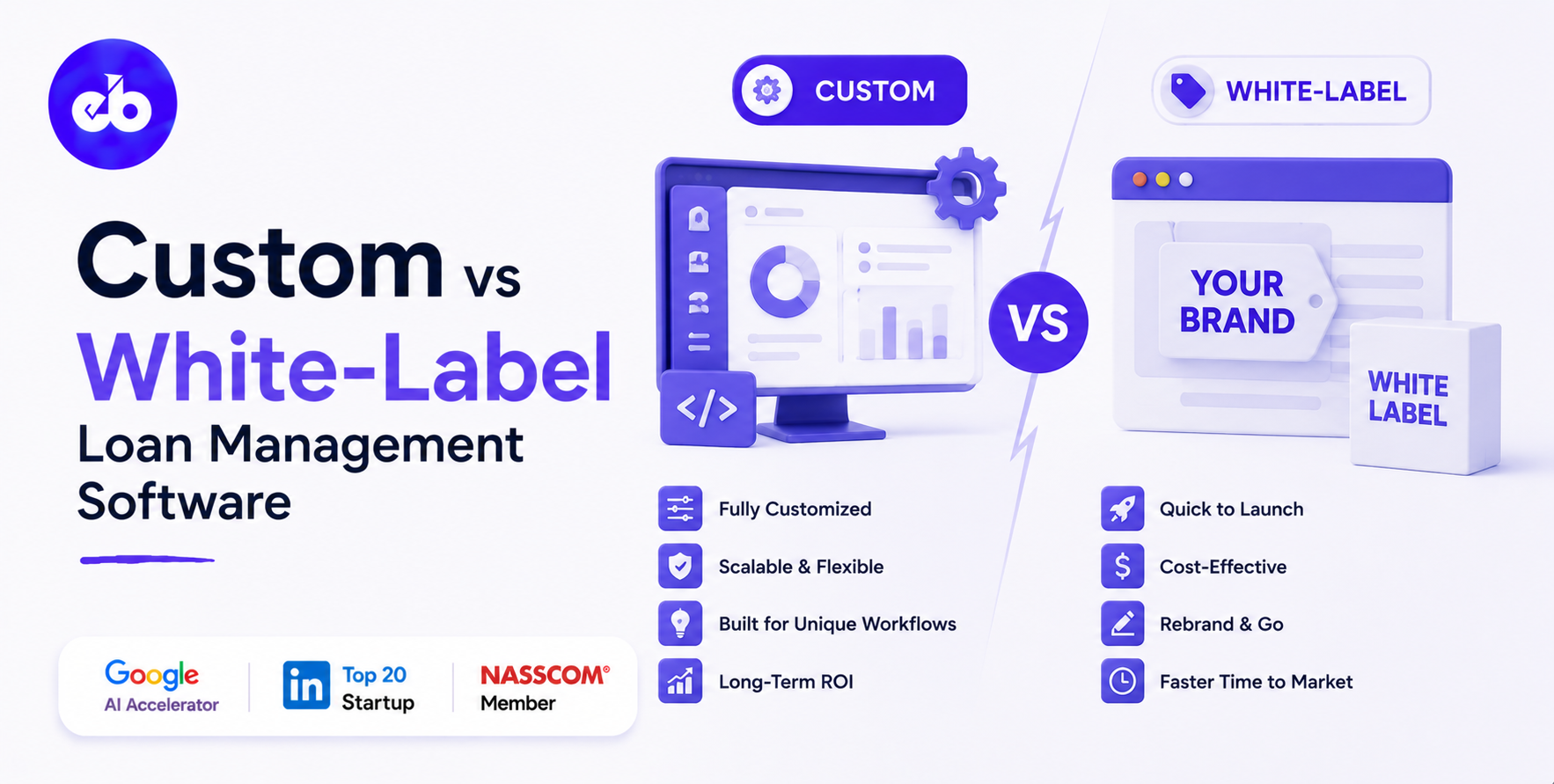
White-label loan management software is a pre-built platform that a vendor licenses to you. You add your logo, adjust a few settings, and launch under your own brand.
The underlying code, architecture, and core logic stay owned by the vendor. You’re renting a proven system rather than building one from scratch.
This model works well for lenders who need to move fast. Onboarding, loan tracking, repayment schedules, and basic reporting usually come ready out of the box.
Custom loan management software is built specifically for your lending business, from workflow design to database architecture. Nothing is inherited from someone else’s product roadmap.
Every screen, rule, and integration reflects how your team actually underwrites, disburses, and collects. If your commission structure is unusual or your compliance requirements are state specific, custom development bends to that reality instead of forcing you to bend to it.
This route takes longer and costs more upfront. But you own the asset outright, and nothing about your platform is shared with a vendor’s other clients.
The custom vs white-label loan management software decision usually comes down to five factors. Here’s how they actually play out.
White-label platforms typically run on a subscription model, often $500 to $5,000 a month depending on loan volume and features. Custom builds usually start at $20,000 for a lean MVP development and can climb past $150,000 for a full-featured platform with credit bureau and payment gateway integrations.
The math flips over time, though. White-label subscription costs compound every year with no ceiling, while a custom platform becomes cheaper to run once development is paid off.
White-label wins here without much debate. Most lenders can be live within two to six weeks since the core system already exists.
Custom loan management software takes three to seven months depending on scope. If you’re racing a competitor or testing a new loan product, that gap matters.
White-label platforms are built for the average lender, not your lender. Adding a new loan product, changing your underwriting logic, or supporting a new region often means submitting a feature request and waiting on someone else’s release calendar.
Custom software has no such ceiling. You can plug in new scoring models, expand into new markets, or layer in AI-driven risk assessment whenever your business needs it, not whenever a vendor schedules it.
Lending is one of the most regulated industries there is, and compliance requirements shift by state and by loan type. With white-label software, you’re limited to whatever compliance logic the vendor has already built.
Custom platforms let you bake in exact regulatory rules from day one, including audit trails, adverse action notices, and jurisdiction-specific documentation. However, make sure to choose the best lending software development company to build this from scratch as compliance gets designed into the architecture rather than patched on afterward.
White-label gives you surface-level branding. Your logo and colors show up, but the underlying user flow, screens, and interaction patterns stay identical to every other lender using the same vendor.
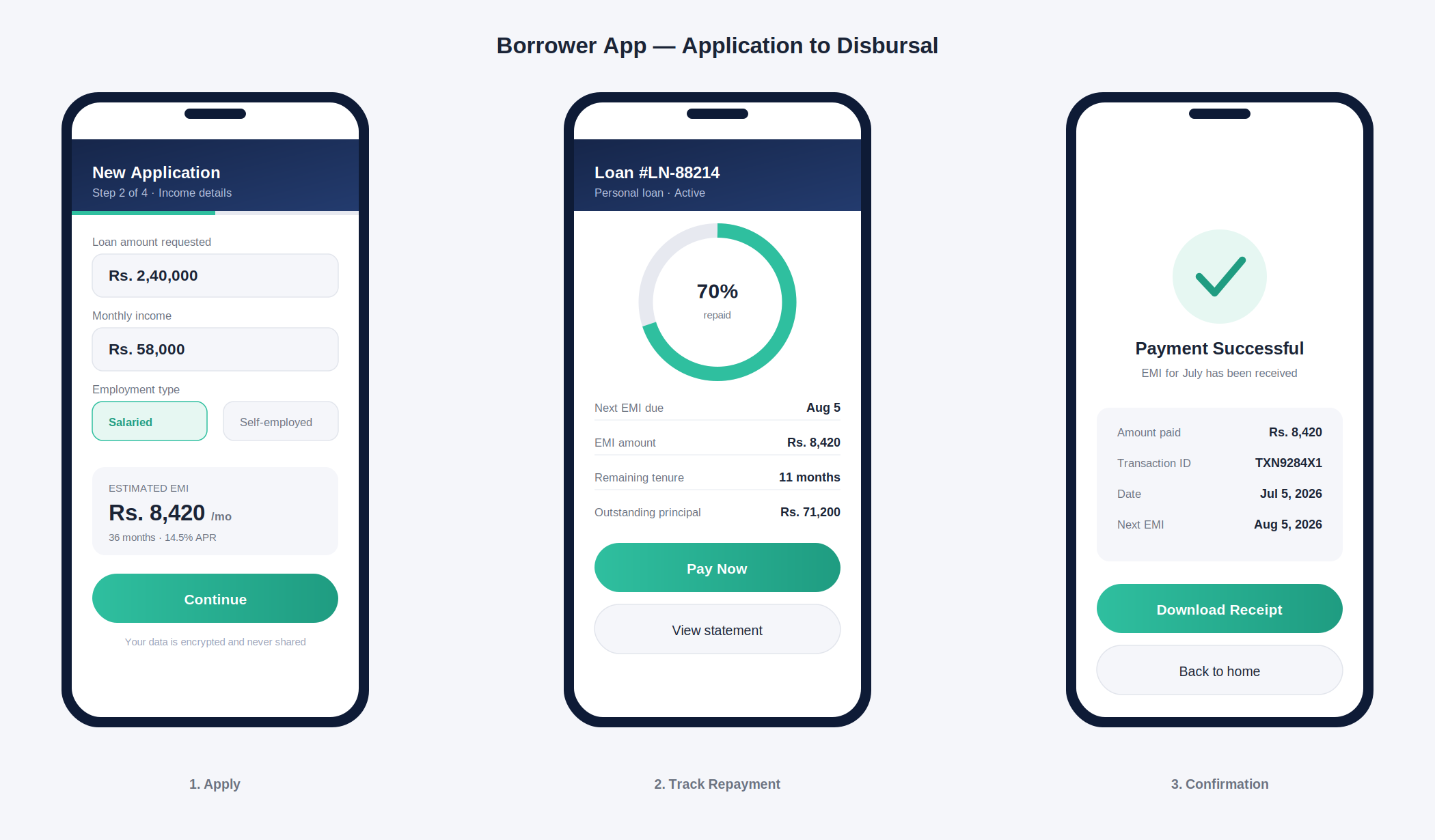
Custom loan management software lets you design the entire borrower journey, from application to disbursement, around your specific audience. That difference shows up directly in conversion rates during onboarding.
White-label loan management software is the smarter pick in a handful of specific situations.
If most of these apply, white-label buys you time without locking you into a massive upfront investment.
Custom loan management software earns its higher cost when your lending business has outgrown generic tools.
Many lenders start with a scoped MVP development approach here. You build the core loan management engine first, launch to a limited borrower base, and expand features based on actual usage rather than guesswork.
Before picking a side in the custom vs white-label loan management software debate, run through these questions honestly.
If you need to be live in under a month, white-label is realistically your only option. Custom development simply cannot compress into that timeline without cutting corners on testing and compliance review.
Standard personal loans or small-ticket consumer lending fit white-label platforms reasonably well. Complex products like DSA-driven commercial lending or alternative credit scoring usually need custom logic that off-the-shelf platforms don’t support natively.
Run the actual numbers, not just the sticker price. Multiply your white-label subscription by 36 months and compare it against a realistic custom development quote plus maintenance. The winner often surprises people.
This is where the gap between custom and white-label widens fastest. Most white-label platforms offer AI features as a fixed, one-size-fits-all module, if they offer them at all.
Custom platforms let you build AI capabilities tuned to your actual borrower data, from alternative credit scoring to fraud detection. You can read more about how this works in our breakdown of AI in loan lending apps.
The same logic applies if you’re lending to businesses rather than individuals. Automated document review and risk scoring look very different for commercial credit lines, which we cover in our piece on the role of AI in automating B2B loan approvals.
Not every lender has to choose one path entirely. A growing number start on a white-label platform to validate their loan product, then transition to custom loan management software once volume justifies the investment.
Others take a middle path: license white-label infrastructure for core loan servicing but build custom modules for underwriting, fraud detection, or borrower communication.
This hybrid model works particularly well when paired with targeted AI development for the pieces that actually differentiate the business, while keeping the rest on proven, maintained infrastructure.
There’s no universal winner in the custom vs white-label loan management software debate. A three-person fintech testing a BNPL product has completely different needs than an NBFC processing thousands of loans a month.
What matters is being honest about your volume, your timeline, and how much your lending model actually differs from the standard playbook. Get that assessment wrong, and you either overspend on custom development you didn’t need or get boxed in by a white-label platform that can’t grow with you.
If you’re weighing this decision for your own lending business, it helps to talk to a team that isn’t trying to sell you a license. EngineerBabu builds custom lending platforms exclusively, so the advice you get is about what your business actually needs, not about pushing you toward a pre-built product with someone else’s roadmap attached to it.
Upfront, yes. Subscription pricing starts lower than a custom build. Over three to five years, though, recurring fees can exceed what a custom platform would have cost once it’s paid off.
To a limited extent. You can usually adjust branding, workflows, and some feature toggles, but core logic and architecture stay controlled by the vendor.
A focused MVP typically takes three to four months. A full-featured platform with credit bureau and payment gateway integrations can run five to seven months depending on scope.
Most startups begin with white-label software to validate their loan product quickly, then shift to custom development once volume and revenue justify the investment.
Generally yes. Custom platforms let you build AI models trained on your own borrower data, while white-label platforms usually offer only pre-set, generic AI modules.