Home Services App Development: A Complete 2026 Guide


Create engaging, high-performance mobile applications tailored to your business needs. We craft future-ready apps that offer smooth user experiences on all devices.
Build robust and scalable websites and CMS platforms that help you manage content effortlessly. Our development ensures a seamless digital presence.
Launch secure, feature-rich online stores with intuitive shopping experiences. We build tailored eCommerce platforms designed for growth.
Design captivating games with immersive gameplay and stunning graphics. From concept to launch, we build engaging experiences that players love.
Enhance your customer relationships with customized Salesforce implementations. Drive growth and efficiency with smarter CRM solutions.
Harness artificial intelligence and machine learning to automate workflows and gain actionable insights. Our AI transforms data into smart decisions.
Accelerate your software delivery lifecycle with continuous integration, delivery, and infrastructure automation to boost efficiency.

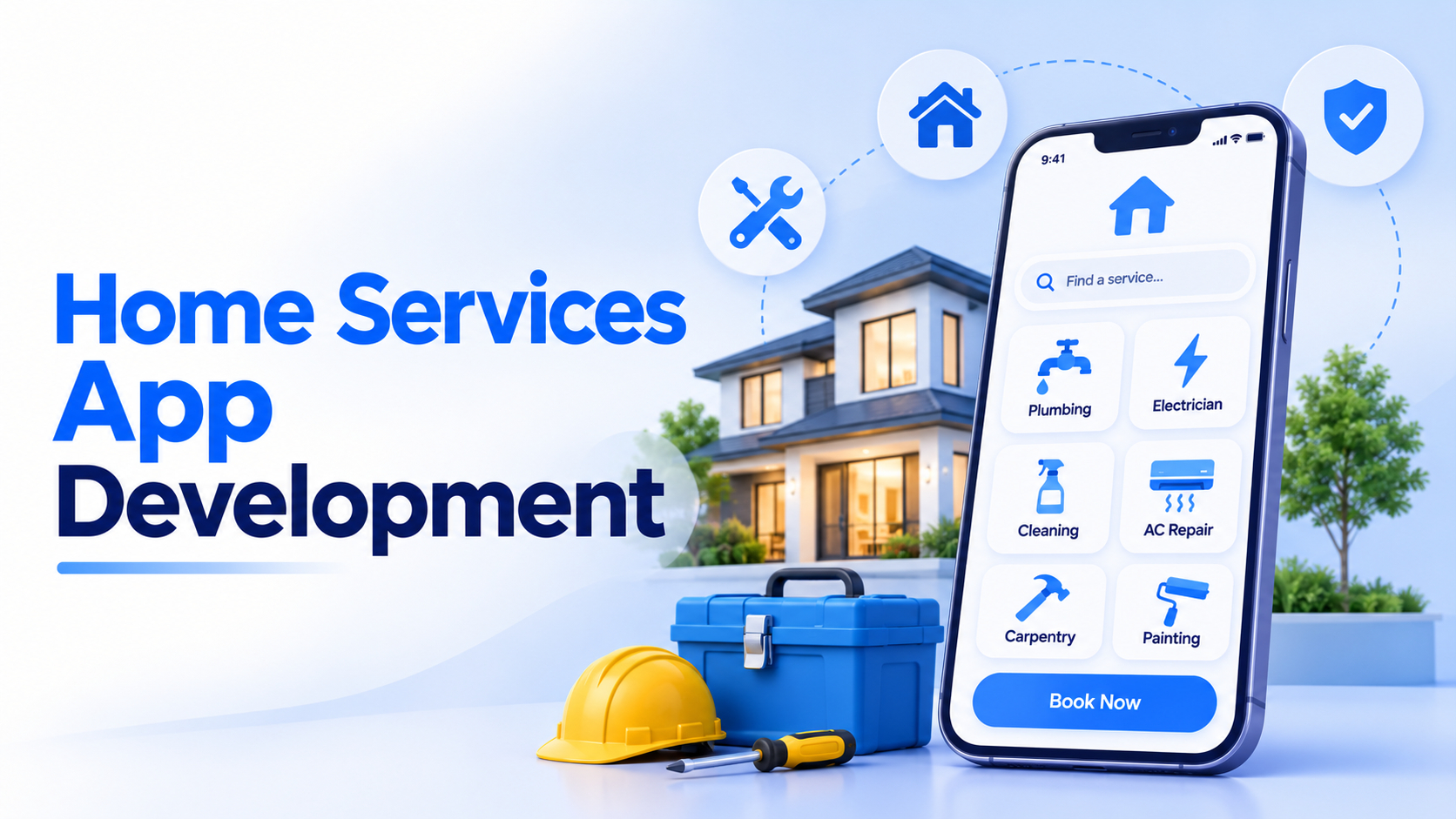
Plumbers, cleaners, and electricians now get booked the same way people order dinner. One tap, one confirmed slot, one technician you can track on a map.
That shift is what home services app development is really about. You are not building a directory of phone numbers. You are building a dispatch engine, a payment rail, and a trust layer that convinces someone to let a stranger into their home.
Most home services app development projects fail for the same reason. The booking flow works beautifully in a demo, then collapses the first week real technicians cancel, run late, or take cash off-platform. This guide covers what home services app development involves, what it costs, which features matter, and where AI is changing the economics.
TL;DR
Home services app development is the process of building a platform that connects customers needing household work with vetted providers. Think cleaning, plumbing, electrical work, pest control, appliance repair, salon-at-home, and painting.
Three products ship together in every home services app development project. The customer app handles discovery, booking, and payment. The provider app handles job acceptance, navigation, status updates, and earnings. The admin panel handles onboarding, commissions, pricing rules, and complaint resolution.
Most founders underestimate the third one. The admin layer is where your margin lives, because it controls how jobs get priced and who gets them. The same architecture powers any online service marketplace, so the patterns are well understood. What changes is the job logic behind each category.
Demand behind home services app development is not slowing down. The online on-demand home services market is expected to reach $6.79 billion in 2026 and $11.78 billion by 2030, growing at a 14.8% CAGR.
Two forces drive that. Households increasingly treat maintenance as something to outsource rather than schedule around. And independent technicians want steady job flow without running their own marketing.
That second group shapes every home services app development roadmap more than founders expect. Supply is the harder side of this marketplace. Customers will try a new app once.
Technicians only stay if jobs are dense enough to fill a day without long travel gaps. Any serious on-demand app development company will push you to solve supply density before spending on customer acquisition.
Home services app development is not one single model, and the model you pick shapes the entire build.
Feature lists are easy to copy. Home services app development lives or dies on the execution behind four or five of them.
Service discovery with transparent pricing comes first. Hidden charges at checkout are the single biggest cause of cancellation in this category. Add slot-based scheduling, address and access notes, live technician tracking, in-app chat, secure payments, and ratings that feed back into dispatch.
Repeat booking belongs in scope from day one, because household work is recurring by nature. A customer who books a deep clean once will book again in ninety days if the first job went well.
Technicians need a job feed, accept and reject controls, navigation, and a clear earnings breakdown. Add checklists, before-and-after photo capture, and digital job completion so disputes carry evidence.
Dispatch here follows the same logic as building an app like Uber, with one difference. Home jobs take hours, not minutes. So matching in home services app development must weigh job duration, skill level, and travel radius together.
This is your control room. Provider onboarding with document and background verification, commission and surge rules, category-level pricing, refund handling, and a dispute queue all live here.
Analytics on fill rate, cancellation reasons, repeat rate, and provider churn matter just as much. Teams that treat the admin panel as an afterthought in home services app development end up guessing which city or category is actually profitable.
Home services app development works best as a sequenced build rather than one big release. Here is the order that keeps risk low.
Start by deciding whether you run a managed marketplace, an aggregator, or a fleet-based service. That choice sets your commission structure, legal exposure, and support load. Then pick one category and one city. Cleaning and appliance repair are common starting points because demand is predictable and skill verification is straightforward.
Resist launching eight categories at once. Every added category multiplies pricing rules, technician training, and quality variance, which is exactly what kills early unit economics in home services app development.
Write the full journey before any design work starts. Customer requests a slot, the system checks provider availability, the job gets offered, the provider accepts, the technician travels, the job completes, payment settles. Document every failure path too.
What happens on a no-show, a partial completion, or a cash request? Teams skip this step and then patch edge cases forever. A mapped flow turns into a cleaner build and far fewer support tickets after launch.
Interfaces here should feel obvious to a 55-year-old homeowner and a technician wearing gloves. Large touch targets, minimal typing, and clear status at all times. Practical UI/UX design choices matter more than visual polish in home services app development.
Build the first version as a working MVP covering booking, dispatch, payment, and ratings only. Skip loyalty points, referrals, and subscriptions for now. Your goal is one real job completed by a real technician for a paying customer within twelve weeks.
This is where home services app development gets technical. You need a payment gateway with split payouts, wallet or escrow handling, refund automation, and tax-compliant invoicing.
Layer in identity checks and background verification for providers before they take their first job. Maps, routing, OTP, and notification services should connect through clean API development rather than SDK calls scattered through the codebase. That abstraction saves weeks when you swap a provider or enter a new market.
Launch inside a tight geographic pocket where you can guarantee enough technicians to fill every booking. Watch four numbers daily: job fill rate, on-time arrival, cancellation reason, and repeat booking rate. Fix supply gaps before widening the map.
Expanding too early leaves customers waiting and technicians idle in both zones. Once fill rate holds above 90%, replicate the same playbook zone by zone. Disciplined rollout is the cheapest insurance in home services app development.
Your stack should favor fast iteration early and stability later. These are the common choices in home services app development today.
If you are weighing platform choices, the trade-offs in native vs cross-platform development apply directly. Cross-platform wins for most projects because feature parity matters more than raw frame rates.
A single-category MVP with booking, dispatch, payments, and an admin panel typically lands between $30,000 and $60,000. A multi-category marketplace with surge pricing and advanced matching runs $80,000 to $150,000 or more.
Four things push home services app development costs up.
Staging the work through proper MVP development is what keeps the first year affordable.
AI in mobile app development has moved past novelty in this category. Three use cases already pay for themselves.
Demand forecasting predicts booking spikes by zone and hour, so you can nudge technicians toward busy areas before requests land. Dynamic job duration estimates beat flat time slots, which lifts the number of jobs each technician completes per day.
Then there is support. An AI chatbot handles rescheduling, cancellation, and invoice questions without a human agent, which matters when margins per job are thin.
In home services app development, prediction and automation deliver more value than any customer-facing AI feature.
Launching with demand but no supply is the classic one. Customers book, nobody shows up, and the reviews never recover.
Letting cash payments leak off-platform is the second. Once technicians collect directly, you lose commission and your ratings data goes blank.
Underbuilding the admin panel is the third. Teams perfect the customer app, then run operations through spreadsheets.
Ignoring post-launch budget is the fourth. Dispatch rules, pricing, and categories change constantly, so mobile app maintenance and support belongs in the plan as a standing line item.
Reviewing common mobile app development mistakes before you scope a home services app development project saves far more than it costs.
EngineerBabu builds on-demand and marketplace products end to end, from architecture through launch and scale. The team runs a CMMI Level 5 delivery process, holds a Google AI Accelerator selection, and has supported 200+ VC-funded products.
For home services app development specifically, that means dispatch logic, provider verification, split payments, and admin tooling built by senior engineers who stay on the project.
Our mobile app development services cover iOS, Android, backend, and DevOps under one roof. You can also hire mobile app developers to extend your in-house team instead of outsourcing the entire build.
Home services app development rewards operational thinking more than feature counting. The platforms that win are the ones where a technician arrives on time and gets paid fairly. The admin team should be able to change pricing without calling a developer.
Build the dispatch and admin layers properly, launch narrow, and expand once your fill rate holds. The feature wish list can wait.
Ready to scope your build? Talk to the EngineerBabu team about your home services app development project.
A single-category MVP with booking, dispatch, payments, and an admin panel usually takes 12 to 16 weeks. Multi-category marketplaces with advanced matching and subscriptions typically need six to nine months.
Most platforms charge a commission per completed job, usually 15% to 30%. Others add provider subscription fees, featured placement, lead charges, or membership plans bundling discounted recurring services for customers.
Yes. The two groups have opposite needs, so one app cannot serve both well. Providers need job feeds and earnings tools, while customers need discovery, scheduling, and live tracking.
Standard practice combines government ID checks, address proof, trade certification, and third-party background screening. Many platforms add a trial period with supervised jobs before granting full marketplace access.
Follow your market. Android dominates India and Southeast Asia, while iOS leads in the US and UK for higher-value households. Cross-platform frameworks remove the choice from home services app development entirely.
Real-time matching under load. Assigning the right technician by skill, rating, travel time, and job duration while hundreds of bookings arrive at once is the hardest part.