How to Build an App Like MyChart in the USA (2026)


Create engaging, high-performance mobile applications tailored to your business needs. We craft future-ready apps that offer smooth user experiences on all devices.
Build robust and scalable websites and CMS platforms that help you manage content effortlessly. Our development ensures a seamless digital presence.
Launch secure, feature-rich online stores with intuitive shopping experiences. We build tailored eCommerce platforms designed for growth.
Design captivating games with immersive gameplay and stunning graphics. From concept to launch, we build engaging experiences that players love.
Enhance your customer relationships with customized Salesforce implementations. Drive growth and efficiency with smarter CRM solutions.
Harness artificial intelligence and machine learning to automate workflows and gain actionable insights. Our AI transforms data into smart decisions.
Accelerate your software delivery lifecycle with continuous integration, delivery, and infrastructure automation to boost efficiency.

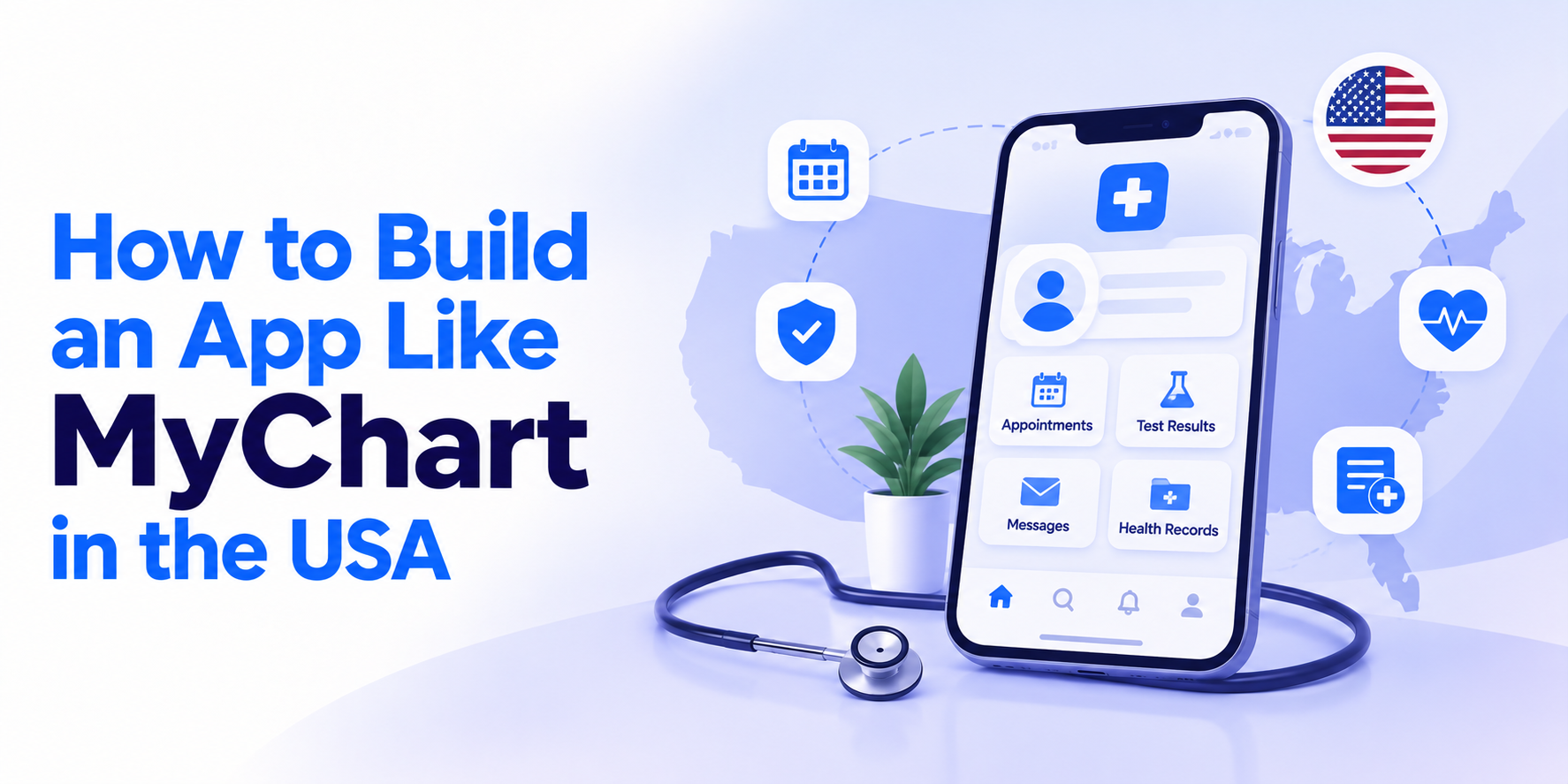
Most US health systems never advertise their patient portal. They do not have to, because MyChart is already sitting on their patients’ phones, holding every lab result and visit summary.
TL;DR
To build an app like MyChart means building a secure window into clinical data that already lives somewhere else. Your users see appointments, results, bills, and messages.
Underneath, your app is negotiating with an electronic health record, an identity provider, and a compliance regime that assumes you will get it wrong.
MyChart is not a standalone medical record. It is a read-and-write interface to Epic, branded by whichever hospital deployed it. Patients at two different systems see two different apps backed by the same engine.
That distinction matters commercially. If you want to build an app like MyChart, pick your model now. You are either building a portal for one provider network, or a multi-tenant product many providers can brand.
The second model is harder and far more valuable. It also forces architecture decisions on day one, because tenant isolation cannot be retrofitted after your first hospital goes live.
The business case to build an app like MyChart rests on operations, not on novelty. Patient portals quietly carry a lot of operational weight. They cut inbound call volume, reduce no-shows, speed up intake, and move billing conversations out of the front desk queue.
The market reflects that. The global patient portal market was valued at $4.4 billion in 2025. It is projected to reach $10.7 billion by 2033 at a 12% CAGR (Grand View Research).
Providers also face pressure from information blocking rules, which require patients to get electronic access to their records without delay. A portal is the cheapest way to satisfy that obligation.
Results delivery, appointment scheduling, prescription refills, secure messaging, e-check-in, bill pay, and proxy access for a parent or caregiver. Proxy access is the feature teams forget and families use constantly.
Video visits matter too, though many systems route them through a separate telemedicine platform development track rather than bolting them into the portal.
Message triage queues, templated replies, scheduling rules, and release logic for sensitive results. Without a staff-side console, every patient message lands in a clinician inbox and the project stalls within a quarter.
Audit trails, consent records, document rendering, and a notification engine that respects quiet hours. Patients judge the app on notifications more than on layout, which is why smart scheduling systems usually ship alongside reminders.
Every team that sets out to build an app like MyChart learns this in month two. Epic exposes patient data through FHIR R4 endpoints with SMART on FHIR authorization. You register your app, request scopes, and move through a sandbox before any production connection is approved.
Read access is straightforward. Write access, including appointment booking and message submission, is where review cycles get long. Plan your Epic FHIR integration timeline around approvals, not around sprint velocity.
Very few US health systems run a single record system cleanly. Acquisitions leave Cerner, Athenahealth, or MEDITECH pockets behind, each with its own quirks.
Build an abstraction layer so your product logic never speaks a vendor dialect directly. That one decision determines whether your second customer takes six weeks or six months, and it is central to healthcare data interoperability work.
Linking a mobile user to the right medical record is the highest-risk step in the whole build. Most systems use an activation code, identity proofing, or a verified demographic match.
Get this wrong and you expose one patient’s chart to another. Treat matching as a security feature, not an onboarding step.
Compliance is not a launch checklist item when you build an app like MyChart. HIPAA sets the floor: encryption in transit and at rest, role-based access, breach notification, and signed business associate agreements with every vendor touching protected health information.
Enterprise buyers will also ask for SOC 2 Type II, and increasingly HITRUST, before signing. Those audits take months. Start evidence collection during development, and design around healthcare data security best practices from the first sprint.
The sequence below reflects how working teams build an app like MyChart without stalling halfway.
Decide early whether you serve one provider or many. A single-tenant portal can hardcode an EHR connection, branding, and scheduling rules, which cuts months of work.
A multi-tenant product cannot. You will need tenant-scoped data isolation, per-tenant theming, configurable feature flags, and separate credential vaults for each connected system. Changing this later means rewriting the data layer.
Write down your first three target customers and check whether they share an EHR vendor. If they do not, multi-tenant is already your answer.
Register with the EHR vendor’s developer program and request the exact scopes your feature list needs. Epic, Cerner, and Athenahealth each run separate review processes with separate documentation.
Start in the sandbox with synthetic patient data and confirm every resource you depend on actually returns usable fields. Vendor documentation often lists resources that a given hospital has not enabled.
Budget six to twelve weeks for approvals. Teams that treat this as a parallel track instead of a blocker stay on schedule.
Teams that build an app like MyChart routinely underestimate this layer. Pull FHIR resources into an internal data model your app controls. Map Patient, Encounter, Observation, MedicationRequest, DocumentReference, and Appointment into clean internal objects.
Normalize units, code systems, and date handling here. LOINC and SNOMED codes arrive inconsistently, and rendering raw values to patients produces confusing results and support tickets.
Cache deliberately. Clinical data changes less often than people assume, and smart caching cuts both latency and API cost noticeably.
Build results viewing, scheduling, refills, and secure messaging first. These four features drive the overwhelming majority of portal sessions in production.
Design result screens for anxious readers. Plain-language explanations, reference ranges, and clear next steps reduce the phone calls that portals exist to prevent.
Run usability sessions with real patients over 60. That group drives heavy portal usage and exposes accessibility gaps faster than any internal review.
Ship bill pay only after these flows feel reliable, because payment friction amplifies every unresolved usability problem.
Run penetration testing, access-control testing, and load testing against realistic concurrency. Portal traffic spikes hard when lab batches release each morning.
Validate audit logging captures every read of protected data, including staff access. Auditors check this first, and gaps here block enterprise deals.
Complete your HIPAA risk assessment, sign BAAs, and start SOC 2 evidence collection before launch rather than during your first enterprise procurement cycle.
Commission a third-party security assessment early, since enterprise buyers routinely ask for that report during procurement.
Roll out to one clinic or service line before the full network. Early cohorts surface matching errors and notification problems while the blast radius stays small.
Track activation rate, message deflection, no-show reduction, and result-view time. These numbers justify the next funding round internally far better than download counts.
Keep a release cadence, because EHR vendors update APIs regularly and silent breakage is the most common cause of portal churn.
| Scope | Timeline | Indicative cost |
| Single-provider MVP, one EHR | 4 to 6 months | $90,000 to $140,000 |
| Multi-tenant portal, two EHRs | 6 to 9 months | $150,000 to $250,000 |
| Enterprise build with SOC 2 and HITRUST | 9 to 14 months | $250,000 to $450,000 |
Budgets to build an app like MyChart should assume ongoing maintenance of 15 to 20% of build cost each year. Integration upkeep, not feature work, consumes most of it.
Comparing a healthcare app development cost in India vs USA breakdown is worth doing before you lock a budget.
Four failures account for most stalled projects to build an app like MyChart.
Treating the EHR connection as a late-stage task. It is the critical path, and discovering a missing scope in month five resets your roadmap.
Skipping the staff console. Patient messaging without triage tooling creates clinician burnout and guarantees the portal gets quietly disabled.
Launching without proxy access. Parents and adult children manage a large share of healthcare, and a portal they cannot use gets abandoned.
Ignoring low-bandwidth and older devices. Portal users skew older and more rural than product teams expect.
Teams that set out to build an app like MyChart usually have the clinical and commercial side figured out, and need engineering that understands FHIR, HIPAA, and real hospital IT constraints.
EngineerBabu works across healthcare software development, EHR integration, and secure mobile delivery, with senior engineers staying on the project through launch and audit. If a portal is on your 2026 roadmap, a scoped technical discovery is the sensible first step.
Yes. Epic supports SMART on FHIR applications through its developer program, and patients can authorize approved third-party apps to read their records after you complete registration, sandbox validation, and security review.
Practically, yes. EHR vendors grant production access tied to a named provider organization, so a launch partner unlocks both the credentials and the real clinical data your product needs to work.
Usually not. Portals that display records, handle scheduling, and support messaging sit outside FDA device rules. Adding diagnostic logic, risk scoring, or clinical decision support can change that classification very quickly.
Expect six to twelve weeks across registration, sandbox testing, security review, and production credentialing. Timelines stretch further when you request write scopes such as appointment booking, refills, or secure messaging.
React Native or Flutter for the client, Node.js or Python for services, and PostgreSQL for storage. The stack matters far less than your integration design, caching strategy, and security architecture.
Ongoing integration maintenance. EHR vendors change APIs, hospitals change configurations, and certificates expire without warning, so keeping connections healthy costs more each year than most teams budget for in their first financial model.