How to Build an App Like Eka Care in India (2026 Guide)


Create engaging, high-performance mobile applications tailored to your business needs. We craft future-ready apps that offer smooth user experiences on all devices.
Build robust and scalable websites and CMS platforms that help you manage content effortlessly. Our development ensures a seamless digital presence.
Launch secure, feature-rich online stores with intuitive shopping experiences. We build tailored eCommerce platforms designed for growth.
Design captivating games with immersive gameplay and stunning graphics. From concept to launch, we build engaging experiences that players love.
Enhance your customer relationships with customized Salesforce implementations. Drive growth and efficiency with smarter CRM solutions.
Harness artificial intelligence and machine learning to automate workflows and gain actionable insights. Our AI transforms data into smart decisions.
Accelerate your software delivery lifecycle with continuous integration, delivery, and infrastructure automation to boost efficiency.

TL;DR
Indian medical history lives in a drawer. Discharge summaries, lab PDFs on WhatsApp, prescriptions on carbon paper, and a vaccination card nobody can find. Eka Care built a business out of that mess.
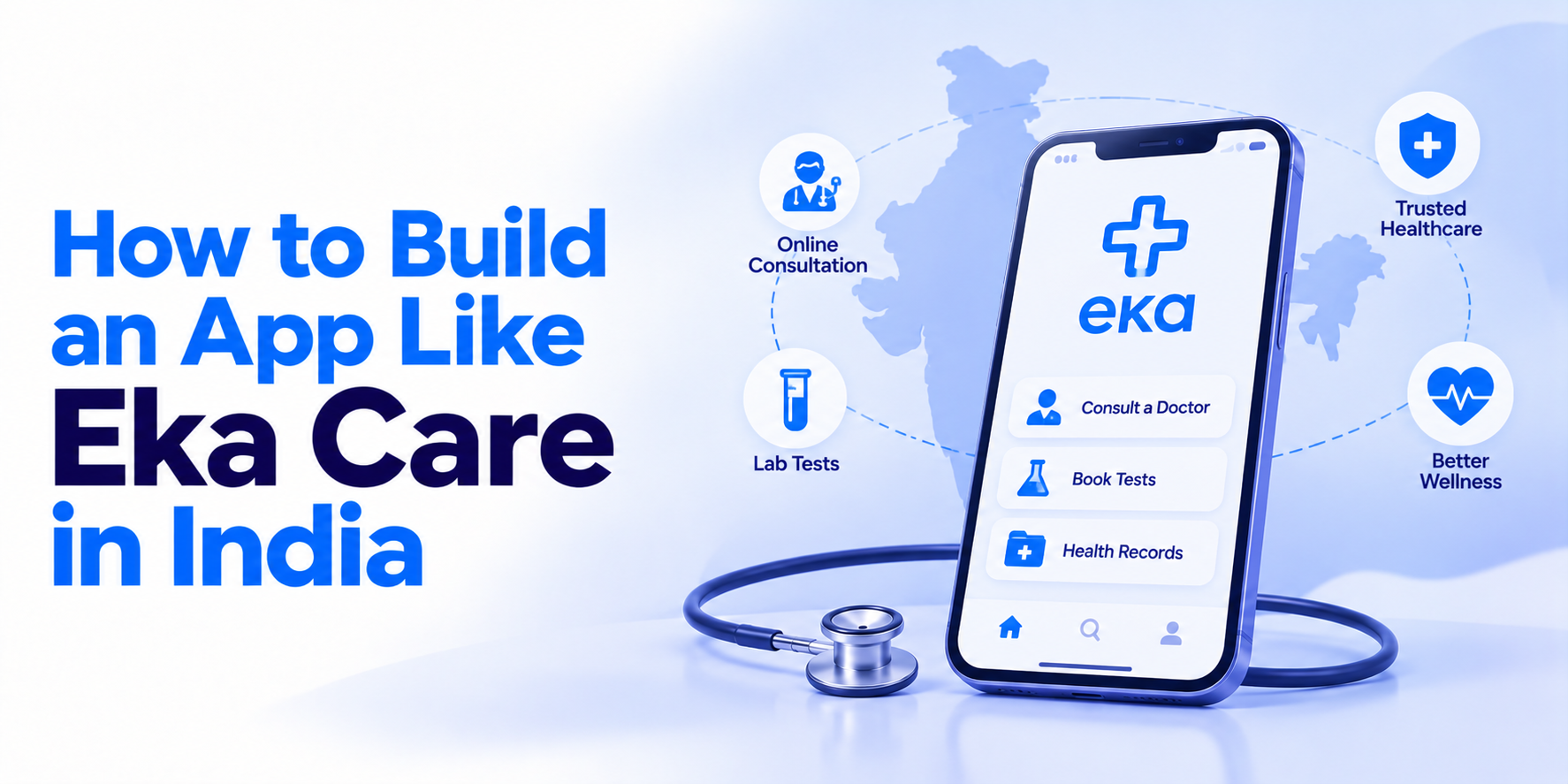
The temptation when you build an app like Eka Care is to copy the patient screens. That is the easy half. The reason Eka Care has data worth showing is that doctors use its clinic software every day, and those records flow straight into patient accounts.
Before you build an app like Eka Care, be clear about which problem it cracked.
Most Indian health data is not structured. It arrives as a photo of a prescription, a scanned discharge summary, or a lab PDF mailed from a diagnostic chain.
Eka Care built ingestion that reads those artifacts, extracts values, and files them against the right person. That capability, not the UI, is the moat.
Linking records to an Ayushman Bharat Health Account gave the app a national identity layer it did not have to invent. Records become portable instead of trapped inside one app.
Anyone who wants to build an app like Eka Care has to solve supply before demand. A patient app with no fresh data dies within months. Eka Care seeded supply by giving doctors a free, genuinely usable clinic tool, then let the records flow downstream.
Demand and infrastructure finally arrived together. India’s digital health market is estimated at $23.78 billion in 2026. It is projected to reach $90 billion by 2034 at an 18.06% CAGR (IMARC Group).
ABDM removed the hardest part of the problem. Identity, registries, and consent plumbing are national infrastructure now, so a startup no longer has to build them alone.
Insurers, employers, and hospital chains are also buying structured patient history, which gives a records app revenue that does not depend on consumer subscriptions.
Every serious plan to build an app like Eka Care involves two products, not one.
| Patient app | Clinic app | |
| Primary user | Individuals and families | Doctors and front desk |
| Core job | Store, read, and share records | Write prescriptions, bill, schedule |
| Data direction | Consumes | Produces |
| Monetization | Freemium, partner services | SaaS subscription |
| Why it matters | Retention | Supply of fresh records |
Teams that build an app like Eka Care and skip the clinic side end up with empty accounts. The consumer app is the storefront, while the doctor tool is the warehouse.
Most Indian practices already evaluate clinic management software development options, so the category is familiar to them.
This is the part of any plan to build an app like Eka Care that sets the real timeline.
ABDM certification runs through defined milestones. M1 covers ABHA creation and verification, M2 covers linking and fetching health records, and M3 covers acting as a Health Information Provider.
Each milestone has its own test cases and approval cycle. Most teams clear M1 quickly and then underestimate the data-sharing work in M2 and M3.
You register on the ABDM sandbox, build against test endpoints, pass milestone demos, and only then receive production credentials. Rushing this stage is the most common schedule failure in Indian healthtech builds.
Keep sandbox and production configurations fully separated. Mixed credentials cause failures that surface only after real patients are on the system.
Consent is the compliance core of any effort to build an app like Eka Care. The Health Information Exchange and Consent Manager governs who sees what, for how long, and for which purpose. Your app must request, store, honor, and expire consent artifacts correctly.
Getting this right requires a proper consent based data sharing architecture rather than a permissions flag on a user table.
Document parsing is where budgets to build an app like Eka Care quietly overrun. Reading an Indian lab report is harder than it looks. Formats differ by chain, units differ by lab, and reference ranges sit in inconsistent positions on the page.
A workable pipeline needs OCR, layout detection, test-name mapping to LOINC, unit normalization, and a confidence score. Anything below the confidence threshold goes to human review instead of silently entering the record.
Multilingual prescriptions add another layer. Handwriting, abbreviations, and regional drug brand names break naive extraction, which is where practical AI use cases in healthcare app development earn their keep.
The first call when you build an app like Eka Care is where to start narrow. Do not launch both products at once. Choose either a clinic specialty with heavy repeat visits, such as diabetology or pediatrics, or a records-heavy group like chronic care patients.
A narrow wedge makes parsing accuracy achievable, because one specialty uses a predictable set of tests, drugs, and formats. Broad launches produce mediocre extraction everywhere.
Define success as records created per active doctor per week. Downloads tell you nothing in this category.
Create a sandbox account, register your application, and build ABHA creation and verification first. Support both Aadhaar-based and mobile-based flows, since many users will not link Aadhaar.
Handle the failure paths properly. OTP timeouts, demographic mismatches, and duplicate accounts are routine, and poor recovery flows kill onboarding completion.
Keep the ABHA address concept visible to users, because people confuse the 14-digit number with the readable handle constantly.
Start with structured sources such as partner labs and your own clinic app before tackling scanned documents. Clean data first makes the messy cases easier to evaluate later.
Build ingestion as a queue with retries, versioning, and an audit trail. Patients will upload the same report three times, and duplicates must merge rather than stack.
Store the original file permanently alongside extracted values, since the source document is your defense in any clinical dispute.
Prescription writing, templates, scheduling, billing, and reports cover most daily needs. Speed matters more than feature count, because a doctor sees patients in six-minute slots.
Work offline-first. Clinic internet in Tier 2 and Tier 3 cities drops regularly, and an app that stalls mid-consultation gets abandoned that same day.
Teams planning this often compare approaches used by an EMR software development company in India before committing to a build.
Let patients share a record with a doctor through a link, a QR code, or an ABHA-linked request. Sharing is the behavior that converts storage into habit.
Add family profiles early. In Indian households, one person typically manages records for parents, a spouse, and children.
Then layer reminders for follow-ups, refills, and vaccinations, which is where medication tracking software patterns lift weekly retention sharply.
Keep sharing available over WhatsApp too, since that is where Indian patients already send reports to relatives and doctors.
Revenue design matters early when you build an app like Eka Care. Clinic SaaS subscriptions between Rs 500 and Rs 3,000 per doctor per month form the reliable base. Consumer payments stay weak, so treat the patient app as distribution rather than revenue.
Beyond that, diagnostics and pharmacy partnerships, insurer and corporate wellness contracts, and teleconsultation commissions carry most of the margin. Data sales are not an option under DPDP obligations.
| Scope | Timeline | Indicative cost |
| Patient app with ABHA, M1 and M2 | 4 to 5 months | Rs 25 to 45 lakh |
| Clinic EMR plus patient app | 7 to 9 months | Rs 60 lakh to Rs 1.2 crore |
| Full platform with parsing and analytics | 10 to 14 months | Rs 1.2 crore and above |
Parsing accuracy work continues indefinitely. Budget a standing data engineering cost rather than treating extraction as a one-time module.
Founders who want to build an app like Eka Care rarely need help with the idea. They need the unglamorous half: ABDM milestones, consent artifacts, parsing accuracy, and an EMR doctors tolerate.
EngineerBabu works as a healthcare software development company in India, covering ABDM-aligned builds, clinic software, mobile engineering, and data pipelines. Starting with a scoped wedge keeps the first release honest.
Not legally, but practically yes. Without ABHA linking, your records stay locked inside your own app and cannot be fetched from hospitals or shared across the national network that providers already use.
Plan for six to ten weeks across registration, milestone demonstrations, and production credentialing. Delays usually come from incomplete test coverage on your side rather than from the review process being slow.
It can, but retention suffers badly. Without a steady source of fresh records, users open the app once, upload a few old reports, and rarely return afterward unless something pulls them back.
The Digital Personal Data Protection Act sets consent, purpose limitation, and breach notification duties. ABDM policies add health-specific rules covering record linking, data sharing, and consent artifact handling across every connected system.
A first release typically needs eight to twelve people, covering mobile, backend, data engineering, design, and QA, plus one person owning ABDM certification from start to finish, including sandbox demos.
No. An ABHA can be created using a mobile number or other accepted identity routes, though Aadhaar-based creation is faster and reduces demographic mismatch errors considerably during the identity verification step.