How to Build an App Like Apple Health Records (USA)


Create engaging, high-performance mobile applications tailored to your business needs. We craft future-ready apps that offer smooth user experiences on all devices.
Build robust and scalable websites and CMS platforms that help you manage content effortlessly. Our development ensures a seamless digital presence.
Launch secure, feature-rich online stores with intuitive shopping experiences. We build tailored eCommerce platforms designed for growth.
Design captivating games with immersive gameplay and stunning graphics. From concept to launch, we build engaging experiences that players love.
Enhance your customer relationships with customized Salesforce implementations. Drive growth and efficiency with smarter CRM solutions.
Harness artificial intelligence and machine learning to automate workflows and gain actionable insights. Our AI transforms data into smart decisions.
Accelerate your software delivery lifecycle with continuous integration, delivery, and infrastructure automation to boost efficiency.

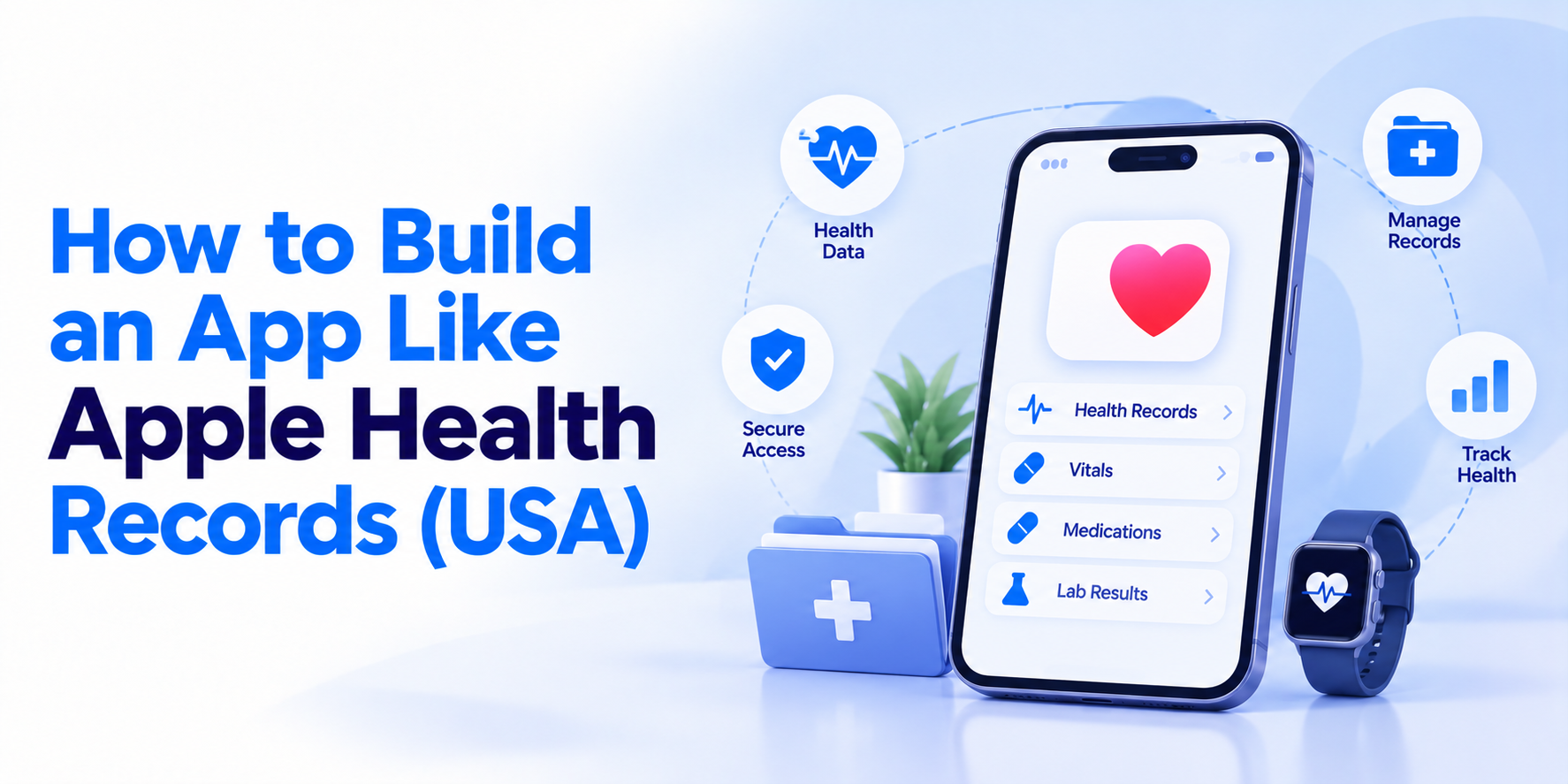
Apple did something unusual with Health Records. It did not build a medical record. It built a translator that quietly pulls your charts out of a dozen hospitals and stacks them in one timeline on your phone.
TL;DR
The reason to build an app like Apple Health Records is simple. Patient data is scattered across providers who have no commercial reason to consolidate it. Whoever assembles that scattered record owns the most useful screen in consumer health.
Nothing in Apple Health Records is authored by Apple. Allergies, conditions, immunizations, labs, medications, procedures, and vitals all arrive from provider systems through standardized endpoints.
That changes your roadmap. You are not designing clinical workflows. You are designing retrieval, reconciliation, and presentation of data someone else wrote.
Records sync to the iPhone and stay encrypted there, not in an Apple-controlled cloud. This single architectural choice removed most of the trust objections that killed earlier personal health record attempts.
The value shows up when three hospitals, two labs, and a pharmacy collapse into a single chronological view. Patients notice duplicates, gaps, and outdated medication lists for the first time.
Strip away the interface and the plan resolves into three systems.
Each provider connection requires registration, approval, and endpoint testing. Hundreds of connections mean hundreds of small onboarding projects, which is why competitors rarely catch up quickly.
The same lab test arrives with different codes, units, and names across systems. Without reconciliation logic, your timeline shows four versions of one cholesterol result.
Privacy is the actual promise in any decision to build an app like Apple Health Records. Users hand over their most sensitive data in exchange for convenience. Your storage, consent, and deletion design is the product promise, so treat it as engineering, not policy copy.
Personal health records moved from novelty to infrastructure once federal rules forced API access to patient data.
The global personal health record software market is projected to reach $53.32 billion in 2026. It should hit $120.87 billion by 2034 at a 10.77% CAGR (Fortune Business Insights).
North America holds roughly 39% of that spend. Most teams that build an app like Apple Health Records target US provider networks first.
Every serious attempt to build an app like Apple Health Records runs on the same handful of standards. FHIR R4 is the transport layer, and USCDI defines the minimum data classes providers must expose. SMART on FHIR handles the authorization dance between your app, the patient, and the hospital.
Legacy systems still push CDA documents and HL7 v2 feeds, so parsing older formats remains part of the job. A working view of HL7 vs FHIR saves weeks of confusion during scoping.
Plan your FHIR R4 integration around the resources patients actually care about. Observation, Condition, MedicationRequest, Immunization, AllergyIntolerance, and DiagnosticReport cover most consumer expectations.
Coverage beats features in this category. The first real decision when you build an app like Apple Health Records is which networks to chase. Start with health systems concentrated in one metro area, because patients see multiple providers within a single region.
Check which EHR vendor each system runs, since one Epic or Cerner integration pattern often unlocks several hospitals at once. Vendor-level reuse is the only way small teams reach meaningful coverage.
Document each system’s registration process, review timeline, and sandbox availability before promising launch dates. Approval cycles vary widely, and a single slow hospital can hold an entire release.
Patients authenticate with their provider credentials, not yours. Your app opens the hospital’s login page, receives an access token, and stores refresh tokens securely.
Token lifetimes differ by vendor, and expired tokens are the top cause of silent sync failures. Build proactive refresh plus clear reconnection prompts into the first release.
Never cache provider credentials. Storing them breaks vendor agreements and converts a manageable app into a serious breach target overnight.
Map incoming resources to an internal schema with consistent units, code systems, and timestamps. LOINC for labs and RxNorm for medications give you a stable backbone.
Deduplication needs rules, not guesses. Match on code, value, effective date, and performer, then surface near-duplicates rather than silently deleting clinical data.
Keep the raw payload alongside the normalized record. When a patient disputes a value, the original response is your only defensible answer.
Chronology alone is not insight. Show trends for repeated labs, flag out-of-range values, and surface medications that appear discontinued at one provider but active at another.
Avoid interpreting results clinically. Explanatory context is useful, while diagnostic conclusions push your product toward FDA oversight.
Layer in wearable device integration in healthcare once clinical records are stable, since device data is noisy and easily overwhelms the view.
Give users a way to hide categories they do not want to see, because mental health and sexual health records demand that control.
Privacy is last in sequence and first in user judgment when you build an app like Apple Health Records. Decide where records live before writing storage code. On-device storage maximizes trust, while cloud storage enables sharing, backup, and analytics.
If data leaves the device, you need encryption at rest, key management, access logging, and signed agreements with every subprocessor. The rules for a HIPAA compliant app apply the moment you touch identifiable records.
Ship account deletion that genuinely deletes. Consumer trust in this category is fragile, and one credible privacy complaint erases years of acquisition spend.
| Factor | On-device | Cloud |
| Trust narrative | Strongest | Needs active proof |
| Cross-device sync | Hard | Native |
| Sharing with family or doctors | Limited | Straightforward |
| Analytics and AI features | Very limited | Full |
| Compliance burden | Lower | Significant |
Most teams that build an app like Apple Health Records choose a hybrid. Records stay local by default, with explicit opt-in for encrypted cloud features and HIPAA compliant cloud storage behind that consent.
One risk sits under every plan to build an app like Apple Health Records: coverage decay. Hospitals migrate EHRs, change endpoints, rotate certificates, and deprecate API versions without telling third-party developers.
A connection that worked in March fails silently in September, and users blame your app rather than the hospital. Budget a permanent engineering allocation for connection health monitoring and automated endpoint testing.
This is the single largest reason small aggregators stall after a strong launch, and it rarely appears in early financial models.
Revenue is the weakest section in most plans to build an app like Apple Health Records. Consumer subscriptions rarely cover costs alone.
The patterns that hold up are B2B2C distribution through employers and payers, consented research recruitment, and care navigation layered on the record.
Selling identifiable data is not a model. It is a lawsuit and a product obituary.
A focused first version with 15 to 25 provider connections, normalization, and an on-device timeline generally runs $110,000 to $180,000 across five to seven months. Broad coverage, cloud sync, sharing, and analytics push a mature platform past $300,000.
Annual maintenance lands near 20 to 25% of build cost, weighted toward connection upkeep. Teams validating demand first often scope an MVP development for healthcare startups track before funding full coverage.
Most founders who want to build an app like Apple Health Records do not struggle with the idea. They struggle with FHIR edge cases, vendor approvals, and privacy architecture that survives a security review.
EngineerBabu works as a HIPAA compliant app development company for US healthcare teams, covering FHIR integration, iOS engineering, cloud security, and audit readiness. A scoped discovery sprint is usually enough to size the connection work honestly.
Yes. Providers expose patient data through standards-based FHIR APIs under federal access rules, so any approved developer can request the same records once the patient authorizes the connection through their own provider login.
Not for simply displaying records. Clearance questions begin when the app interprets values, suggests a diagnosis, or recommends treatment changes, because that behavior resembles clinical decision support under current FDA guidance.
Regional usefulness starts around 20 to 30 well-chosen systems. National credibility usually requires several hundred, which is why reusable EHR-vendor-level integration patterns matter far more than individual hospital deals negotiated one at a time.
Rarely. Most provider APIs grant read access only. Write scopes need separate approval, and hospitals grant them cautiously, inconsistently, and usually only for scheduling or messaging features rather than clinical data writes.
No. Provider APIs are open to approved developers under federal access rules, and Apple controls only its own application. You register directly with each individual health system you intend to support.
Not technically, but Android lacks a native health records framework comparable to Apple’s. You build more of the storage, encryption, and permission layer yourself on that platform before any records appear.