Healthcare Data Security Best Practices for App Developers


Create engaging, high-performance mobile applications tailored to your business needs. We craft future-ready apps that offer smooth user experiences on all devices.
Build robust and scalable websites and CMS platforms that help you manage content effortlessly. Our development ensures a seamless digital presence.
Launch secure, feature-rich online stores with intuitive shopping experiences. We build tailored eCommerce platforms designed for growth.
Design captivating games with immersive gameplay and stunning graphics. From concept to launch, we build engaging experiences that players love.
Enhance your customer relationships with customized Salesforce implementations. Drive growth and efficiency with smarter CRM solutions.
Harness artificial intelligence and machine learning to automate workflows and gain actionable insights. Our AI transforms data into smart decisions.
Accelerate your software delivery lifecycle with continuous integration, delivery, and infrastructure automation to boost efficiency.
Hire app developers ready to turn your ideas into sleek, high-performing mobile apps for any platform.
Bring in frontend pros who craft smooth, beautiful, and user-friendly interfaces that your visitors will love.
Get backend developers who build fast, secure, and reliable systems to keep everything running behind the scenes.
Hire eCommerce developers who build secure, scalable online stores designed to offer seamless shopping and grow your sales.
Get dedicated developers committed to your projects, delivering consistent quality and speed as an extension of your team.
A digital health founder once walked us through his patient portal. Clean interface, fast load times, a signed BAA sitting in his compliance folder. Then someone on the call changed the patient ID in the API URL and pulled up a stranger’s chart.
Nobody hacked anything. A number in a request was swapped, and the server handed over protected health information.
That app was encrypted end to end. What it lacked was an authorization check on the endpoint serving medical records. This is exactly why Healthcare Data Security Best Practices belong in your codebase, not just in a policy PDF nobody opens.
Healthcare breaches cost an average of $6.64 million in 2026, the highest of any industry for the thirteenth consecutive year, according to IBM’s Cost of a Data Breach Report. Most of that damage traces back to decisions made by developers long before an attacker showed up.
A stolen credit card gets canceled in an hour. A stolen medical record contains a name, date of birth, Social Security number, insurance ID, and diagnosis history. None of that can be reissued.
That permanence is why full health records sell for far more than payment card data on criminal markets. Attackers know it, and they know health apps often ship with startup-grade security and enterprise-grade data.
The other problem is surface area. A modern health app touches an EHR, a lab API, a pharmacy system, an analytics SDK, and a cloud database.
Every one of those connections is a place where patient data can leak, which is why Healthcare Data Security Best Practices have to cover integrations as seriously as they cover storage.
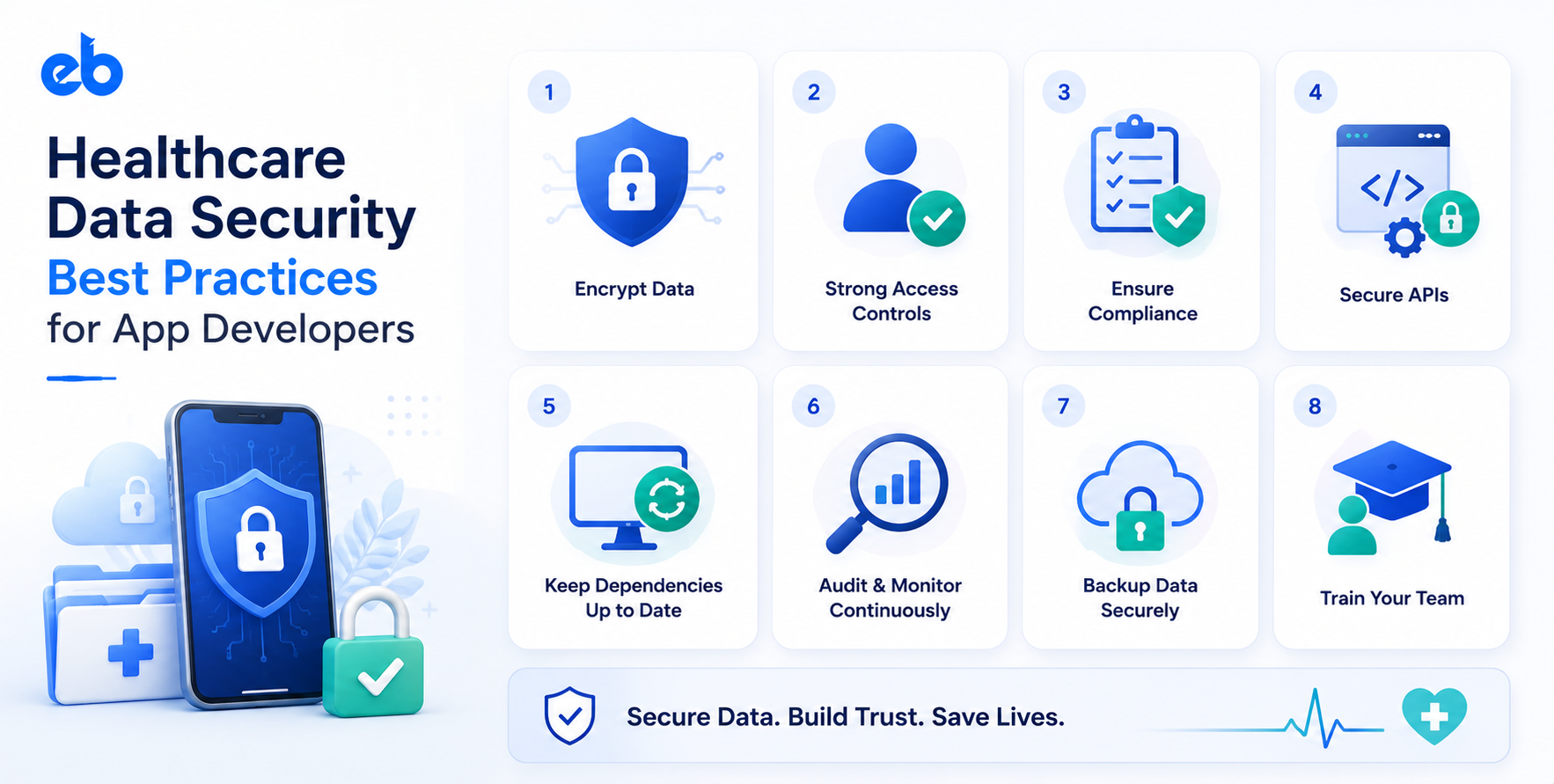
These Healthcare Data Security Best Practices are the controls that hold up under a real audit and a real attack.
TLS 1.2 or higher for everything in transit, AES-256 for everything at rest. That part is easy. What teams get wrong is key management.
Storing encryption keys in the same database, in environment files committed to Git, or hardcoded in the mobile binary makes the encryption decorative. Use a managed key service like AWS KMS or Azure Key Vault, rotate keys on a schedule, and keep key access logs separate from application logs.
Also encrypt database backups and any temporary files your processing pipeline writes to disk.
Authentication proves who the user is. Authorization decides what that specific user can see. Health apps break at the second step.
Before returning any record, verify that the requesting user has a treatment relationship, an ownership claim, or an explicit role permission for that exact record. Do this check server side on every request, including internal service calls.
Never rely on the client to hide data it should not have received. If your API returns a full patient object and the UI filters it, the data has already left your server.
Every field you store is a field you must protect, encrypt, log, back up, and eventually breach-notify on. Ask what your product actually requires.
Do you need a full Social Security number, or the last four digits for identity matching? Do you need date of birth, or just an age range for eligibility logic? Do you need to retain chat transcripts forever, or for ninety days?
Data minimization is the cheapest security control available. It also shrinks the blast radius when something does go wrong.
HIPAA requires you to know who accessed which record and when. Auditors will ask for this, and so will your incident response team.
Log the user ID, patient ID, action, timestamp, and source IP for every read and write involving PHI. Ship those logs to append-only storage that application credentials cannot modify or delete.
Then set alerts on the patterns that matter. A clinician account pulling four hundred records at 3 a.m. should page someone, not sit in a dashboard until Monday.
APIs are where most health data actually moves, and where most of it leaks. Treat every endpoint as internet-facing, even the ones you assume are private.
Enforce short-lived access tokens, rate limits per user rather than per IP, and strict input validation on every parameter. Return generic error messages so responses do not confirm whether a patient record exists.
Teams building API Development for clinical integrations should also version endpoints deliberately, since a deprecated route left running is an unmonitored door into your data.
Mobile devices get lost, rooted, shared, and backed up to personal cloud accounts. Design as if yours will be.
Never cache PHI in plain text, in shared preferences, or in screenshots the OS takes during app switching. Store tokens in the iOS Keychain or Android Keystore, add certificate pinning, and disable verbose logging in production builds.
Solid Mobile App Development for healthcare also includes remote session revocation, so a lost device stops being a live entry point within minutes.
That analytics SDK you added in week two may be transmitting screen names, user IDs, and device identifiers to a vendor with no BAA in place. Regulators have treated that as a reportable disclosure.
Inventory every SDK, library, and vendor that can observe PHI. Confirm each one signs a business associate agreement, and strip PHI from anything sent to tools that do not. Scan dependencies continuously, because an unpatched library is a common route into health systems.
Most breaches trace back to a small set of repeated mistakes.
None of these require sophistication to fix. They are Healthcare Data Security Best Practices that simply need an owner before launch.
Compliance frameworks and Healthcare Data Security Best Practices overlap, but they are not the same thing. HIPAA tells you what to document. It does not tell you how to write a secure query.
Passing a compliance review while shipping an insecure endpoint happens constantly, because the two are measured differently.
Treat the HIPAA Security Rule as your baseline and layer real engineering practice on top. If you sell to hospitals or payers, expect procurement to ask for SOC 2 Type II or HITRUST as well.
Start that work early. Retrofitting evidence collection, access reviews, and change management into a live product costs far more than building it in.
AI features have quietly become the biggest new risk surface in health apps, and Healthcare Data Security Best Practices now have to cover model inputs and outputs too.
A summarization feature that sends clinical notes to a general purpose model may be disclosing PHI to a vendor with no agreement covering it.
Before any patient data reaches a model, confirm the provider will sign a BAA and contractually excludes your data from training. De-identify inputs wherever the feature still works without identifiers.
Teams doing AI Development for clinical products should also log prompts and outputs as PHI, since both routinely contain it. For custom risk scoring or triage models, ML Development needs the same access controls as your production database, plus documented guardrails on what the model is allowed to return.
Healthcare Data Security Best Practices work best inside your definition of done. Security added at the end of a project is expensive and usually incomplete.
Threat model each feature during design by asking who could reach this data and how. Add automated dependency and secret scanning to CI so problems surface in pull requests. Require security review on any code touching authentication, authorization, or PHI storage.
Book an external penetration test before your first enterprise customer asks for one. Even at the MVP Development stage, the core controls of encryption, authorization, and audit logging should already be in place. Everything else can iterate. These cannot.
Healthcare Data Security Best Practices are not a phase you complete before launch. They are a set of engineering habits your team applies to every endpoint, every SDK, and every new AI feature.
The teams that avoid becoming a breach statistic tend to do ordinary things consistently. They minimize what they collect, check authorization on every object, log access immutably, and vet every vendor touching patient data.
If you are building a health product and want those controls designed in rather than bolted on, working with a partner experienced in HIPAA-grade engineering makes the path considerably shorter.
Object-level authorization, proper encryption with managed keys, strict data minimization, immutable audit logging, and vendor controls covering every SDK that can observe patient data.
No. HIPAA sets administrative and documentation requirements, while Healthcare Data Security Best Practices govern how the code behaves. An app can satisfy those and still expose records through a missing authorization check or a leaky third-party SDK.
Not safely. Staging environments rarely match production controls. Use synthetic or properly de-identified datasets, and treat any environment holding real PHI as production.
Sign a BAA with the provider, confirm your data is excluded from training, de-identify inputs where possible, and log prompts and responses as protected health information.
Built in from the start, they typically add a modest percentage to the build. Retrofitted after a failed audit or a breach, the cost is many times higher.