How Much Does It Cost to Build an App in Mumbai?


Create engaging, high-performance mobile applications tailored to your business needs. We craft future-ready apps that offer smooth user experiences on all devices.
Build robust and scalable websites and CMS platforms that help you manage content effortlessly. Our development ensures a seamless digital presence.
Launch secure, feature-rich online stores with intuitive shopping experiences. We build tailored eCommerce platforms designed for growth.
Design captivating games with immersive gameplay and stunning graphics. From concept to launch, we build engaging experiences that players love.
Enhance your customer relationships with customized Salesforce implementations. Drive growth and efficiency with smarter CRM solutions.
Harness artificial intelligence and machine learning to automate workflows and gain actionable insights. Our AI transforms data into smart decisions.
Accelerate your software delivery lifecycle with continuous integration, delivery, and infrastructure automation to boost efficiency.
Hire app developers ready to turn your ideas into sleek, high-performing mobile apps for any platform.
Bring in frontend pros who craft smooth, beautiful, and user-friendly interfaces that your visitors will love.
Get backend developers who build fast, secure, and reliable systems to keep everything running behind the scenes.
Hire eCommerce developers who build secure, scalable online stores designed to offer seamless shopping and grow your sales.
Get dedicated developers committed to your projects, delivering consistent quality and speed as an extension of your team.
The cost to build an app in Mumbai ranges from about ₹6 lakh for a lean single-platform build to ₹1 crore and above for a regulated fintech or marketplace platform.
Rates in the city run higher than the rest of India because Mumbai concentrates BFSI clients, senior engineering talent, and expensive commercial real estate in one place.
Demand explains the pressure on pricing. India recorded 25.5 billion app downloads in 2025, up from 24.6 billion the year before, and time spent in apps climbed to 1.23 trillion hours (Sensor Tower data via TechCrunch). Mumbai founders are building for that audience, and vendor quotes reflect it.
This guide breaks the number down by complexity, by stage, and by the specific things that inflate budgets in this city.
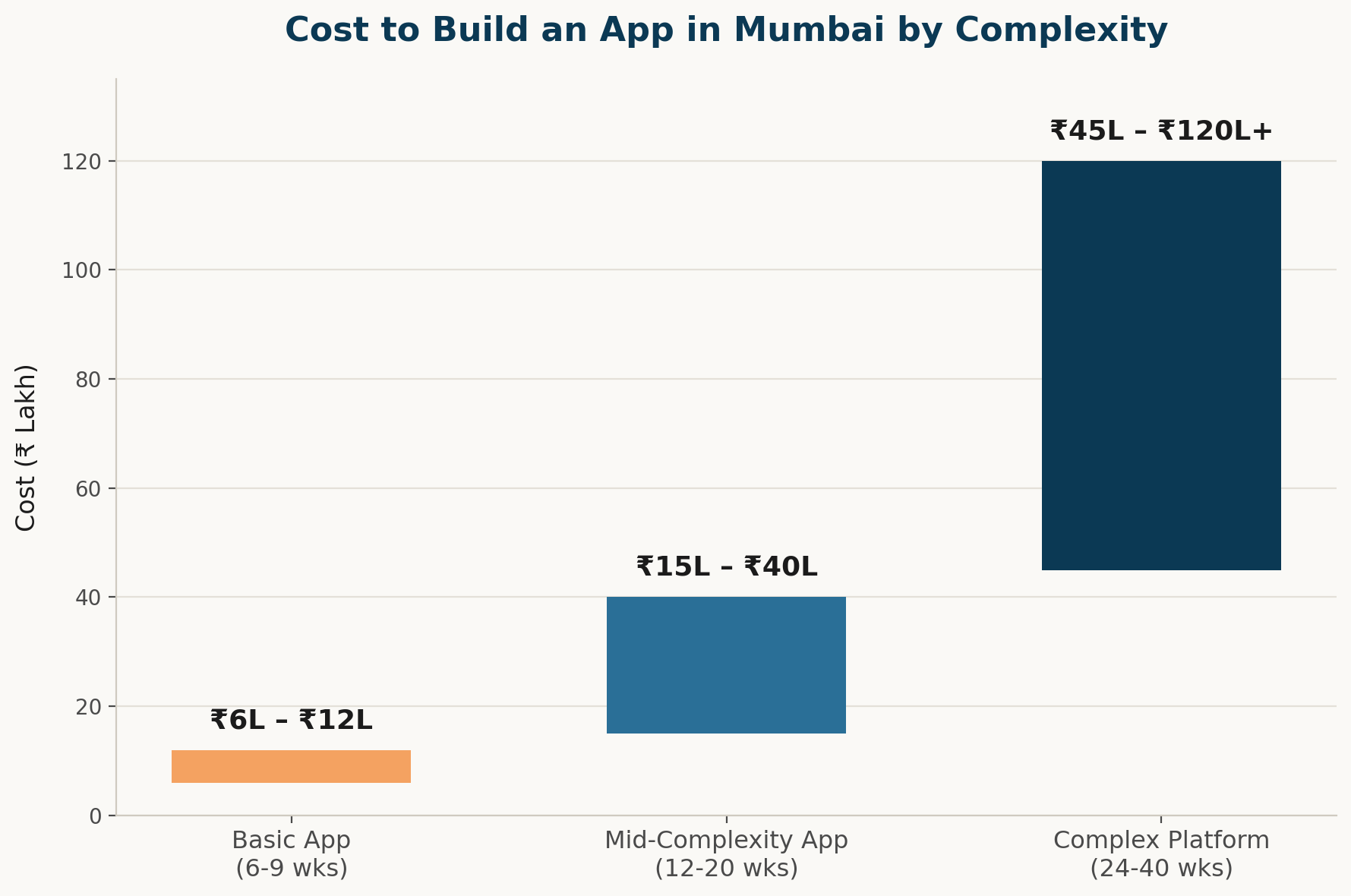
Complexity, not screen count, decides the bracket you land in. Here is what current Mumbai market pricing looks like.
| App type | What it includes | Cost (INR) | Cost (USD) | Timeline |
| Basic app | 6 to 10 screens, static content, no custom backend | ₹6L to ₹12L | $7K to $14K | 6 to 9 weeks |
| Mid-complexity app | Login, payments, push, admin panel, third-party APIs | ₹15L to ₹40L | $17K to $45K | 12 to 20 weeks |
| Complex platform | Real-time data, AI features, multi-role access, audit trails | ₹45L to ₹1.2Cr+ | $50K to $135K+ | 24 to 40 weeks |
Most funded Mumbai startups land in the middle row. A D2C commerce app, a doctor booking app, or a driver-partner app almost always sits there once payments and notifications are added.
Four decisions account for most of the variance between quotes for the same idea.
Two native codebases cost 60 to 80% more than one Flutter or React Native build. Native iOS and Android mobile app development makes sense for camera-heavy, offline, or hardware-linked products. For a first commercial version aimed at Indian users, cross-platform usually delivers the same experience for less.
Each integration adds development plus testing time. UPI and card gateways, Aadhaar or PAN verification, CRM sync, logistics tracking, and WhatsApp notifications all stack up. Solid API development work on the payment and KYC layer alone can consume 15 to 20% of the build.
A template-driven UI costs a fraction of a custom design system with motion, illustration, and a design library. Mumbai consumer apps competing with Zepto or CRED get benchmarked against that polish, which pushes design spend up.
A ₹1,500 per hour team and a ₹3,000 per hour team can quote the same total. The difference shows up in architecture decisions that either survive your first traffic spike or force a rebuild.
Location changes the hourly rate more than it changes the code. These are typical blended rates for app development work.
| Team type | Hourly rate | Notes |
| Mumbai full-service agency | ₹1,500 to ₹3,000 | Highest overheads, strongest BFSI exposure |
| Bengaluru agency | ₹1,400 to ₹3,200 | Deep product and AI talent pool |
| Pune studio | ₹1,000 to ₹2,200 | Common overflow choice for Mumbai founders |
| Tier-2 partner (Indore, Jaipur, Coimbatore) | ₹800 to ₹1,800 | Same output at 30 to 40% lower cost |
| Independent freelancer | ₹600 to ₹1,500 | Cheapest, weakest on QA and continuity |
For perspective, US agencies bill $100 to $200 an hour, which is why so many mobile app development companies in the States run delivery from India. Many Mumbai founders now do the same in reverse.
They keep product ownership in BKC or Lower Parel and run engineering from a partner in a lower-cost city.
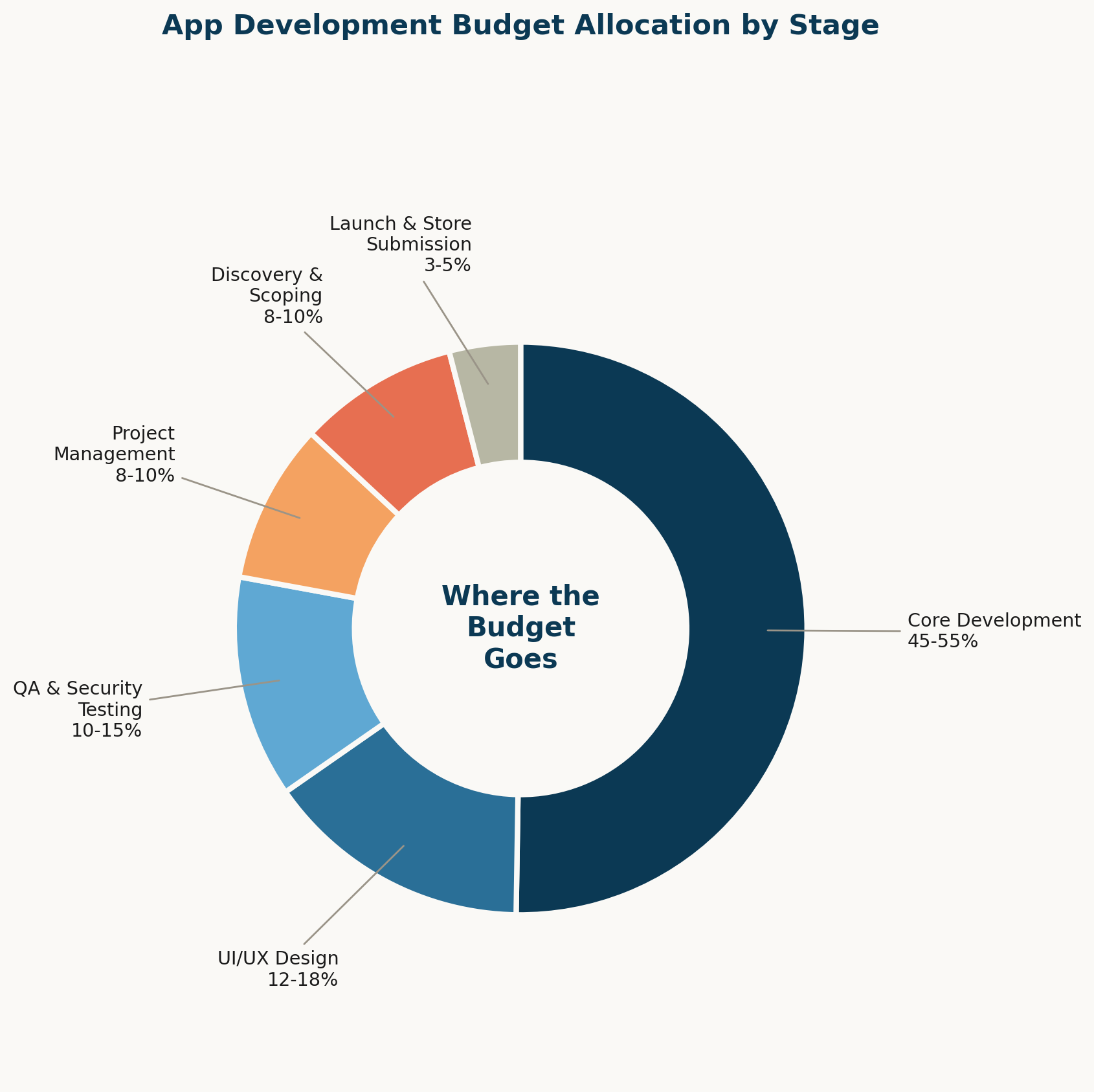
Ask any vendor to split the quote by stage. A single lump sum hides the tradeoffs you most need to see.
| Stage | Share of budget | Typical duration |
| Discovery and scoping | 8 to 10% | 1 to 2 weeks |
| UI/UX design | 12 to 18% | 2 to 4 weeks |
| Core development | 45 to 55% | 8 to 16 weeks |
| QA and security testing | 10 to 15% | Runs parallel, plus 2 weeks |
| Project management | 8 to 10% | Full project |
| Launch and store submission | 3 to 5% | 1 week |
Discovery looks like the easiest line to delete. It is also the stage that prevents the mid-build scope fight that adds lakhs to the final invoice.
Some cost pressures are local. They show up repeatedly in quotes from this city and rarely in quotes from smaller markets.
AI has stopped being a differentiator and become a line item. Adding a support chatbot, a recommendation feed, or document extraction through AI development typically raises the base build cost by 20 to 40%.
Two things drive that. First, prompt design, guardrails, and evaluation need engineering time that traditional features do not. Second, inference is a recurring bill, not a one-time cost. A moderately used assistant can run ₹25,000 to ₹1.5 lakh a month in model and infrastructure charges.
Custom models cost more again. If you need a credit risk score or a demand forecast trained on your own data, ML development work adds four to ten weeks and a data pipeline you have to maintain.
Scope to the one workflow that proves people want this. A focused MVP development build usually costs 40 to 55% less than a full launch and reaches users months earlier. You then spend the remaining budget on features your data supports rather than features from a planning document. Founders who skip this step commonly pay twice, once to build assumptions and again to remove them.
Check your own analytics before splitting the budget across iOS and Android. If 85% of your web traffic is Android, launch Android and follow with iOS after retention holds. This single decision often saves ₹8 lakh to ₹15 lakh on a mid-complexity build. Cross-platform frameworks give you a middle path, with one codebase serving both stores at close to single-platform cost.
Authentication, payments, notifications, chat, and analytics all have mature providers. Building any of them in-house adds weeks and creates code you must maintain forever. Integrating Razorpay, Firebase, or a KYC vendor costs a fraction of custom work and comes with compliance already handled. Reserve custom engineering for the logic that makes your product different from every competitor in your category.
Lock the feature list, acceptance criteria, and change process before development starts. Ambiguity is what turns a ₹20 lakh quote into a ₹32 lakh invoice. Ask for a written change-request rate, a milestone schedule, and named engineers on the project. Also confirm who owns the repository and the design files. Clear paperwork costs nothing and removes the most expensive category of surprise from any build.
The build budget is not the whole number. Plan for these from month one.
The cost to build an app in Mumbai is a range, not a price, and the range narrows only after your feature list is specific. Two quotes that differ by ₹15 lakh usually differ in what they assume about compliance, testing, and who writes the code.
Get every proposal split by stage, ask which engineers are assigned, and confirm what happens after launch. Founders who do that stay near their original budget. Founders who accept a single number rarely do.
Most projects land between ₹15 lakh and ₹40 lakh. Basic apps start near ₹6 lakh, while regulated fintech or marketplace platforms cross ₹1 crore.
Tier-2 partners typically cost 30 to 40% less per hour for comparable output. Many Mumbai founders keep product strategy local and place engineering elsewhere.
A basic app takes 6 to 9 weeks. Mid-complexity apps run 12 to 20 weeks, and enterprise platforms need 24 weeks or more including testing.
Yes. A well-scoped MVP generally costs 40 to 55% less because it ships one core workflow instead of an entire roadmap.
Plan 15 to 20% of your development cost each year, plus hosting and usage-based API charges. Ignoring this line is the most common budgeting mistake.