How to Build an App Like Park+ in India: Features, Stack, Cost


Create engaging, high-performance mobile applications tailored to your business needs. We craft future-ready apps that offer smooth user experiences on all devices.
Build robust and scalable websites and CMS platforms that help you manage content effortlessly. Our development ensures a seamless digital presence.
Launch secure, feature-rich online stores with intuitive shopping experiences. We build tailored eCommerce platforms designed for growth.
Design captivating games with immersive gameplay and stunning graphics. From concept to launch, we build engaging experiences that players love.
Enhance your customer relationships with customized Salesforce implementations. Drive growth and efficiency with smarter CRM solutions.
Harness artificial intelligence and machine learning to automate workflows and gain actionable insights. Our AI transforms data into smart decisions.
Accelerate your software delivery lifecycle with continuous integration, delivery, and infrastructure automation to boost efficiency.
Hire app developers ready to turn your ideas into sleek, high-performing mobile apps for any platform.
Bring in frontend pros who craft smooth, beautiful, and user-friendly interfaces that your visitors will love.
Get backend developers who build fast, secure, and reliable systems to keep everything running behind the scenes.
Hire eCommerce developers who build secure, scalable online stores designed to offer seamless shopping and grow your sales.
Get dedicated developers committed to your projects, delivering consistent quality and speed as an extension of your team.
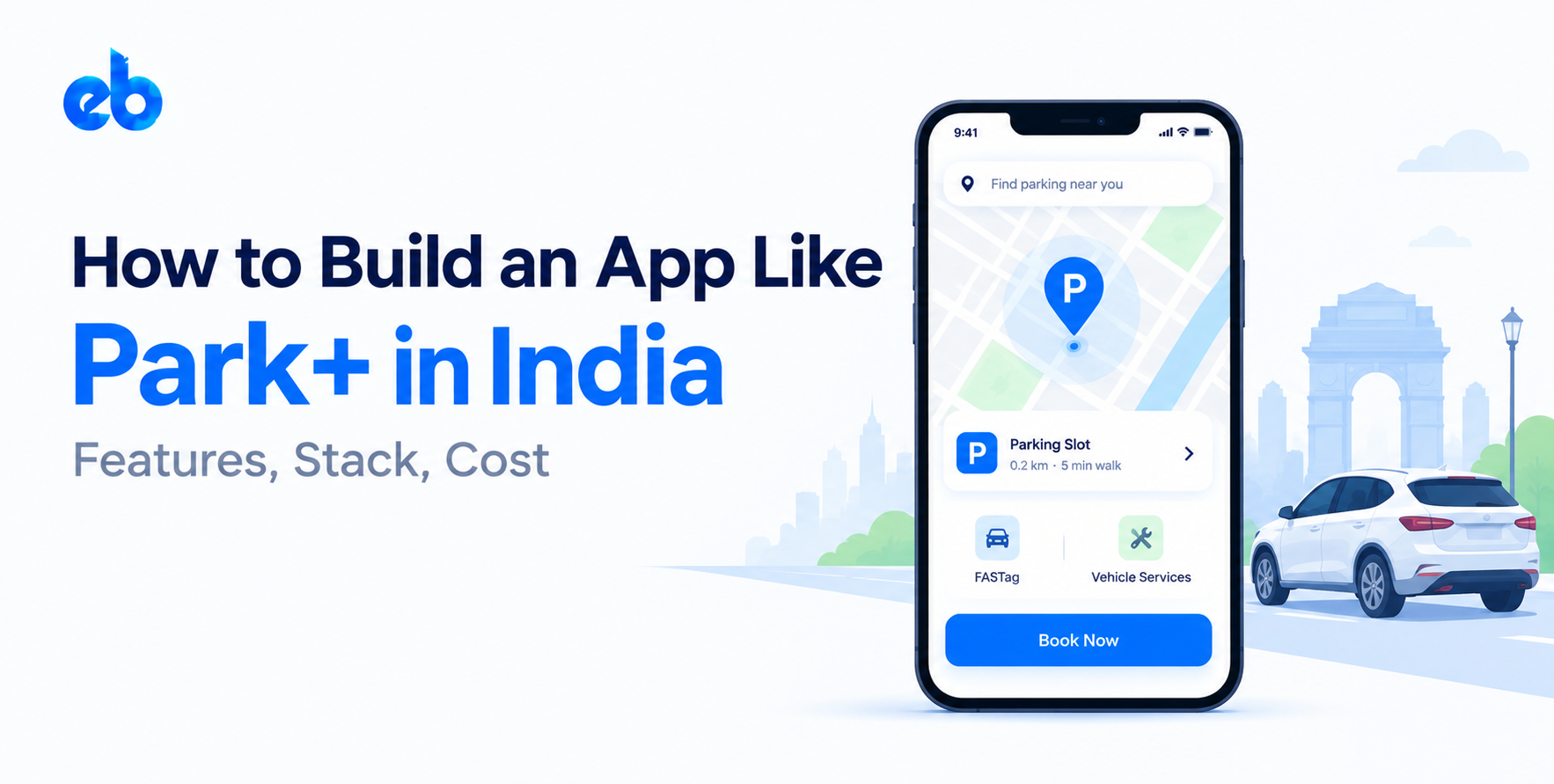
A car owner in Gurugram opens Park+ to find a slot at a mall. Three weeks later, the same person is recharging FASTag, checking a pending challan, and booking a car wash inside that app.
That is the whole trick. Parking gets people in. Everything after it is what pays.
So if you want to build an app like Park+, understand what you are actually copying. You are not building a map with pins on it. You are building a car ownership account, where parking is the cheapest way to open one.
To build an app like Park+, you need four systems working together: a real parking inventory network, a payments and FASTag layer, integrations with government vehicle databases, and a services marketplace layered on top. Most founders budget carefully for the app and badly underestimate the first and third.
Indian cities added cars far faster than they added organized parking. That gap is the product.
Municipal bodies are now pushing structured, digital parking to cut roadside chaos and make revenue traceable. The India smart parking systems market is projected to reach USD 948.0 Million by 2034, growing at a CAGR of 12.16% from 2026 to 2034, according to IMARC Group (source).
But here is the part that matters commercially. Parking alone is a thin-margin business with messy cash collection. Park+ solved that by treating the app as an online service marketplace for car owners, where each new service reuses the same verified vehicle profile.
That vehicle number is the account. Once you have it, every other service becomes a low-cost cross-sell.
This is the layer everyone pictures and the one that is hardest to fake. You need real slots, real availability, and real pricing from mall operators, societies, and civic parking lots.
Detection works through operator-entered counts, boom-barrier sensors, or camera-based ANPR at entry. Live availability, geofencing for arrival detection, and advance booking with a QR or FASTag-based entry pass complete the loop.
Payments are not a checkout screen here. They are a rail that has to handle prepaid wallets, UPI, cards, and FASTag deductions at barriers.
FASTag distribution and recharge need a bank or NPCI-authorized partner, which is a commercial conversation before it is a technical one. Your API development work then wraps those partner endpoints so the app never talks to a bank directly.
Challan status, RTO owner details, PUC validity, and insurance expiry come from Parivahan and state transport sources, usually through licensed aggregators.
These feeds are slow, inconsistent, and occasionally down. Cache aggressively, show a last-updated timestamp, and never let a stale record trigger a payment.
Car wash, servicing, insurance renewal, fuel vouchers, EV charging, used-car listings. Each is a partner network with its own SLA, commission, and support burden.
This layer behaves exactly like on-demand services logistics, so build it only after the first three are stable.
Feature bloat kills these products. Split the build by who is using it.
For car owners
For parking operators
For your admin team
The consumer side lives or dies on speed. A driver deciding at a mall gate gives you about eight seconds, which is why UI/UX design here should be measured in taps, not screens.
| Layer | Practical choice |
| Mobile app | Flutter or React Native for a single codebase |
| Backend | Node.js or Go, service-oriented from day one |
| Database | PostgreSQL with PostGIS for slot geo-queries |
| Caching and queues | Redis, Kafka or SQS for webhook events |
| Maps | Google Maps Platform or MapmyIndia for India coverage |
| Payments | Razorpay or Cashfree, plus a FASTag issuer partner |
| Vehicle data | Licensed Parivahan and challan aggregators |
| Infra | AWS or GCP, autoscaled around evening and weekend peaks |
Cross-platform is the same default for this product. A Flutter build keeps parity between iOS and Android while you are still changing the booking flow every fortnight.
Go native only if ANPR camera work or deep Bluetooth barrier integration becomes core, and read the native vs cross-platform trade-offs before committing either way.
Do not launch nationally. Pick a single city and one anchor use case, usually mall or corporate park parking, where you can sign ten to fifteen locations yourself.
Walk those locations. Learn how the guard actually collects cash, where the barrier sits, and who owns the billing relationship. That fieldwork shapes your data model more than any competitor teardown will.
Then scope it as an MVP with booking, payment, and entry, nothing else. Your only goal in this phase is proving a driver will pre-book instead of circling.
Supply is the moat and the bottleneck. Mall and society operators care about two things: guaranteed settlement and zero disruption to their existing gate process.
Offer a revenue share, a daily reconciliation report, and an offline fallback if your app is down. Get signed terms, slot counts, and peak-hour pricing in writing.
Real inventory from twelve locations beats scraped listings from two hundred. Skip this step and your launch looks like a directory, not a booking product.
Everything in the app hangs off one registration number. Model it properly: vehicle, owner, documents, payment instruments, and service history as linked records.
Fetch RTO details once and store them with field-level encryption, since you are holding owner name, chassis data, and payment tokens together.
Get this right and adding insurance or car wash later takes weeks. Get it wrong and every new service needs its own onboarding flow, which is exactly how these apps get bloated.
Build the wallet, UPI autopay mandate, and FASTag deduction flow as one state machine. Track every transaction through initiated, authorized, settled, failed, and refunded.
Failed exits are the real risk. If a barrier opens but the deduction fails, you owe the operator money and the driver owes you nothing.
Design that reconciliation before launch. Run the whole thing on infrastructure sized for peaks, because cloud scalability matters most at 8 PM on a Saturday.
Simulators will not catch a barrier that opens two seconds late or a basement with no signal. Run field tests at every launch location, at peak and off-peak hours.
Check offline booking retrieval, QR scan failures, duplicate entry attempts, and wrong-plate reads from ANPR.
Formal application testing should cover payment reversals and partner API timeouts specifically. Those two failure modes cause most refund tickets in the first month.
Once bookings are steady, layer in FASTag recharge or challan lookup. Both reuse the vehicle profile, so acquisition cost is close to zero.
Measure whether parking users actually convert. If they do not, your account layer is not sticky yet, and adding a third service will not fix that.
Only then open the services marketplace, one category at a time, with one partner per city.
| Scope | What it includes | Indicative cost |
| MVP, one city | Booking, payments, vehicle profile, basic admin | ₹25L to ₹45L |
| Growth build | FASTag, challan, operator dashboard, autopay | ₹50L to ₹80L |
| Full super app | Marketplace, EV charging, insurance, ANPR, B2B access control | ₹90L to ₹1.2Cr+ |
Two costs sit outside the build and surprise people. Licensed vehicle data access carries per-call fees, and hardware at operator sites needs capex or a leasing arrangement.
Running costs are real too. Budget 15 to 20% of build cost annually for support, partner API fees, and updates, which tracks with typical mobile app development cost patterns for transactional products.
The B2B line deserves attention. Selling access control to a thousand societies produces steadier revenue than chasing consumer bookings one slot at a time.
Skip the chatbot. The useful applications are narrower.
Demand forecasting per location lets you price dynamically instead of flat-rating a mall basement all day. ANPR accuracy improves with a model trained on Indian plate formats, which vary far more than vendors assume.
Churn and renewal prediction also works well here, since predictive analytics in mobile apps can flag an insurance expiry 45 days out and time the nudge.
Teams that build an app like Park+ usually stumble on sequencing, not on code. The engineering problem is coordination between partner APIs, hardware at the gate, and a payments ledger that has to reconcile daily.
EngineerBabu’s mobile app development services cover that full path, from the vehicle-profile data model through payment integrations and operator dashboards. If you are still shortlisting partners, this buyer’s checklist is a practical place to start.
The decision to build an app like Park+ is really a decision about what you own. If you own parking supply and a verified vehicle account, every additional service is cheap to add.
If you own neither, you have built a search box competing with Google Maps.
Start with one city, fifteen signed locations, and one revenue line that settles cleanly. The super app comes later, and only if the first layer actually holds.
An MVP with booking, payments, and vehicle profiles takes around 4 to 6 months. A full multi-service version with FASTag, challans, and a marketplace usually runs 10 to 14 months, plus partner onboarding time that happens in parallel.
FASTag distribution requires a partnership with an NPCI-authorized issuing bank. Challan and RTO data must come from licensed aggregators, not scraping. Wallet or payment handling requires an RBI-compliant payment partner rather than in-house custody of funds.
Yes. Park+ aggregates rather than owns. You sign revenue-share agreements with malls, societies, and civic operators, then run booking and settlement on their behalf.
Not at launch. Many operators still use QR or boom barriers with app-based checkout. FASTag becomes valuable once you want contactless entry and a second recharge revenue line.
Payment and gate-state mismatch. A barrier opening without a confirmed deduction creates revenue leakage and operator disputes, so the reconciliation logic needs to be built before launch, not patched after.
B2B access control for societies and corporate parks often generates revenue faster and builds parking supply at the same time. Many teams use it to fund the consumer side.