What is a Loan Origination System? Complete Guide to Building One in 2026


Create engaging, high-performance mobile applications tailored to your business needs. We craft future-ready apps that offer smooth user experiences on all devices.
Build robust and scalable websites and CMS platforms that help you manage content effortlessly. Our development ensures a seamless digital presence.
Launch secure, feature-rich online stores with intuitive shopping experiences. We build tailored eCommerce platforms designed for growth.
Design captivating games with immersive gameplay and stunning graphics. From concept to launch, we build engaging experiences that players love.
Enhance your customer relationships with customized Salesforce implementations. Drive growth and efficiency with smarter CRM solutions.
Harness artificial intelligence and machine learning to automate workflows and gain actionable insights. Our AI transforms data into smart decisions.
Accelerate your software delivery lifecycle with continuous integration, delivery, and infrastructure automation to boost efficiency.
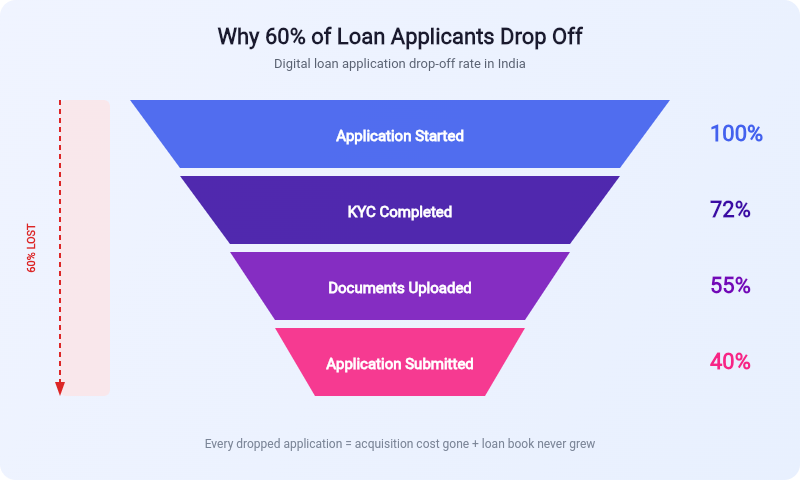
Digital loan application drop-off rates in India exceed 60%.
Six out of every ten borrowers who start an application don’t finish it. Not because they don’t need the loan. Because the process was too slow, too frustrating, or asked them to do something twice that a smarter system would have done automatically.
Every dropped application is a borrower you paid to acquire through marketing, through your DSA network, through your field team who never became a loan. The acquisition cost is gone. The loan book never grew.
The Loan Origination System is where that 60% is won back or lost permanently.
I co-founded EngineerBabu 14 years ago. The team has built loan origination systems for lenders at every scale from an early salary advance platform that became one of India’s first to disburse over ₹10,000 crore, to LoanOS, the team’s own modular lending platform currently processing ₹1,000 crore annually through a live DSA.
The CTO spent 17 years at Wishfin one of India’s largest credit marketplaces building the bureau integrations, underwriting engines, and KYC workflows that determine whether a borrower gets a decision in 4 minutes or 4 days. That 4-minute vs. 4-day gap is an LOS architecture decision. And it is made once, in the first 6 weeks of a build.
This guide covers both what a Loan Origination System is and what it takes to build one that works at scale.
If you already know you need a custom LOS built – email mayank@engineerbabu.com.
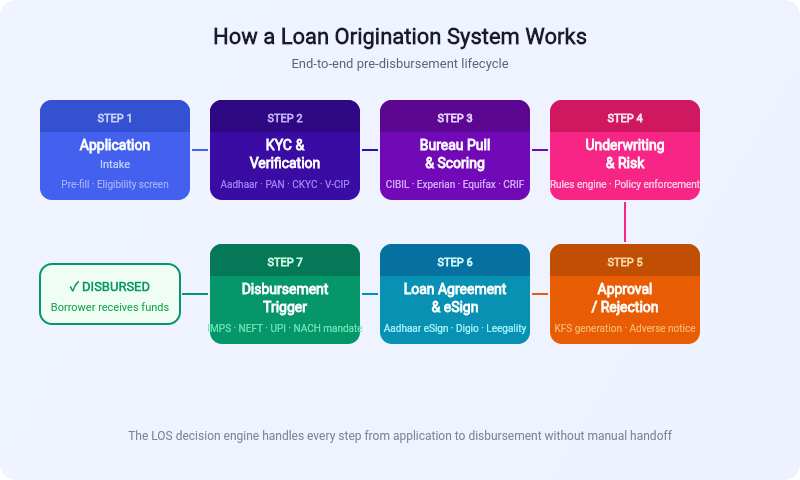
A Loan Origination System (LOS) is a software platform that manages the complete pre-disbursement lifecycle of a loan – from the moment a borrower submits an application through KYC verification, document collection, credit assessment, underwriting, approval, and final disbursement.
Think of it as the decision engine for your lending operation. Before a single rupee reaches a borrower, the LOS has already evaluated their identity, verified their income, assessed their creditworthiness, applied your credit policy, generated a loan offer, and triggered the disbursement instruction.
The global loan origination software market is projected to reach $12.2 billion by 2032. In India, the LOS market is growing even faster as NBFCs, DSAs, and fintech lenders replace manual origination with automated digital workflows.
A well-built LOS does not just digitize the paperwork. It enforces consistent credit policy across every application, reduces turnaround time from days to hours, creates a full audit trail that satisfies RBI inspection requirements, and connects the borrower’s journey seamlessly from application to disbursement without a single manual handoff.
A poorly-built LOS creates a new set of problems: KYC failures that block good borrowers, bureau integrations that time out under load, underwriting rules that can’t be changed without a developer, and compliance gaps discovered during an inspection rather than during development.
The difference between these two outcomes is almost entirely architecture decisions made in the first 8 weeks of the project.
Understanding the workflow reveals where the engineering complexity lives and where most LOS implementations quietly fail.
The borrower submits an application through a web form, mobile app, or branch interface. The LOS captures personal details, income information, loan purpose, and employment status in a structured format.
A well-built intake layer does three things simultaneously that most implementations treat as sequential: it pre-fills data from existing records (returning borrowers shouldn’t re-enter what you already know), it validates fields in real time so incomplete data gets caught before it wastes anyone’s time, and it applies initial eligibility screening so a borrower who categorically doesn’t qualify is told immediately rather than after completing a 20-minute application.
That last point matters more than it seems. Showing a borrower a clean rejection with a reason at Step 1 preserves their dignity and your cost. Letting them complete a full application and then rejecting them 48 hours later is expensive operationally and damaging reputationally.
Once the application is received, the LOS triggers a document checklist based on the loan type and borrower profile. The borrower uploads identity proofs, income statements, bank statements, and any other required files.
Production KYC in 2026 for an Indian lender:
Aadhaar eKYC (UIDAI API) – OTP-based Aadhaar verification pulls name, address, and photograph directly from UIDAI. No document upload required for Aadhaar-verified borrowers. The UIDAI API has a rate limit and requires certified authentication service provider (ASP) integration not a direct call.
PAN verification (ITD API) – PAN validation against the Income Tax Department database. Name matching against the loan application. PAN-Aadhaar linkage verification.
CKYC lookup (CERSAI registry) – if the borrower has a CKYC record from a previous financial relationship, the LOS retrieves it automatically. CKYC reduces the KYC burden for repeat borrowers across the financial system.
Video KYC (V-CIP) – for fully digital lending, RBI’s V-CIP (Video-based Customer Identification Process) allows face-to-face KYC over video without a physical branch visit. The LOS must support video session management, recording, and storage in the format required for regulatory audit.
Bank statement analysis (Perfios, Finbox, Karza) – the LOS triggers bank statement pull via AA (Account Aggregator) framework or through PDF statement upload with automated categorisation. Income estimation, expense patterns, existing EMI obligations, and average balance trends are extracted.
Here’s what nobody tells you about KYC at scale: the failure rate is not zero. Aadhaar liveness checks fail for 3–8% of users depending on device quality and lighting. UIDAI API has outage windows. OCR on uploaded documents has error rates that vary by document type. A production LOS must handle every failure state gracefully – with a clear fallback path for the borrower and a clear queue entry for the operations team rather than dropping the application into a silent error state.
The LOS automatically requests credit reports from CIBIL, Experian, Equifax, and/or CRIF. Each bureau has a different API, a different response format, and different data coverage strengths. The LOS maps the bureau response against the lender’s predefined scoring thresholds and risk bands.
The bureau sequencing decision – which bureau to hit first, and whether to hit multiple bureaus simultaneously or sequentially directly affects both cost and turnaround time. Bureau API calls have a unit cost. For high-volume lenders, the sequencing logic (hit CIBIL first, hit Experian only if CIBIL is thin-file) can meaningfully reduce bureau costs per application.
The thin-file problem – 30–40% of India’s addressable borrower population has insufficient bureau history for traditional credit scoring. For these borrowers, alternative data sources are the only path to a credit decision:
The team’s Google AI Accelerator 2024 selection reflects specifically the production ML capabilities for credit scoring models that work on real data at real scale, not Kaggle competition models that fail in production.
The underwriting engine applies the lender’s credit policy to the borrower’s complete financial profile. This is the step where the LOS earns its keep or exposes its limitations.
A rules-based underwriting engine applies a sequential decision tree: does the borrower meet the minimum CIBIL threshold? Does their debt-to-income ratio fall within the permitted range? Is their employment tenure above the minimum? Is their requested loan amount within the LTV limits for their income band?
A well-designed rules engine has three properties that most implementations skip:
No-code configurability – credit policy changes should not require a developer. The lender’s credit team should be able to update a bureau threshold, adjust an income ratio, or add a new negative list check through a UI, not through a Jira ticket. At EarlySalary’s scale thousands of credit decisions daily the ability to iterate credit policy without engineering involvement was the difference between a 2-day policy update and a 2-week one.
Explainable decisions – every approved and rejected application must have a documented decision trail: which rules were evaluated, which values triggered which outcomes, and what the final decision basis was. This is not just a UX feature. It is a regulatory requirement under the RBI Digital Lending Guidelines 2022 (Key Fact Statement disclosure) and a basic requirement for fair lending practice.
Exception routing – not every application is a clean auto-approve or auto-reject. Borderline cases applications that fail one rule but pass ten others need a defined escalation path to a human underwriter. The LOS must support a manual review queue with the right context for the reviewer, not just a “pending” status.
Based on the underwriting output, the system routes to: automated approval (generate sanction letter, initiate loan agreement), automated rejection (generate adverse action notice with reason code, required by RBI Fair Practices Code), or referral to human review.
The RBI Digital Lending Guidelines 2022 introduced specific disclosure requirements: lenders must provide borrowers with a Key Fact Statement (KFS) before loan execution. The KFS format is specified it must include the APR, all fees, the total cost of credit, and the lender’s grievance redressal contact. The LOS must generate this document in the correct format, with the correct calculations, before the borrower signs anything.
The approved borrower receives the loan agreement digitally. The LOS generates the agreement from a template populated with the loan-specific terms amount, rate, tenure, EMI schedule, pre-payment clauses and routes it for digital signature.
eSign via Aadhaar (NSDL/CDSL) – legally valid Aadhaar-based eSign for Indian borrowers. Biometric authentication with a digital signature certificate generated on the spot. The signed document is stored in the LOS with the signing event logged for regulatory purposes.
eSign via DSC or OTP-based platforms (Digio, Leegality, SignDesk) – alternative eSign workflows for borrowers who can’t complete Aadhaar eSign.
Once the agreement is signed, the LOS triggers disbursement. The disbursement instruction goes to the payment module – which creates the IMPS/NEFT/UPI credit to the borrower’s verified bank account. Per the RBI Digital Lending Guidelines 2022, disbursement must happen directly to and from the borrower’s verified bank account – no third-party routing, no intermediary holding accounts.
The LOS also triggers NACH mandate registration at disbursement the mandate that enables automated EMI debit for the life of the loan. If the mandate registration fails or is delayed, the collections team is manually managing EMI collection from day one. This is covered in detail in the loan management software development guide.
Not every LOS is built the same. These are the features that separate a high-performing platform from a basic digitisation tool.
Configurable workflow engine every lender has different products, different credit policies, and different compliance requirements. A production LOS allows the credit team to configure approval flows, document checklists, and eligibility criteria per product without writing code.
Multi-bureau integration – CIBIL, Experian, Equifax, CRIF with intelligent sequencing logic, error handling for bureau API failures, and response normalisation so the underwriting engine sees a consistent data format regardless of which bureau returned the report.
Account Aggregator (AA) integration – consent-based financial data pull from any registered FIP. The AA framework is now the preferred method for bank statement analysis for digital lending in India, replacing the friction of PDF upload and OCR.
Decision engine with audit trail – every credit decision documented with the rule set applied, the data values evaluated, and the outcome. Immutable. Exportable in the format required for RBI inspection.
Key Fact Statement (KFS) generation automated generation of the RBI-mandated KFS document in the correct format, with APR calculation that accounts for all fees and charges.
Maker-checker controls – for manual review cases, a two-level approval workflow where one officer recommends and another approves. Required for high-value lending and for maintaining separation of duties in regulated entities.
DSA and channel partner management – most NBFCs originate through DSA networks. The LOS must support DSA-specific application portals, commission tracking per application, and DSA performance dashboards. LoanOS has this as a core module not a plugin.
This section is for teams building a custom LOS not evaluating off-the-shelf platforms. These are the decisions that determine whether the system works in production or produces a support backlog.
Every LOS team builds for the happy path: Aadhaar eKYC succeeds, bureau call returns a score, document OCR reads correctly, bank statement parses cleanly.
Production reveals a different reality. 8% of Aadhaar liveness checks fail on the first attempt. Bureau APIs time out approximately 0.5% of the time. OCR on uploaded documents misreads 5–10% of fields requiring correction. AA framework calls fail when the borrower’s bank hasn’t implemented the FIP API correctly.
None of these failure rates are high enough to justify not using the technology. All of them are high enough that an LOS built only for the happy path produces a poor experience for a meaningful percentage of borrowers.
The engineering requirement: every external API integration has a defined failure handling path. For KYC failures: retry logic with configurable retry count, fallback to video KYC, fallback to physical document upload, and queue entry for operations team if all automated options fail. For bureau timeouts: cached recent reports where available, fallback to secondary bureau, and queue for manual review rather than silent failure.
The team designed this failure handling into EarlySalary’s origination system before go-live, not after the first wave of support tickets arrived. The KYC completion rate at launch was 88%. Within 60 days, after iterating the fallback paths, it was 94%. That 6-point improvement at thousands of applications per month was a material revenue difference.
The biggest mistake in LOS development: building credit rules as hardcoded logic.
A lender’s credit policy changes frequently – in response to NPA trends, new regulatory guidance, new product launches, and seasonal risk calibration. Every change that requires a developer adds cost and delay. Every change that’s delayed means the credit policy in production doesn’t match the credit policy the risk team decided on.
The correct architecture: credit rules are data, not code. The rules engine is a separate service that reads policy definitions from a database. The credit team uses a UI to define, test, and activate policy changes. The rules engine executes them without any code deployment.
Building this correctly requires:
Rule definition language – a structured way to express credit policy that is flexible enough for complex rules (DTI below 40% AND employment tenure above 6 months AND bureau score above 650) but simple enough for a credit analyst to maintain without engineering support.
Rule testing environment – before a policy change goes live, the credit team should be able to run it against the last 30 days of applications and see the approval rate impact. Changes that would have rejected 20% of previously-approved borrowers get caught in testing, not in production.
Version control and rollback – every policy version is stored. If a new policy change produces unexpected NPA outcomes, the previous version can be reactivated immediately.
The moment a loan is disbursed, the LOS has completed its job. The LMS takes over. The handoff between them is where data quality problems most commonly enter the lending system.
If the handoff is manual an operations person copies the loan terms from the LOS screen into the LMS intake form every manual entry is a potential error. A wrong interest rate entered into the LMS means every EMI calculation for that loan’s lifetime is wrong. A wrong tenure means the EMI schedule ends before the loan is repaid.
The correct architecture: the LOS and LMS share a defined data contract. When the LOS confirms disbursement, it publishes an event to an integration bus. The LMS consumes that event and creates the loan record automatically. Zero manual re-entry. Zero transcription errors.
This seems obvious. It is consistently not done. The most common reason: the LOS and LMS are built by different teams, or the LOS is purchased and the LMS is custom-built, and nobody scoped the integration between them at the start of the project.
Building a single CIBIL integration is a week of work. Managing bureau integrations at scale is an ongoing engineering challenge.
Each credit bureau has:
At high volumes, bureau API cost becomes material. An NBFC processing 5,000 applications per month at ₹15–30 per bureau hit is spending ₹75,000–₹150,000 monthly on bureau costs alone. The sequencing logic hit bureau A first, hit bureau B only if bureau A returns thin-file is a meaningful cost optimisation.
The team’s CTO built bureau integrations at Wishfin across multiple Indian credit bureaus for nearly two decades. The failure modes authentication token expiry at 3am during a peak application window, response format changes with bureau API upgrades, partial report returns for specific borrower types were learned from production experience, not documentation. Every edge case the team encountered became a test case in every subsequent build.
The RBI’s Digital Lending Guidelines 2022 introduced specific requirements that changed the architecture of every LOS built for the Indian market:
Direct disbursement to borrower’s bank account no intermediary routing through the lender’s or service provider’s account. The LOS disbursement trigger must produce a payment instruction that credits the borrower’s verified bank account directly.
Key Fact Statement (KFS) – generated before loan execution, in a specific format that includes all fees, the APR, total cost of credit, and grievance redressal information. The KFS is not a disclosure checkbox – it is a specific document with a specific format and specific content requirements.
Cooling-off period – borrowers must be given a cooling-off period to exit the loan without prepayment penalty. The LOS must track the cooling-off window per loan and prevent penalty application within it.
Grievance redressal – the LOS must have a documented, functional grievance mechanism with defined response timelines. RBI inspectors check this specifically.
Data localisation – all borrower data must reside on servers in India. This is an infrastructure requirement, not a software one but the LOS architect must specify it.
Building compliance in after the LOS is live is dramatically more expensive than designing it in from the start. The data fields, the document generation logic, the disclosure workflows – all of these affect the data model and the application flow. Retrofitting them onto a system not designed for them requires touching nearly every module.
Application volumes are not uniform. A marketing campaign, a new DSA partnership, or a payroll season can produce 5–10x normal volume in a single week.
The components of an LOS that degrade under volume spikes:
Bureau API calls – each application triggers one or more bureau calls. At 10x normal volume, the burst hits the bureau’s rate limit and starts producing throttling errors.
Document processing – OCR processing for uploaded documents is compute-intensive. A queue of 10,000 documents waiting for OCR produces an hours-long processing backlog that delays approvals.
Underwriting engine – if the rules engine is synchronous the application waits while the engine runs high volume produces slowdowns in the borrower-facing application experience.
The production architecture for high-volume LOS:
Asynchronous processing – the borrower submits an application and receives an acknowledgment immediately. The KYC checks, bureau calls, and underwriting run asynchronously. The borrower gets a status update via SMS/WhatsApp when the decision is ready. The application is not blocked waiting for any external API call.
Queue-based document processing – documents enter a processing queue. Workers consume from the queue. Adding more workers scales processing capacity horizontally without any architecture change.
Cached bureau responses – for returning borrowers with a recent bureau pull, the LOS uses the cached report rather than triggering a new call. Bureau data is typically valid for 30–90 days for credit policy purposes.
Frontend: Flutter (borrower mobile app) + Next.js (loan officer web portal + DSA dashboard)
Flutter for the borrower app application intake, document upload, KYC video capture, eSign, disbursement notification. Next.js for the loan officer and credit team application queue, manual review interface, credit decision dashboard, policy configuration.
Backend: Python FastAPI (credit scoring + ML models) + Node.js NestJS (application orchestration, KYC workflows, document management)
NestJS manages the LOS workflow: application state machine, API orchestration (bureau calls, KYC providers, AA framework), document management, decision routing, KFS generation, and eSign workflow. Python handles ML components: alternative data scoring, bank statement analysis models, fraud detection.
Database: PostgreSQL + Redis
PostgreSQL for the application record – every state transition logged as an immutable event. No mutable application state – a complete, reconstructable audit trail. Redis for real-time queue management and document processing state.
Integration stack (India market):
Cloud: AWS Mumbai (AP South 1) – RBI data localisation. All borrower data on Indian servers.
The EarlySalary LOS was built to handle something that no off-the-shelf platform in India supported at the time: instant credit decisions on salary advance products for first-time digital borrowers with limited bureau history.
The CTO’s 17-year Wishfin background was the specific advantage. He had built bureau integrations that handled every Indian bureau’s quirks. He had built rules engines that credit teams could configure without engineering support. He had watched LOS systems fail under application volume spikes and rebuilt the architecture around asynchronous processing.
The EarlySalary build applied all of that pattern recognition from the first sprint. The bureau sequencing logic was built before the bureau integrations were completed. The rules engine configurability was designed before the first credit policy was encoded. The AA framework integration was scoped in 2019, before most lenders had heard of it, because the architecture needed to accommodate it when it became production-ready.
The platform has disbursed over ₹10,000 crore. The LOS is still the same architecture scaled, not rebuilt.
LoanOS carries the same architectural decisions into a modular platform: the same asynchronous processing, the same no-code rules engine, the same bureau sequencing logic, the same AA integration. The difference is that what took 6 months to build for EarlySalary is now a configurable module that a new NBFC can deploy in 8–10 weeks.
The team can scope your LOS and have a proposal in your inbox within a week. mayank@engineerbabu.com.
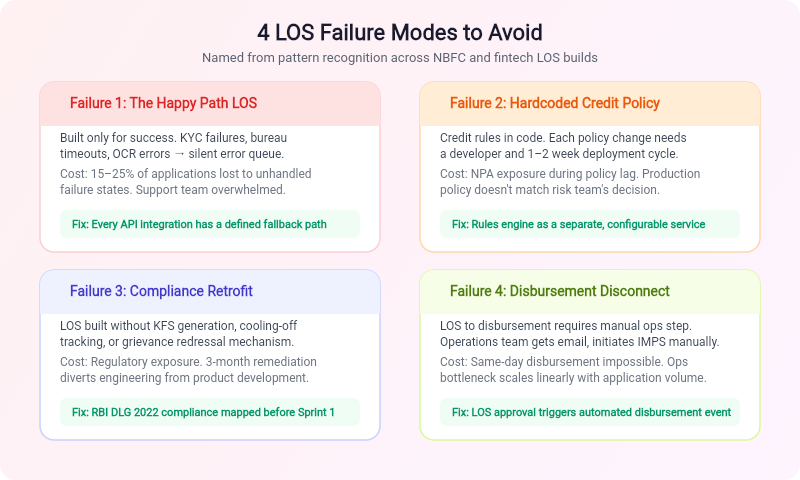
Four failure modes. Named. From pattern recognition across LOS builds for NBFCs, DSAs, and fintech lenders.
Built for success cases. Every failure state KYC failure, bureau timeout, OCR error, AA framework refusal routes to a generic error screen or drops into a silent error queue. Borrowers who hit a failure state disappear without ever knowing why or what to do next.
The cost: 15–25% of applications lost to failure states that have no recovery path. Support team overwhelmed with borrowers who submitted applications and heard nothing.
The fix: Every external integration has a defined failure path retry, fallback, alternative, or graceful operations queue entry before any integration is built.
Credit rules are embedded in application code. When the risk team changes the minimum CIBIL threshold, a developer deploys a code change. The change takes 1–2 weeks. For 2 weeks, the credit policy in production doesn’t match the credit policy the risk team decided on.
The cost: NPA exposure during policy lag periods. Approvals of borrowers who shouldn’t have been approved under the new policy.
The fix: Rules engine as a separate, configurable service from day one. Policy changes are configuration changes, not code changes.
The LOS is built without KFS generation, without cooling-off period tracking, without a documented grievance redressal mechanism. The first RBI inspection surfaces all three. Remediation takes 3 months.
The cost: Regulatory exposure during the gap. Engineering resources diverted from product development to compliance retrofitting.
The fix: RBI Digital Lending Guidelines 2022 compliance requirements mapped to technical controls before sprint 1. KFS generation, cooling-off logic, and grievance mechanism are design constraints, not post-launch features.
The LOS approves the loan and triggers disbursement. The disbursement system is a separate product, integrated via a manual process the operations team gets an email and initiates the IMPS transfer manually.
The cost: Same-day disbursement is impossible. Operations team becomes a bottleneck at scale. Borrowers experience multi-hour or multi-day delays between approval and fund receipt.
The fix: LOS-to-disbursement is an automated API event. Approval triggers a disbursement instruction automatically. The only manual intervention is for exceptions holds, fraud flags, incomplete bank account verification.
Buy an off-the-shelf LOS (LendFoundry, TurnKey Lender, Roopya LOS, CarmaOne, Finflux) when: your loan products are standard, you want to be operational in weeks rather than months, and your credit policy follows conventional bureau-score based decisioning without proprietary models. Off-the-shelf platforms handle the standard Indian integrations (CIBIL, Aadhaar, NACH) and the regulatory basics. The constraint appears when your products, your credit model, or your workflow diverge from what the platform was designed for.
Build custom when: your credit model is proprietary it is the competitive moat that differentiates your lending from the NBFC next door. When your product structures are non-standard (daily EMI, group lending, embedded lending within a non-financial app). When your LOS must integrate with a specific ecosystem (a supply chain platform, a B2B commerce platform, an enterprise ERP). When you have passed the volume threshold where per-application platform costs become material.
The EngineerBabu LoanOS middle path: modular lending infrastructure that covers the full origination stack KYC, AA integration, bureau sequencing, configurable rules engine, eSign, disbursement triggering deployed as a platform the lender owns outright. No licensing fees. No per-application fees above a flat deployment cost. No vendor lock-in. Configurable to any loan product without development work for standard products, with development support for custom products.
A Loan Origination System manages everything before disbursement: application, KYC, bureau, underwriting, approval, agreement, and disbursement trigger.
A Loan Management System manages everything after disbursement: EMI scheduling, NACH-based collection, repayment tracking, NPA classification, collections workflows, and regulatory reporting.
They are different systems solving different problems. A single system that attempts to do both well tends to do neither well. The data models, the performance requirements, the compliance obligations, and the user interfaces are fundamentally different.
They must, however, integrate seamlessly. The LOS creates the loan. The LMS manages it. The data flowing from LOS to LMS at disbursement loan terms, repayment schedule, mandate reference, borrower profile must be complete, accurate, and automated. Any manual step in that handoff is a data quality risk that compounds across the loan’s lifetime.
For more on the LMS side of the lending platform, see the complete loan management software development guide.
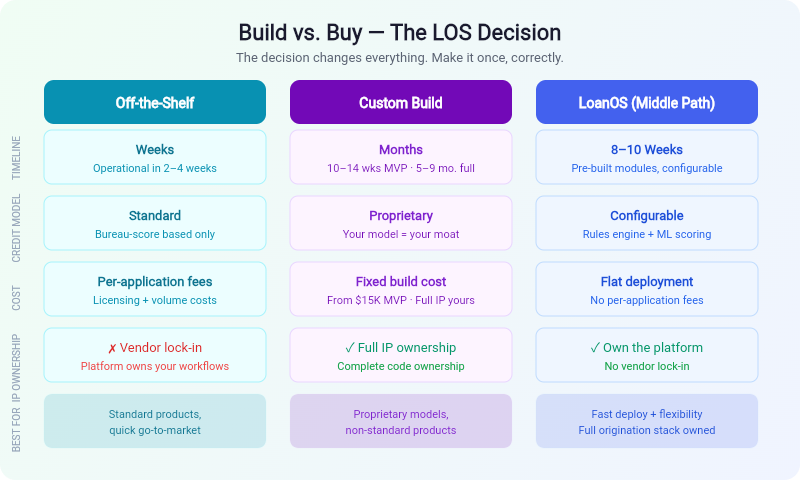
Building a custom loan origination system starts from $15K for a production-ready LOS MVP single loan product, complete KYC stack (Aadhaar eKYC, PAN, bureau integration), configurable rules engine, eSign, and disbursement trigger.
Full LOS platforms multi-product, AA integration, alternative data scoring (GST, bank statement AI), maker-checker underwriting workflows, DSA portal, KFS generation scoped after understanding the specific loan products, credit policy requirements, and compliance obligations. Exact numbers after a 30-minute scoping conversation.
Timeline: Single-product LOS MVP in 10–14 weeks. Full multi-product platform with AI scoring in 5–9 months. Critical external timelines: CIBIL/bureau production certification takes 4–8 weeks and must be initiated in week 1. Aadhaar eKYC requires UIDAI authorisation. AA framework integration requires registration as FIU.
40–60% cost savings vs US/UK equivalent quality. CMMI Level 5 process. Google AI Accelerator 2024 production ML for credit scoring.
The EarlySalary LOS ₹10,000 crore disbursed. LoanOS ₹1,000 crore processing annually right now. CTO 17 years at Wishfin bureau integrations, underwriting engines, and compliance systems built in production across nearly two decades of Indian credit markets.
This is not lending knowledge from case studies. It is pattern recognition from systems that have processed millions of applications, encountered every failure mode, and been rebuilt to not fail again.
Google AI Accelerator 2024. Production ML for credit scoring alternative data models, thin-file decisioning, fraud detection deployed in live lending systems, not proof-of-concept environments.
CMMI Level 5. Every quality gate enforced. Every compliance requirement documented before the first sprint. Relevant when your RBI inspection arrives.
Mayank leads personally. 4 unicorn clients. 75 YC-selected product builds. Full IP ownership. No vendor lock-in.
A fintech lender came to the team with a credit model based on bank statement analysis and GST data a genuinely proprietary underwriting approach for MSME lending that no off-the-shelf LOS could accommodate. The custom LOS the team built encoded that credit model in a configurable rules engine the credit team could update without engineering support. The lender’s approval rate on thin-file MSME borrowers was 3x the industry average. The LOS was the mechanism that operationalised the advantage.
Every week a lender operates with an LOS that can’t encode their credit policy correctly is a week of NPA exposure and missed approvals that a better system prevents.
30 minutes. Honest assessment of your loan products, your credit model, and what an LOS that survives scale actually requires.
Mayank Pratap Co-founder, EngineerBabu mayank@engineerbabu.com | engineerbabu.com
Google AI Accelerator 2024 · CMMI Level 5 · ₹10,000Cr Lending Platform · LoanOS (₹1,000Cr/yr Live) · CTO 17yr Wishfin · 4 Unicorn Clients · 75 YC Selections · 200+ VC-funded Products · Backed by Vijay Shekhar Sharma · LinkedIn Top Startup India (Twice)
A Loan Origination System is a software platform that manages the complete pre-disbursement lifecycle of a loan from application intake through KYC verification, document collection, credit bureau assessment, underwriting, approval decision, loan agreement, and disbursement trigger. It enforces consistent credit policy across every application, creates a full audit trail for regulatory compliance, and connects the borrower journey from application to disbursement without manual handoffs.
A Loan Origination System manages everything before disbursement: application, KYC, bureau, underwriting, approval, and disbursement trigger. A Loan Management System manages everything after disbursement: EMI scheduling, NACH collections, repayment tracking, NPA classification, and regulatory reporting. They are different systems that must integrate cleanly the LOS creates the loan, the LMS manages it for its lifetime.
Single-product LOS MVP: 10–14 weeks. Full multi-product platform with AI credit scoring and DSA portal: 5–9 months. The critical external timeline: CIBIL and bureau production certification takes 4–8 weeks and must be initiated in week 1. Aadhaar eKYC requires UIDAI authorisation with its own approval timeline.
KYC in an LOS covers: Aadhaar eKYC (UIDAI API for identity verification), PAN verification (ITD API), CKYC lookup (CERSAI registry), video KYC (V-CIP for fully digital lending), and bank statement analysis (via Account Aggregator or bank statement APIs). Production KYC must handle failure states liveness check failures, API timeouts, OCR errors with defined fallback paths. Failure rates of 3–8% are normal; a production LOS is designed for failure handling, not just the happy path.
The Account Aggregator framework is the RBI-mandated digital data sharing infrastructure that allows borrowers to consent to sharing their financial data from any registered Financial Information Provider. For an LOS, AA integration enables pulling bank account transaction history, investment data, and insurance policy data directly from the source with borrower consent replacing the friction of PDF bank statement upload and OCR. AA integration is now the preferred approach for digital lending in India.
Key requirements: direct disbursement only to the borrower’s verified bank account (no intermediary routing), Key Fact Statement (KFS) generation before loan execution in the specified format with APR and all fees, cooling-off period tracking, documented grievance redressal mechanism with defined timelines, and complete audit trails of all origination decisions. All of these must be designed into the LOS architecture retrofitting them after launch is significantly more expensive than building them in from the start.
Off-the-shelf platforms (LendFoundry, TurnKey Lender, Roopya, CarmaOne) are right for standard loan products with conventional bureau-score-based decisioning. Custom build is right when your credit model is proprietary it is the competitive moat or when your products are non-standard, your workflow has specific requirements generic platforms don’t support, or your volume makes per-application platform costs material. LoanOS provides a middle path: full-stack origination infrastructure with no licensing fees and complete code ownership.
Building only for the happy path. Every external API integration KYC, bureau, AA framework, bank statement analysis has a failure rate. A production LOS has defined failure handling for every integration: retry logic, fallback alternatives, and graceful queue entry for the operations team. An LOS without failure handling loses 15–25% of applications to silent error states and overwhelms the support team with borrowers who applied and never heard back.
Three high-value AI applications: alternative data credit scoring (GST data, AA bank transaction analysis, and behavioral signals for thin-file borrowers who lack bureau history), fraud detection (device fingerprinting, behavioral biometrics during onboarding, synthetic identity detection), and document OCR and verification AI (automated extraction of income figures, employment details, and identity fields from uploaded documents with accuracy that reduces manual review needs by 70–80%).
The credit rules engine is the component that applies the lender’s credit policy to each application. In a well-built LOS, credit rules are data not code. The credit team configures rules through a UI, tests them against historical applications, and activates them without any engineering involvement. This is the capability that allows credit policy to respond to NPA trends, new regulatory guidance, and new product launches without developer dependency. Hardcoded credit rules are the single most common reason LOS systems become operational bottlenecks as lenders scale.