How to Build an App Like Dil Mil in the USA (2027 Guide)


Create engaging, high-performance mobile applications tailored to your business needs. We craft future-ready apps that offer smooth user experiences on all devices.
Build robust and scalable websites and CMS platforms that help you manage content effortlessly. Our development ensures a seamless digital presence.
Launch secure, feature-rich online stores with intuitive shopping experiences. We build tailored eCommerce platforms designed for growth.
Design captivating games with immersive gameplay and stunning graphics. From concept to launch, we build engaging experiences that players love.
Enhance your customer relationships with customized Salesforce implementations. Drive growth and efficiency with smarter CRM solutions.
Harness artificial intelligence and machine learning to automate workflows and gain actionable insights. Our AI transforms data into smart decisions.
Accelerate your software delivery lifecycle with continuous integration, delivery, and infrastructure automation to boost efficiency.

Mainstream dating apps are excellent at volume and terrible at context. For someone who wants a partner sharing their language, faith, food habits, and family expectations, an open pool of fifty million strangers is a chore, not a shortcut.
That mismatch is the whole reason Dil Mil exists, and it is why founders keep asking what it actually takes to build an app like Dil Mil for the US market.
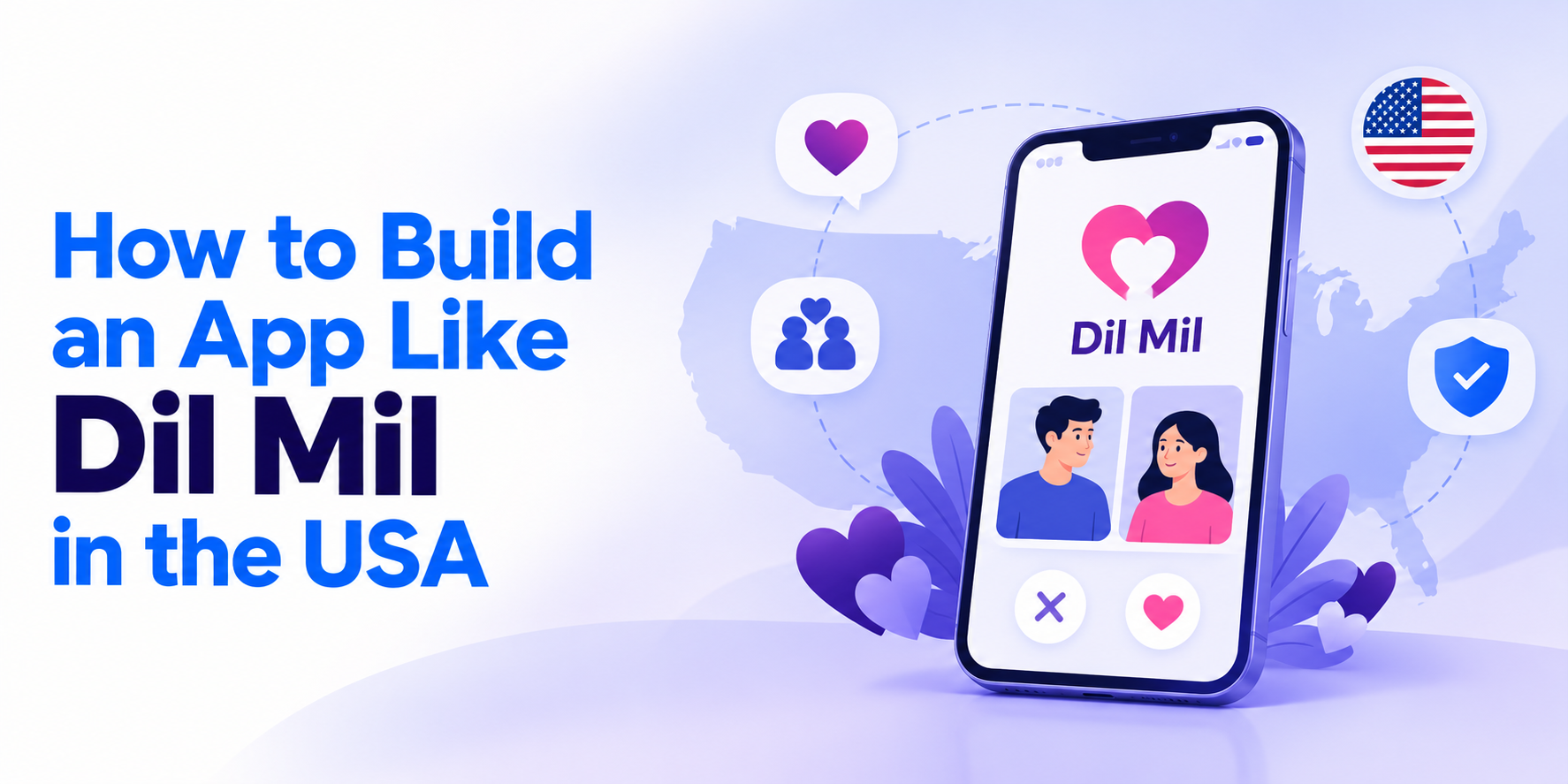
To build an app like Dil Mil, you need a mobile dating platform where cultural attributes are first-class data rather than optional bio text.
Users sign up, verify themselves, fill a structured profile covering language, community, religion, diet, and relationship intent, then receive a ranked daily stack of people filtered on those attributes.
Premium tiers unlock extra likes, visibility, and advanced filters. The engineering difficulty sits in matching quality and trust, not in the swipe animation.
TL;DR
Niche platforms convert better because the first filter is already applied. A user arriving on a community app assumes everyone shares a baseline, so conversations start further along.
That shortens the path from match to meeting, which is the only metric that drives word of mouth in this category.
The money follows that behavior. The US online dating application market is projected to reach $2.96 billion by 2030, growing at a 7.0% CAGR (Grand View Research).
Most of that growth is going to focused products rather than another general swipe app, which is why dating app development briefs have shifted toward community, faith, and intent-specific audiences.
On general apps, your mother tongue sits in a bio nobody reads. Here it is a queryable field that changes who you see. Religion, sect, regional background, diet, and family values all behave the same way.
Users state whether they want marriage, a long-term relationship, or something casual. The stack respects that, so serious users are not wasting swipes on mismatched intent.
Community apps attract catfishing and scam accounts quickly because trust is the selling point. Selfie verification, phone verification, and visible badges are table stakes, not a phase-two nicety.
Member-side features
Matching and discovery
The stack should blend attribute overlap, distance, recency of activity, and likelihood of a reply. Photo-led profiles need the same media handling discipline you would apply to build a mobile app like Instagram, including compression, CDN delivery, and lazy loading, because dating feeds are image heavy and users judge speed instantly.
Admin and moderation
Thoughtful UI/UX design matters more here than on most products, since the entire experience is judged in the first ninety seconds of onboarding.
Start by narrowing exactly who the app serves. Dil Mil focused on South Asian singles across the US, UK, and Canada, which made every later product decision easier. Define the community, age band, and intent level you are building for.
Run twenty to thirty interviews inside that group and ask what mainstream apps get wrong for them. You are listening for filters they wish existed, deal breakers that never show up in profiles, and safety concerns specific to their community. This research directly shapes your profile schema in the next step.
Your profile fields are your matching inputs, so treat them as data architecture rather than form design. Beyond photos and bio, plan structured fields for language, religion, community background, diet, education, profession, and relationship intent.
Make each field optional but filterable. Store what a person is separately from what a person wants, since the two rarely line up perfectly. Version the schema from day one, because you will add fields after launch and existing profiles need sensible defaults rather than blank states.
Swipe order is the product. A first version scores candidates on attribute overlap, distance, activity recency, and reciprocal interest likelihood. Weight community attributes above generic interests, because that is the reason people chose your app over Hinge.
Add a feedback loop that learns from replies and conversation length, not just likes. Most teams start with transparent rules, then layer AI development work on top once interaction data accumulates. Cap profile repetition carefully, or a smaller pool will feel empty within a week.
Messaging is where retention is won, so build it with moderation attached rather than bolted on later. You need real-time chat, read states, photo sharing with automated scanning, optional voice and video calls, and report flows that act within minutes.
Add selfie verification at signup with a visible badge on the profile. Keep an audit trail for every report, since community apps live and die on reputation. Rate-limit messages from accounts under forty-eight hours old to cut spam and bot activity sharply.
Liquidity beats reach for a niche dating product. Pick two or three metros with dense target populations, such as the Bay Area, New Jersey, or Toronto, and spend your entire launch budget there. A thousand active users in one city outperforms ten thousand scattered across forty states.
Seed both sides of the pool through campus groups, cultural associations, and local events. Open a second city only after match rate and reply rate in the first one stay stable for a full month. Treating this as an MVP development exercise keeps the burn sane.
| Layer | Practical choice | Why it fits |
| Mobile client | React Native or Flutter | One codebase, fast iteration on swipe UX |
| Backend | Node.js or Python | Strong real-time and ML ecosystem |
| Realtime chat | WebSockets, Firebase, or Stream | Presence and delivery states out of the box |
| Database | PostgreSQL plus Redis | Relational matching queries, cached stacks |
| Search and ranking | Elasticsearch or OpenSearch | Fast multi-attribute filtering at scale |
| Media | S3 plus CloudFront | Image-heavy profiles need CDN delivery |
| Payments | Apple and Google IAP, Stripe | Store rules require IAP for digital goods |
React Native development is the common pick for early-stage dating products, since both platforms ship together and A/B tests roll out faster. On the server side, Node.js development handles concurrent socket connections well without heavy infrastructure overhead.
Three things move the number most: how sophisticated the ranking engine is, how much moderation tooling you build versus buy, and whether video calling is in scope.
Offshore and hybrid teams typically land 40% to 60% below US agency rates, which is why most founders comparing mobile app development cost in USA end up with a blended team.
On schedule, a focused MVP runs sixteen to twenty weeks, roughly in line with the usual timeline to build a mobile app in this complexity band.
Community apps monetize earlier than general ones because intent is higher. Users looking for marriage pay faster than users browsing casually.
The decision to build an app like Dil Mil is really a decision about how narrow you are willing to go. The narrower the community, the better the matching feels and the faster users pay. Breadth is the enemy here.
If you are scoping a community dating product for the US, working with a mobile app development company in the USA like EngineerBabu gives you a team that has shipped matching engines, verification flows, and subscription billing before, which removes most of the guesswork from your first release.
Dil Mil offers free signup with limited daily likes. Paid tiers unlock unlimited likes, advanced filters, profile boosts, and visibility features, which is the standard freemium structure across most community dating apps today.
A typical MVP team runs five to seven people: two mobile developers, one backend developer, one designer, one QA engineer, and a part-time project manager. Add a data engineer once ML matching begins.
Yes, for digital goods like subscriptions and boosts. Apple and Google require their billing systems and take a commission. External payment links are allowed only in limited regions and categories.
Review usually takes one to three days, but dating apps face extra scrutiny on age gating, content moderation, and safety reporting. Budget two weeks for possible rejection and resubmission.
You need clear terms, a privacy policy covering sensitive data, age verification over eighteen, CCPA compliance for California users, and in several states, a disclosure about fraud warnings and banned-member policies.