Hidden Costs of App Development: What Quotes Leave Out (2026)


Create engaging, high-performance mobile applications tailored to your business needs. We craft future-ready apps that offer smooth user experiences on all devices.
Build robust and scalable websites and CMS platforms that help you manage content effortlessly. Our development ensures a seamless digital presence.
Launch secure, feature-rich online stores with intuitive shopping experiences. We build tailored eCommerce platforms designed for growth.
Design captivating games with immersive gameplay and stunning graphics. From concept to launch, we build engaging experiences that players love.
Enhance your customer relationships with customized Salesforce implementations. Drive growth and efficiency with smarter CRM solutions.
Harness artificial intelligence and machine learning to automate workflows and gain actionable insights. Our AI transforms data into smart decisions.
Accelerate your software delivery lifecycle with continuous integration, delivery, and infrastructure automation to boost efficiency.

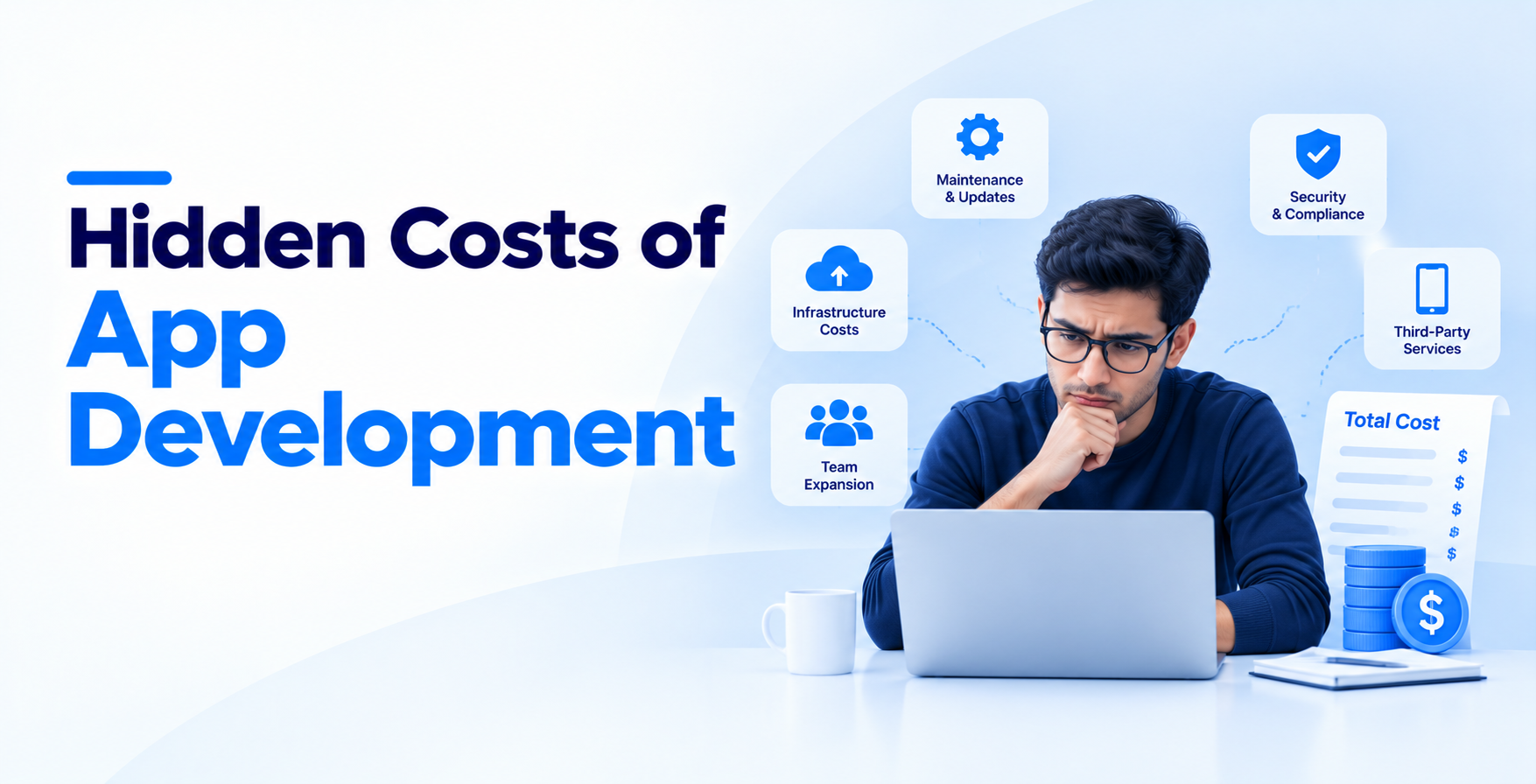
A founder once showed us a signed quote for $62,000 and a bank statement showing $94,000 spent. The app had not gained a single new feature in that gap. Every extra dollar went to things nobody wrote down at the start.
That gap has a name. The hidden costs of app development are the real expenses that sit outside the proposal, not because anyone lied, but because quotes price features and reality prices consequences.
Understanding mobile app development cost at the feature level is easy. Understanding what happens around those features is where budgets survive or die.
This guide walks through where the money actually goes, stage by stage.
TL;DR
A hidden cost is any spend that is predictable in hindsight but absent from the original scope document.
It is not fraud and it is not padding. It is usually a cost that belongs to a different budget line, a different team, or a different quarter. Store fees land on finance. Server bills land on ops. Rework lands on the next sprint. Nobody sees the total until someone adds it all up.
The hidden costs of app development cluster into four stages: before the build, during the build, at launch, and after launch. The last one is the heaviest by a wide margin.
Skipping discovery feels like saving two weeks and $6,000. It usually costs more than that in month three, when the team builds a flow nobody validated and then rebuilds it.
The choice between MVP vs full-scale development belongs in this phase too. Founders who defer that decision tend to build a full product, launch it, and then discover which third of it users actually open.
Vendor evaluation is unpaid work that still costs money. Four weeks of calls, three scoping documents, and a delayed launch all carry a price.
Worse is the switching cost. Replacing a team mid-project means paying someone to read a codebase they did not write. Doing the work to choose a mobile app development company properly the first time is cheaper than a handover.
Your app almost certainly depends on services you do not own. Maps, SMS, push notifications, payments, identity verification, analytics, crash reporting.
Each one has a free tier that stops being free around the time you get traction. A payments integration is not just API development hours. It is transaction fees, sandbox testing, failure handling, and a yearly compliance review.
List every external dependency during scoping. Put the pricing tier next to each one.
Designs look finished in Figma. Then a developer discovers the empty state was never drawn, or that the list breaks at 40 characters.
Strong UI/UX design anticipates edge states, error screens, and loading behavior. Weak design produces a file that looks complete and a build that stalls for clarification. Those clarification cycles are among the most common hidden costs of app development on mid-size projects.
Scope creep rarely announces itself. It arrives as “can we just add a filter here.”
Three of those requests equal a sprint. A sprint equals real money. Track change requests formally from week one, even the small ones, especially the small ones.
Testing is the first thing cut when a timeline slips, and the most expensive thing to cut.
Functional application testing across real devices takes time that fixed-bid quotes often underestimate. Android fragmentation alone can double QA hours compared to a single-platform build.
Then there is security testing, which teams skip until a client, investor, or regulator asks for a report. Commissioning a penetration test after launch costs more than building securely, because findings arrive as emergency fixes rather than planned work.
Store submission is not a formality. Apple and Google both reject apps for reasons that are documented but easy to miss.
Common rejection triggers:
Each rejection cycle costs days, not hours. Add developer account fees, code signing certificates, and the marketing assets nobody scoped. Most of these show up in post-mortems about mobile app development mistakes, which is a polite way of saying everyone learns them the expensive way.
Industry benchmarks put annual app maintenance at roughly 15% to 20% of the original build cost. Year one often runs higher while defects surface and OS updates land.
That means a $100,000 app carries a real five-year cost closer to $175,000. Planning mobile app maintenance and support before launch turns a surprise into a line item.
Hosting is cheap at 500 users and expensive at 500,000. Database reads, image storage, bandwidth, and background jobs all scale with usage, not with revenue.
Architecture decisions made in week two determine that bill. The role of cloud computing in app scalability is less about tooling and more about whether your costs grow linearly or exponentially.
This is the one almost nobody budgets. Every shortcut taken to hit a date becomes interest paid on every future sprint.
Deloitte’s 2026 Global Technology Leadership Study estimates that technical debt accounts for 21% to 40% of an organization’s IT spending. That is up to 40 cents of every technology dollar servicing past decisions instead of building new value.
Disciplined DevOps practices and continuous mobile app performance optimization keep that number at the low end of the range.
| Stage | Hidden cost | Typical share of total spend |
| Pre-build | Skipped discovery, rework from unvalidated flows | 5% to 10% |
| Build | Third-party services, design clarifications, scope creep | 10% to 20% |
| QA | Device coverage, security review, accessibility fixes | 10% to 15% |
| Launch | Store rejections, fees, assets, legal review | 2% to 5% |
| Year one | Maintenance, hosting, support, OS updates | 20% to 50% of build cost |
Choosing native or cross-platform is usually framed as a build-cost decision. It is really a maintenance-cost decision.
Two native codebases mean two sets of OS updates, two release cycles, and two QA passes forever. The tradeoffs in native vs cross-platform development matter far more in year three than in month three.
For many products, cross-platform app development saves costs mainly by halving the recurring work, not the initial build.
Request the estimate split across discovery, design, development, QA, launch, and the first year of support. A single lump number hides everything that matters.
Any partner who cannot break it down either has not thought it through or does not want you looking closely. Push for hours per stage, not just dollars. Then ask which assumptions the estimate rests on. The assumptions are where the hidden costs of app development usually hide, because every one of them is a place where reality can disagree with the proposal.
Write down every external service the app will call. Next to each one, record the pricing tier, the rate limit, and what happens when you exceed it.
Do this before development starts, not after a bill arrives. Pay attention to services priced per user or per transaction, since those scale directly with your success. Also check contract terms for annual commitments. A service that costs $50 a month at launch can cost $2,000 a month at scale, and that line never appears in a build quote.
Build a year-one operating budget alongside the development budget. Include hosting, maintenance retainer, store fees, monitoring tools, and support hours.
Use 15% to 20% of build cost as your maintenance baseline, then add infrastructure separately. If that total makes the project unviable, you have learned something important before spending anything. Teams looking to reduce mobile app development costs often find bigger savings here than in the build itself, because recurring costs compound while build costs happen once.
Every project changes. The question is whether changes get priced transparently or accumulate as goodwill until someone runs out of it.
Define a change request process in the contract. Set a threshold where a change needs written approval and a revised estimate. Also agree on what counts as a bug versus a new requirement, because that boundary causes more disputes than any other. Realistic planning around the timeline to build a mobile app makes these conversations far less tense.
Ask who owns the code, the repositories, the cloud accounts, and the store listings. Ask what documentation ships with the final build.
A clean handover is the difference between hiring any competent team later and being locked into one. This matters especially when outsourcing mobile app development, where access and ownership can get tangled across time zones and contracts. Put all of it in writing before the first invoice, not during the last one.
Any one of these means the hidden costs of app development have simply been moved to a conversation you will have later, with less leverage.
Most budget blowouts are scoping failures, not engineering failures. The fix is putting the uncomfortable numbers on the table while there is still room to adjust.
EngineerBabu scopes mobile app development with maintenance, infrastructure, and QA priced as part of the original estimate. Senior engineers stay on the project, and the CMMI Level 5 delivery process means decisions get documented rather than remembered.
The hidden costs of app development are not unknowable. They are just unasked.
Teams that budget for year one instead of launch day end up spending less overall, because they make architecture and scope decisions with the full picture visible. The quote is the beginning of the cost conversation, not the end of it.
If you want an estimate that includes the parts most proposals leave out, that is a conversation worth having before you commit.
EngineerBabu is a technology development company building products across fintech, healthtech, and AI, from MVPs to scaled, production-ready platforms.
It holds a CMMI Level 5 rating, has worked with 4 unicorn clients, and has supported 200+ VC-funded products. The company is backed by Vijay Shekhar Sharma.
Founded by Mayank Pratap (Co-founder) · mayank@engineerbabu.com
They include skipped discovery rework, third-party service fees, design clarification cycles, device testing, security reviews, store rejections, hosting, maintenance, and technical debt. Most sit outside the build quote but inside the real budget.
Plan for 15% to 20% of your original development cost annually. Year one commonly runs higher while post-launch defects and OS compatibility work get cleared.
Usually because the quote prices features while the project pays for consequences. Scope changes, untested assumptions, and unpriced dependencies account for most overruns.
It reduces recurring ones by consolidating maintenance into a single codebase. It does not remove infrastructure, third-party fees, or technical debt.
Ask for a stage-level breakdown, a list of third-party dependencies with pricing tiers, a year-one operating budget, and a written change request process before signing.