Outsourcing Mobile App Development: Pros, Cons, and How to Do It Right


Create engaging, high-performance mobile applications tailored to your business needs. We craft future-ready apps that offer smooth user experiences on all devices.
Build robust and scalable websites and CMS platforms that help you manage content effortlessly. Our development ensures a seamless digital presence.
Launch secure, feature-rich online stores with intuitive shopping experiences. We build tailored eCommerce platforms designed for growth.
Design captivating games with immersive gameplay and stunning graphics. From concept to launch, we build engaging experiences that players love.
Enhance your customer relationships with customized Salesforce implementations. Drive growth and efficiency with smarter CRM solutions.
Harness artificial intelligence and machine learning to automate workflows and gain actionable insights. Our AI transforms data into smart decisions.
Accelerate your software delivery lifecycle with continuous integration, delivery, and infrastructure automation to boost efficiency.
Hire app developers ready to turn your ideas into sleek, high-performing mobile apps for any platform.
Bring in frontend pros who craft smooth, beautiful, and user-friendly interfaces that your visitors will love.
Get backend developers who build fast, secure, and reliable systems to keep everything running behind the scenes.
Hire eCommerce developers who build secure, scalable online stores designed to offer seamless shopping and grow your sales.
Get dedicated developers committed to your projects, delivering consistent quality and speed as an extension of your team.
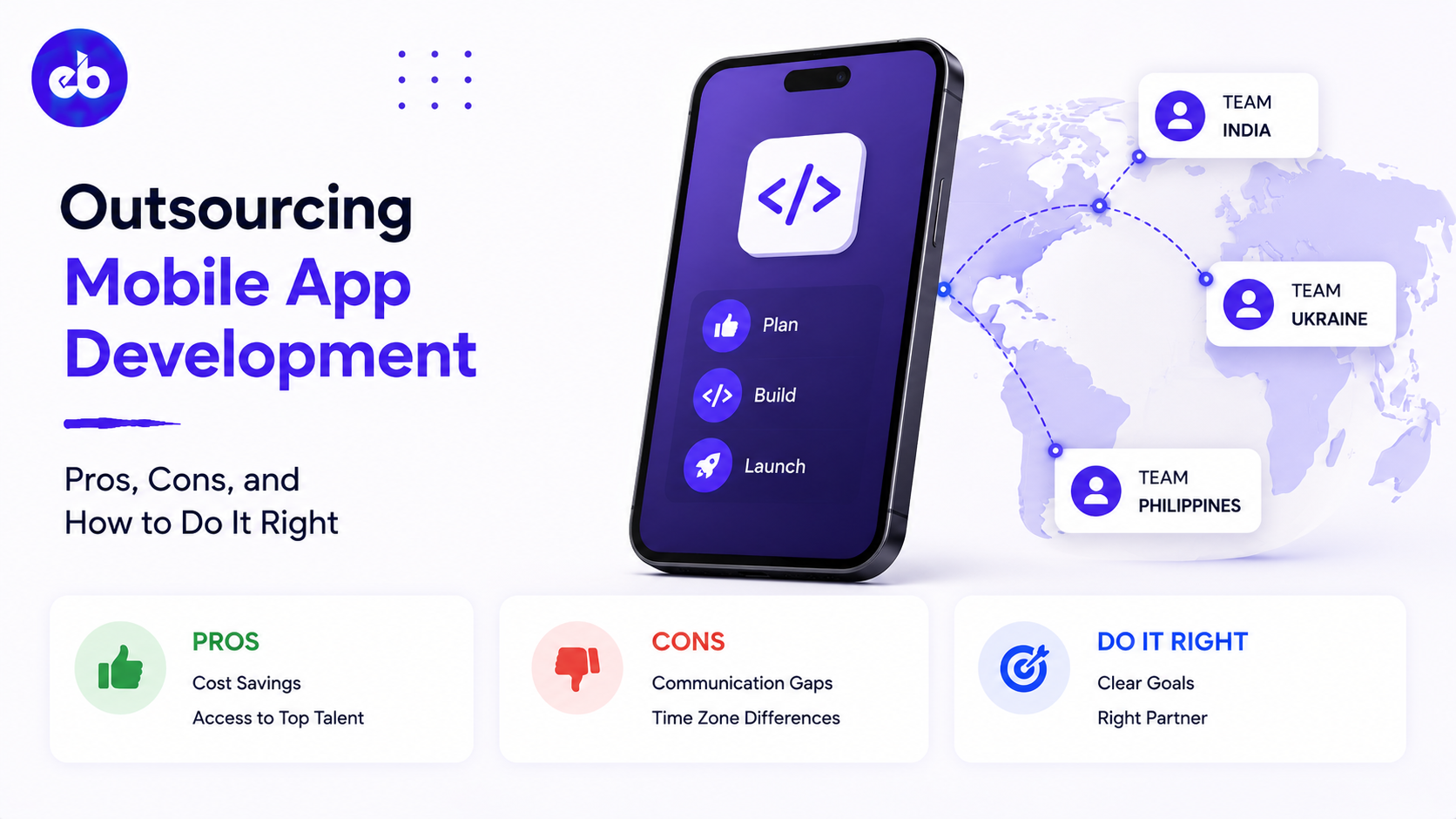
The app on your phone that feels the most polished was probably never built by the company whose logo sits on it. A four-person startup, a hospital network, and a Fortune 500 bank might all run on code from the same outsourced team.
Nobody advertises that. But it is quietly how most of the mobile economy actually works.
Outsourcing mobile app development is not a fallback for companies that cannot afford an in-house team anymore. It is a deliberate choice made by founders and CTOs who would rather buy expertise than build it from scratch.
The question is not really whether to outsource. It is how to do it without losing control of your product, your timeline, or your budget.
Outsourcing mobile app development means hiring an external team to design, build, test, or maintain your app instead of doing it in-house. That team could be an agency, a studio, or a handful of freelancers.
It can mean the whole build, from a wireframe to an App Store listing. It can also mean just one piece, like backend architecture or QA, while your own team handles the rest.
The practice is far more common than most founders assume. Over 72% of companies that build mobile applications now rely on third-party outsourcing partners for full or partial development, according to Market Growth Reports.
That number covers everything from two-person agencies to enterprise mobile app development shops running hundreds of engineers across multiple time zones.
Building a strong in-house team means hiring a designer, iOS and Android engineers, a backend developer, and a QA specialist. That is five salaries before you write a single feature. Outsourcing lets you rent that entire bench for the length of one project. You might only need someone fluent in AI Development for a single recommendation feature, not a permanent hire.
Hourly rates vary sharply by region. Developers in India typically charge $20 to $40 an hour, while North American teams charge $150 to $250. That gap is why hybrid models pay off. Pairing an onshore lead with an offshore build team commonly saves 35 to 42% over a fully domestic build. The savings come from labor cost, not from skipping testing or design.
An outsourced team that has already shipped forty apps does not need weeks to ramp up. Many founders outsource just the MVP Development phase first. They launch fast, gather feedback, then decide whether to scale that partner or bring development in-house. That sequencing gets a real product in front of real users months earlier than hiring from zero.
A twelve-hour time difference means your “urgent” Slack message sits unanswered until you are asleep. Decisions that should take an hour stretch into two-day round trips. Teams that outsource well build overlap windows into the schedule instead of hoping timing works itself out.
Code written by a rotating cast of contractors is harder to maintain than code written by a stable team that understands the product’s history. If your outsourcing partner reassigns engineers mid-project, institutional knowledge walks out the door with them. Ask upfront how much staff turnover to expect on your account.
Your app touches user data, payment details, and possibly proprietary algorithms. Handing that to an external team without airtight contracts is a real risk, not a theoretical one. Non-disclosure agreements, IP assignment clauses, and access controls need to be settled before any code gets written, not after.
Not every project fits the same arrangement. Offshore outsourcing, usually to India, Vietnam, or Eastern Europe, gets you the lowest rates but the widest time gap.
Nearshore outsourcing trades some cost savings for a closer time zone and easier live collaboration. Onshore outsourcing costs the most but removes almost all communication friction.
A hybrid model tends to work best for most companies. It pairs an onshore product lead with an offshore build team, giving you both cost control and daily oversight.
The right model depends on how hands-on you want to be and how much of a budget cushion you actually have.
A to-do list app and a lending app cannot be outsourced the same way. Regulated industries add layers that generalist agencies often miss entirely. A team building for a bank needs to understand compliance before writing a single line of code.
That is exactly why founders in that space often work with a specialized fintech app development company instead of a generalist shop.
The same logic applies across verticals. A team that has shipped dozens of learning platforms will avoid mistakes a generalist would make twice.
If you are scoping an education product, start by reviewing a shortlist of edtech app development companies in the USA. That extra hour before you sign anything pays for itself.
Write down your core features, target platforms, timeline, and budget ceiling before your first vendor call. Vague requirements are the single biggest reason outsourced projects go over budget. Every gap in the brief gets filled with the vendor’s assumptions instead of yours.
A one-page scope document, even a rough one, changes every conversation that follows. Agencies quote faster and more accurately when they are not guessing. You also get to compare proposals against the same baseline, instead of five different interpretations of your idea.
Ask for case studies in your specific category, not a generic portfolio. Request references you can actually call, and ask those references pointed questions about missed deadlines or scope creep.
A useful starting point is comparing a shortlist of established mobile app development companies against your specific requirements. Do not just pick the first one with a slick website. Reviews on Clutch or GoodFirms help, but a fifteen-minute reference call tells you more than fifty star ratings ever will.
Get IP assignment, confidentiality, and data handling terms in writing before development starts, not after the first milestone. Specify who owns the source code, the design files, and any AI models trained on your data.
Vague contracts are where founders lose leverage, usually right when they need it most. This single step prevents more outsourcing disasters than anything else on this list. It costs almost nothing to have a lawyer review the contract before signing.
Decide on your meeting cadence, reporting format, and escalation path before the first sprint starts. A weekly demo plus a shared project board keeps both sides honest about progress and blockers.
Teams that skip this step tend to discover problems weeks later than they should have. Build in a defined overlap window even across a wide time zone gap. That way urgent issues do not sit for a full day waiting on a reply.
Payment gateways, maps, authentication providers, and analytics tools all fail in ways you cannot predict from documentation alone. Push your outsourced team to build and test real API Development integrations in the first few sprints, not the last one. Catching a broken payment flow in week three costs an afternoon of debugging.
Catching it in week fifteen costs your launch date and possibly your investor’s patience. Ask the vendor to demo each integration live on a staging build, not just describe it in a status report. Seeing it work removes a lot of guesswork later.
Ask what happens after launch day, specifically. Bug fixes, OS updates, and app store compliance do not stop once the app ships. Agree on a maintenance retainer or support SLA as part of the original contract.
Do not leave it as a separate negotiation after the team has moved on. Ask specifically who is on call for the first ninety days, and what response time is guaranteed for critical bugs.
A support gap right after launch is when new users judge your app the hardest.
A simple app with a handful of screens typically runs $10,000 to $30,000 outsourced. Mid-complexity apps with custom backends, payments, and integrations land between $40,000 and $90,000
Enterprise builds with AI features or heavy compliance requirements can exceed $150,000. Location shifts these numbers significantly, since Eastern European and Indian teams routinely cost 40 to 60% less than North American ones for comparable output.
There is no shortcut version of outsourcing mobile app development that skips the groundwork. Done carelessly, it produces buggy apps, blown timelines, and code nobody in-house can maintain.
Done with a real scope document, a vetted partner, and airtight IP protection, outsourcing works. It gets a serious product built faster and cheaper than hiring from scratch ever could.
The founders who get burned are almost always the ones who skipped the boring parts: the written scope, the reference calls, the contract review. Do those three things and outsourcing stops being a gamble.
Usually, yes. Hourly rates for outsourced developers, especially in India or Eastern Europe, run well below the cost of full-time in-house salaries plus benefits. The savings shrink somewhat with heavy oversight and coordination needs, but most companies still come out well ahead.
Sign an NDA before any details are shared, and put IP assignment terms directly into the development contract. Reputable agencies expect this and will not hesitate at the request. Hesitation from a vendor here is itself a warning sign.
kipping the scope document. Vague requirements lead to scope creep, missed deadlines, and budget overruns almost every time. A clear, written brief before the first vendor call prevents most of the problems founders run into later.
It depends on the team’s existing skills. Many startups outsource the full MVP build first. Once they have traction, they bring specific work in-house and justify full-time hires for roles that matter most.
A simple app can ship in 8 to 12 weeks. Mid-complexity apps with custom backends typically take 4 to 6 months. Enterprise-grade builds with heavy integrations or compliance needs can run 8 months or longer.